
Mosaic Glossary
Terms of the Mosaic, from Tessera to Matching Rule
The words of the mosaic, from the workshop of antiquity to the studio of today. Each entry gives the meaning in a sentence or two and points to the page where the subject is treated at length. The traditional terms come first, then patterns and tilings, then the terms of digital and algorithmic mosaic, and last the frameworks we use in our own work.
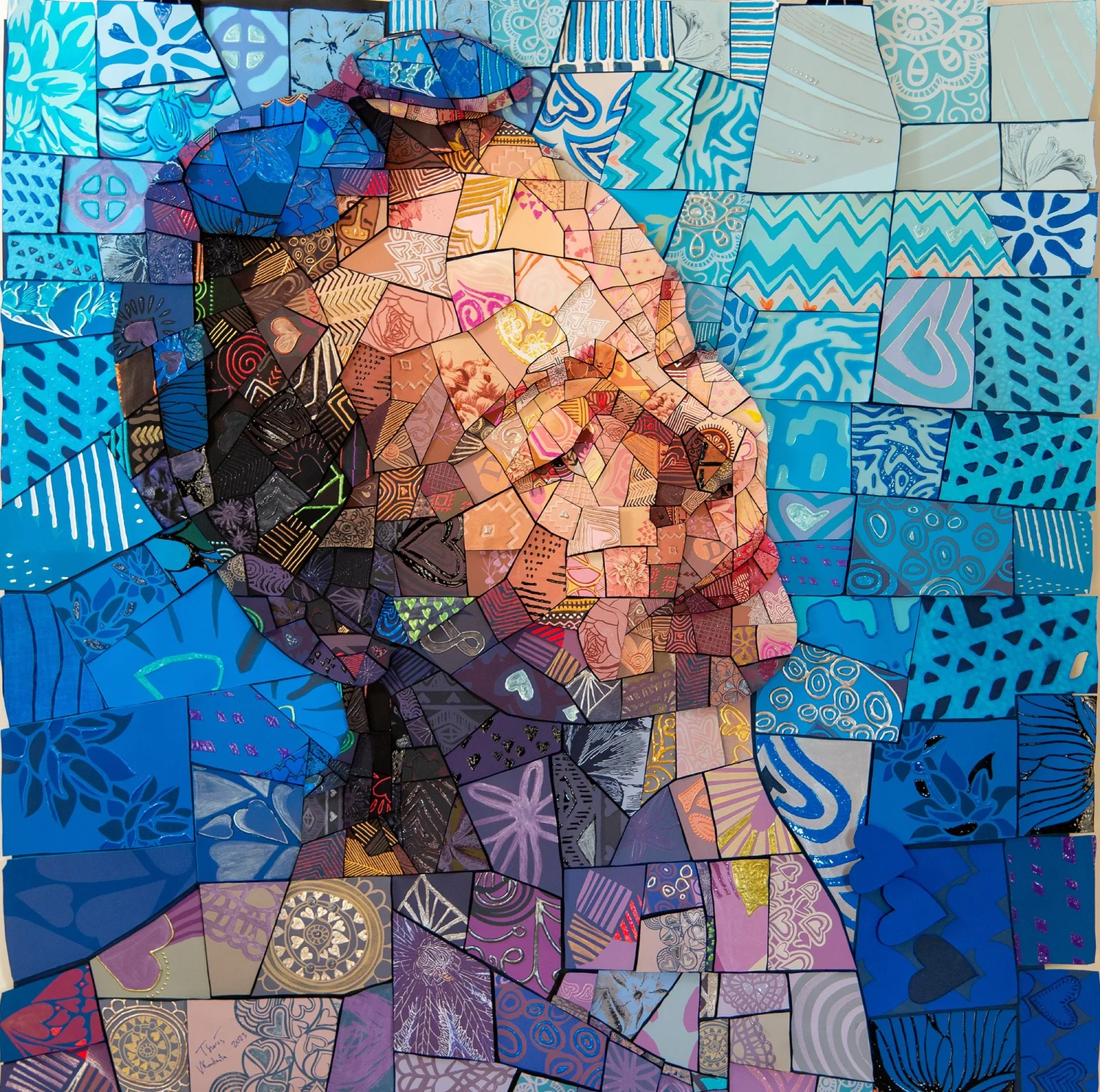
The mosaic and its pieces
Mosaic. An image or pattern made from many small, separate pieces set close together on a surface and fixed in place. The longer answer is on What Is a Mosaic?
Tessera. One piece of a mosaic, plural tesserae. From the Latin for a small cube, the shape that cut stone and glass took from the Hellenistic period on.1, 2
Pebble. The material of the earliest Greek mosaics: natural river and sea stones, sorted by colour and size and set into a floor.3
Smalti. Opaque coloured glass made for mosaic, cast in slabs and cut into tesserae; singular smalto. It opened a range of colour that stone could not offer.2
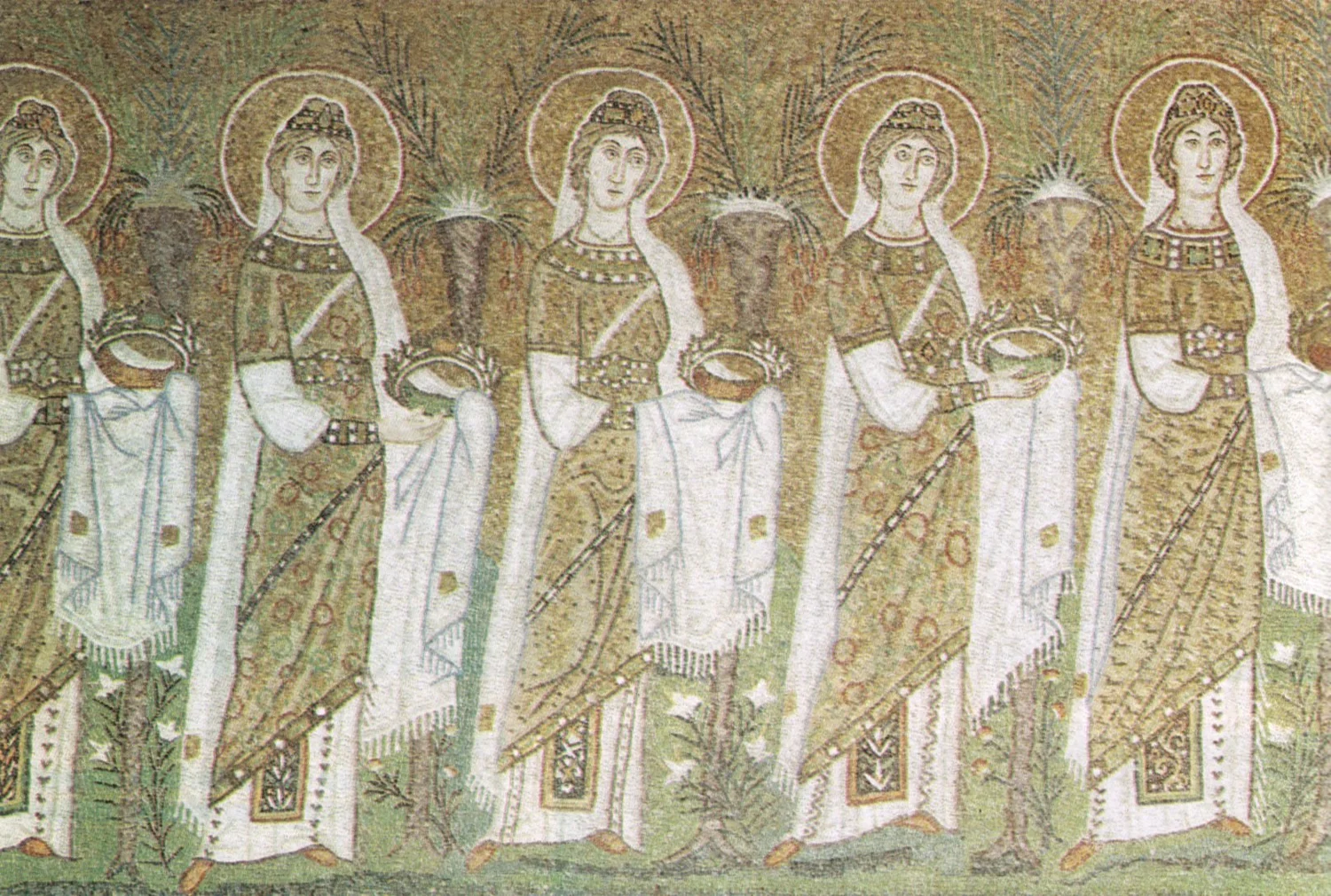
Gold tesserae. Gold or silver leaf sealed under a thin layer of glass. Because wall mosaics are not walked on, Byzantine makers could use them, and they set them at angles to catch the light.1
Marble. Cut marble and other stone gave Hellenistic and Roman mosaicists a range of natural colours that does not fade. Most Roman floors are made of stone tesserae.
Ceramic tile. Fired clay, glazed or unglazed, cut or broken into pieces: the material of trencadís and of much modern mosaic.
Joint. The gap between neighbouring tesserae, also called the interstice. Its width is part of the design: narrow joints let the pieces merge into tone, wide ones keep each piece visible.
Grout. The material that fills the joints between tesserae; in ungrouted work, the setting bed shows in the joints instead. Their width and colour change the image, because the eye reads them as part of the surface.
Setting bed. The layer of mortar or adhesive into which the tesserae are pressed.
Substrate. The surface a mosaic is fixed to: a floor, a wall, a vault, a panel or a mesh.

Tools and methods
Cartoon. The full-size drawing that fixes the main image and the divisions of the surface before any piece is cut.
Hammer and hardie. The traditional cutting tools: the hardie is a chisel-shaped blade set into a block, and the tessera is cut on it with a hammer. Today wheeled nippers do much of the same work.
Wheeled nippers. A hand tool with two hardened wheels that cut glass and smalti cleanly; the everyday cutting tool of today’s mosaicists.
Direct method. Each piece is set face up, straight into the final bed, and the maker watches the image grow. It was the ordinary method of antiquity and of medieval wall mosaics.1
Indirect method. The mosaic is first set in reverse, glued face down on paper or cloth in the workshop, and then applied to the floor or wall. It allows large works to be assembled away from the building.1
Paper-faced mosaic. In the indirect method, the tesserae glued face down on paper. Once the mosaic is set, the paper is wetted and peeled away.
Mesh mounting. Tesserae glued face up on a fibreglass mesh in the workshop, then set in place together with the mesh.
Andamento. The flow of a mosaic: the direction in which the rows of tesserae run. Rows can follow the contour of a face, radiate from a centre or run in straight courses across a background. Computer graphics research reproduces it with centroidal Voronoi tessellations; see The Mathematics of the Mosaic.4
Emblema. A finely made figurative panel, often made separately on a tray and set into the centre of a floor; plural emblemata.5
Techniques and types
Pebble mosaic. Floors of natural pebbles, the earliest kind of mosaic in the eastern Mediterranean, found from the eighth century BCE; the floors of Pella date from the late fourth century BCE.3
Opus tessellatum. Tesserae of roughly regular size laid in rows: the standard technique of Hellenistic, Roman, early Christian and Byzantine mosaics.5
Opus vermiculatum. Very small tesserae set closely in wavy, worm-like rows that follow the forms, used above all for the emblema.5
Opus regulatum. A term of today’s mosaic vocabulary for tesserae laid in a straight grid, aligned in both rows and columns.
Opus circumactum. A term of today’s mosaic vocabulary for tesserae laid in overlapping arcs or fan shapes across a background.
Opus palladianum. A term of today’s mosaic vocabulary for irregular pieces fitted together like crazy paving.
Opus sectile. Larger pieces of marble, stone or glass cut to the shapes of the design, so that one piece can form a whole part of a figure.
Commesso. Florentine mosaic: pictures made of thin, cut-to-shape pieces of hard stone (pietre dure) fitted together, the work of the Opificio delle Pietre Dure in Florence from 1588.6
Cosmatesque. Geometric inlay of coloured stone and marble, made in Rome and central Italy in the twelfth and thirteenth centuries by the Cosmati families of craftsmen, on church floors and furnishings.
Micromosaic. Mosaic of tiny glass tesserae for portraits, views and jewellery, developed in eighteenth-century Rome around the workshop of St Peter’s Basilica.7
Trencadís. Mosaic from broken tiles and ceramic, developed by Antoni Gaudí and Josep Maria Jujol in Barcelona. The irregular fragment becomes the language of the surface.8
Pique assiette. Mosaic made from broken plates and crockery; the name is a French expression for a scrounger.
Zellige. Moroccan mosaic of hand-cut pieces of glazed terracotta, set into geometric patterns.
Azulejo. Painted, tin-glazed ceramic tile of Portugal and Spain. It is a tile tradition rather than a mosaic, but its language runs through our murals for USA House at the Rio 2016 Games.
Roman mosaic. Floors of cut stone in opus tessellatum, with fine emblemata at the centre, laid across the Roman world in houses, baths and public buildings.
Byzantine mosaic. Glass and gold tesserae on walls, vaults and domes, set to catch the light and seen at the scale of a building.
Early Islamic mosaic. Glass mosaics without human figures, from the Dome of the Rock in Jerusalem (691) to the Great Mosque of Damascus. More types are on What Is a Mosaic?
Patterns and tilings
Tessellation. A covering of a surface by shapes that leave no gaps and do not overlap. Only three regular polygons tile the plane on their own: the triangle, the square and the hexagon.
Voronoi diagram. A division of a surface into cells around a set of seeds, in which each cell holds every place closer to its seed than to any other.9
Centroidal Voronoi tessellation. A Voronoi diagram in which every seed sits at the centre of mass of its own cell, reached with Lloyd’s algorithm. With a density function, its cells grow small where detail is needed and large elsewhere.10
Lloyd’s algorithm. A method that moves every seed of a Voronoi diagram to the centre of mass of its cell and repeats. Stuart Lloyd wrote it down at Bell Labs in 1957; it was published in 1982. See The Mathematics of the Mosaic.
Tessellation art. Art built from tilings. M. C. Escher (1898–1972) made it famous with interlocking birds, fish and lizards that fill the plane.
Truchet tiles. Square tiles divided along a diagonal into two colours, studied by Sébastien Truchet in 1704. Turned at random or by a rule, they make endless patterns, and they are a common grid in generative art.11
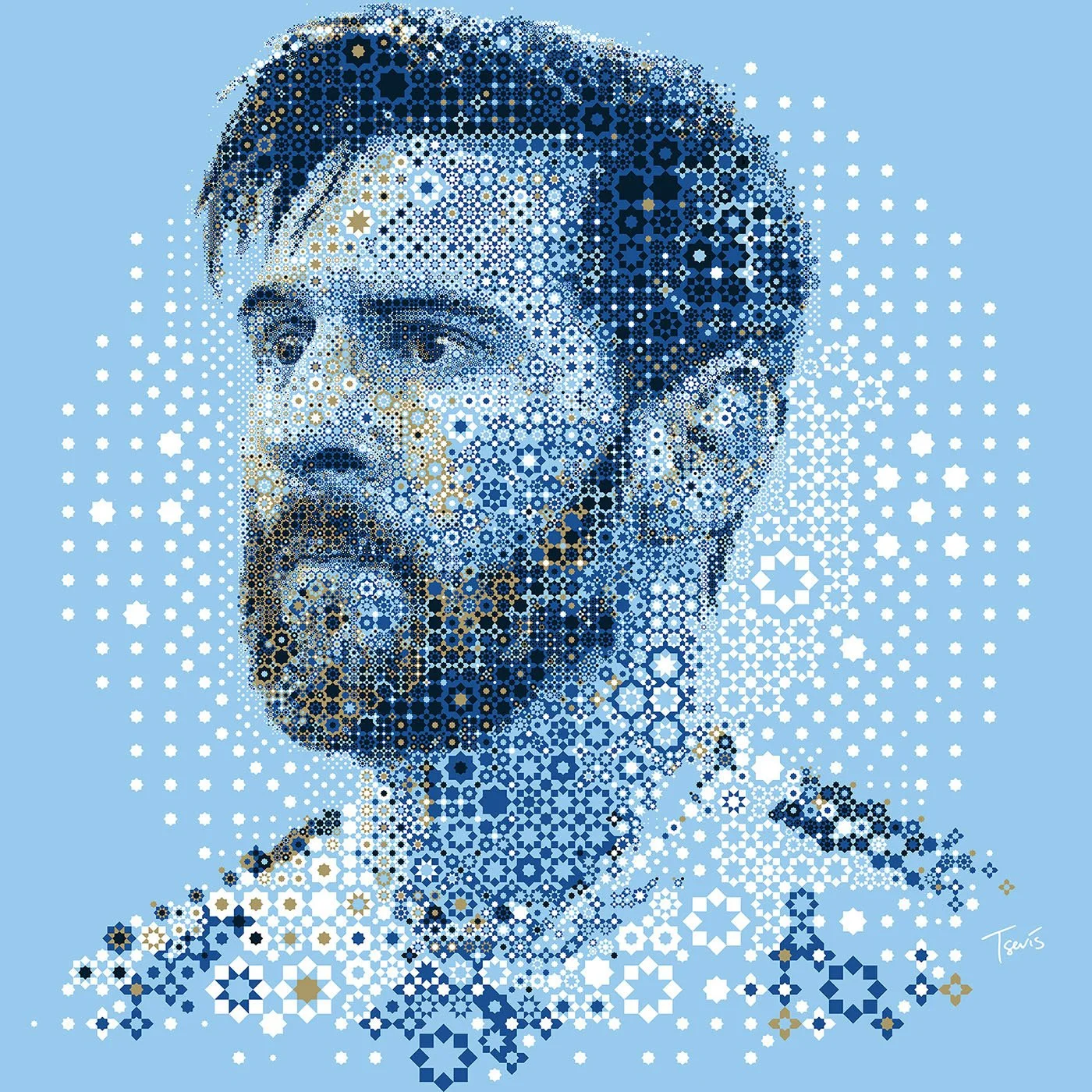
Girih. The star-and-polygon strapwork patterns of medieval Islamic architecture; the Persian word means “knot”. In 2007 Peter Lu and Paul Steinhardt showed that some of them were built from a set of five decorated tiles, the girih tiles, and that some come close to quasi-crystalline order.12
Penrose tiling. A tiling that covers the plane without gaps but never repeats itself. Roger Penrose published it in 1974.13
Kumiko. Japanese lattice woodwork, assembled from small wooden pieces without nails into geometric patterns. It is one of the nine grids on The Four Layers of a Mosaic.
Circle packing. An arrangement of circles that do not overlap, most of them touching their neighbours. As a mosaic grid it gives round pieces of varying size.
Digital and algorithmic mosaic
Pixel. Picture element: the smallest unit of a digital image, and the tessera of the screen. I wrote about this in Every Pixel Is a Tessera.
Pixel art. Images drawn pixel by pixel at low resolution, a language that grew from early computer and video game graphics.
Halftone. Printing tone with dots of varying size or spacing. Seen from reading distance, the dots merge into grey.
Computer-assisted mosaic tessellation. Making mosaics with the help of computers. Kenneth Knowlton, who made computer mosaics at Bell Labs from the 1960s, gave the title “Computer Assisted Mosaic Tessellations” to his invited talk to the Society of American Mosaic Artists in 2001.14 It is also how we describe our own practice.
Photographic mosaic. An image built from many small photographs, each chosen mainly to match the colour and tone of one part of a larger picture. The method, also called photomosaic, was made widely known by Robert Silvers in 1996.15
Algorithmic mosaic. A mosaic in which a rule decides where each fragment goes, and in which every fragment carries meaning of its own. The rule can follow structure, importance and meaning, not only colour. See Algorithmic Mosaic.16
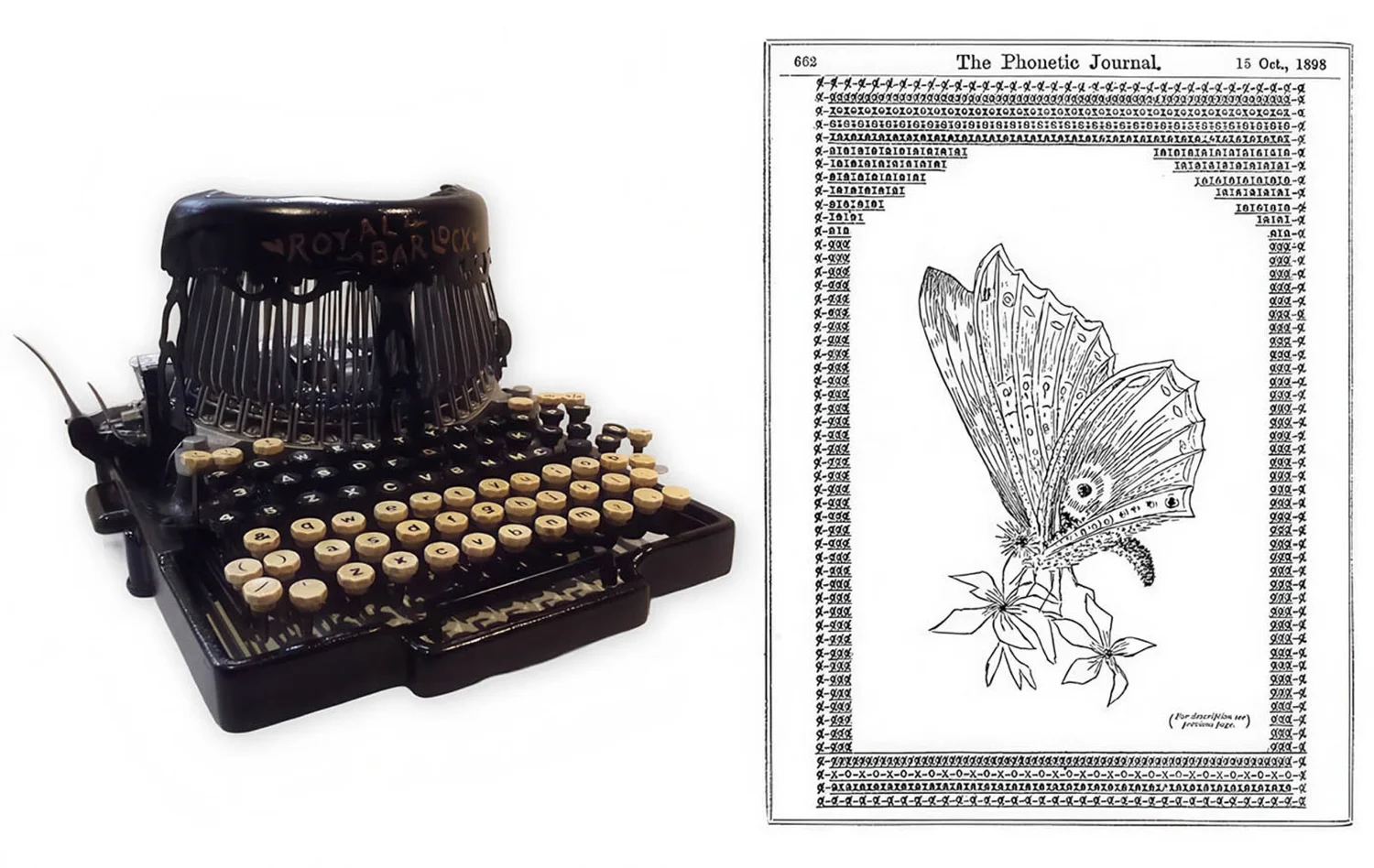
Character art. Images built from letters and symbols: typewriter art, ASCII art and ANSI art. Each character is chosen for its visual density as well as, or instead of, its meaning.
Typewriter art. Images typed on a typewriter, with characters chosen for their density. Flora Stacey’s butterfly of 1898 is an early example.17
ASCII art. Character art made with the 95 printable characters of the ASCII standard.
ANSI art. Character art that adds colour through ANSI escape codes, usually with the block and line characters of the IBM PC character set.
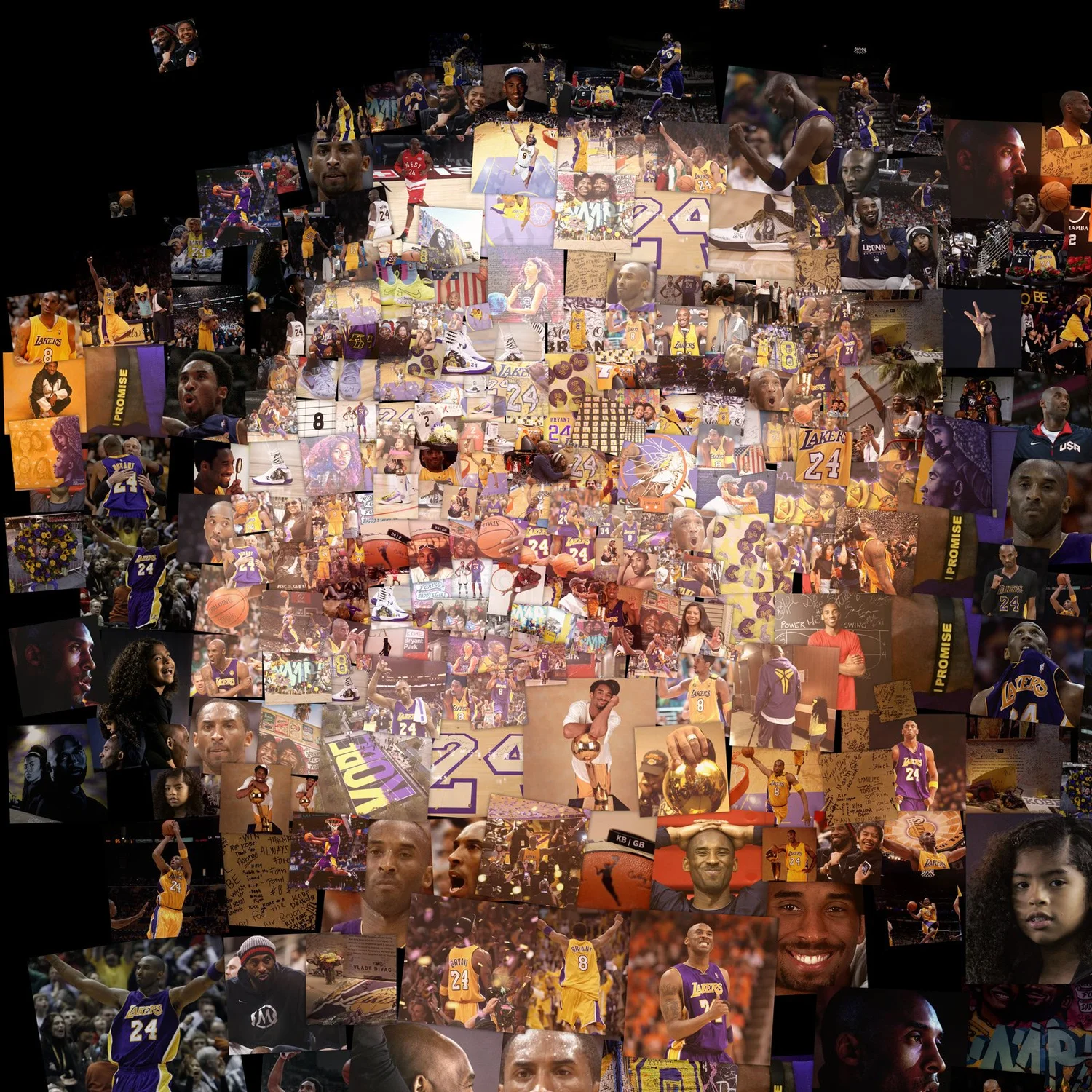
Target image. In a digital mosaic, the image that the tiles rebuild: the main image of the four layers.
Tile. In a digital mosaic, one piece: a photograph, icon, illustration or character that fills one cell of the grid.
Grid. In a digital mosaic, the division of the picture into cells: squares, hexagons, historical patterns, Voronoi cells or shapes that follow the image. It is the constructing mechanism made explicit.
Tile library. The set of pieces a digital mosaic draws on: photographs, icons, illustrations, characters. Choosing the library is choosing what the image is made of, and so part of what it means.
Matching rule. The rule that decides which tile goes into which cell. It can compare average colour, brightness, edges, the structure of tone inside the cell, or features learned by a vision model. See The Four Layers of a Mosaic.
Assignment problem. Choosing a tile for every cell at once, so that each tile is used no more than once and the total error is as small as possible. It is solved with Harold Kuhn’s Hungarian method of 1955.18
Saliency. The quality that makes part of an image draw the eye. A saliency map computes it from features such as colour, intensity and orientation.19
Importance map. A map of the places in an image that matter, computed from the features that draw the eye. In our work the maps are made with Hipparchus, our mapping application, and edited by hand for each mosaic. They decide where the pieces are small and where they are large.19
Variable-size mosaic. A mosaic whose pieces change in size across the picture, usually small where there is detail or importance and large in quiet areas. See Why a Mosaic Works.
Video mosaic. A mosaic in motion: every frame of a video rebuilt as a new mosaic. Examples are on The Four Layers of a Mosaic.
Dithering. A way of keeping the tone of an image when the available tones are few, by mixing those tones in fine patterns that the eye averages. In error diffusion, published by Robert Floyd and Louis Steinberg in 1976, the error at each point is passed on to its neighbours.20
Our frameworks
The four layers. The main image, the tesserae, the constructing mechanism and the semantic layer: the four layers every mosaic has, ancient or digital. See The Four Layers of a Mosaic.21
Main image. The first layer: what you see first, the face, figure, landscape or message.
Constructing mechanism. The third layer: the grid, the method and the logic of assembly. In a digital mosaic it is an explicit rule.
Semantic layer. The fourth layer: the meaning that binds the other three. It is where a mosaic stops being ornament and becomes a statement.
Algorithmic Gestalt. The application of perceptual theory to the computational design of mosaic systems: Gestalt principles of emergence, figure and ground, and proximity become rules a program can follow and an artist can adjust.16
Macro-Micro Narrative. The principle that every scale of a work must carry and amplify its central message: the figure from afar, the pieces from close, and the relationship between them.16
Questions
What are the small pieces of a mosaic called?
Tesserae, singular tessera, from the Latin for a small cube. The earliest Greek mosaics used natural pebbles instead.
What is andamento in mosaic?
The direction in which the rows of tesserae run. It can follow the contours of the figure, radiate from a centre or run straight across a background, and it shapes how the image is read.
What is the difference between the direct and the indirect method?
In the direct method each piece is set face up in its final place. In the indirect method the mosaic is assembled face down on paper or cloth in the workshop and then transferred to the wall or floor.
What is the difference between a tessellation and a mosaic?
A tessellation is any covering of a surface by shapes without gaps or overlaps, a mathematical idea. A mosaic is a made object: material pieces, fixed in place, that together form an image or pattern.
What are smalti?
Opaque coloured glass made for mosaic and cut into tesserae. Gold smalti have gold leaf sealed under a layer of glass.
Further reading
- What Is a Mosaic?Meaning, materials, techniques, types and history: the answer, from pebbles to algorithms.
- The Four Layers of a MosaicOne portrait, twenty-seven mosaics: the grid, the tiles and the matching rule, changed one at a time.
- Why a Mosaic WorksPerception, Gestalt and distance: why the eye finds the figure in the fragments.
- The Mathematics of the MosaicTessellation, Voronoi cells, matching and dithering, written down as equations.
- The Tradition We Work InThe history of the mosaic, from the clay cones of Uruk to Bell Labs.
- Research, Science and TechnologyMatching, importance, Gestalt and geometry: the knowledge behind our instruments.
- Algorithmic MosaicWhat an algorithmic mosaic is, and how we make one.
- ApplicationsWhere mosaics work today: campaigns, editorial, architecture, corporate art and gifts.
- Photographic Mosaics: How the Algorithms DevelopedSixty years of mosaic algorithms, from Bell Labs to diffusion models.
- Mosaic StylesThe styles of our digital work, from classic grids to maps and stained glass.
References
- “Mosaic,” Encyclopaedia Britannica. britannica.com
- “Tessera,” Encyclopaedia Britannica. britannica.com
- “Pebble mosaic,” Encyclopaedia Britannica. britannica.com
- Alejo Hausner, “Simulating Decorative Mosaics,” Proceedings of SIGGRAPH 2001: 573–580. doi:10.1145/383259.383327
- “Opus tessellatum,” Encyclopaedia Britannica. britannica.com
- “Commesso,” Encyclopaedia Britannica. britannica.com
- Corning Museum of Glass, “A Papal Mosaic,” 2025. blog.cmog.org
- UNESCO World Heritage Centre, Works of Antoni Gaudí; Fundació Catalunya La Pedrera, Park Güell (1900–1914). whc.unesco.org · lapedrera.com
- Georges Voronoi, “Nouvelles applications des paramètres continus à la théorie des formes quadratiques. Deuxième mémoire,” Journal für die reine und angewandte Mathematik 134 (1908): 198–287.
- Qiang Du, Vance Faber and Max Gunzburger, “Centroidal Voronoi Tessellations: Applications and Algorithms,” SIAM Review 41, no. 4 (1999): 637–676. doi:10.1137/S0036144599352836
- Sébastien Truchet, “Mémoire sur les combinaisons,” Mémoires de l’Académie Royale des Sciences (1704): 363–372.
- Peter J. Lu and Paul J. Steinhardt, “Decagonal and Quasi-Crystalline Tilings in Medieval Islamic Architecture,” Science 315, no. 5815 (2007): 1106–1110. doi:10.1126/science.1135491
- Roger Penrose, “The Role of Aesthetics in Pure and Applied Mathematical Research,” Bulletin of the Institute of Mathematics and Its Applications 10 (1974): 266ff.
- Ken Knowlton, “Ken Knowlton, in brief.” kenknowlton.com
- Robert S. Silvers, Photomosaics: Putting Pictures in Their Place, S.M. thesis, Massachusetts Institute of Technology, Program in Media Arts and Sciences, 1996. hdl.handle.net
- Tsevis Studio, Algorithmic Mosaic: What It Is and How We Make It. tsevis.com
- Flora F. F. Stacey, typewriter butterfly, Pitman’s Phonetic Journal, 15 October 1898; Barrie Tullett, Typewriter Art: A Modern Anthology (London: Laurence King, 2014).
- Harold W. Kuhn, “The Hungarian method for the assignment problem,” Naval Research Logistics Quarterly 2 (1955): 83–97. doi:10.1002/nav.3800020109
- Laurent Itti, Christof Koch and Ernst Niebur, “A model of saliency-based visual attention for rapid scene analysis,” IEEE Transactions on Pattern Analysis and Machine Intelligence 20, no. 11 (1998): 1254–1259. doi:10.1109/34.730558
- Robert W. Floyd and Louis Steinberg, “An adaptive algorithm for spatial greyscale,” Proceedings of the Society for Information Display 17, no. 2 (1976): 75–77.
- Tsevis Studio, The Tradition We Work In, sections I, III, IV and XIII. tsevis.com
About the author
Charis Tsevis is a Greek visual designer and computational artist educated in Athens and Milan. A designer since the late 1980s, he has worked with mosaics for more than three decades and builds his own tools for them. He has taught design thinking, colour theory and Gestalt psychology at art colleges since 1996. With Vira Konstanta he runs Tsevis Studio. About the studio.
Version and how to cite
Version 1.0, 2026-10-20. Corrections are listed here with their dates.
Tsevis, Charis. “Mosaic Glossary.” Tsevis Studio, 2026-10-20. https://www.tsevis.com/mosaic-glossary