
What Is a Mosaic?
Art, History, Science and Technology
I started working with mosaics at the end of the 1980s, and I have never stopped. Clients, students and friends still ask me the same simple question: what is a mosaic, exactly? This is my answer. It begins with river pebbles and ends with algorithms, because the question has not changed in five thousand years. Only the instruments have.
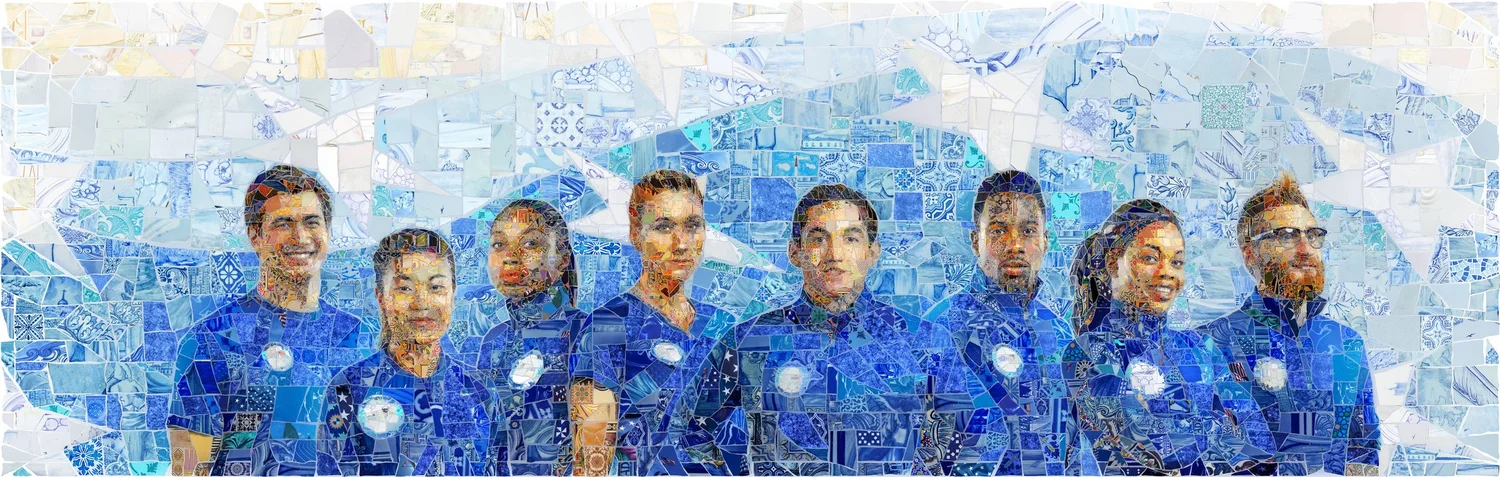
What is a mosaic?
A mosaic is an image or pattern made from many small, separate pieces, called tesserae, set close together on a surface and fixed in place. The pieces can be stone, glass, ceramic or shell; today they can also be photographs, symbols and letters. No single piece holds the picture. The picture lives in the relationships between the pieces.1, 2
Mosaic at a glance
- Definition
- An image or pattern made of small, separate pieces set close together on a surface.
- The pieces
- Tesserae (singular: tessera).
- Materials
- Pebbles, stone and marble, coloured glass and smalti, gold-leaf glass, ceramic, shell; in digital work, images, symbols and characters.
- Oldest surviving
- The clay-cone walls of Uruk, in Mesopotamia, late fourth millennium BCE.
- Main techniques
- Pebble mosaic, opus tessellatum, opus vermiculatum, opus sectile, micromosaic, trencadís.
- Main types
- Greek, Roman, Byzantine, early Islamic, Florentine, micromosaic, trencadís, photographic, character art, algorithmic.
This is why I have never thought of the mosaic as a technique. It is a principle that nature arrived at long before we did: coherent meaning can emerge from discrete units, each of which is abstract on its own. Aristotle already observed that in things made of parts, the whole is something besides the parts.3 A leaf is made of cells. A face is made of features held in relationship. A mosaic makes that principle visible, and it gives the viewer two pictures for the price of one: the fragments, and the figure they become. In a good mosaic, both are designed. In a bad one, only the figure is.
What does "mosaic" mean?
The English word comes, through Old French and Italian, from the Medieval Latin musaicum, “work of the Muses”. The exact path is disputed: the late Greek word for mosaic work, mouseion, may itself have been borrowed from Latin.4
My own language is more down to earth. Greek names the art by its material. Psēphidotó (ψηφιδωτό) comes from psēphís (ψηφίς), “a small pebble”, a word also used, in late antiquity, for tessellated work.5 It is an honest name: the first Greek mosaics were made of river pebbles. The Latin tessera, plural tesserae, is a small cube, the shape that cut stone and glass took from the Hellenistic period on.2
In everyday English, “mosaic” also means any whole made of many distinct parts, as in “a mosaic of cultures”. The figurative sense keeps the original idea intact. The parts stay visible, and the whole still holds.
The four layers of every mosaic
When I explain a mosaic, to a client or to a class, I take it apart into four layers. Every mosaic has them, ancient or digital, stone or pixel: the main image, what you see first; the tesserae, the individual units and what they carry; the constructing mechanism, the grid, the method and the logic of assembly; and the semantic layer, the meaning that binds the other three. Naming them is the quickest way to see why one mosaic carries meaning and another remains decoration.6 The Four Layers of a Mosaic takes each layer through history and through our studio, and shows how to read a mosaic with them.
Why a mosaic works
Because we see the whole before we see the parts. The eye groups separate pieces into forms by laws such as proximity, similarity and continuity, as Max Wertheimer described in 1923, and it recognises a large form before the small forms it is made of, as David Navon showed in 1977.7, 8 I like to say that distance is the mosaic’s second material: close to the wall, the eye finds tesserae and joints; step back, and a figure appears that none of the pieces contains. Why a Mosaic Works follows this through Gestalt psychology, face perception, figure and ground, colour at a distance and variable size.
What are mosaics made of?
Almost anything that can be cut, broken or collected in small units and fixed into a bed:1, 9
- Pebbles. River and sea stones, sorted by colour and size: the material of the earliest Greek floors.
- Cut stone and marble. From the Hellenistic period on, cut stone replaced pebbles and allowed finer, more controlled images.9
- Glass. Coloured glass, including the opaque glass known as smalti, opened a palette that stone could not offer.
- Gold and silver leaf glass. Metal leaf sealed under a layer of glass. Because wall mosaics are not walked on, Byzantine makers could use these fragile materials. They set gold tesserae at angles to catch the light, tilted them further in dark corners, and sometimes set them reversed, so that a thicker layer of glass softened the gleam.1, 10
- Ceramic and broken tile. From glazed tiles to the broken pieces of trencadís.
- Shell, mother-of-pearl and other materials.
- Images, symbols and characters. The tesserae of digital work.
The material is never neutral. Gold glass in a church vault and photographs of athletes in a stadium mural say different things before any image is formed. Choosing the pieces is already choosing the meaning. I wrote about this conversation between materials in Every Pixel Is a Tessera.
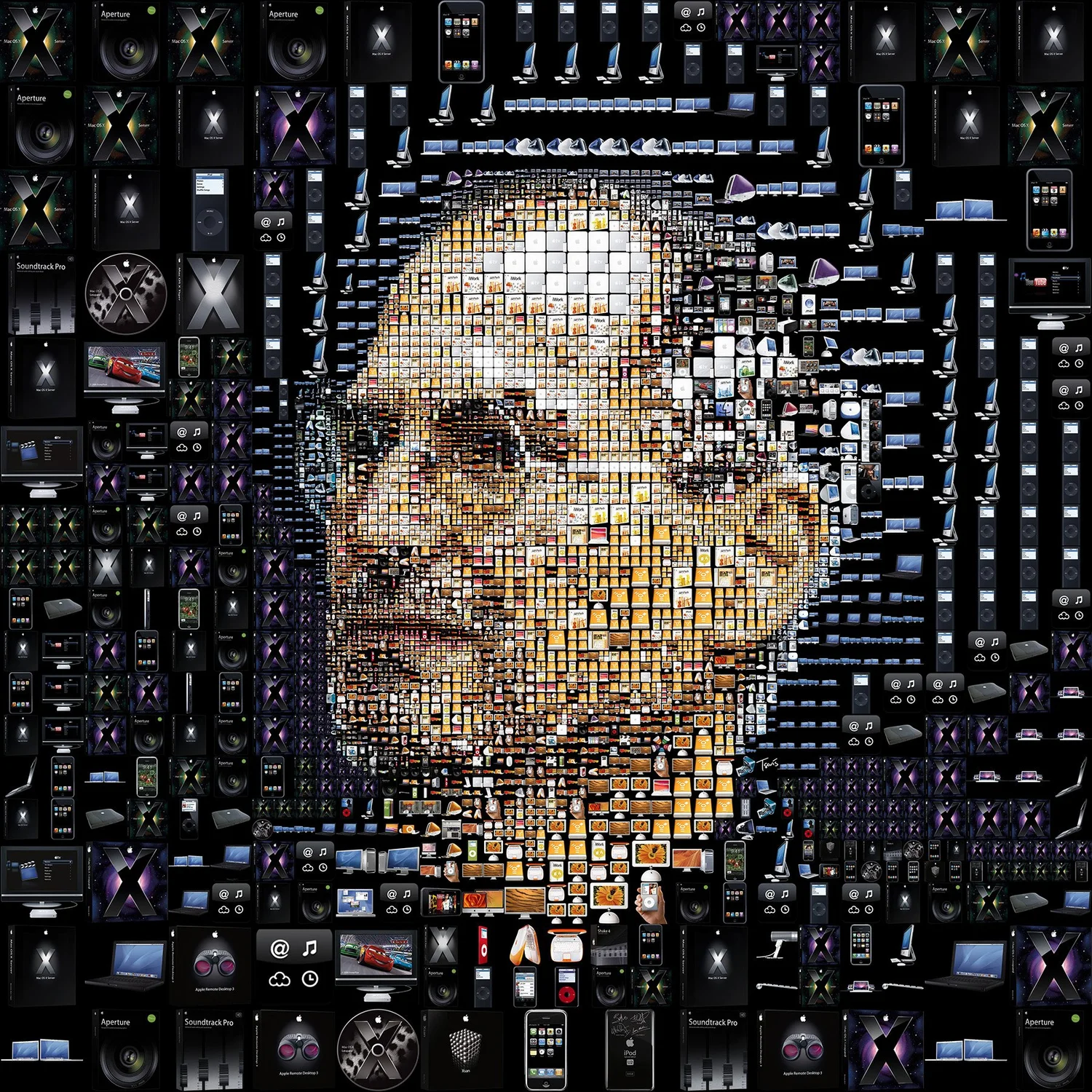
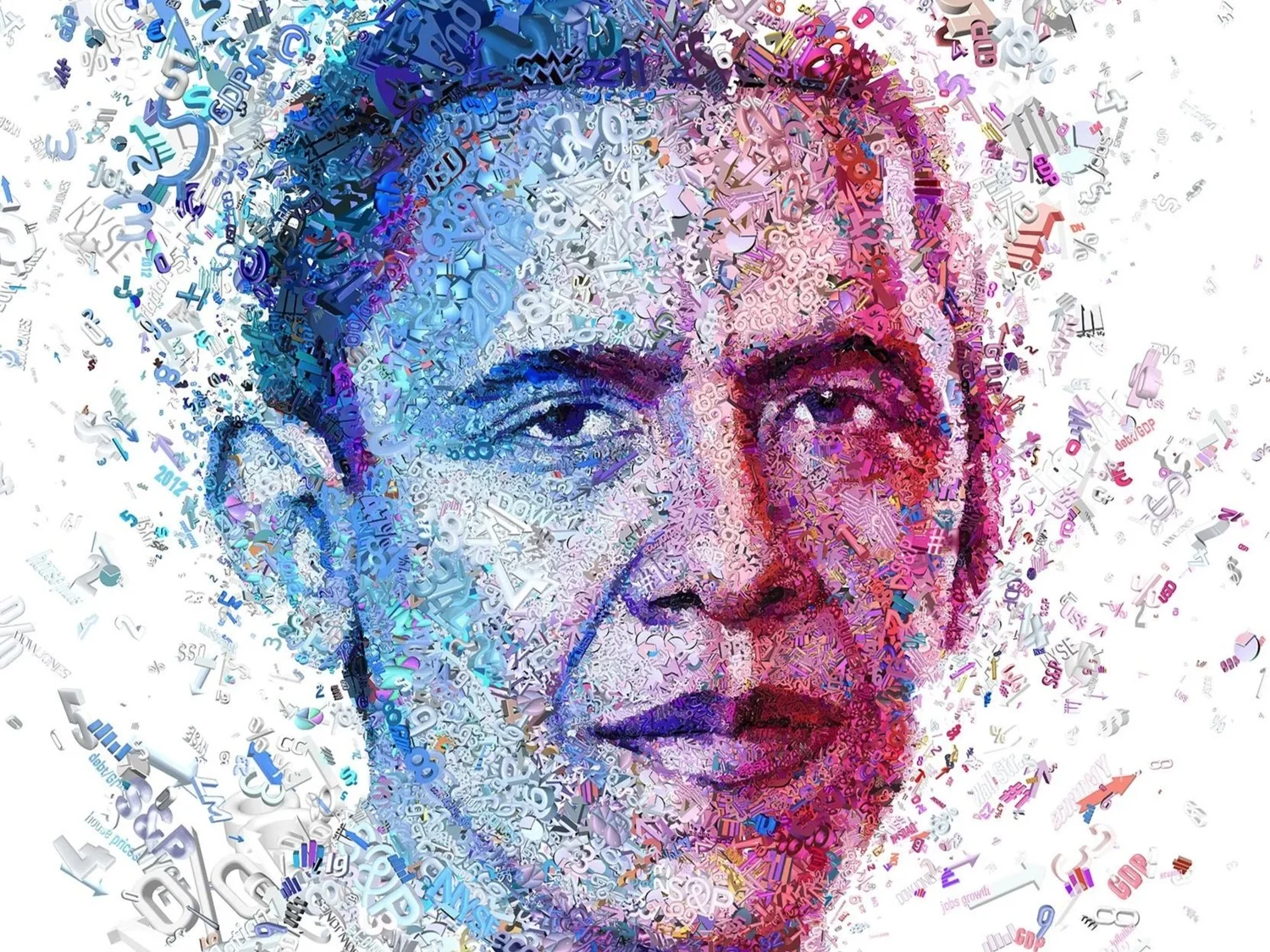
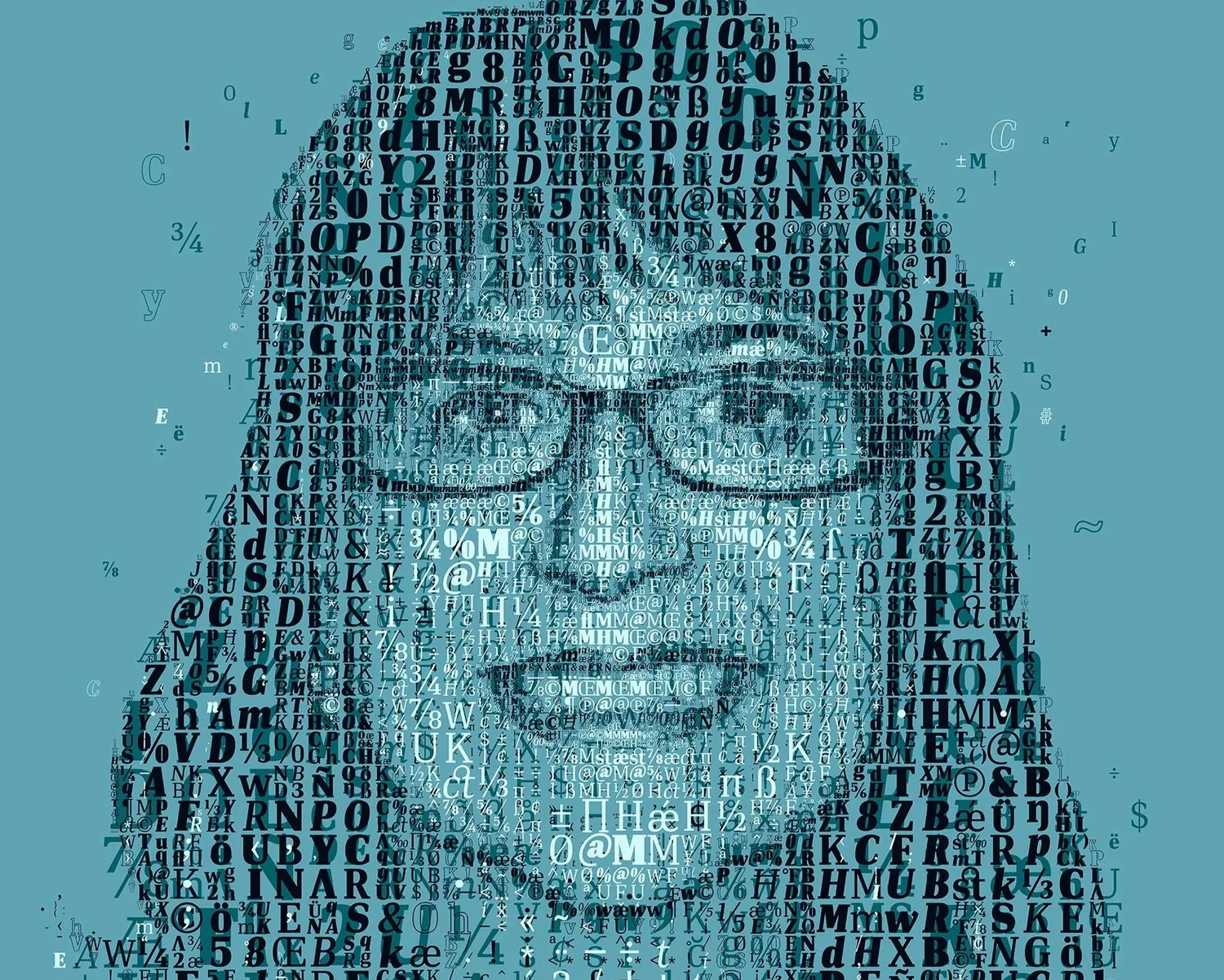
Three materials, three meanings: Apple products, numbers and typographic characters. Algorithmic mosaics by Tsevis Studio.
How are mosaics made?
In any century, the making of a mosaic follows the same sequence of decisions.
Design. It begins with a drawing, often a full-size cartoon, which fixes the main image and the divisions of the surface.
Cutting. Stone and glass are cut into tesserae, traditionally with a hammer and a hardie (a chisel-shaped blade set into a block), and today also with wheeled nippers.
Setting. The tesserae are fixed into a bed of mortar or adhesive by one of two methods.1 In the direct method, each piece is set face up, straight into the final bed, and the maker watches the image grow; this was the ordinary method of antiquity and of medieval wall mosaics. In the indirect method, the mosaic is first set in reverse, glued face down on paper or cloth in the workshop, and then applied to the floor or wall. It allows large works, even for cupolas and apses, to be assembled away from the building, and it was the method most used in the twentieth century. It has ancient roots: many Roman emblemata were made on trays of stone or terracotta and then set into the floor.
Andamento. The Italian word for the flow of a mosaic: the direction in which the rows run. Rows can follow the contour of a face, radiate from a centre or march in straight courses across a background. Andamento is the constructing mechanism made visible, and it is exactly what computer graphics research tries to reproduce when it simulates decorative mosaics.11, 12
Finishing. The joints between tesserae are filled with grout or left open. They are never empty: their width and colour change the image, because the eye reads them as part of the surface.
The grid is the decision clients see least and the one I think about most. The Four Layers of a Mosaic shows why, with one portrait on many different grids.
The classical techniques
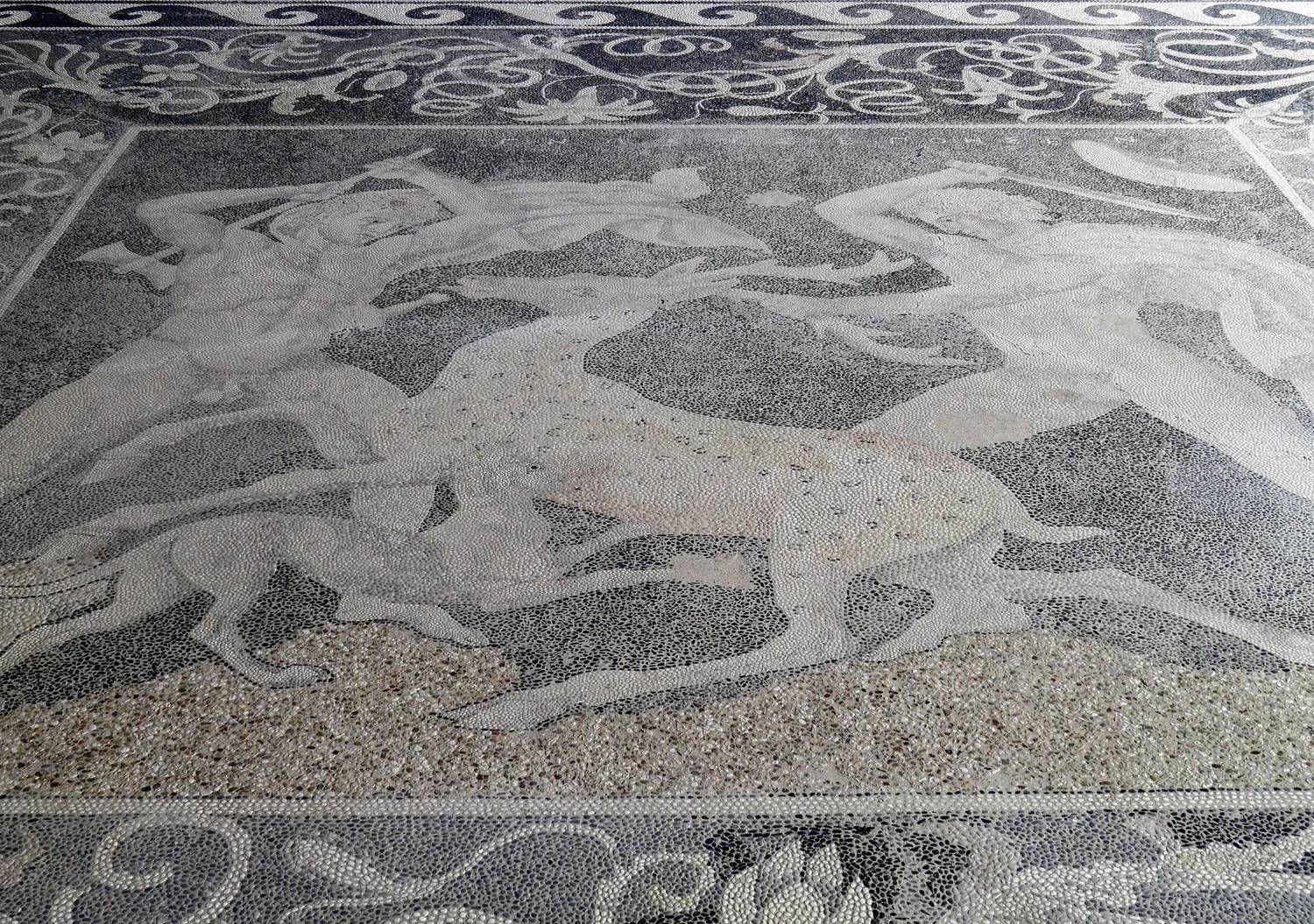
Pebble mosaic. The earliest kind in the eastern Mediterranean, used only for floors, and the principal form until about the third century BCE. At Pella, the late pebble floors added thin strips of lead or terracotta to draw contours.9
Opus tessellatum. Tesserae of roughly regular size laid in rows: the standard technique of Hellenistic, Roman, early Christian and Byzantine mosaics.13
Opus vermiculatum. Very small tesserae set closely in wavy, worm-like rows that follow the forms, used above all for the emblema, the finely made figurative panel at the centre of a floor.13, 14
Opus sectile. Larger pieces of marble, stone or glass cut to the shapes of the design, so that one piece can form a whole part of a figure. It was practised alongside mosaic in Rome and Byzantium.15
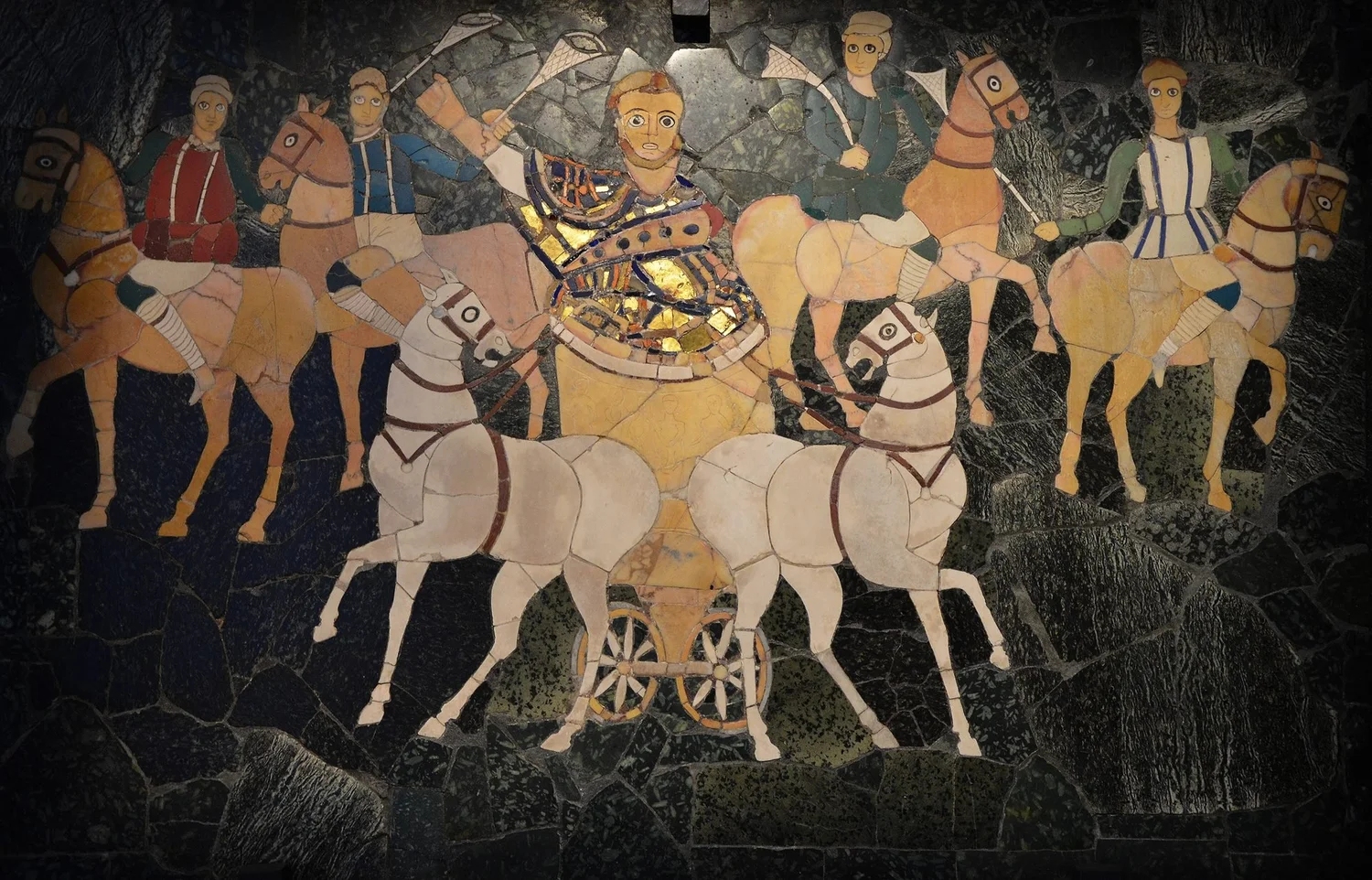

Micromosaic. Mosaics of tiny glass tesserae, developed in eighteenth-century Rome around the workshop of St Peter’s Basilica, the Vatican Mosaic Studio.16
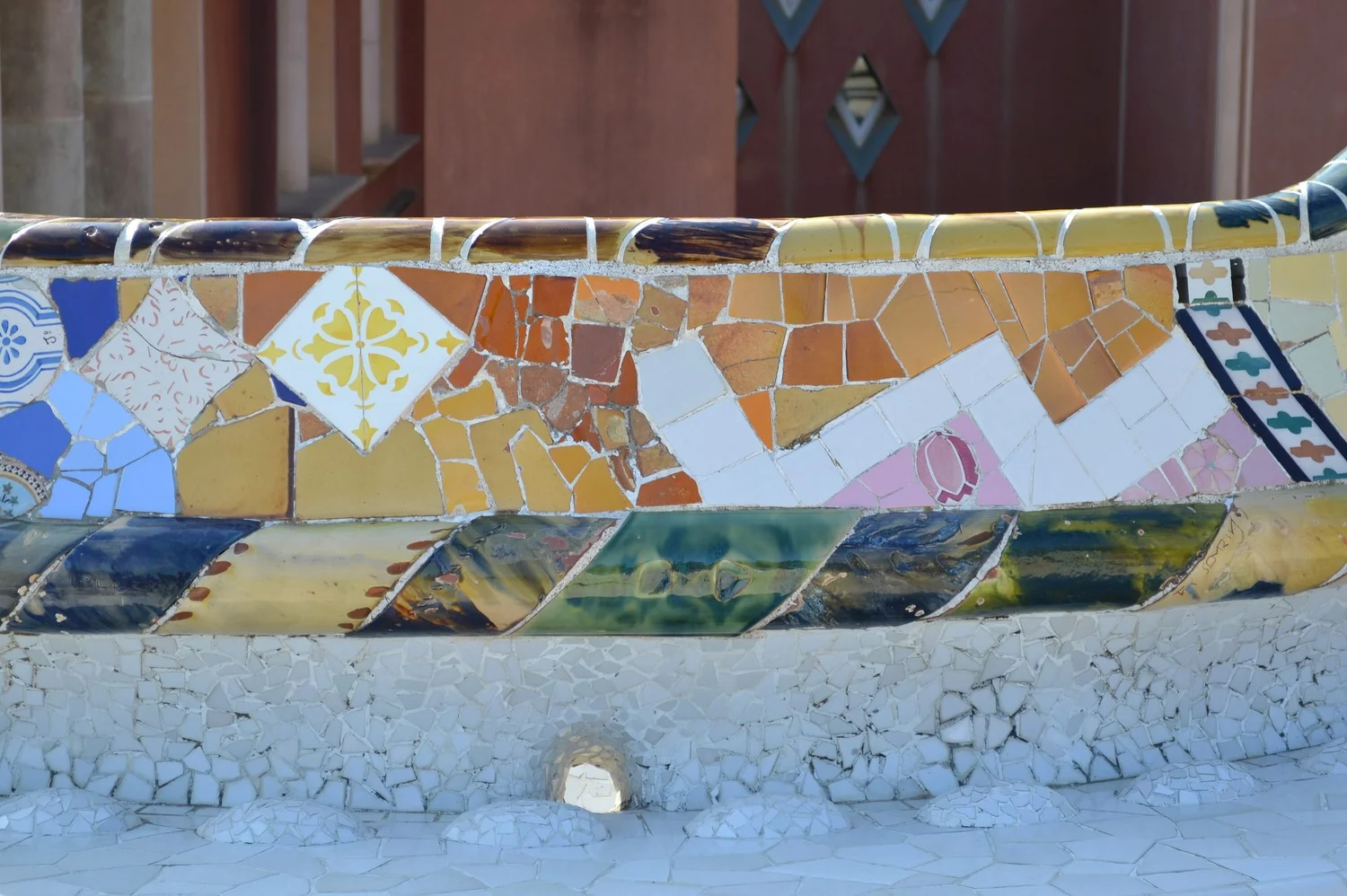
Trencadís. Mosaic from broken tiles and ceramic, made famous by Antoni Gaudí and Josep Maria Jujol in Barcelona. The irregular fragment is no longer hidden. It becomes the language of the surface.17

Types of mosaic
Techniques describe how the pieces are set. Types describe the traditions that grew from them. These are the main types of mosaic art, from the oldest to the newest:
- Greek pebble mosaic. Floors of natural pebbles, from the fifth century BCE, at their height at Pella in the late fourth.9
- Roman floor mosaic. Cut stone tesserae in opus tessellatum, with fine emblemata at the centre, laid in houses, baths and public buildings across the empire.13, 18
- Byzantine wall mosaic. Glass and gold tesserae on walls, vaults and domes, set to catch the light and seen at the scale of a building.10, 19
- Early Islamic glass mosaic. Mosaics without human figures, from the Dome of the Rock to the landscapes and buildings of the Great Mosque of Damascus.20
- Florentine mosaic (commesso, pietra dura). Images inlaid in thin, precisely cut pieces of hard stone, the work of the Opificio delle Pietre Dure in Florence from 1588.21
- Micromosaic. Tiny glass pieces for portraits, views and jewellery, from eighteenth-century Rome.16
- Trencadís. Broken tile and ceramic, from Gaudí’s Barcelona.17
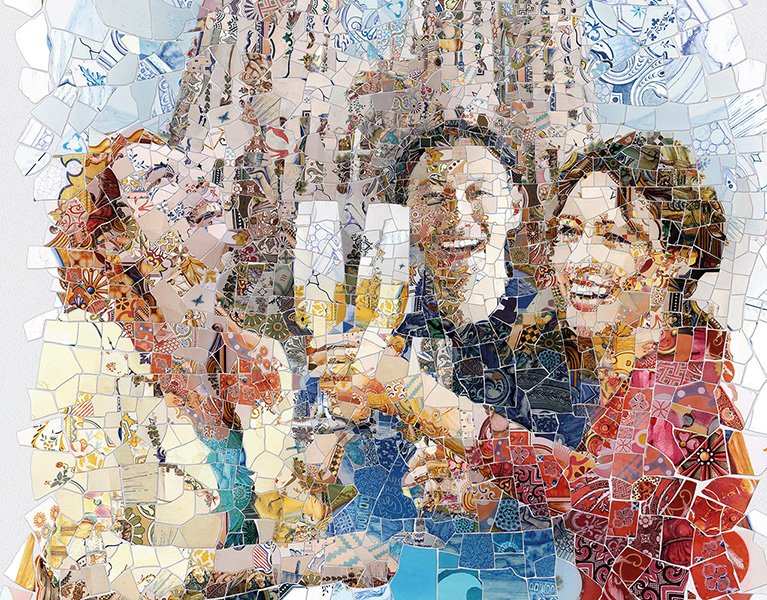
- Photographic mosaic (photomosaic, photo mosaic). An image built from many small photographs, each chosen mainly to match the colour and tone of one part of a larger picture.22, 23
- Character art. Images built from letters and symbols: typewriter art, ASCII and ANSI art.24 My own path into it began with my father, an engineer, and I told that story in When Machines Dream in Letters.
- Algorithmic mosaic. A mosaic in which a rule decides where each fragment goes, and in which every fragment carries meaning of its own. The rule can follow structure, importance and meaning, not only colour.23
For the styles we use in our own digital work, from classic grids to maps and stained glass, see Mosaic Styles.
A short history of mosaic art
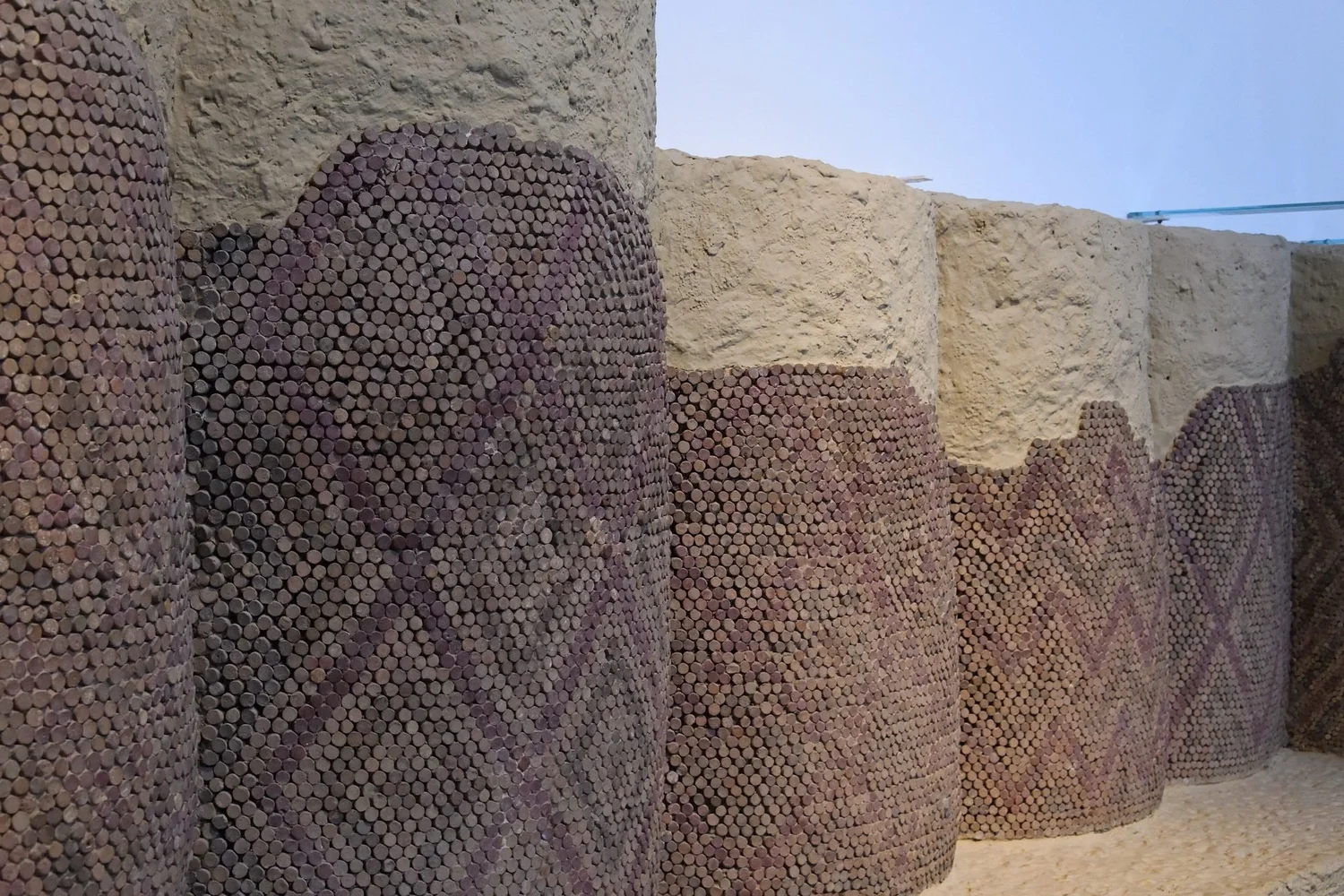
The oldest surviving mosaics predate Greece. At Uruk, in southern Mesopotamia, in the late fourth millennium BCE, builders pressed thousands of painted cones of clay and stone into temple walls. Their black, red and white ends formed lozenges and zigzags.25

In the late fourth century BCE, at Pella, the Macedonian capital, a mosaicist named Gnosis signed a pebble floor, the earliest known signature of a mosaicist. The Stag Hunt carries the words Gnosis made it.26 From across the room it is a hunting scene. Up close it is a system of decisions: which pebble, at which angle, beside which neighbour.

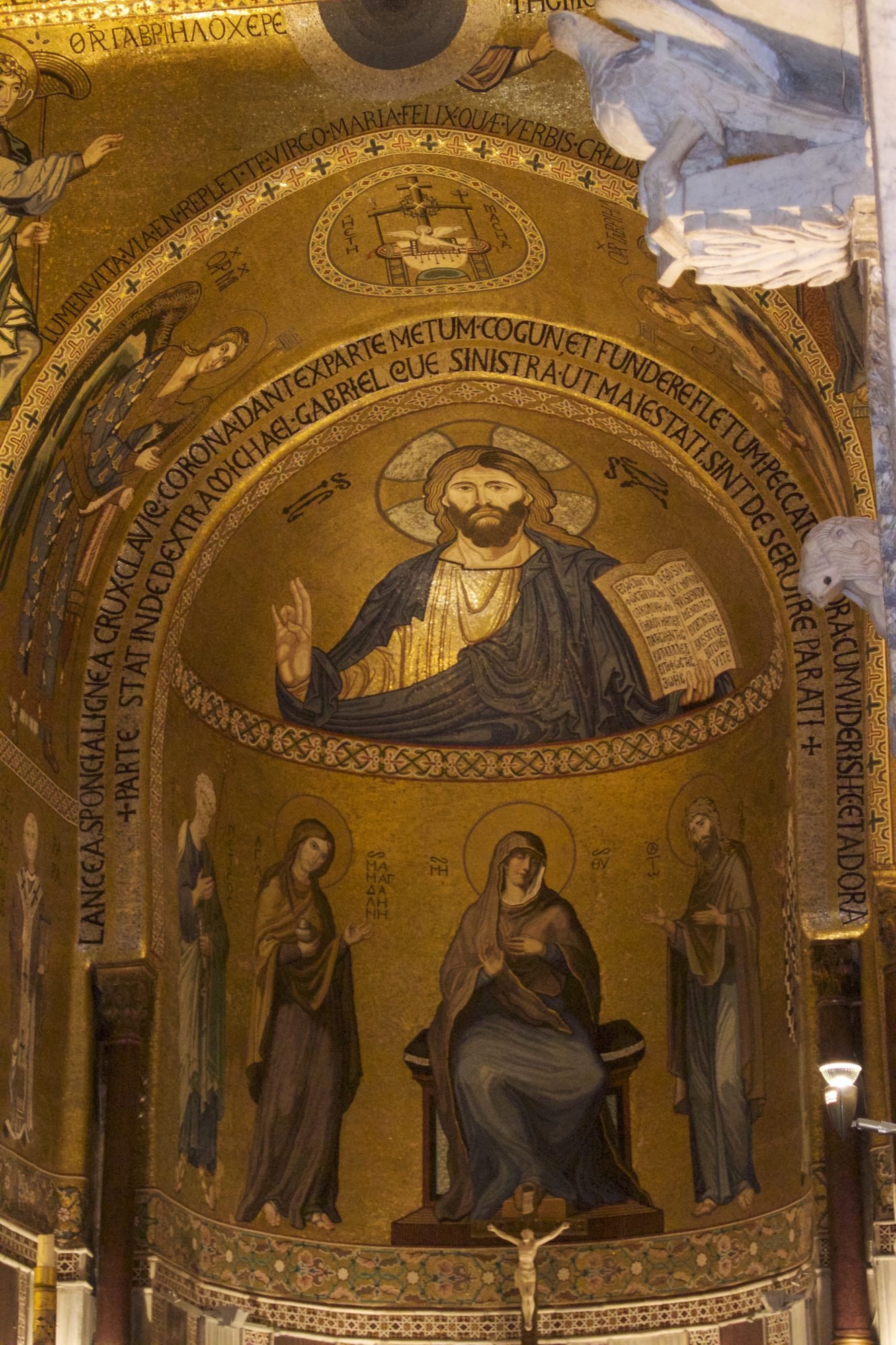
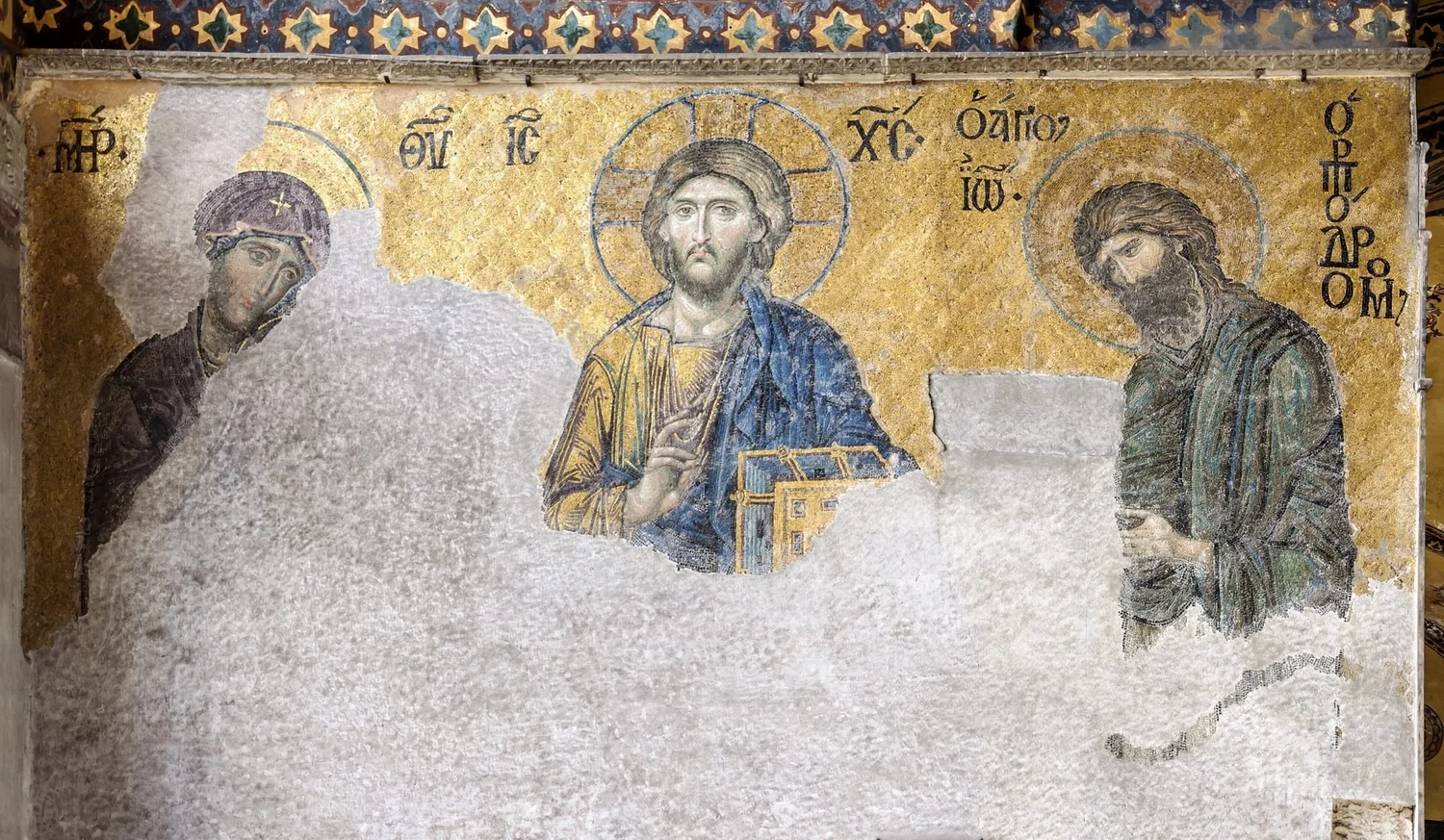
Hellenistic and Roman makers turned to cut tesserae and to the fine work of the emblema, and mosaic floors spread across the Roman world.18 Late antiquity and Byzantium made the wall and the vault the mosaic’s main field. In Ravenna, Constantinople and Palermo, glass and gold tesserae built images that resolve only at the distance of a nave,19 and Hagia Sophia, rebuilt in 537, carried glass mosaic across its central dome and vaults.27


The early Islamic world took up the art in its first great buildings. The Dome of the Rock in Jerusalem was erected in 691, as its inscriptions record, and the Great Mosque of Damascus was built between 706 and 715 and covered with mosaics inside and out. Who made them is still debated. Arab sources report that the caliphs received craftsmen and materials from the Byzantine emperor; papyri record skilled workmen sent from Egypt, and analysis of the glass confirms that Egyptian materials were used.20
In Rome, mosaic work at St Peter’s Basilica began in the late sixteenth century, and in 1727 the workshop became a permanent institution, the Vatican Mosaic Studio, with a stock of glass enamels in tens of thousands of tones.16 In Barcelona, between 1900 and 1914, Gaudí and Jujol covered Park Güell in trencadís. The park is not decorated with mosaic. It is built from it.17
A parallel line runs through technology, and it is the one I grew up in. In 1898, Flora F. F. Stacey made a butterfly on a typewriter, choosing characters for their visual density rather than their meaning.24 In 1967, at Bell Telephone Laboratories, Kenneth Knowlton and Leon Harmon built Studies in Perception I, a portrait of the dancer Deborah Hay made from small electronic and mathematical symbols chosen for their tonal weight. It appeared in The New York Times that October and at the Museum of Modern Art in 1968.28, 29 Knowlton gave the practice a precise name: computer-assisted mosaic tessellation.30
What connects Uruk, Pella, Ravenna and Bell Labs is not an unbroken line of influence. It is one structural insight, found again and again across cultures: meaning is made from fragments held in relationship.6 The long version of this history is The Tradition We Work In.
Famous mosaics
Ten mosaics, in order of date, that show what the art can do:
- The Stag Hunt, Pella (c. 300 BCE). A pebble floor signed by Gnosis, the first known signature of a mosaicist. Archaeological Museum of Pella.26
- The Alexander Mosaic, Pompeii (about 100 BCE). Alexander the Great and Darius III in battle, from the House of the Faun, in opus vermiculatum; it is believed to copy an earlier Greek painting. National Archaeological Museum of Naples.14, 31
- The Gypsy Girl, Zeugma (2nd century CE). A Roman floor portrait from the ancient city of Zeugma, now in the Zeugma Mosaic Museum in Gaziantep.32
- Villa Romana del Casale, Sicily (4th century CE). About forty rooms paved in polychrome mosaic, some 3,500 square metres; a UNESCO World Heritage Site since 1997.33, 34
- The Mausoleum of Galla Placidia, Ravenna (5th century CE). A small building lined with blue and gold mosaic, among the Early Christian Monuments of Ravenna.19
- Justinian and Theodora, San Vitale, Ravenna (6th century CE). The imperial panels of a church completed in 547.19, 35
- The Dome of the Rock, Jerusalem (691 CE). Glass and gold mosaics, with the gold tesserae steeply tilted in unlit areas to catch the light.1, 20
- Monreale Cathedral, Sicily (1174–89). More than 6,000 square metres of gold-ground mosaic, made for King William II.19, 36
- The Deësis, Hagia Sophia, Istanbul (13th century). Christ between the Virgin and John the Baptist, a late work of Byzantine wall mosaic.
- Park Güell, Barcelona (1900–1914). Gaudí and Jujol’s serpentine bench and terraces in trencadís.17
From tesserae to algorithms
The computer did not change what a mosaic is. It changed the instrument. The four layers stayed the same; what changed is that the constructing mechanism became an explicit rule, one that can be written down, tested and changed.
Leon Harmon’s 1973 portrait of Abraham Lincoln, reduced to a few hundred grey blocks, showed how little information a recognisable face needs.37 In 1996, Robert Silvers’s MIT thesis made widely known the method of building one photograph from many others.22 Since then, research in matching, visual attention and machine learning has changed how fragments are chosen and placed.38 I followed that development, from Bell Labs to diffusion models, in Photographic Mosaics: How the Algorithms Developed.
The difference between a photomosaic and an algorithmic mosaic is worth one sentence. A photomosaic matches photographs to the colour of a target image; an algorithmic mosaic chooses its fragments for what they mean, and places them by a rule that can follow structure and importance as well as colour.23 A traditional mosaic and an algorithmic one differ in their instruments, not in their nature.
One portrait, twenty-seven mosaics
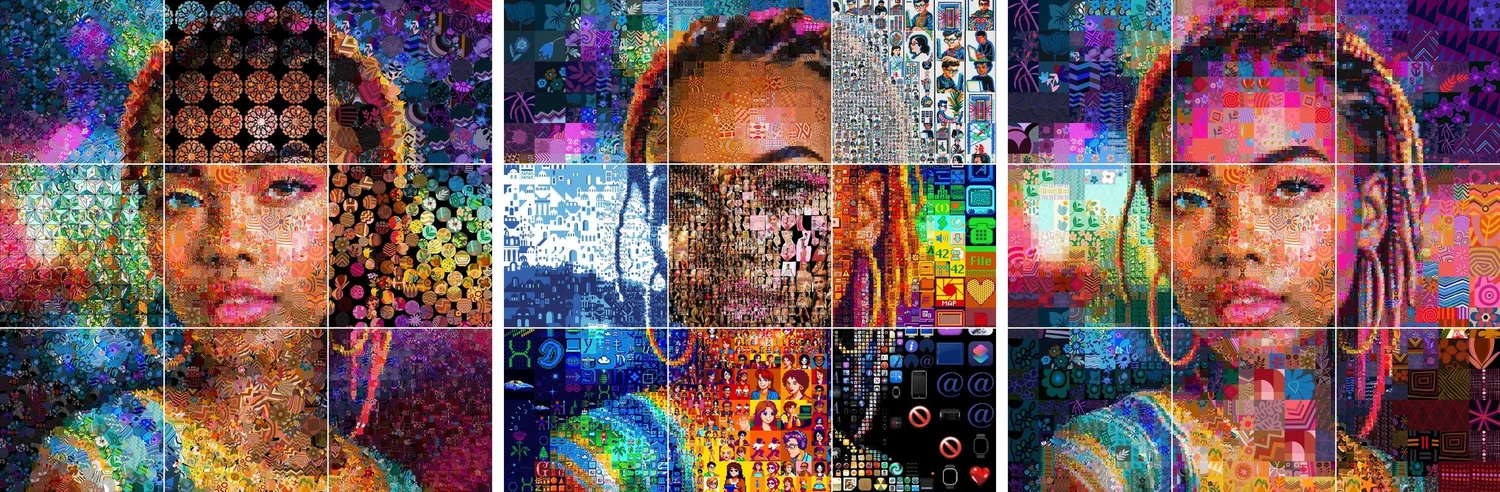
The four layers are easiest to understand when you change them one at a time. On The Four Layers of a Mosaic, one portrait is rebuilt twenty-seven times: on nine grids, from nine libraries of tiles and with nine rules for matching them, and then in motion, as a video mosaic and as character art.
What is mosaic art used for?
A mosaic is chosen when one image has to carry many things at once. That single property explains where mosaic art is used today.
Storytelling. A mosaic holds two scales of story in one picture: the figure you recognise, and the many smaller stories it is made of. Giannis Antetokounmpo’s portrait, later installed by Nike in Athens, is built from the map and the street photographs of Sepolia, the Athens neighbourhood where he grew up. Kobe and Gianna Bryant are built from moments of his career and photographs of father and daughter in Mamba Forever. Vassilis Spanoulis’s retirement tribute is made of thousands of photographs from his career, and Abraham Lincoln, for Smithsonian, of the hundred most significant Americans. I wrote at length about this in Visual Storytelling in Art for Sports.
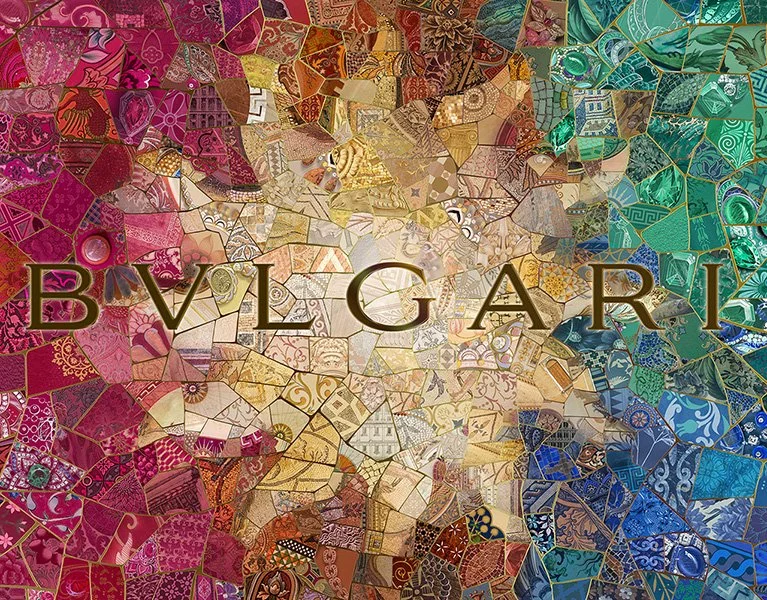
Campaigns. A campaign needs an image that can be read in a second and a depth that rewards a second look. A mosaic gives both, and it can be built from the brand’s own material. Eurobank built office buildings, warehouses and hotels from more than 300 AI-generated portraits representing Greek workers. Hansaplast built a smile from thousands of children’s drawings, with a donation for every drawing. Siemens built people, towers and homes from lines of code, layered for animation. Bulgari Mediterranea joined Mediterranean ornamental traditions for a high jewellery collection, and Codorníu took Gaudí’s trencadís to Japan.
Editorial and science. A cover has to state an idea, not only show a face. When the pieces are the subject’s own world, the image becomes an argument. Elon Musk, as TIME Person of the Year 2021, is made of Tesla, SpaceX and Boring Company parts; Steve Jobs, for Fortune, of Apple products. For Science, a pregnant woman and a baby are made of microbes, and another Science cover uses the heat maps of the authors’ own research. Caltech Magazine built extinct species from atoms and molecules, working from scientists’ sketches and 3D models. More in Where Science Meets Art.
Architecture and public art. On a wall, a mosaic is read twice: as an image from across a hall, and as material from arm’s length. Moments Gate, a 41-foot mural for the Delta Sky Club at San Francisco International Airport, is built from photographs of the Golden Gate Bridge by day and night. The murals for USA House at the Rio 2016 Games speak the language of azulejos, and the artworks for Legendary Area in Moscow were made for a residential complex built around sport.
Corporate art. An organisation is made of people, products and history, and a mosaic can show all three in one image. The portrait of SoftBank’s founder for SoftBank is built from the logos of the companies in his portfolio. Hello, for the headquarters of iSquare, rebuilds the 1984 Macintosh greeting from forty years of Apple interface icons. A Company Built by Its People is made from photographs of Lhoist employees around the world, and the Shashi Hotel in Silicon Valley hangs four pioneers of computing and communication. See also Imagine the Workspace as a Storytelling Canvas.
Gifts for clients, leaders and collectors. A mosaic made for one occasion carries that occasion in its pieces. That is why it is kept. For the 40th anniversary of Quest, a mosaic of the logo became a limited-edition gift to a list of important people; Nestlé Hellas gave limited-edition mosaics to its top employees. The Royal Mosaics of Bahrain were presented to the King and the Crown Prince, each made of hundreds of hand-finished tiles, and the royal digital mosaics carry metal details and gold leaf. Singularis works are made once, by hand, for one place.
Sport, culture and causes. A team, a city or a cause is a community, and a mosaic shows a community as one figure. The Royal Mint turned a mosaic of runners into the relief of a 27 mm Olympic coin. Qatar 2022 joined football portraits with Islamic geometry and Kufic calligraphy; the NBA Creator Series joined the Greek key with Nigerian Aso Oke colours. The Legends of Greek Basketball were auctioned to equip the Greek wheelchair basketball team, and Healthy Seas rebuilt the Minoan dolphin fresco from more than 1,500 photographs of its own work at sea. On working across cultures, see Cultural Intelligence in Olympic Art.
All the fields are gathered on the Applications page.
How we work with the mosaic today
Our medium is the mosaic. At Tsevis Studio, Vira Konstanta and I practise computer-assisted mosaic tessellation: we build algorithmic mosaics from images, symbols and typographic characters chosen for what they carry, with instruments I have been building for three decades. Two frameworks guide how we design and read a mosaic. Algorithmic Gestalt applies perceptual theory to the computational design of mosaic systems. The Macro-Micro Narrative is the principle that every scale of a work must carry and amplify its central message.6, 23 With Singularis, Vira rebuilds digital mosaics by hand in paper relief, gold leaf and archival inks, and the mosaic returns to matter.
Questions
What is a mosaic?
A mosaic is an image or pattern made from many small, separate pieces of stone, glass, ceramic or other material, called tesserae, set close together and fixed to a surface. No single piece contains the picture; it exists in how the pieces are arranged.
What does "mosaic" mean, and where does the word come from?
The word comes from the Medieval Latin musaicum, “work of the Muses”. Greek calls a mosaic psēphidotó, from psēphís, a small pebble, the material of the first Greek floors. By extension, “mosaic” also means any whole made of many distinct parts.
What is mosaic art?
Mosaic art is the art of making images and patterns from small, separate pieces. It runs from the pebble floors of ancient Greece and the gold walls of Byzantium to trencadís, photographic mosaics and algorithmic mosaics made with software.
What are the pieces of a mosaic called?
They are called tesserae (singular tessera), from the Latin for a small cube. The earliest Greek mosaics used natural pebbles; later makers cut stone, marble and glass into tesserae.
What materials are mosaics made of?
Pebbles, cut stone and marble, coloured glass and smalti, gold- and silver-leaf glass, ceramic, shell and broken tile. In digital mosaics, the pieces can be photographs, symbols or typographic characters.
How are mosaics made?
A design is drawn, the material is cut into tesserae, and the pieces are set into mortar or adhesive, either directly in place or face down on paper or cloth in the workshop and then transferred (the indirect method). The direction in which the rows run, the andamento, shapes how the image is read.
What are the main types of mosaic?
Greek pebble mosaics, Roman floor mosaics, Byzantine wall mosaics, early Islamic glass mosaics, Florentine stone mosaic, micromosaic, trencadís, photographic mosaics, character art and algorithmic mosaics.
What is the oldest known mosaic?
The oldest surviving mosaics are the cone walls of Uruk, in southern Mesopotamia, made in the late fourth millennium BCE. The first known signature of a mosaicist, Gnosis, is on a pebble floor at Pella from the late fourth century BCE.
What are the most famous mosaics?
Among them are the Alexander Mosaic from Pompeii, the floors of the Villa Romana del Casale in Sicily, the mosaics of Ravenna, the Deësis in Hagia Sophia, the Dome of the Rock, Monreale Cathedral and Gaudí’s Park Güell.
Why does a mosaic look like a picture from far away?
Because human vision perceives the whole before its parts. From a distance, the joints between tesserae close and neighbouring tones merge, so the eye groups the pieces into one figure, as described by Gestalt psychology.
What is the difference between Roman and Byzantine mosaics?
Roman mosaics were mostly floors, made largely of stone, with fine figurative panels (emblemata) at their centre. Byzantine mosaics were mainly on walls and vaults, used glass and gold-leaf tesserae set to catch the light, and were designed to be seen at the scale of a building.
What is a photo mosaic?
A photo mosaic, or photomosaic, is an image built from many small photographs, each chosen mainly to match the colour and tone of one part of a larger picture. The method was made widely known by Robert Silvers in 1996.
Is a digital mosaic a real mosaic?
Yes, when it works as one. A digital mosaic has the same four layers as a stone one: a main image, tesserae, a constructing mechanism and a meaning that binds them. Only the instrument changes: the logic of assembly becomes an explicit rule.
What is an algorithmic mosaic?
A mosaic in which a rule decides where each fragment goes, and in which the fragments (images, symbols or characters) each carry meaning of their own. See Algorithmic Mosaic: What It Is and How We Make It.
Further reading
- The Four Layers of a MosaicOne portrait, twenty-seven mosaics: the grid, the tiles and the matching rule, changed one at a time.
- Why a Mosaic WorksPerception, Gestalt and distance: why the eye finds the figure in the fragments.
- The Mathematics of the MosaicTessellation, Voronoi cells, matching and dithering, written down as equations.
- Mosaic GlossaryThe words of the mosaic, from tessera and andamento to matching rule.
- The Tradition We Work InThe history of the mosaic, from the clay cones of Uruk to Bell Labs.
- Research, Science and TechnologyMatching, importance, Gestalt and geometry: the knowledge behind our instruments.
- Algorithmic MosaicWhat an algorithmic mosaic is, and how we make one.
- ApplicationsWhere mosaics work today: campaigns, editorial, architecture, corporate art and gifts.
- Photographic Mosaics: How the Algorithms DevelopedSixty years of mosaic algorithms, from Bell Labs to diffusion models.
- Mosaic StylesThe styles of our digital work, from classic grids to maps and stained glass.
On the blog:
- When Machines Dream in Letters: typewriter, ASCII and ANSI art.
- Psychology of Variable-Size Mosaic Art
- Every Pixel Is a Tessera
- African Mosaic Art
References
- “Mosaic,” Encyclopaedia Britannica. britannica.com
- “Tessera,” Encyclopaedia Britannica. britannica.com
- Aristotle, Metaphysics, book VIII (H), 6, 1045a8–10.
- “Mosaic (n.),” Online Etymology Dictionary. etymonline.com
- “ψηφίς,” Liddell–Scott–Jones, A Greek–English Lexicon: “small pebble”; “tessellated work”. lsj.gr
- Tsevis Studio, The Tradition We Work In, sections I, III, IV, X and XIII. tsevis.com
- Max Wertheimer, “Untersuchungen zur Lehre von der Gestalt II,” Psychologische Forschung 4 (1923): 301–350; English translation, “Laws of Organization in Perceptual Forms.” psychclassics.yorku.ca
- David Navon, “Forest before trees: The precedence of global features in visual perception,” Cognitive Psychology 9 (1977): 353–383.
- “Pebble mosaic,” Encyclopaedia Britannica. britannica.com
- National Gallery of Art, “Byzantine mosaics.” web.archive.org
- Alejo Hausner, “Simulating Decorative Mosaics,” SIGGRAPH 2001.
- Sebastiano Battiato, G. Di Blasi, G. M. Farinella and G. Gallo, “Digital Mosaic Frameworks: An Overview,” Computer Graphics Forum, 2007.
- “Opus tessellatum,” Encyclopaedia Britannica. britannica.com
- Museo Archeologico Nazionale di Napoli (MANN), Alexander Mosaic from the House of the Faun, Pompeii, inv. 10020. museoarcheologiconapoli.it
- Museo Nazionale Romano, Palazzo Massimo alle Terme, Rome: opus sectile panels from the Basilica of Junius Bassus, 4th century CE. museonazionaleromano.it
- Corning Museum of Glass, “A Papal Mosaic,” 2025. blog.cmog.org
- UNESCO World Heritage Centre, Works of Antoni Gaudí; Fundació Catalunya La Pedrera, Park Güell (1900–1914). whc.unesco.org · lapedrera.com
- Katherine M. D. Dunbabin, Mosaics of the Greek and Roman World (Cambridge: Cambridge University Press, 1999).
- UNESCO World Heritage Centre: Early Christian Monuments of Ravenna; Historic Areas of Istanbul; Arab-Norman Palermo and the Cathedral Churches of Cefalù and Monreale. whc.unesco.org · whc.unesco.org · whc.unesco.org
- Sara Fiorentino, “A Tale of Two Legacies: Byzantine and Egyptian Influences in the Manufacture and Supply of Glass Tesserae under the Umayyad Caliphate (661–750 AD),” Heritage 4, no. 4 (2021): 2810–2834. doi:10.3390/heritage4040158
- “Commesso,” Encyclopaedia Britannica. britannica.com
- Robert S. Silvers, Photomosaics: Putting Pictures in Their Place, S.M. thesis, Massachusetts Institute of Technology, Program in Media Arts and Sciences, 1996. hdl.handle.net
- Tsevis Studio, Algorithmic Mosaic: What It Is and How We Make It. tsevis.com
- Flora F. F. Stacey, typewriter butterfly, Pitman’s Phonetic Journal, 15 October 1898; Barrie Tullett, Typewriter Art: A Modern Anthology (London: Laurence King, 2014).
- The Metropolitan Museum of Art, “Mosaic cone”, Late Uruk, ca. 3500–3100 BCE, 62.154.2 (collection record). metmuseum.org
- Stag Hunt mosaic, signed by Gnosis, c. 300 BCE, Archaeological Museum of Pella; see also “Pebble mosaic,” Encyclopaedia Britannica. britannica.com
- The Metropolitan Museum of Art, “Glass Ornaments in Late Antiquity and Early Islam (ca. 500–1000).” metmuseum.org
- Victoria and Albert Museum, Kenneth C. Knowlton and Leon D. Harmon, Studies in Perception I, 1967, collection record. collections.vam.ac.uk
- “Art and Science Proclaim Alliance in Avant-Garde Loft,” The New York Times, 11 October 1967; The Museum of Modern Art, The Machine as Seen at the End of the Mechanical Age, 1968, press release. moma.org
- Ken Knowlton, “Ken Knowlton, in brief.” kenknowlton.com
- Smarthistory, “Alexander Mosaic from the House of the Faun, Pompeii.” smarthistory.org
- Gaziantep Provincial Directorate of Culture and Tourism, “Zeugma Mosaic Museum.” gaziantep.ktb.gov.tr
- UNESCO World Heritage Centre, Villa Romana del Casale (inscribed 1997). whc.unesco.org
- Italia.it, the official tourism portal of Italy, “Villa Romana del Casale.” italia.it
- “Basilica of San Vitale,” Wikipedia: construction completed by Bishop Maximian in 547; the Justinian and Theodora panels completed in 547. en.wikipedia.org
- Reuters, “Sicilian cathedral’s stunning mosaics regain golden lustre,” 2024 (as published by the South China Morning Post). scmp.com
- Leon D. Harmon, “The Recognition of Faces,” Scientific American 229, no. 5 (November 1973): 70–82. doi:10.1038/scientificamerican1173-70
- Tsevis Studio, Research, Science and Technology. tsevis.com · Photographic Mosaics: How the Algorithms Developed, 1966–2026. tsevis.com
About the author
Charis Tsevis is a Greek visual designer and computational artist educated in Athens and Milan. A designer since the late 1980s, he has worked with mosaics for more than three decades and builds his own tools for them. He has taught design thinking, colour theory and Gestalt psychology at art colleges since 1996. With Vira Konstanta he runs Tsevis Studio. About the studio.
Version and how to cite
Version 1.0, 2026-10-20. Corrections are listed here with their dates.
Tsevis, Charis. “What Is a Mosaic? Art, History, Science and Technology.” Tsevis Studio, 2026-10-20. https://www.tsevis.com/what-is-a-mosaic