Photographic Mosaics: How the Algorithms Developed, 1966–2026
I have been making mosaics since the end of the 1980s. A few years ago I started building my own software for them, Mozaix, and that sent me back to the library. I collected and read dozens of papers on how computers make photographic mosaics, from a Bell Labs experiment in 1966 to diffusion models published this year.
What I found was more than a technical history. Every method is a decision about what an image is allowed to keep and what it has to give up. In that sense, it is also a history of taste. This is that history as I see it. It is not a neutral survey: I read these papers as a mosaicist, and I could not help taking sides.
The four decisions behind the image
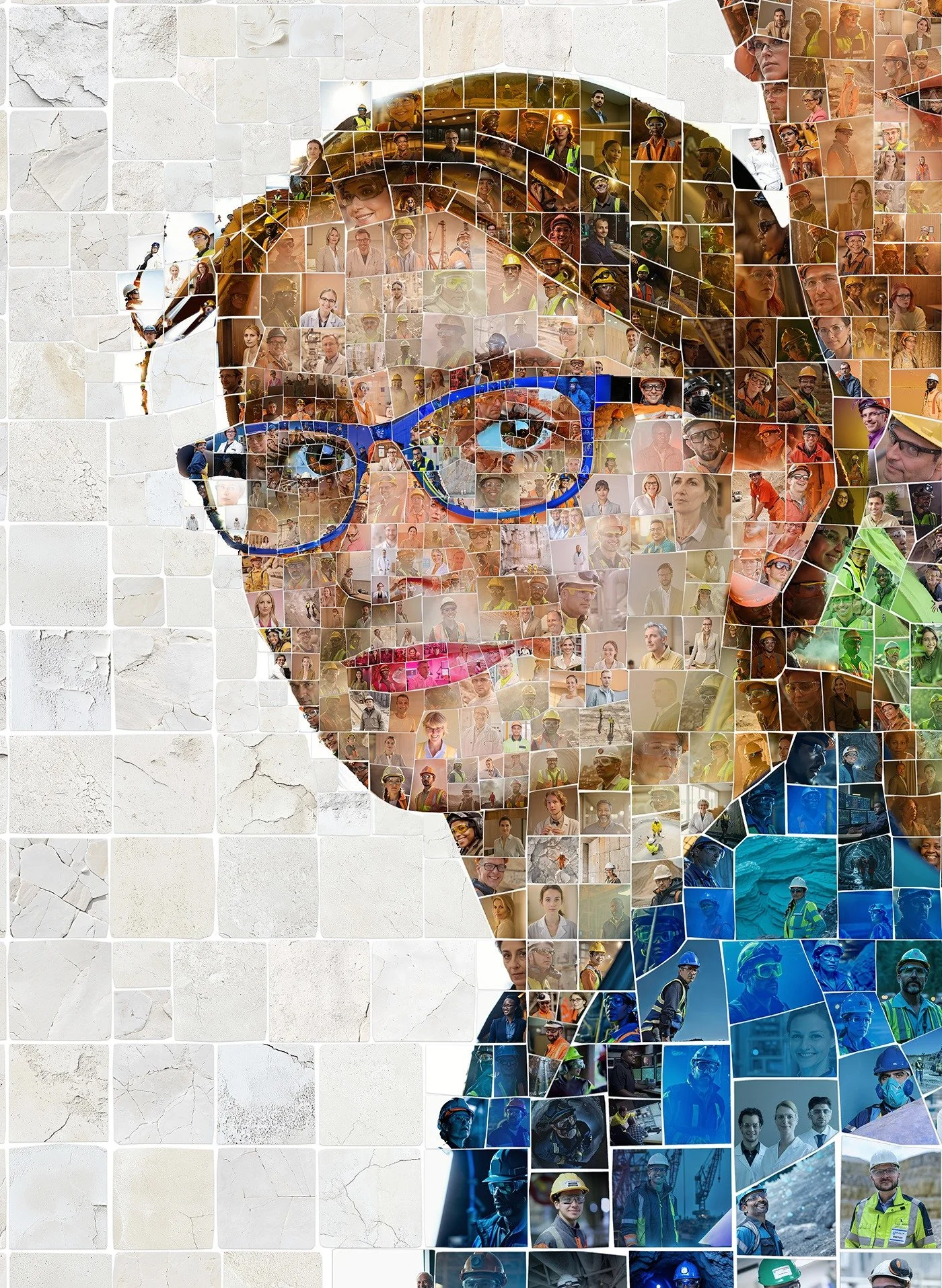
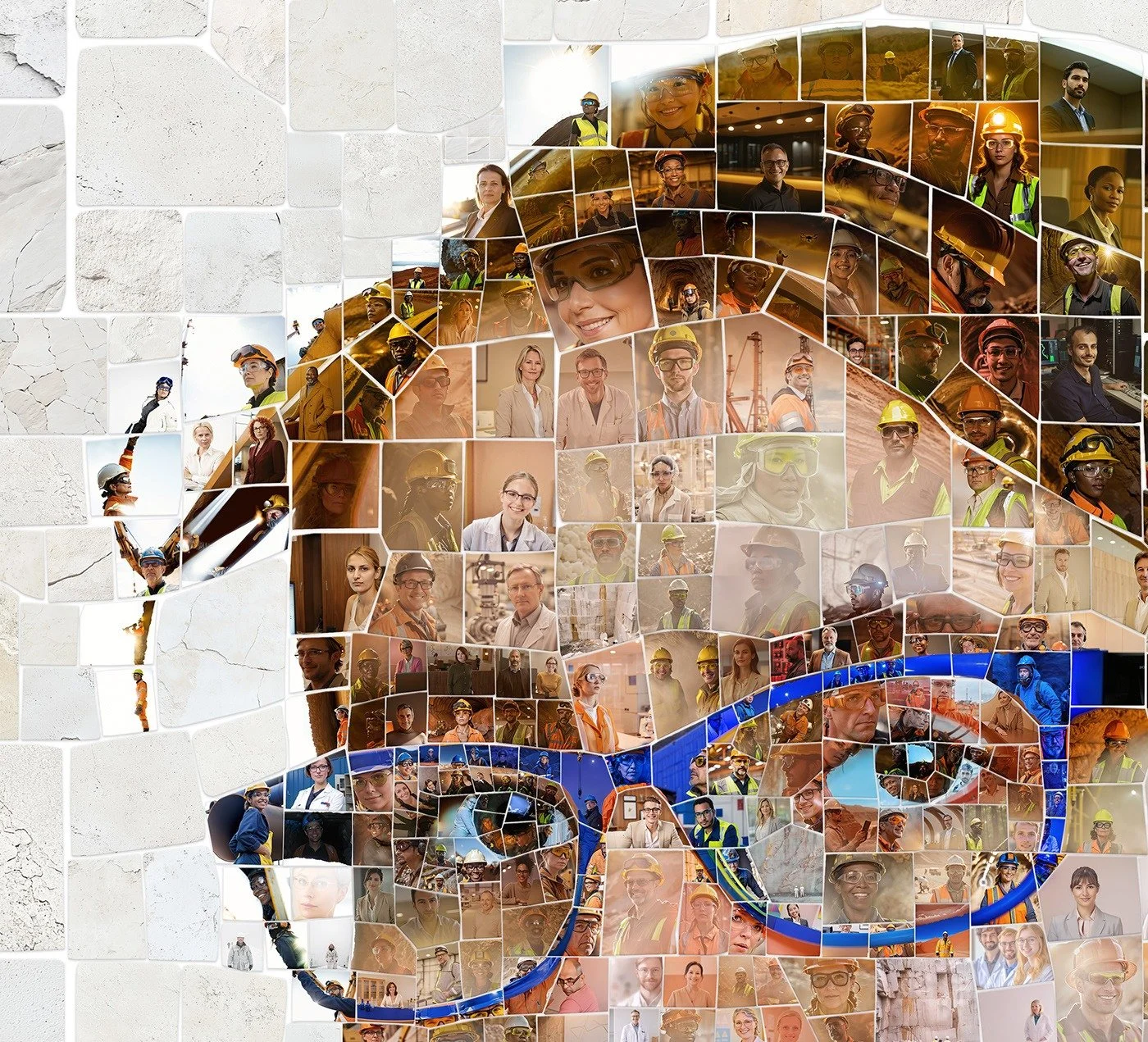
A photographic mosaic is two pictures in one. From across the room you see a portrait, a landscape or a symbol. Walk closer and it breaks into hundreds or thousands of small photographs, each with its own subject and its own story. That switch between the two readings is, for me, the whole point.
The algorithm has to make room for both. Strip away the jargon and it makes four decisions: where the pieces go, what to compare, which photograph goes where, and how to show it. Layout, description, assignment and rendering. These four words are the most useful way I know to follow sixty years of research. Every generation answers them differently, and every answer changes the picture.
1. Before photographs: Bell Labs and the science of seeing (1966–1992)
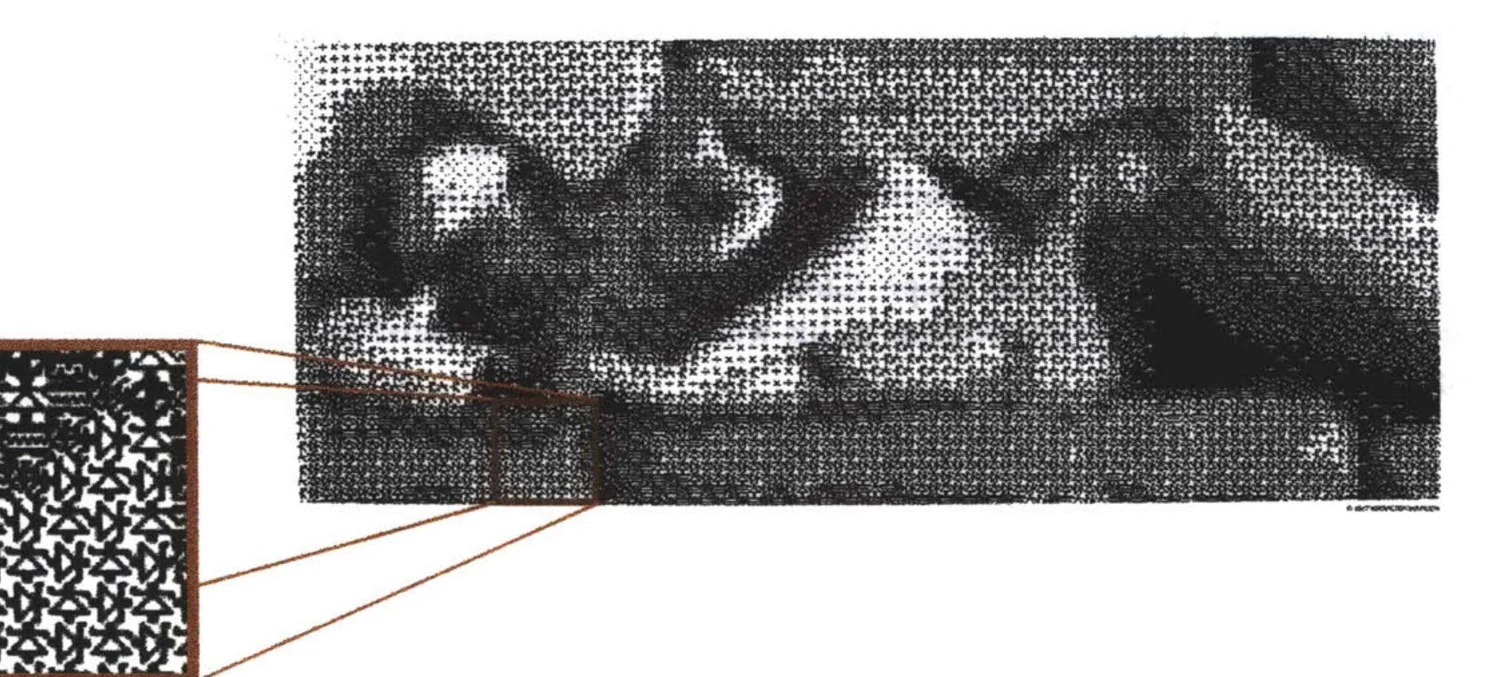
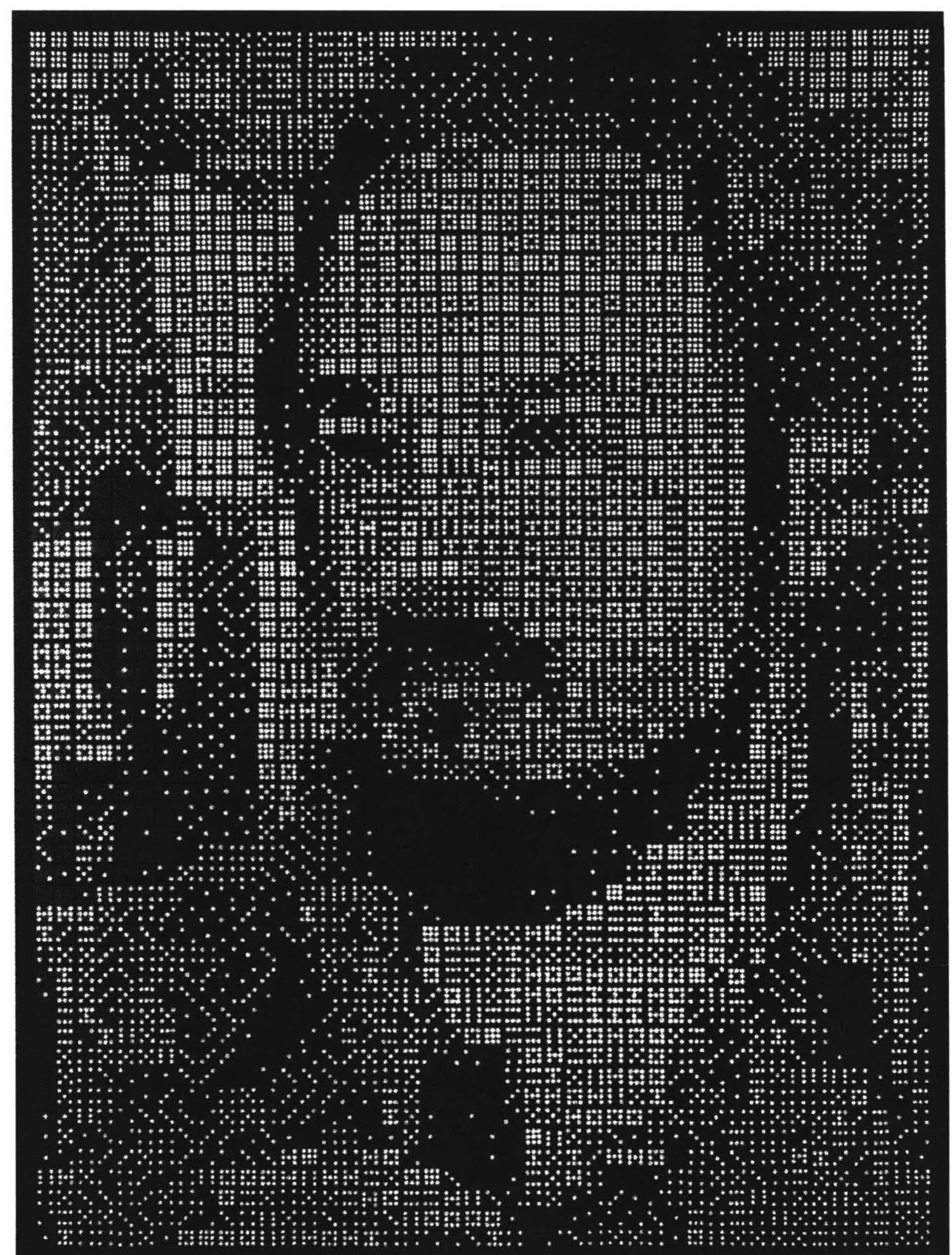
The story starts without a single photograph in the mosaic. At Bell Labs in 1966, Ken Knowlton and Leon Harmon digitised a photograph of a reclining figure and rebuilt it from small black-and-white symbols: Studies in Perception I. Each symbol had a measurable density, the share of its area that was black. Darker parts of the figure got denser symbols; lighter parts got more open ones. Step back, and the symbols become a body.
I consider this the founding image of everything we do at the studio. The principle is already complete: many small marks can describe one large image, as long as you measure what each mark contributes at the right distance.
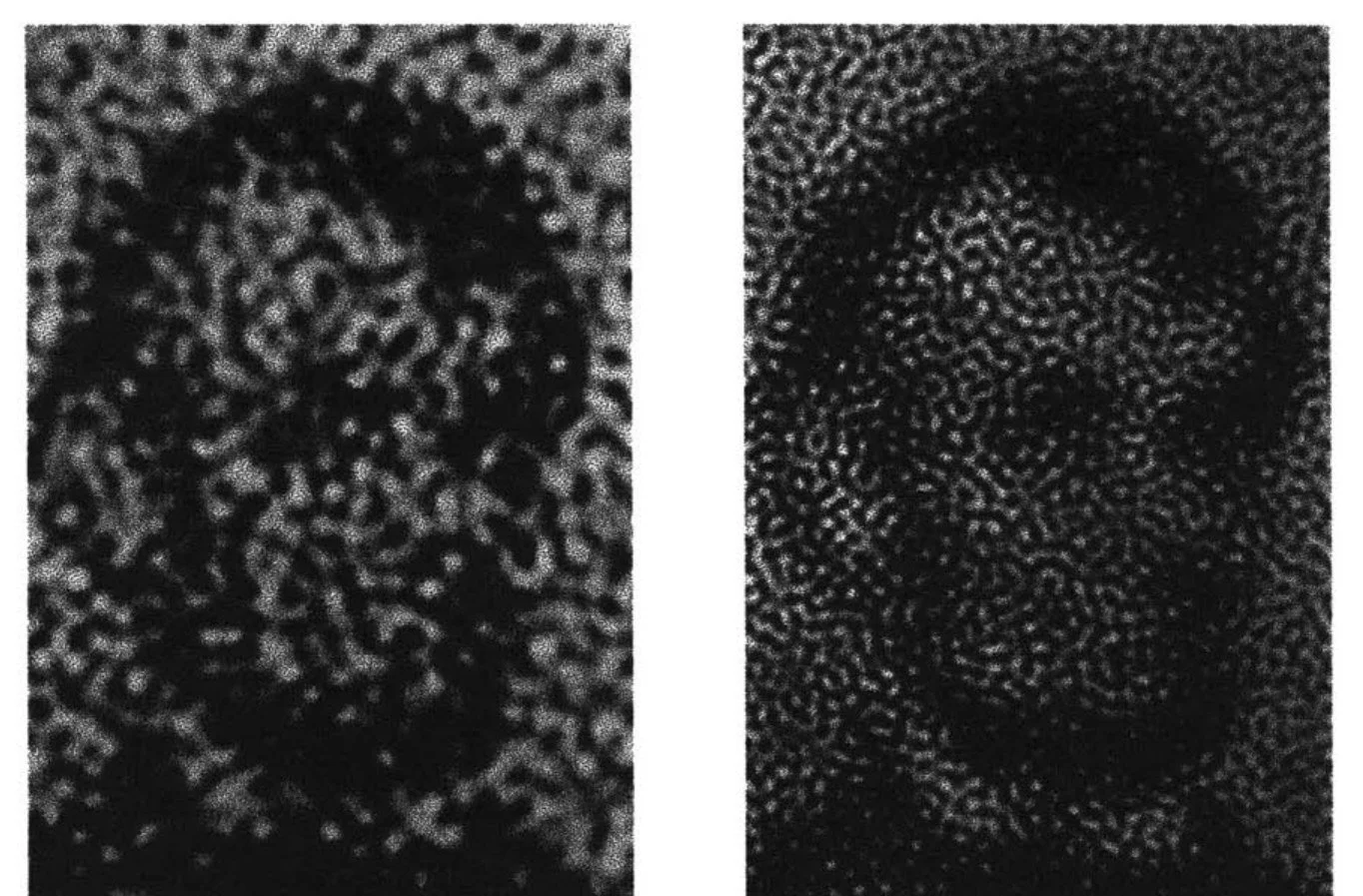
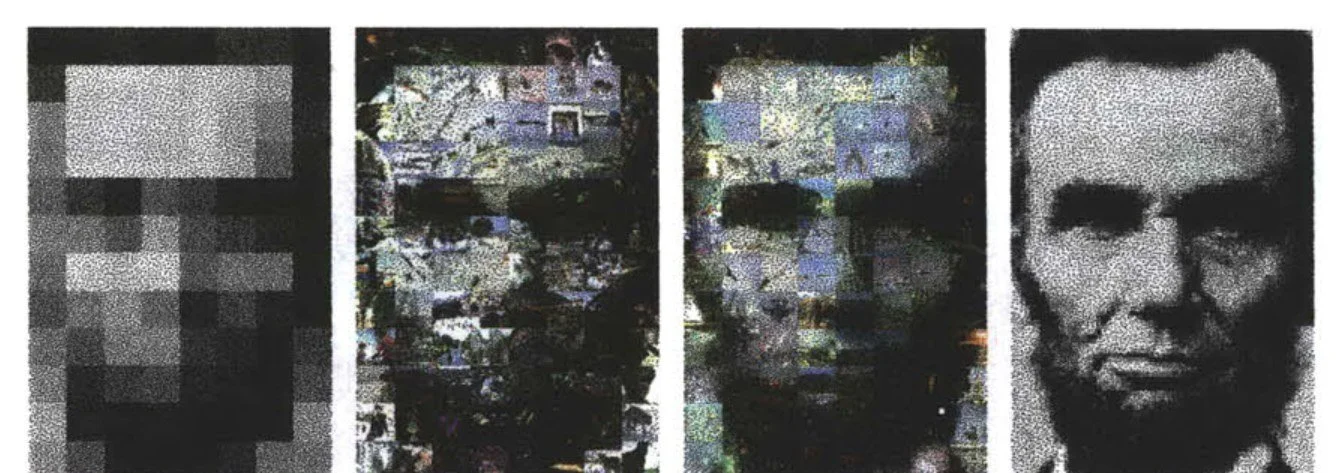
Harmon kept pulling at the same thread. In “The Recognition of Faces” (Scientific American, 1973) he showed a portrait of Lincoln reduced to a coarse grid, usually illustrated at about 16 × 16 blocks. You can still recognise him, because enough of the arrangement of light and shadow survives. But lay the wrong pattern over it, at the wrong spatial frequency (the scale at which a pattern varies across the image), and the face is gone. Salvador Dalí saw Harmon’s image and turned it into a painting in 1976, Gala Contemplating the Mediterranean Sea…, which became a lithograph a year later as Lincoln in Dalivision.
For a mosaicist this is not an academic curiosity. It is the daily problem. The detail inside the tiles can live with the face, or fight it.
Then came the dominoes, and with them a problem every mosaic maker knows. Knowlton’s domino pictures, and his patent Representation of designs (filed 1981, granted 1983), worked with complete sets. Once a piece is used in one place, it is gone. Pick the best match at every step and you may run out of good pieces for the rest of the picture. Robert Bosch later treated all those choices together with integer programming, solving the whole arrangement under explicit inventory limits.
Every photographic mosaic with a limit on repetition faces the same thing. One greedy placement can steal from the next ten.
2. Photographs become the tiles (1993–1997)
By the early 1990s the pieces were becoming photographs. It is also, more or less, when I started working with mosaics myself, so this part of the story feels close to home. And it is messy, which I like, because real histories usually are. Joseph Francis’s Live from Bell Labs poster (1993) is often cited as an early computer-made photographic mosaic; in his own account it was the first image his software produced, made at R/Greenberg Associates for the annual Live From Bell Labs event. Dave McKean’s 1994 comics work appears in Battiato and colleagues’ survey. Artists and engineers were arriving at the same place from different directions. An early image and an early published algorithm are different kinds of evidence. Both belong here, with their dates kept honest.
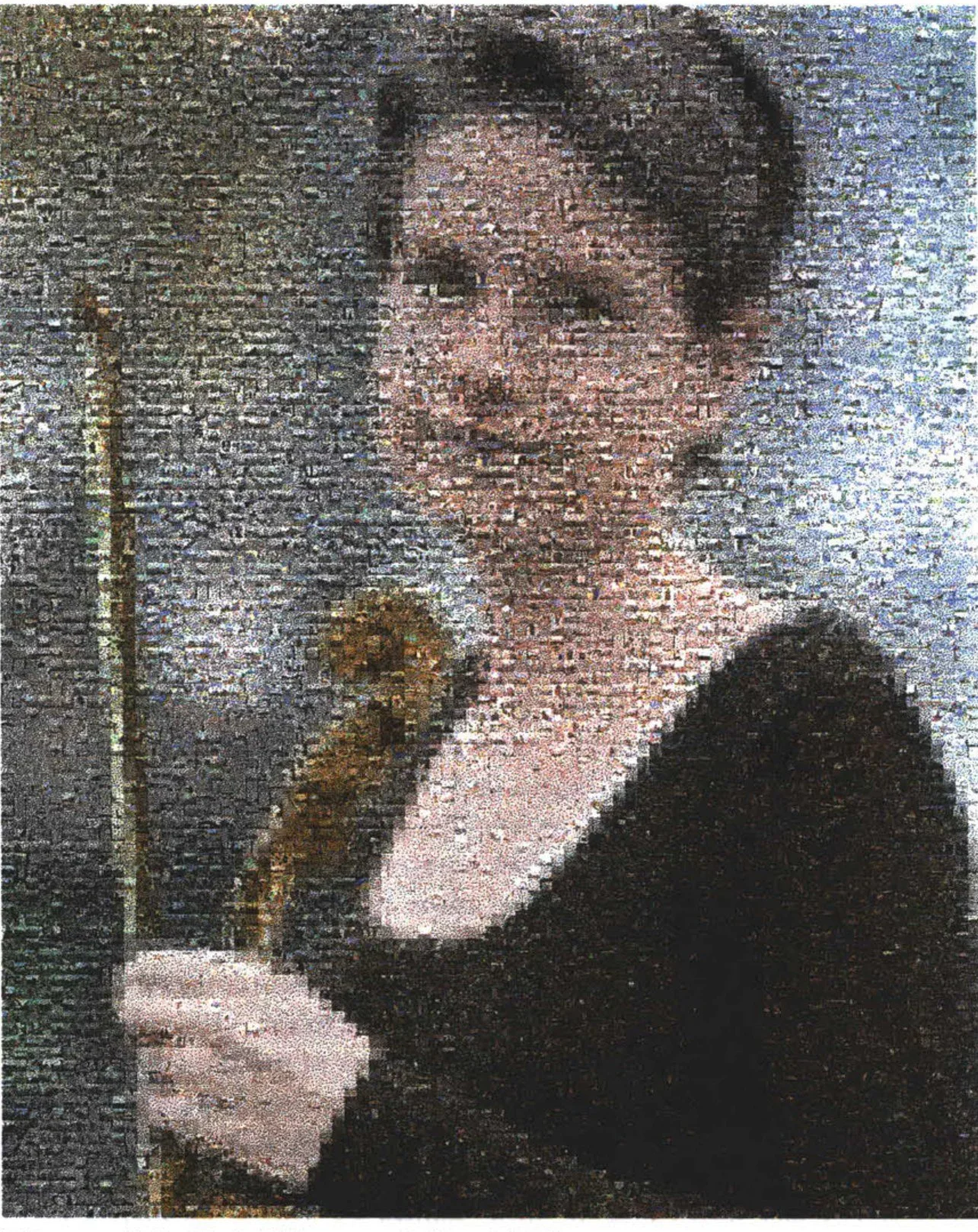
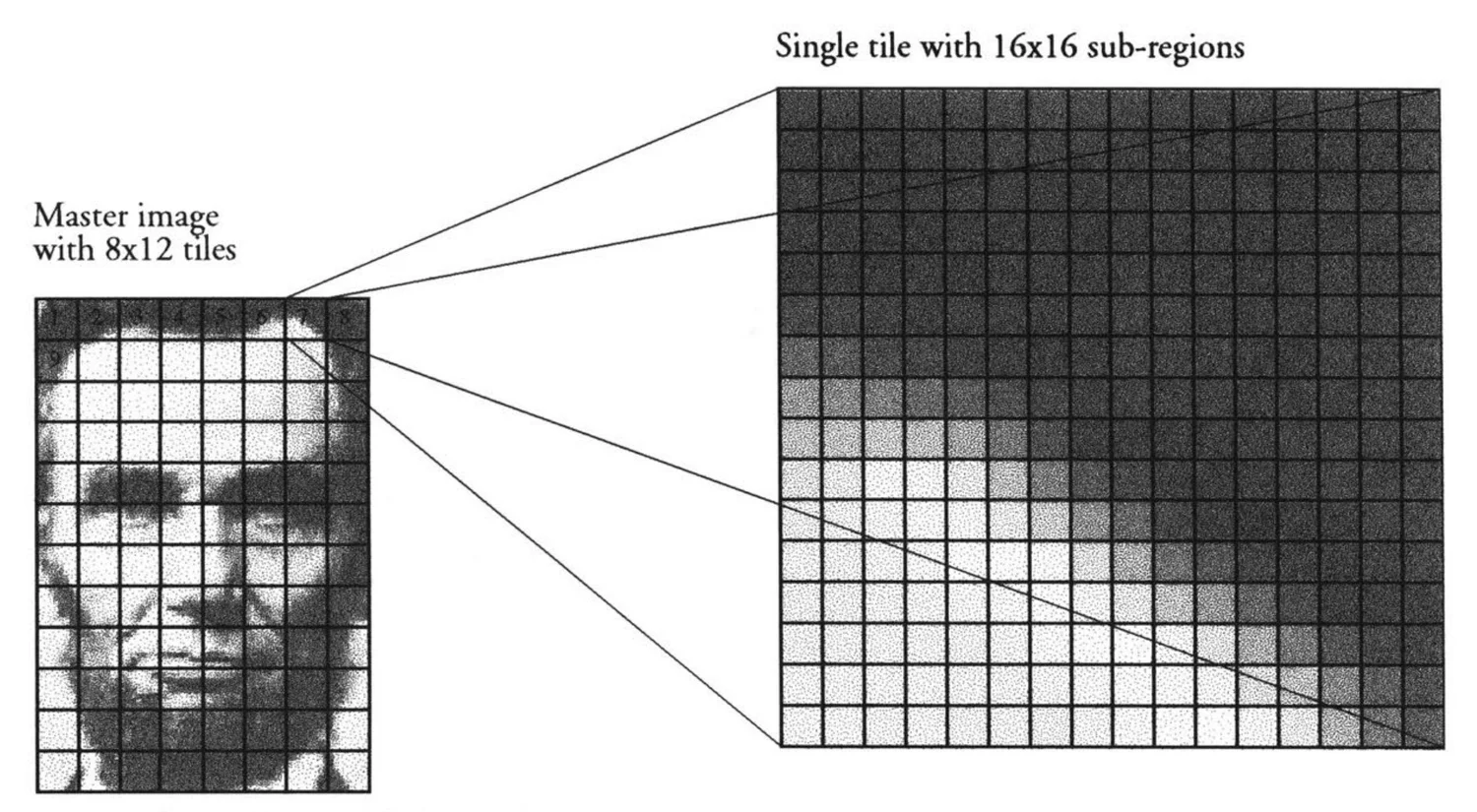
Then Robert Silvers wrote the thesis that changed matching. His 1996 MIT thesis, Photomosaics: Putting Pictures in their Place, followed by a book in 1997 and a patent, explains something that sounds obvious once you hear it: an average colour throws away where the colours are. A photograph that is dark at the top and light at the bottom can have exactly the same average as one that is the other way round. Silvers’s sub-picture resolution keeps that information by comparing a small grid of samples inside each tile. Suddenly the shadows and edges inside a photograph can help draw the larger subject. The multiresolution image-querying work of Jacobs, Finkelstein and Salesin (1995) offered related tools for describing images compactly at several scales.
Thirty years later, this idea is still at the heart of how I match images in Mozaix.
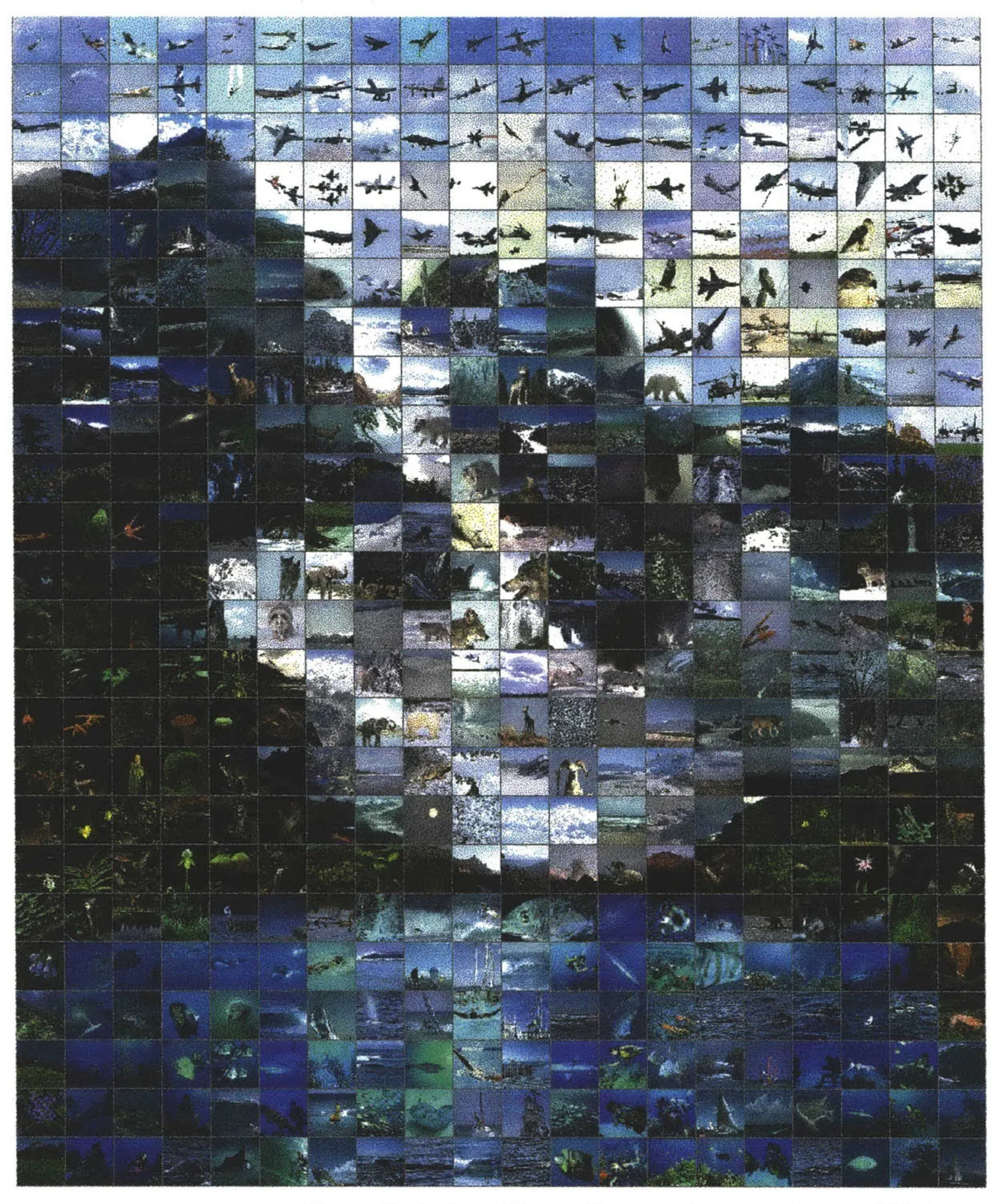
Silvers did something else that matters to me even more: he gave the small photographs a meaning. With a semantic map, different parts of the target could ask for different kinds of images: birds for a sky, for example, or photographs connected with the person in the portrait. Resemblance and meaning became two criteria in the same picture.
This is where the library stops being a bucket of pixels and becomes part of the design. What you put in it decides both the colours the algorithm can use and the stories the viewer will find. I have written it before and I will write it again: when I build a mosaic, I’m not just placing shapes; I’m placing meaning.
3. Describing and arranging pictures (1998–2003)
What if the right photograph has the wrong colour? Finkelstein and Range’s Image Mosaics (1998) answered by nudging the chosen images towards the target colours. That gives the system a lot of freedom: a useful shape or texture can stay where it is while its colour changes. It also makes rendering part of matching. For a designer this is a real choice, and not an easy one: how much alteration can a work take before the small photographs stop telling the truth? Whenever someone compares methods, I want to know whether the photographs were recoloured, cropped or blended with the target.
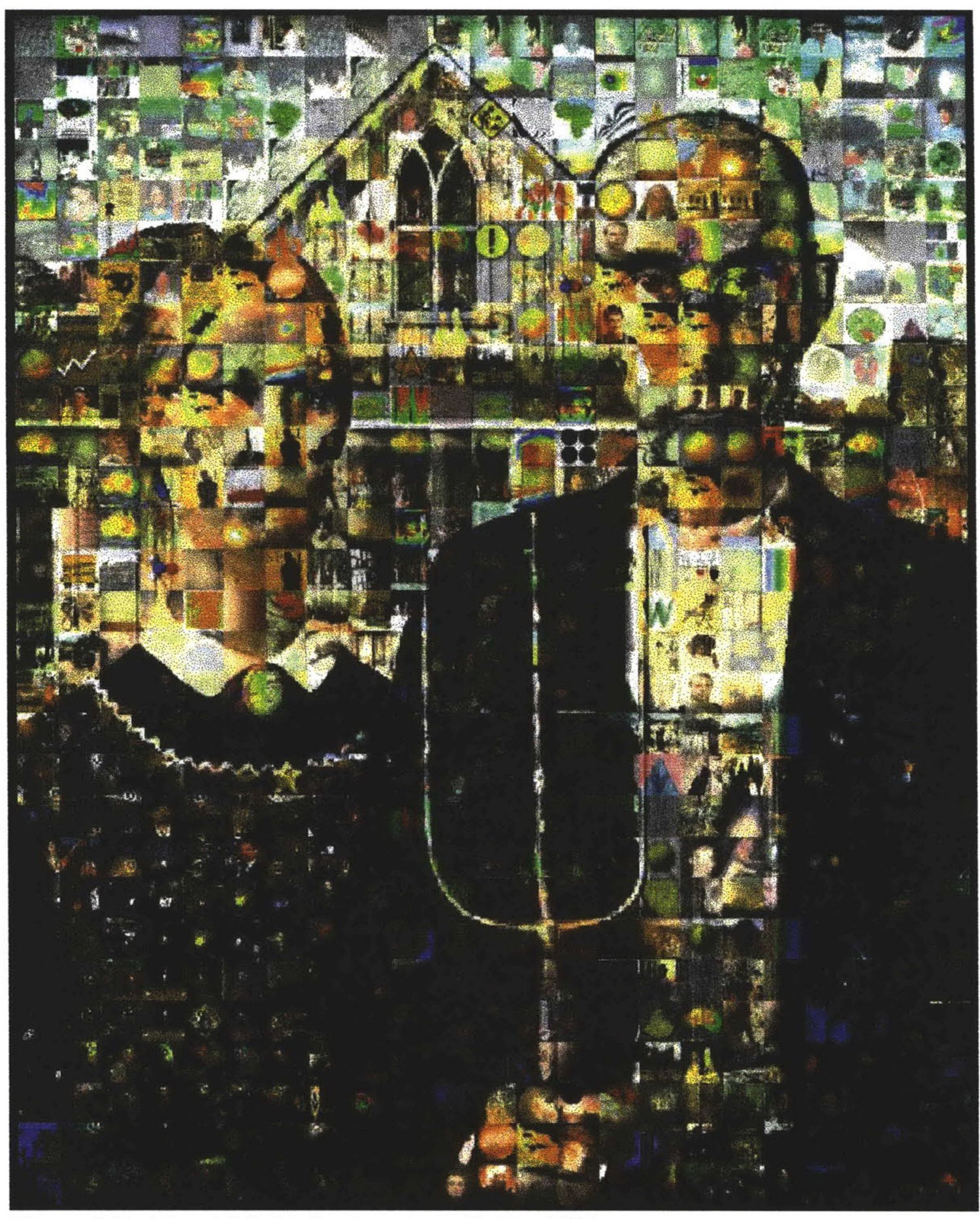
Nicholas Tran’s Generating Photomosaics: An Empirical Study (ACM SAC, 1999) matched image rows as sequences, using dynamic programming. More importantly for me, it named three qualities that I find as useful today as they were in 1999: similarity, granularity and variety. Make the pieces smaller and the face gets sharper, but the pieces become too small to recognise. Reuse the perfect photograph and the tones improve, but the surface turns repetitive. These are different dials. Turning one of them up does not make the picture better as a whole.
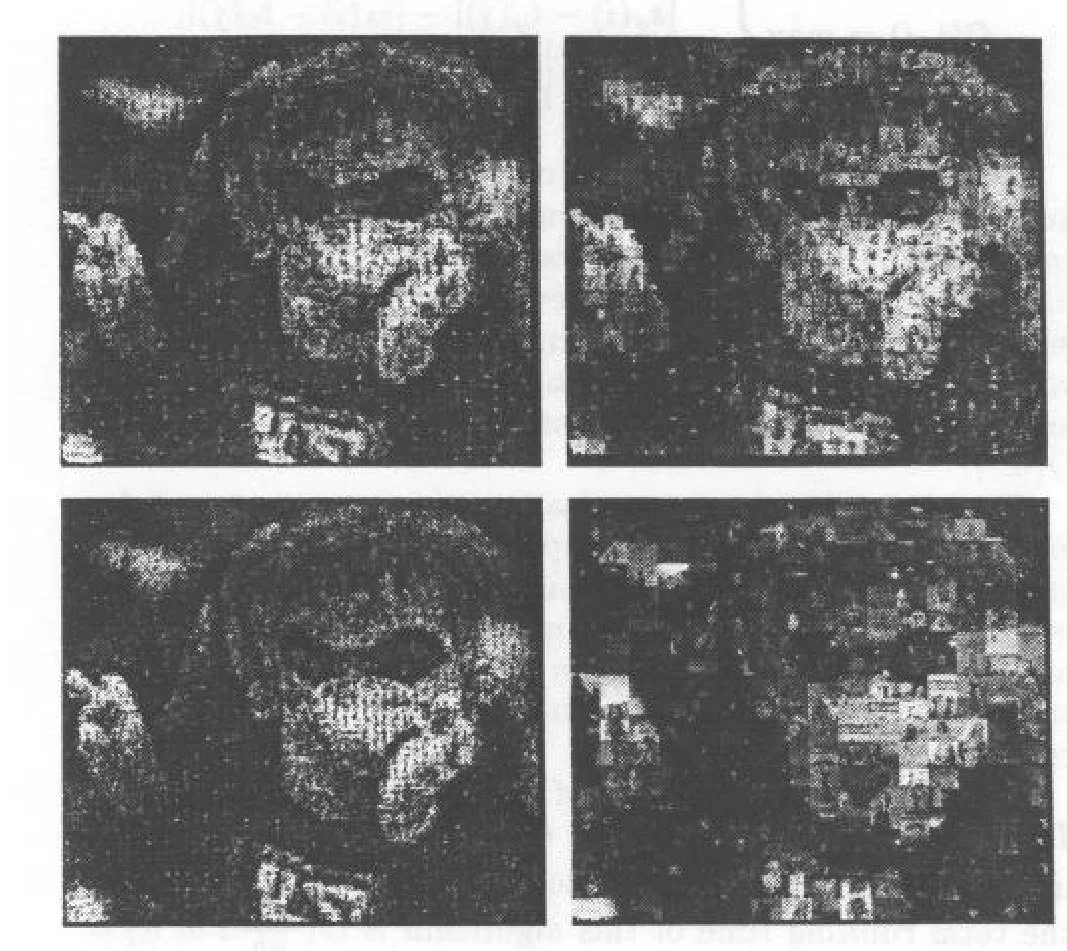
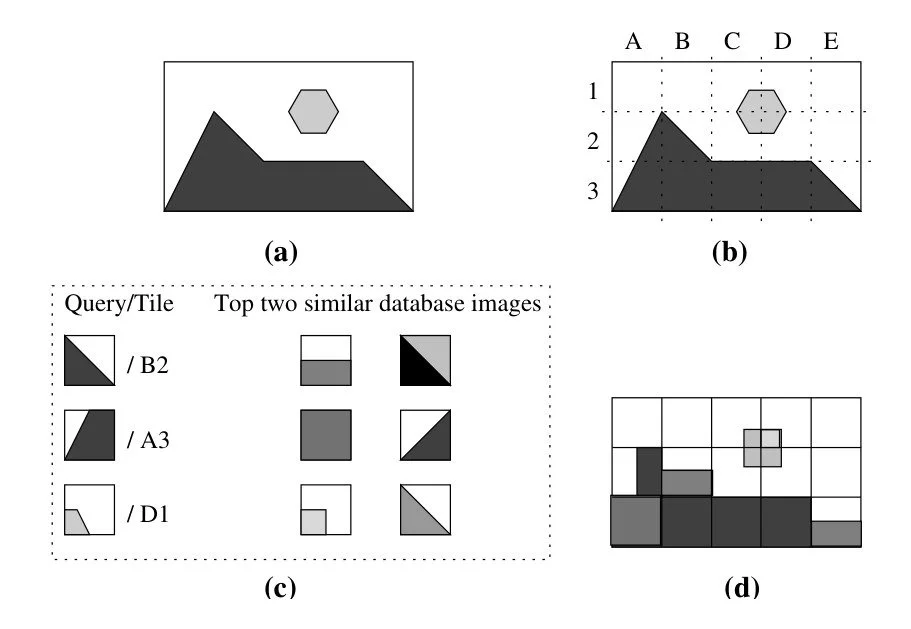
In 2003, Zhang, Nascimento and Zaïane treated mosaic building as content-based image retrieval: searching a collection by what its pictures look like. Compact colour descriptions and different ways of dividing the target narrowed the search, and their idea of visual flow points back to the arrangement of information inside each piece. They also make a point I wish more people understood. Ten thousand similar photographs are not necessarily more useful than a smaller, varied collection. The range of colours and structures in your library decides which parts of the target you can match well. Quantity is not quality.
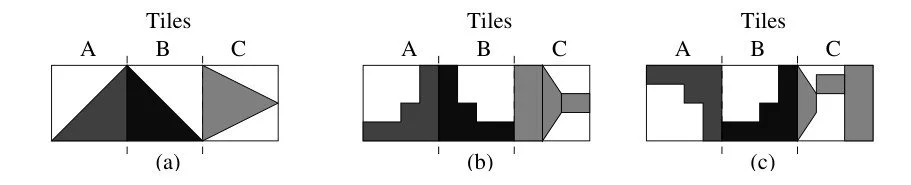
When the pieces move, everything gets harder. In Klein, Grant, Finkelstein and Cohen’s Video Mosaics (NPAR, 2002), the tiles are video clips described with three-dimensional wavelet signatures, which record change across frames as well as across the image. A clip may fit one moment of the target and not the next. Swap it at once for a better match and the viewer sees a jump. So the method has to care about continuity as much as resemblance. The viewer watches the transitions, not only the frames.
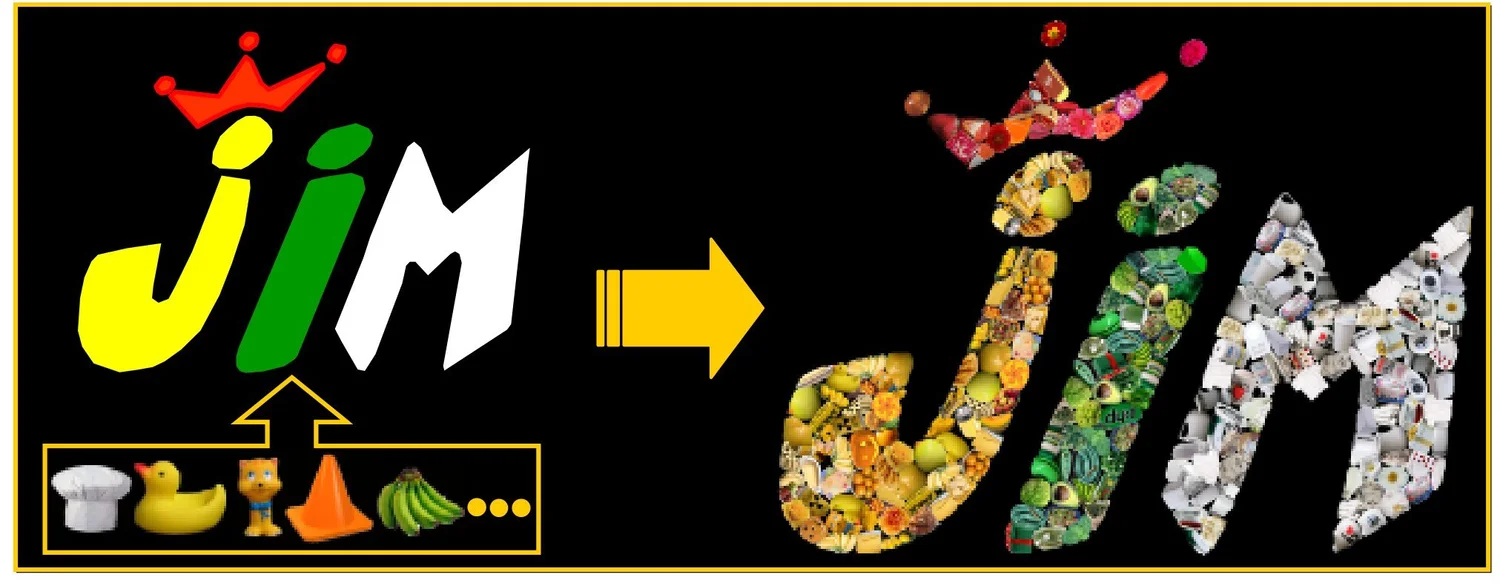
Kim and Pellacini’s Jigsaw Image Mosaics (SIGGRAPH, 2002) is a paper I keep going back to. The pieces get irregular outlines: cut-out images are chosen and packed into regions of the target, with a little controlled deformation to help them fit. All the competing demands go into an energy function, a combined penalty for colour error, gaps, overlaps and distortion. Lower one and another goes up: a piece fits the colour but leaves an ugly gap. For mosaics made from silhouetted objects, this changes everything. The contour of the small image becomes part of the drawing.
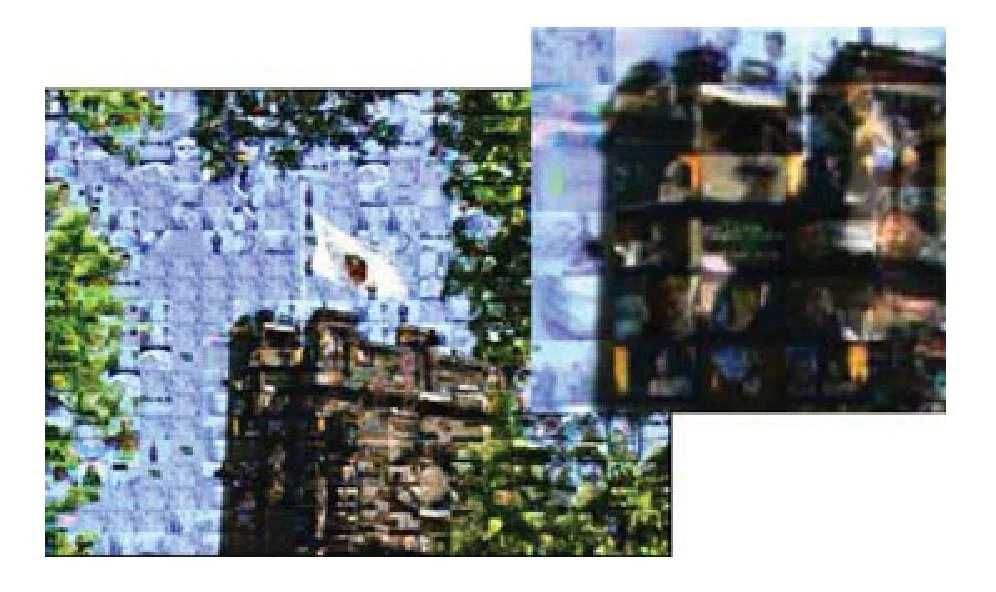
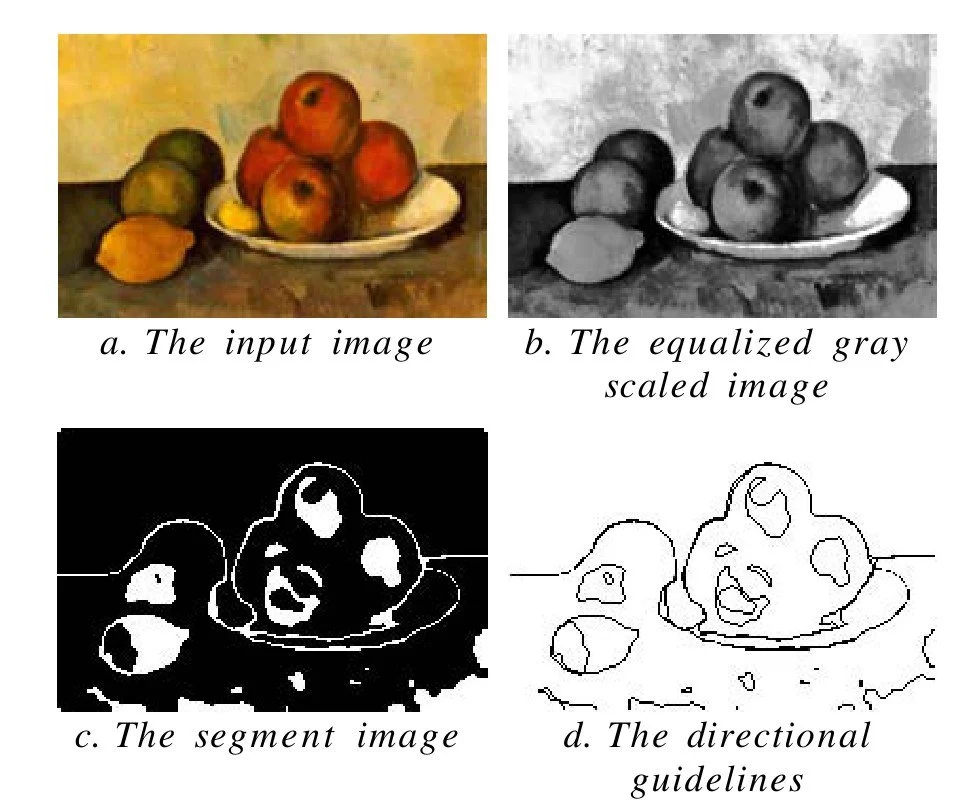
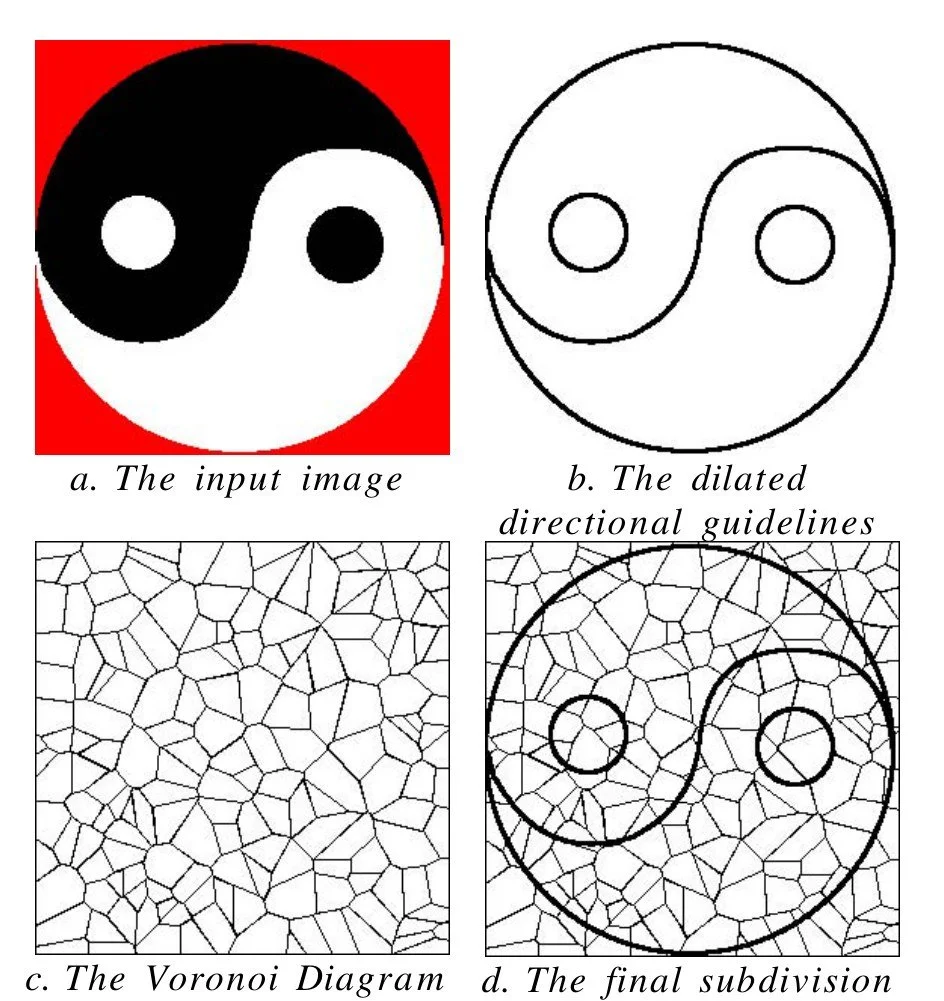
The geometry also grew up through decorative mosaics made from plain coloured tesserae. Haeberli (1990), Hausner (2001), Dobashi and colleagues (2002), Elber and Wolberg (2003), Di Blasi and Gallo (2005) and Faustino and de Figueiredo (2005) all studied how pieces can follow an image’s contours; Hausner’s centroidal-Voronoi approach is a beautiful example. This part feels like home. Any mosaicist knows that rows following a cheek or a fold describe its form. Byzantine craftsmen knew it fifteen centuries ago. Photographic pieces add one more layer, because the patterns inside them can support that direction or fight it.
4. Searching larger collections (2004–2008)
Bigger libraries meant slower searches. Di Blasi and Petralia’s Fast Photomosaic (WSCG, 2005) organised candidates in an antipole tree by their distances in a feature space, so far fewer comparisons were needed. Di Blasi, Gallo and Petralia then carried the idea to other mosaic families and, a year later, to adaptive subdivisions such as quadtrees, which split a region into four and keep splitting wherever more detail is needed. Battiato and colleagues’ 2007 survey then put all of this into one classification. It helps separate faster retrieval from real changes to the geometry of the picture.
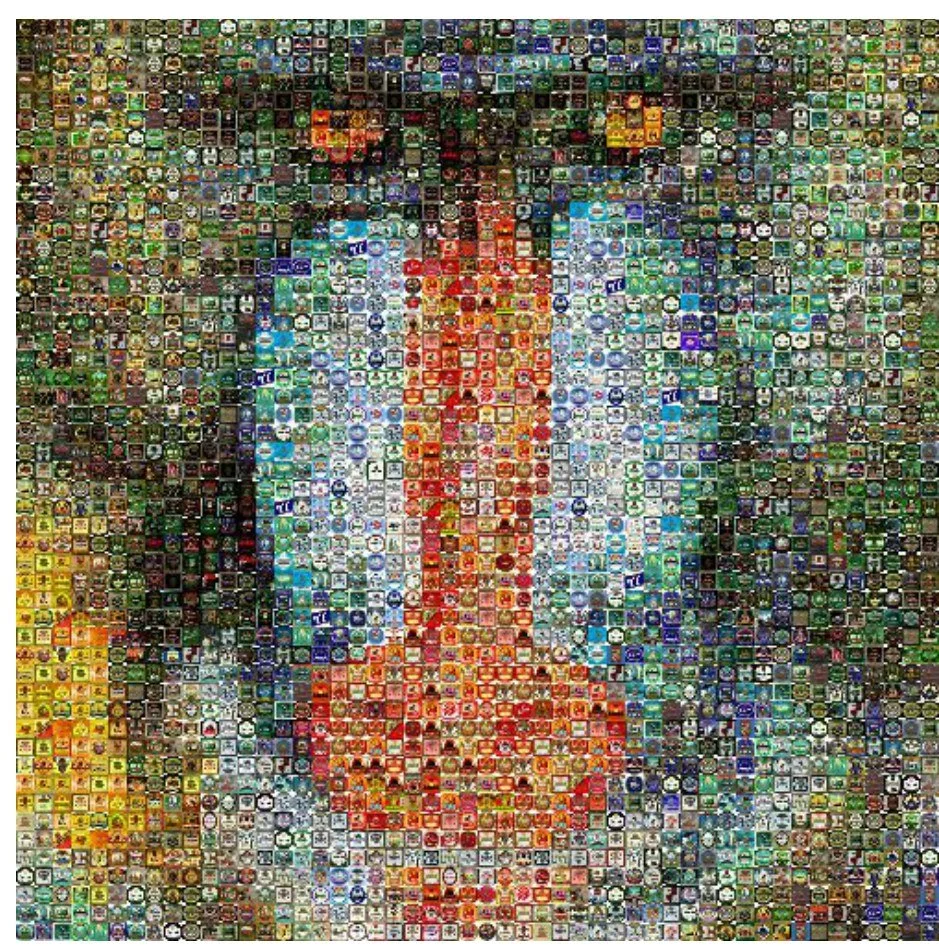
Other researchers let whole arrangements evolve. D’Souza, Ciesielski and colleagues (2007) and Mat Sah, Ciesielski and D’Souza (2008) used genetic algorithms and genetic programming: candidate solutions are varied and judged over many rounds, so early choices can be reconsidered, and animated or self-referential images become possible. But an evolutionary search is only as wise as its scoring. If it measures resemblance alone, it will happily repeat the same tile everywhere. If you want variety, you have to ask for it. Animation had its own line of work too: Smith, Liu and Klein’s Animosaics (2005) packed irregular tiles into moving shapes, frame after frame.
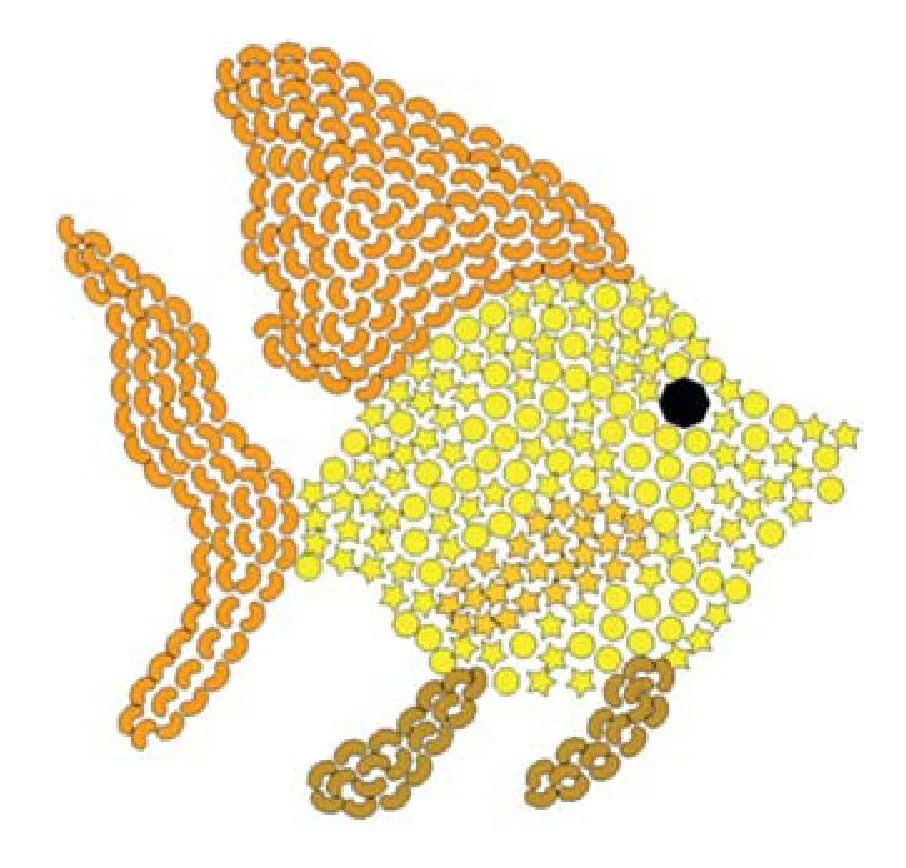
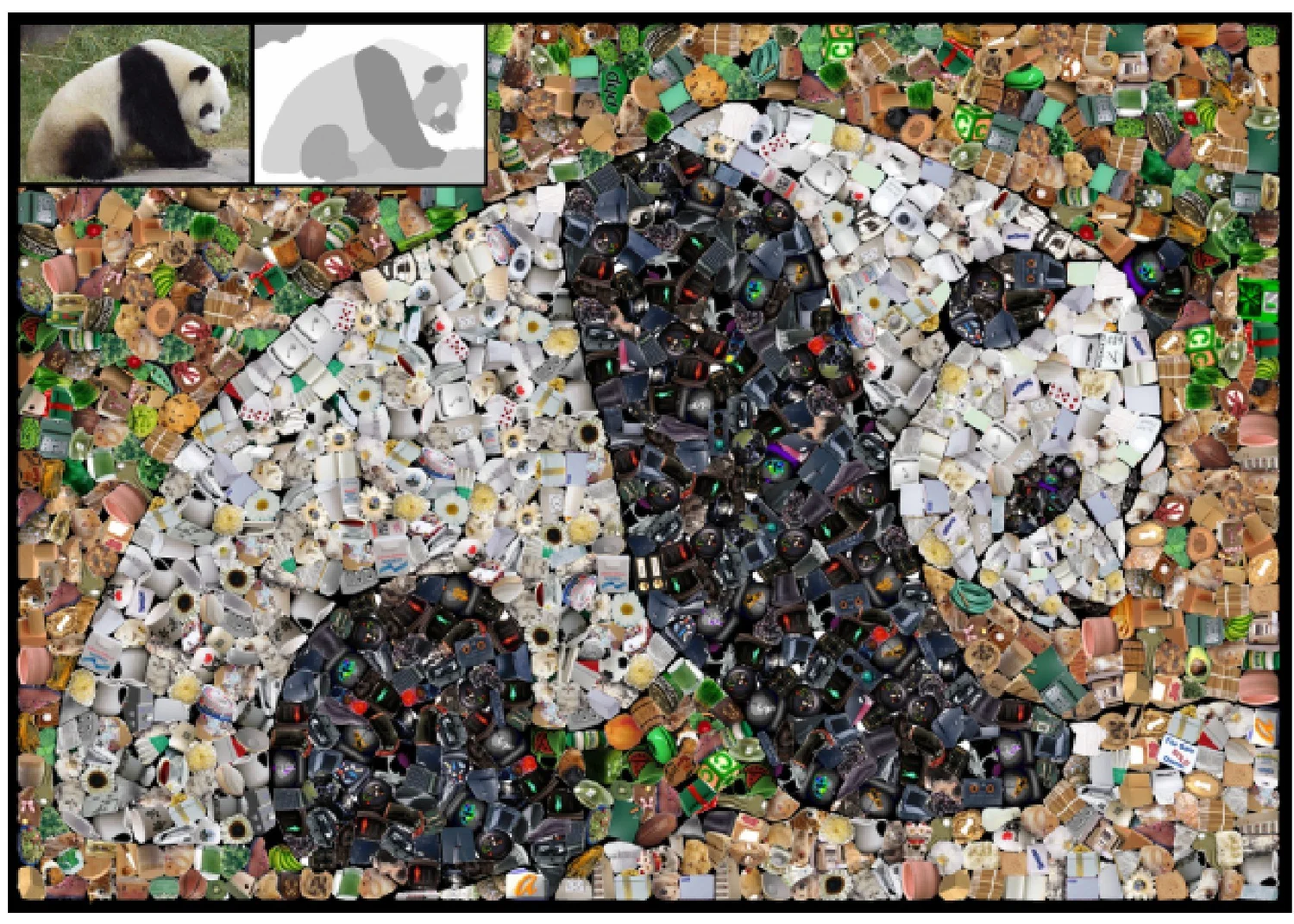
In Orchard and Kaplan’s Cut-Out Image Mosaics (NPAR, 2008), matching uses fast Fourier transform techniques to search for suitable sub-images under irregular tile shapes; a cut-out here can be a fragment clipped to a cell, not a whole object. The paper gave a name to something I deal with on every project: the accuracy–discernibility trade-off. The closer the pieces fit the big picture, the easier it is to read, but each piece must still keep enough of itself to be worth looking at. Irregular shapes change that balance. They do not make it go away.
Meanwhile, desktop software put these ideas into everyone’s hands. Metapixel, AndreaMosaic, Mazaika, ArcSoft PhotoMontage and Foto-Mosaik-Edda let people work with their own collections and adjust the construction. The Nifty Assignments material of 2005, associated with Pattis, and the Williams CS326 exercises brought the same ideas into classrooms. Even a small student program has to decide how to measure similarity and how often an image may come back. I like that these tools made the algorithm understandable through its results: change a parameter, rebuild, and see what happens to the picture. It is still the best way to learn.
5. Choosing for the whole mosaic (2009–2013)
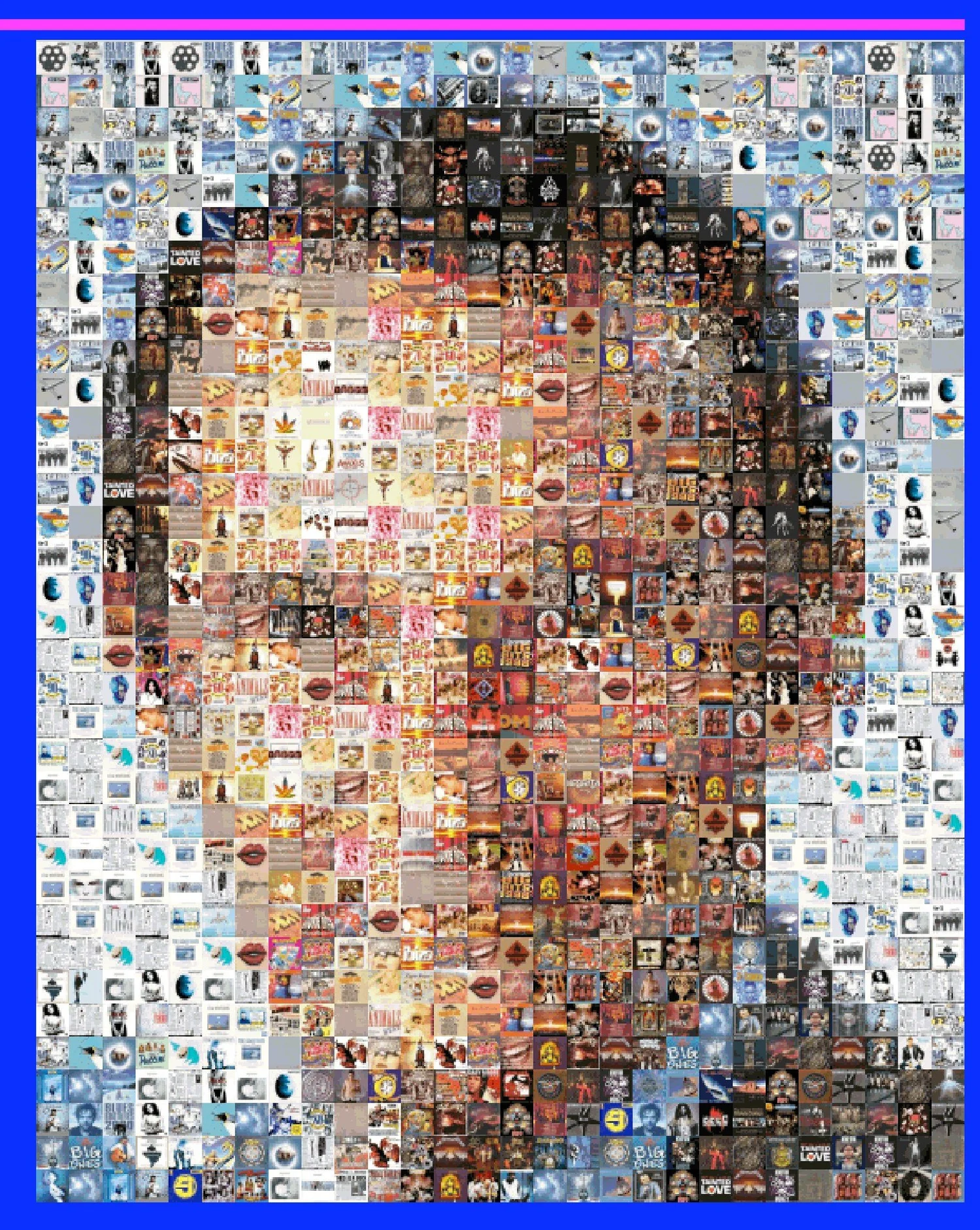
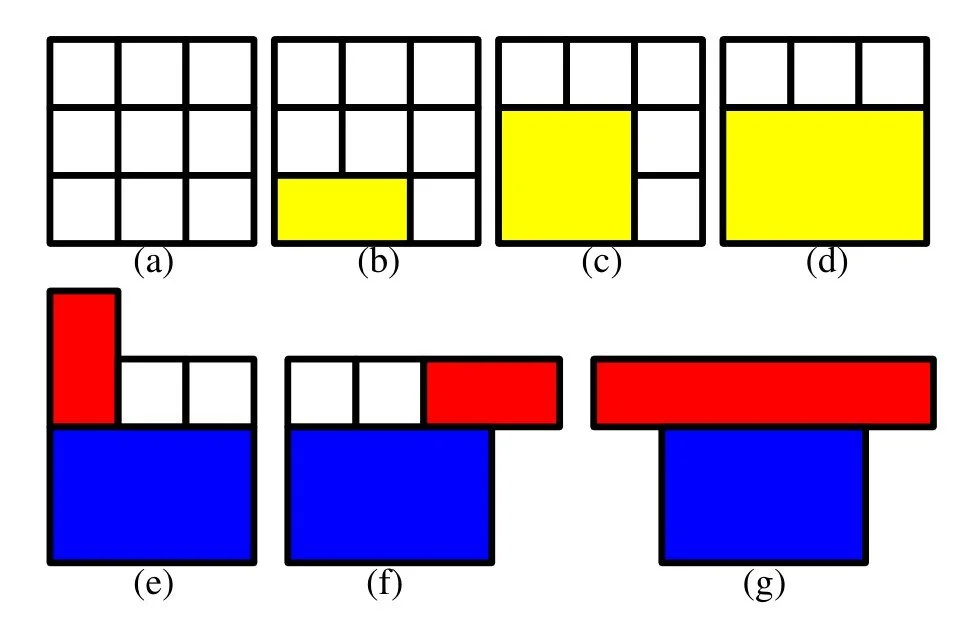
Pavić, Ceumern and Kobbelt’s GIzMOs (Computer Graphics Forum, 2009) went for stronger reconstruction through selection and layout alone, without colour shifts or overlays. They removed uninformative images from the library, used different descriptions for different kinds of region and let neighbouring cells merge, so calm areas could hold larger photographs and detailed areas smaller ones. I respect that discipline. The “genuine” in the title refers to this treatment of the source images; it does not mean every object stays whole, because fitting photographs into adaptive regions can still involve cropping.
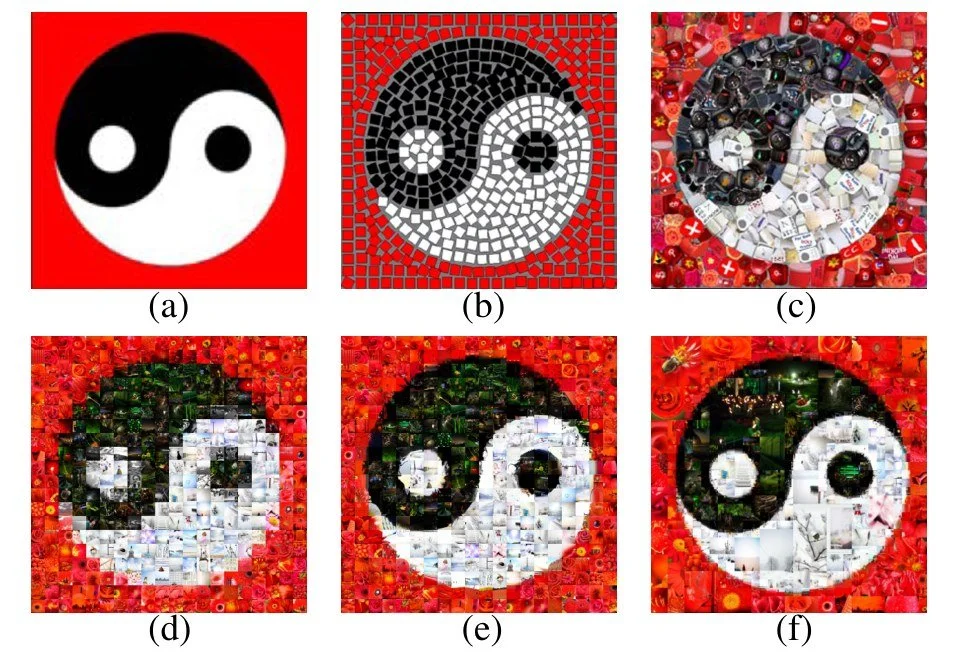
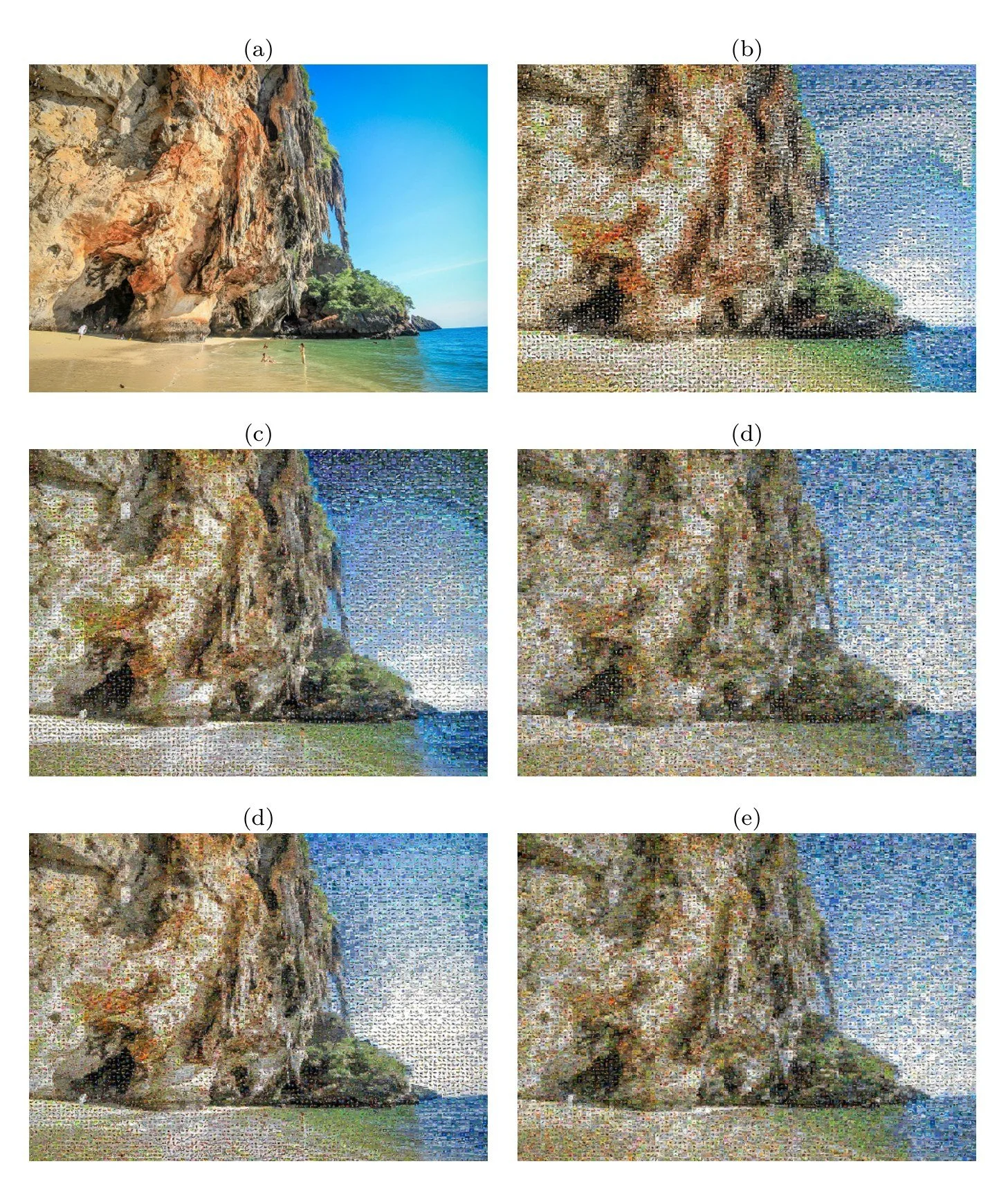
Narasimhan and Satheesh’s A Randomized Iterative Improvement Algorithm for Photomosaic Generation (NaBIC, 2009) turned repetition control into a search over whole arrangements. Start from a valid grid, then try two kinds of move: replace a randomly chosen tile with one still under its reuse cap, or swap two tiles. Score by the sum of absolute RGB differences, and now and then accept a worse move so the search does not settle too early. With 10 × 10-pixel tiles from 8,227 photographs, each capped at ten uses, the authors report faster improvement than with a genetic algorithm, and they show the intermediate mosaics as an animation, which I find lovely. Still, a fixed grid and a pixel-by-pixel score leave structure and perception outside what is measured. And structure and perception are exactly what I care about most.
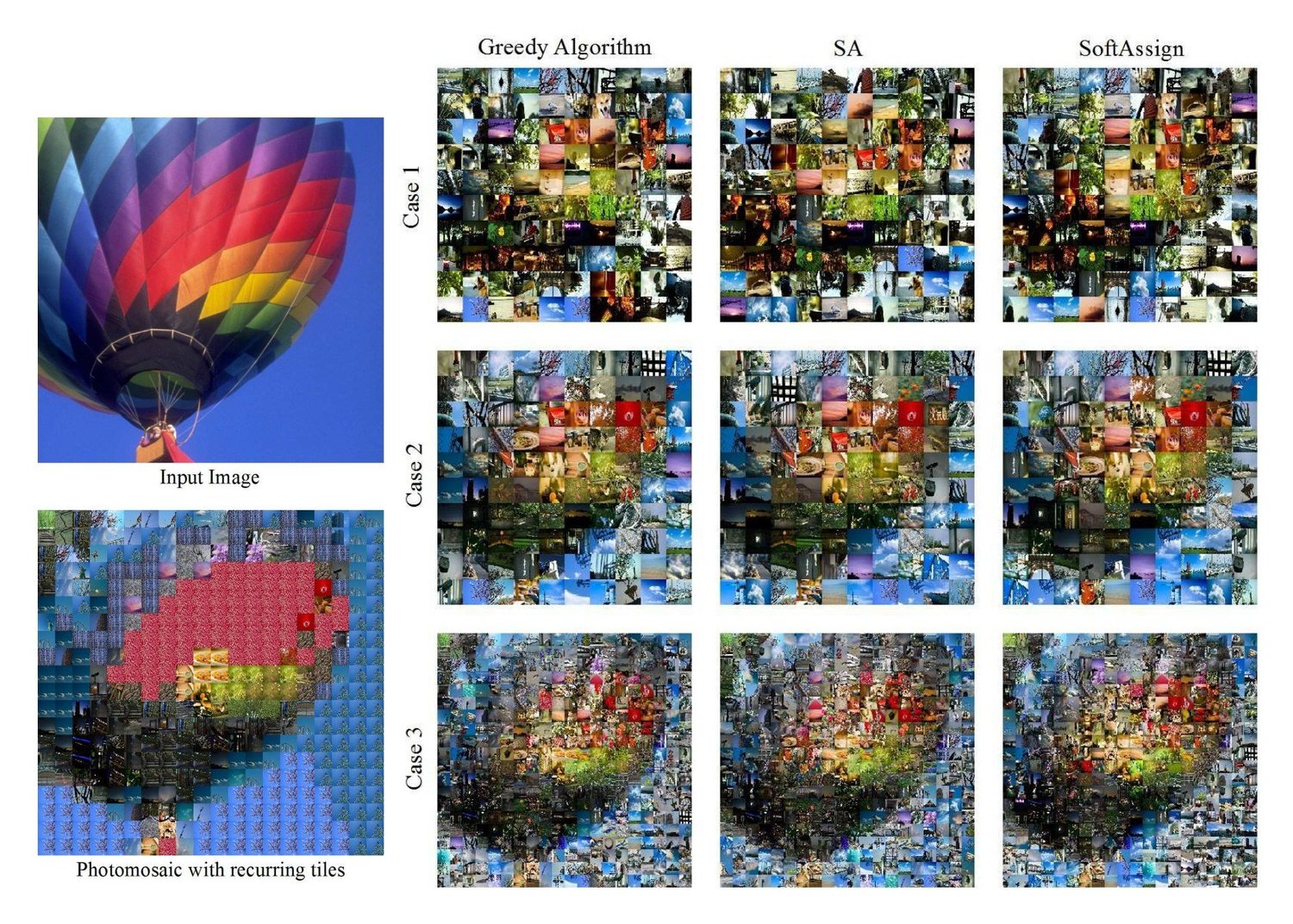
Once repetition is limited, placement becomes a problem for the entire mosaic. Slomp and colleagues’ GPU-based SoftAssign study (IJNC, 2011) compared greedy selection, simulated annealing and SoftAssign, which moves gradually from provisional assignments towards a final arrangement. With fixed costs for every tile–position pair, the no-repeat problem can even be solved exactly, with assignment algorithms such as the Hungarian method or min-cost flow. “Exactly” sounds reassuring. But it only means exact for those costs and constraints. The choice of what counts as visually similar is still ours, and in my view that is where the art is. Choi, Koo and Moon (2010) explored genetic methods for making the construction more effective.
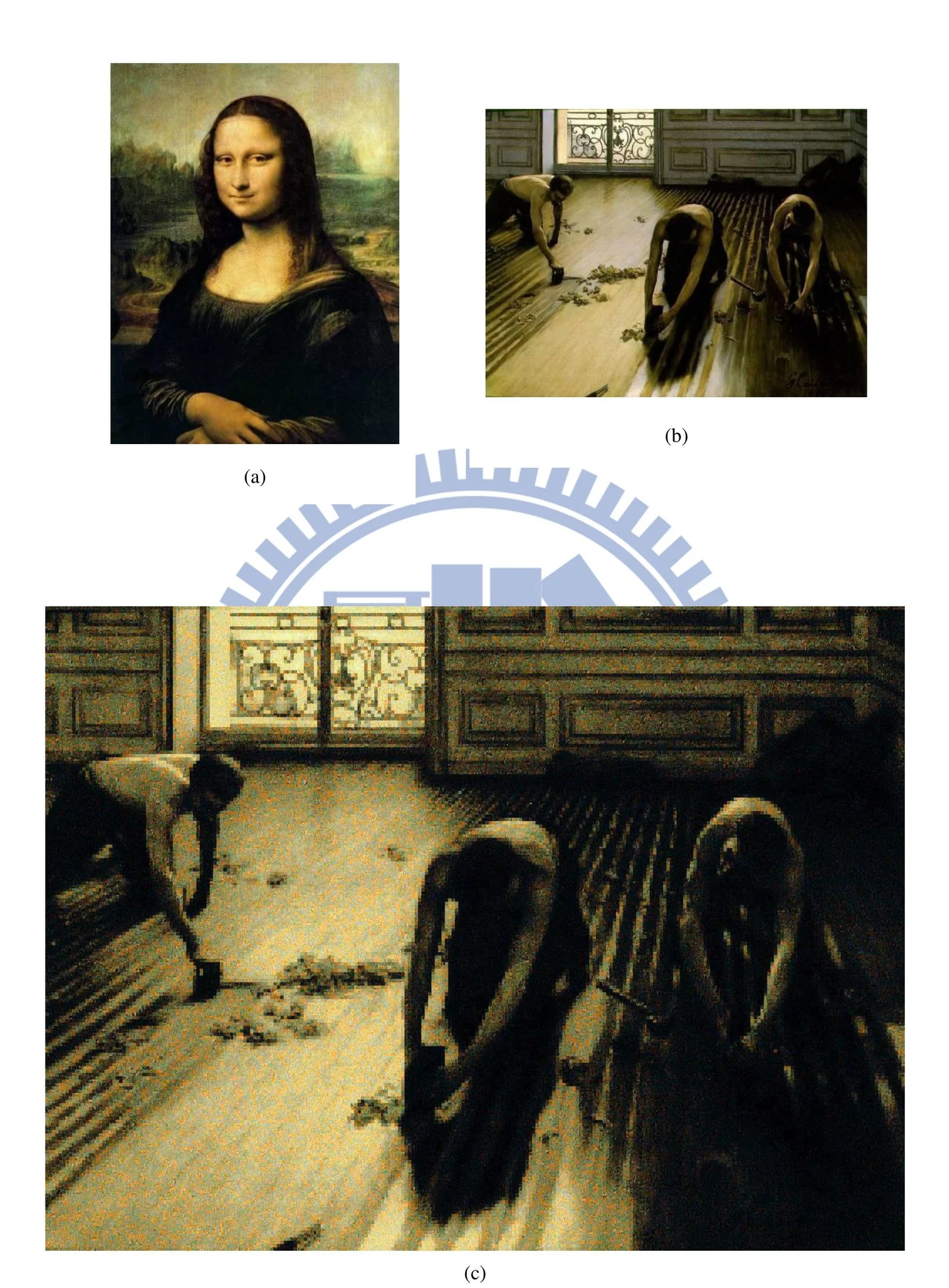
A mosaic can also hide another image. Lai and Tsai, at National Chiao Tung University, developed secret-fragment-visible mosaics (thesis 2010; IEEE TIFS 2011): the pieces of a secret image are rearranged to look like a different target, while the information needed to reverse the process is kept. Lama and colleagues’ 2014 SVD-based variant belongs to the same information-hiding branch. It is not my field, but I find it fascinating. The arrangement still depends on matching and assignment, yet reversibility adds constraints no ordinary artwork has. The result has to work as an image and as a safe.
The experience of making and using a mosaic became a research subject of its own. Kang and colleagues’ smartphone work (2011) and Fujisawa and colleagues’ interactive GPU system (2012) worked on access and speed. In a different direction, Plant, Lumsden and Nabney’s The Mosaic Test (2013) used mosaic construction to measure how well colour-based image retrieval works: the finished picture shows the consequences of thousands of retrieval decisions at once. Progress, it turns out, can mean a better match, a more responsive tool, or simply a clearer way to see what the matching is doing.
6. Edges, relationships and other constraints (2014–2017)
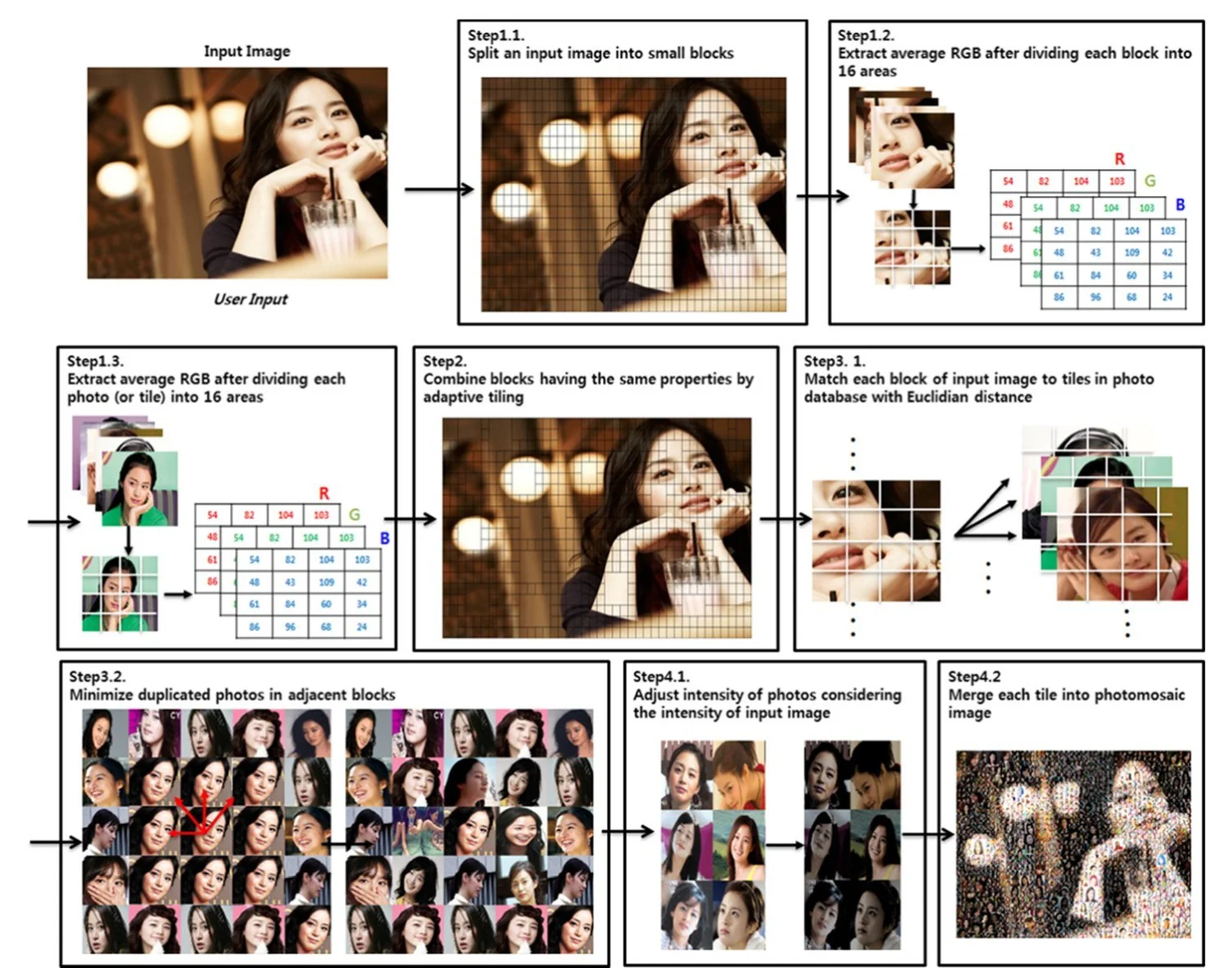
Hae-Yeoun Lee’s work (2014; MTAP 2017) brings several practical operations into one process: block matching, intensity adjustment, adaptive merging and repetition control. Similar neighbouring blocks can share a larger tile while busier areas keep smaller ones, so the amount of detail in the layout follows the target. The final image also depends on how strongly colour or brightness is corrected after selection. Worth remembering whenever you compare mosaic software: what looks like a better matcher may partly be a different grid or a heavier correction.
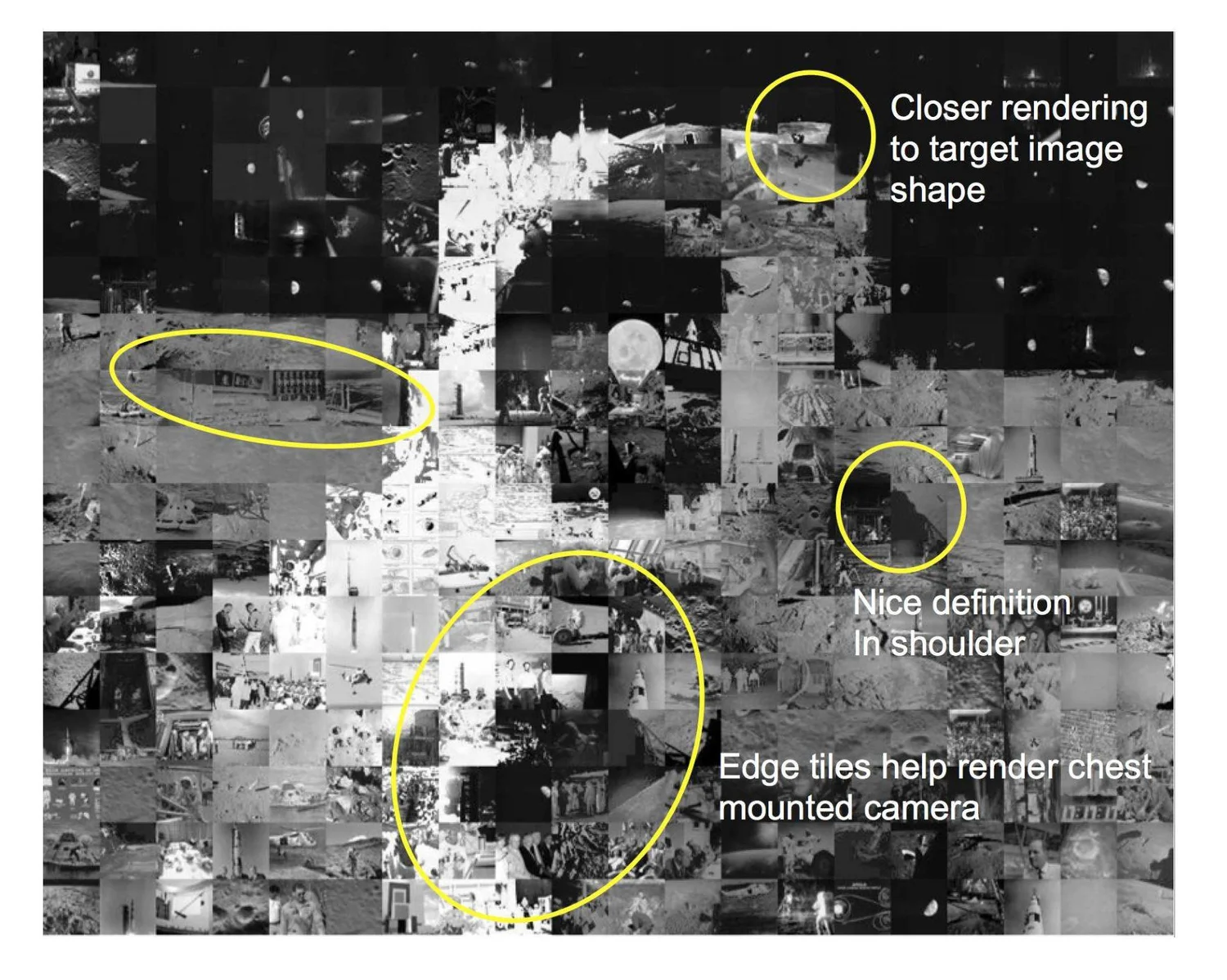
William Kromydas’s edge-priority method, a Stanford project report, speaks to me directly. It gives the dominant edges an extra assignment pass, followed by enhancement, and it was designed for small thematic libraries, where the choice of photographs is limited. A shoulder, a helmet or the outline of a face carries information that a patch of background does not. Spend your effort there and recognition improves, even when the overall colour error barely moves. The method turns a judgement an artist makes almost without thinking into a priority in the construction.
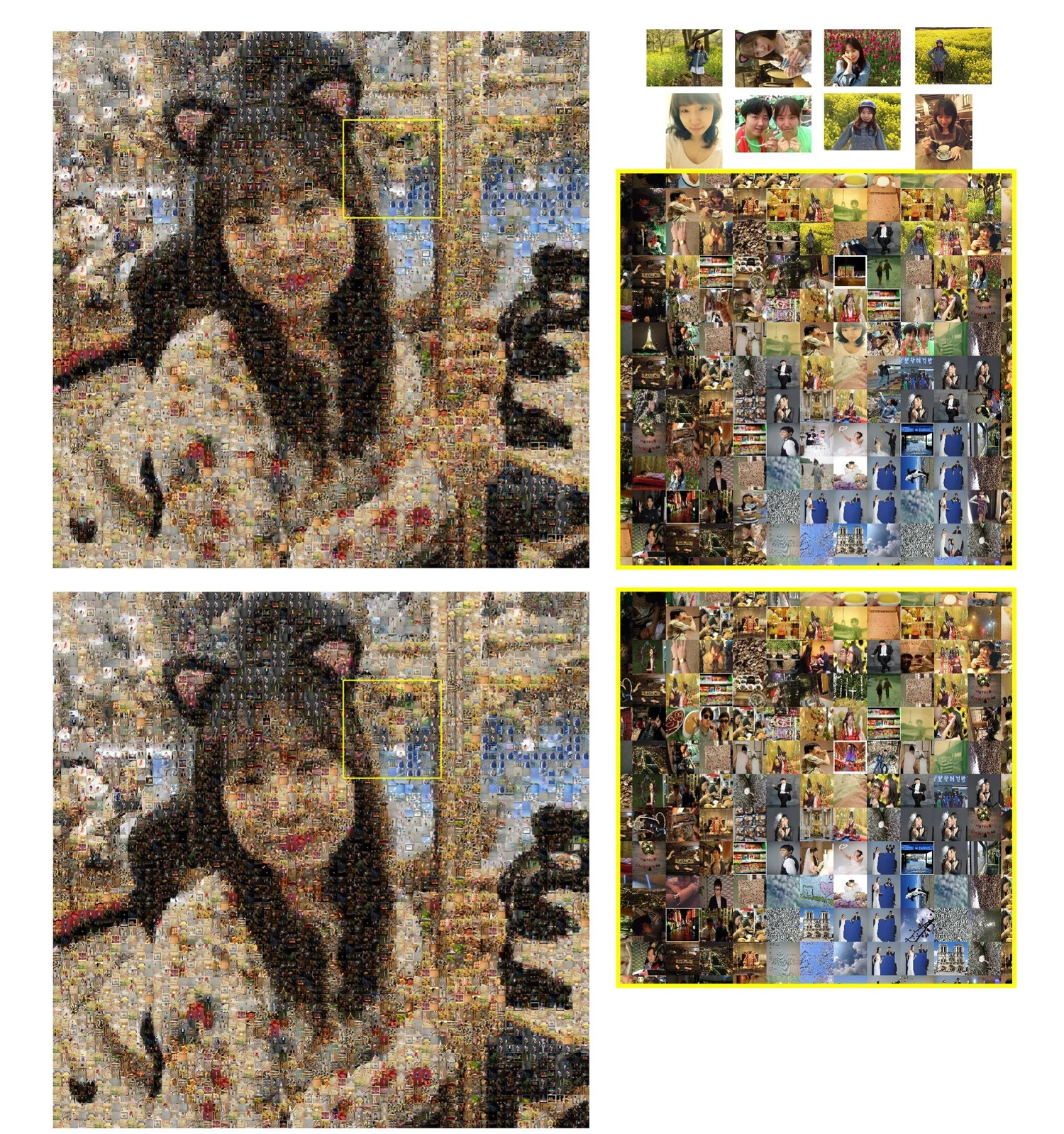
Seo and Kang’s social-network mosaic method (MTAP, 2016) adds people and their relationships to the selection. A photograph of someone connected with the subject can be the right choice even when its colour match is a little weaker. Live-event photo walls and participatory installations use contributed photographs in a similar spirit, and Luque Ruiz and colleagues’ NFC-linked work (2018) adds interaction. My work is about honouring people, so this direction moves me. The small images become evidence of participation, not just material. They can explain who the portrait represents and why this particular collection belongs together.
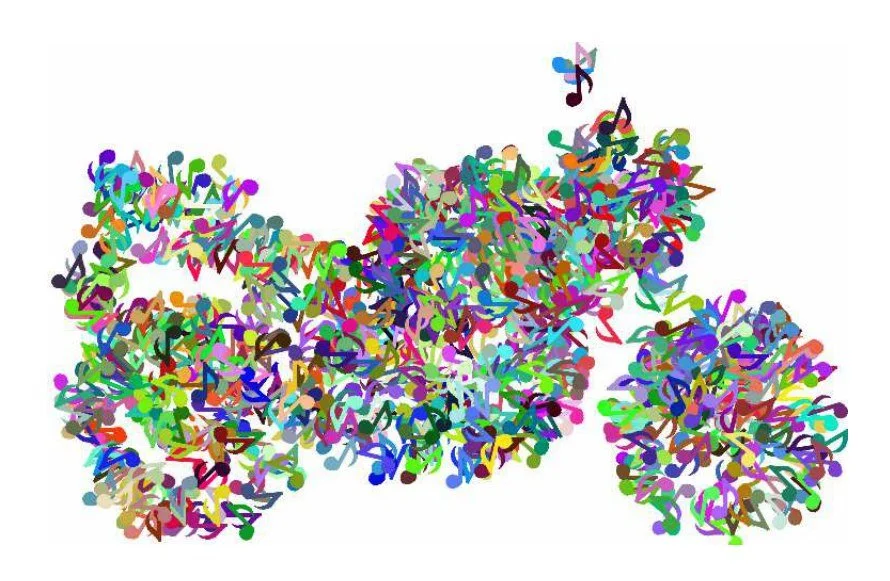
Direction can be part of what a tile contributes. Seo and Hong’s Scattered Mosaic Rendering Using Unit Images (2017) arranges rotatable motifs using the target’s structure and the direction of its brightness changes. The number of units, their orientation and the treatment of boundaries all affect how clearly the subject appears. The units need not be photographs, so the method sits close to ornament and silhouette. Visually, the lesson is simple and old: many small directional forms can draw a large curve, and the spaces between them are part of the image.
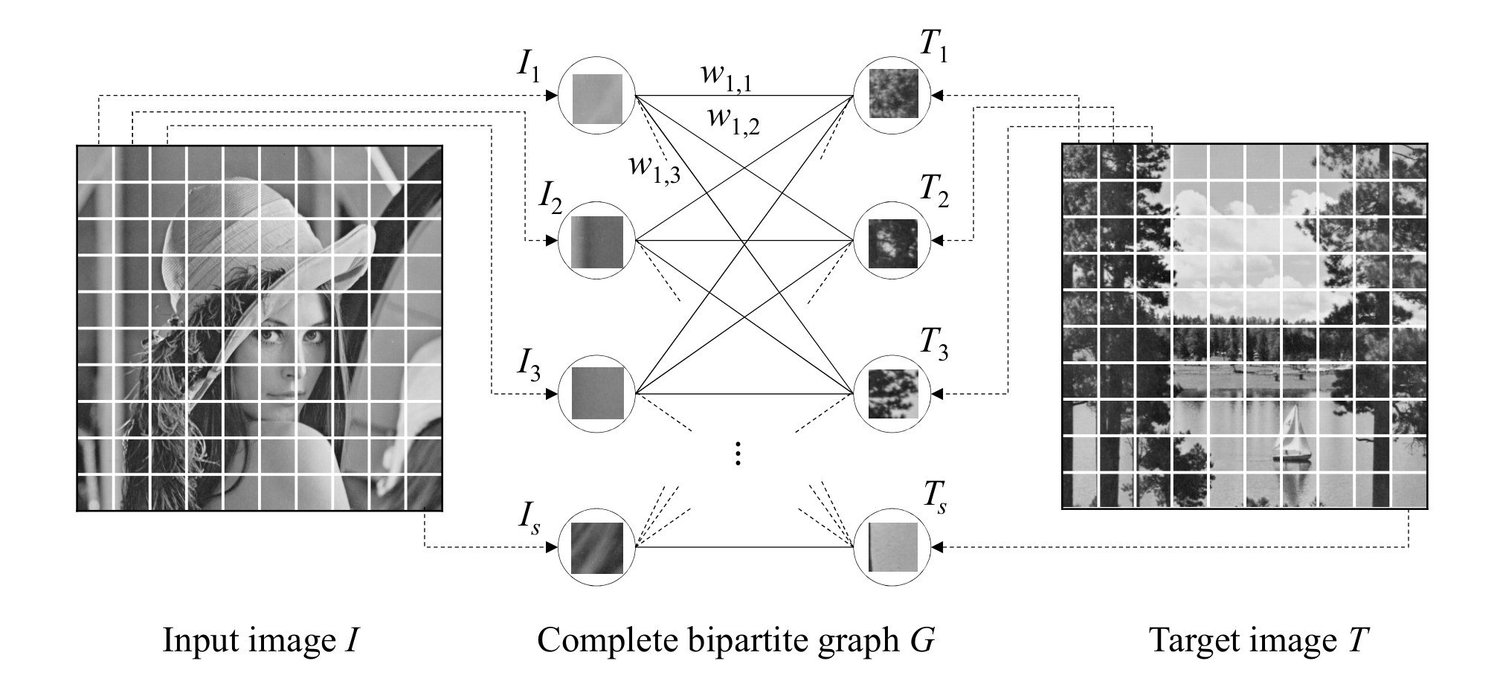
Yang, Ito and Nakano (APDCM, 2017) built mosaics by rearranging the pieces of one picture to reproduce another. They described it as a weighted bipartite graph: source tiles on one side, destination positions on the other, a cost for every possible connection. Their GPU work included an exact assignment and a faster approximation. This is the fixed-inventory problem in its purest form. Every piece has to find a place, and a move that looks good locally is only as good as the arrangement it leaves behind.
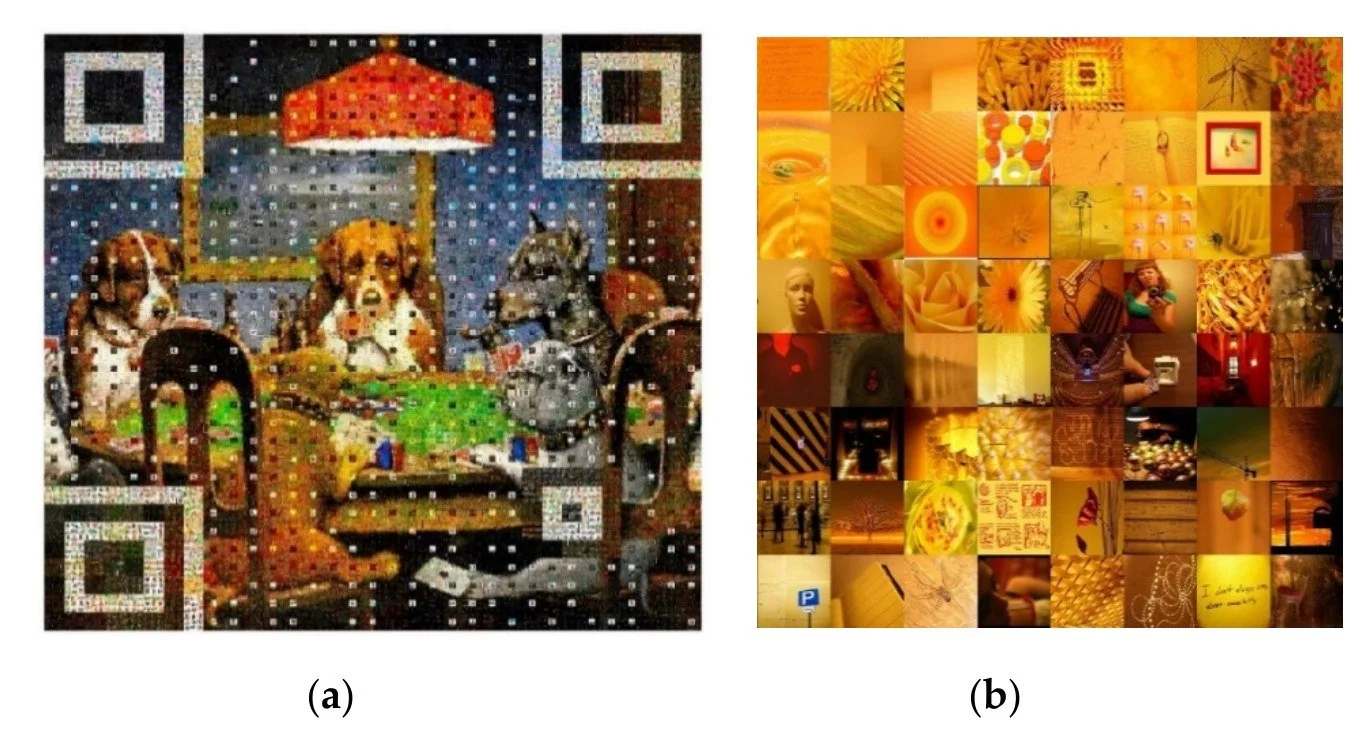
With Li, Su and Wang’s QR-code mosaics (ICMEW 2017; Mathematics 2020), the picture has to please two audiences: people and phone cameras. The small dark and light modules of the QR code restrict the photographic construction, and enough of that structure must survive for the code to stay readable while the photographs describe something else. Three layers of information share one surface: the large image, the small photographs and the pattern the machine reads. Some visual freedom is traded for a measurable function.
7. Learning what to compare (2017–2021)
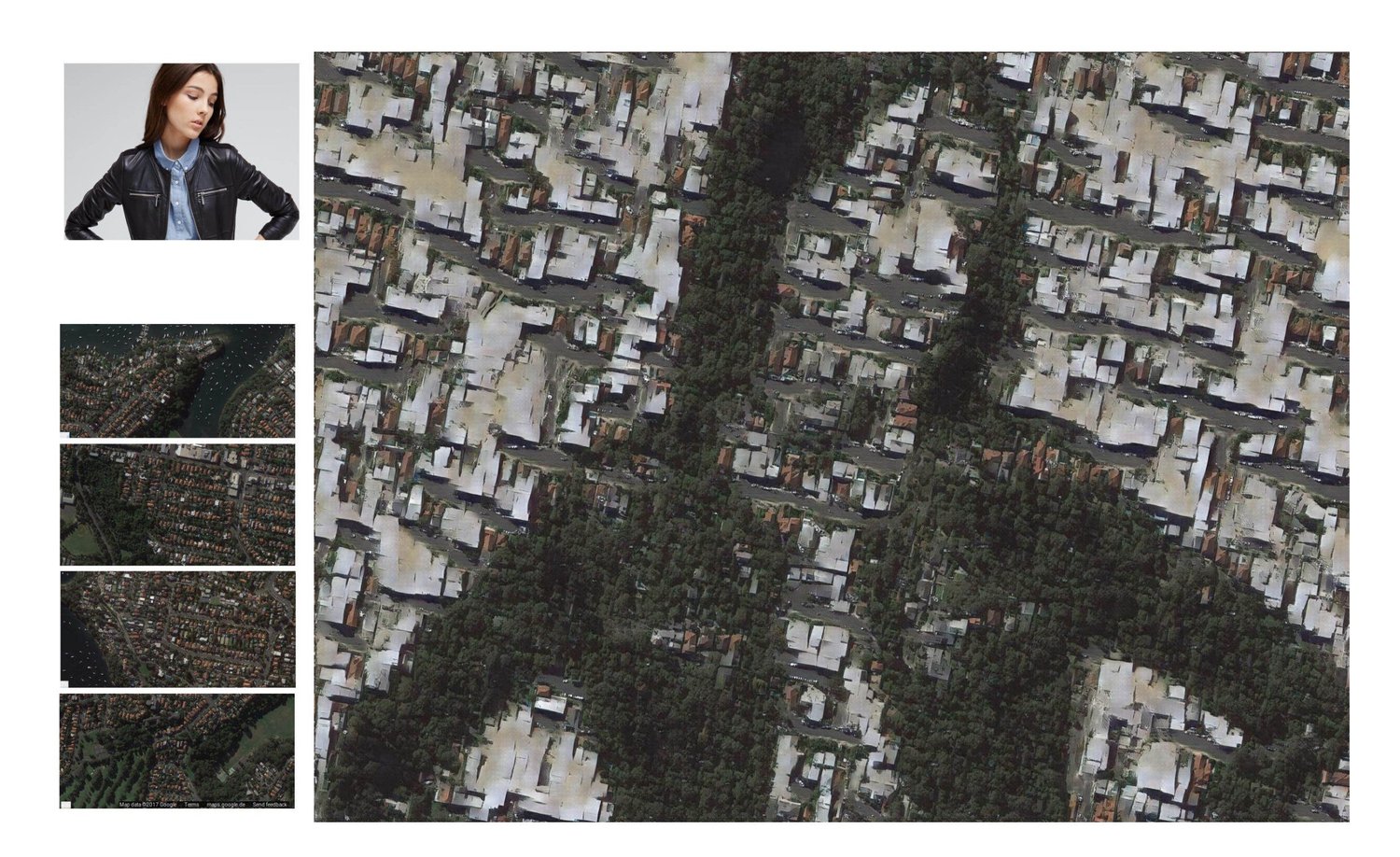
Jetchev, Bergmann and Seward’s GANosaic (NIPS Workshop, 2017) changes where the material comes from. A generative adversarial network trained on textures supplies a range of possible patterns, and optimisation searches for the combination that resembles the target. The method can produce textures between the examples it has learned, instead of choosing from a finite set of stored photographs, so its pieces are really generated texture regions. Their portrait made of satellite-like city texture shows the idea beautifully: local material and global subject can be completely different, as long as they share a compatible organisation of tone.
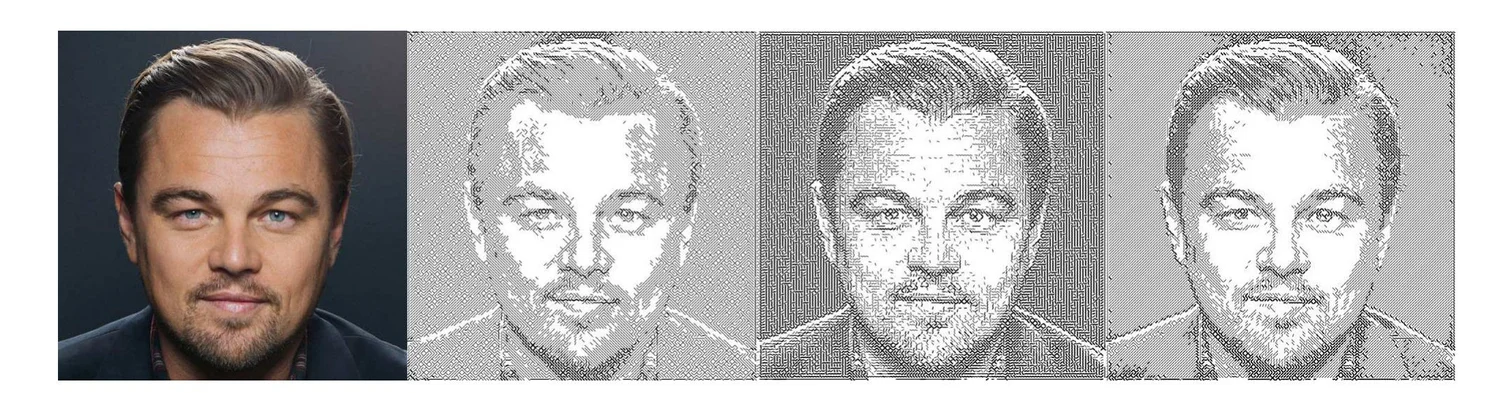
The scale at which you compare two images also changes what counts as a good match. Tesfaldet, Saftarli, Brubaker and Derpanis (ECCV Workshops, 2018) built mosaics from templates with a convolutional network and multiscale perceptual losses, which compare what a neural network sees at fine and at coarse scales. A coarse comparison protects the arrangement of a face; a fine one shapes its detail. Their experiments with glyphs and other small templates show how the material and the scale of evaluation work together.
Learned features also entered the more familiar library-based workflows. Taqa (2018) investigated texture statistics with clustering, neural and fuzzy matching. He, Zhou and Yuen (MTAP, 2019) combined clustering with evolutionary programming under repetition limits. Tom Hudson’s practitioner account connected neural image descriptions with linear optimisation. My own Tsevis Deep Mosaic matcher can join this family too: after its colour and layout scoring, an optional DINOv3 stage, Meta’s self-supervised vision transformer, re-ranks the hundred most plausible tiles by what they look like to a learned eye. It helps to keep two decisions apart. A descriptor decides which images look similar to the system; an assignment method decides how to distribute them across the target. Change either and the result changes, but they solve different parts of the problem.
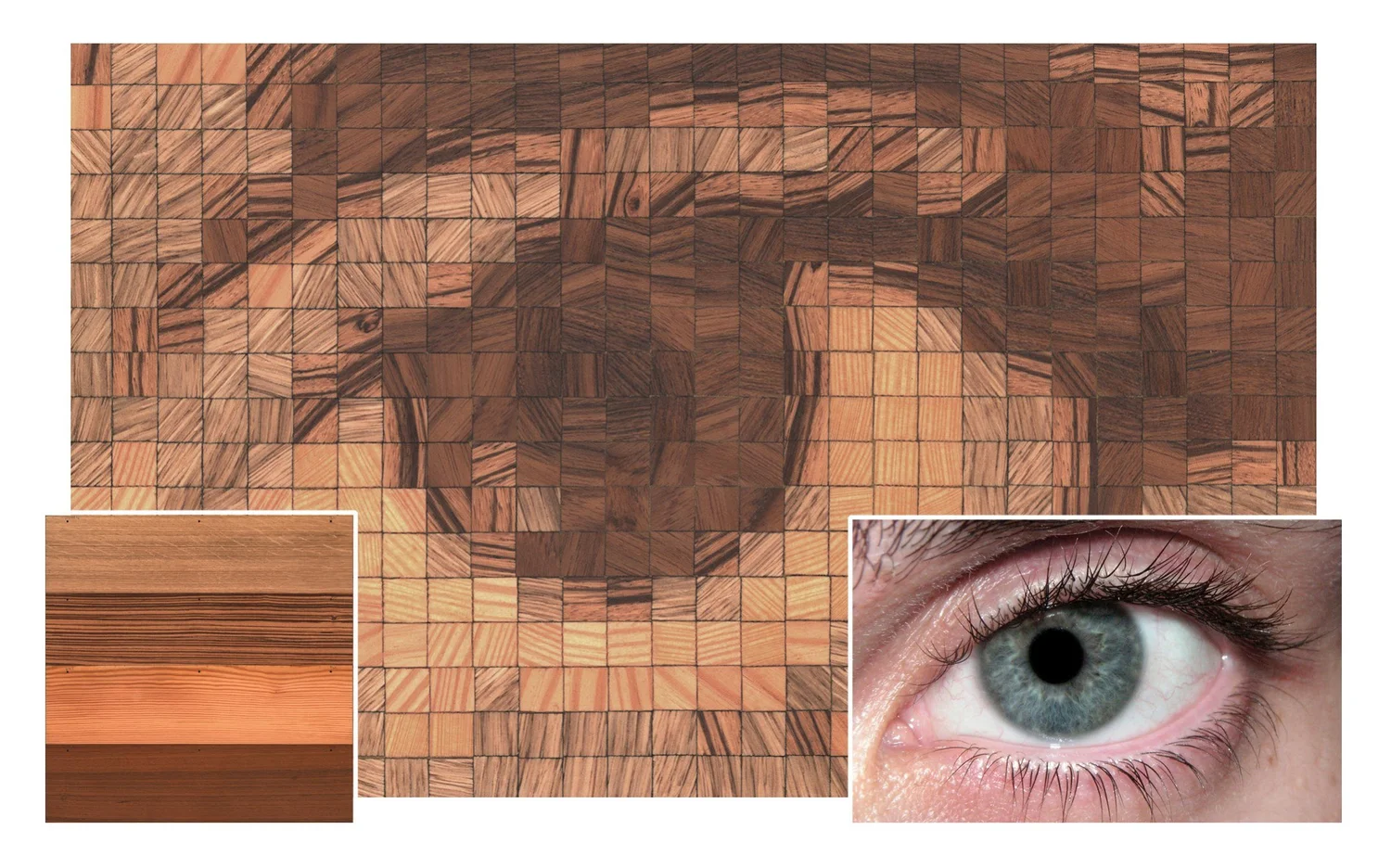
In Iseringhausen’s 2019 doctoral work and Computational Parquetry (ACM TOG, 2020), the library is scanned wood veneer. Grain, tone and direction become features matched to a reference image before the pieces are cut and assembled. Of all the papers in this history, this is the one that feels most like making a mosaic by hand. A line in the wood can draw part of an eye, just as a line inside a photograph can draw part of a face. And the final arrangement has to respect the material actually available for cutting, so the digital solution never forgets the workshop.
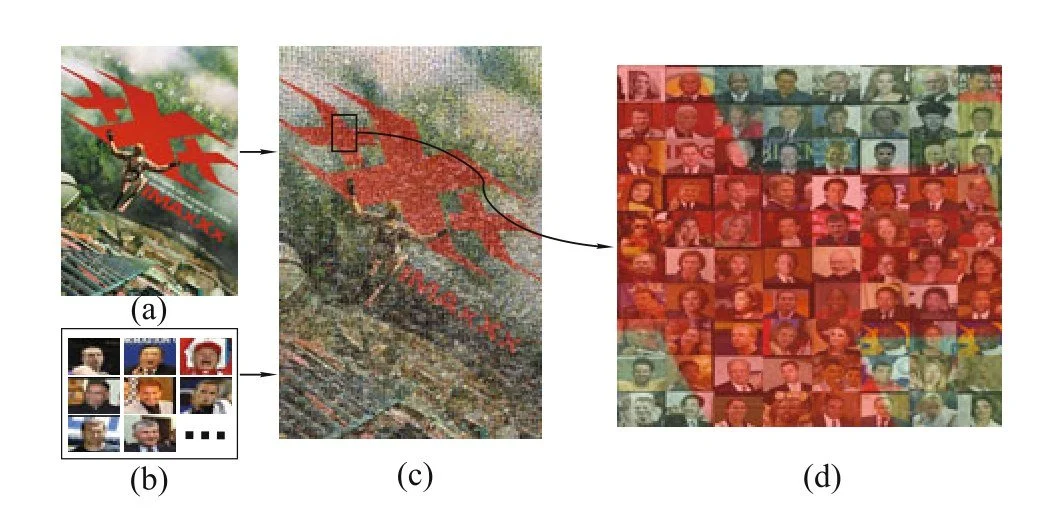
Several methods kept working on the balance between the big subject and the visibility of the pieces. Xu, Ding, Zhang and Huang (2019) used edge-aware adaptive tiles. Zhang and colleagues (Frontiers of Computer Science, 2021) combined error-minimising selection with a weighted overlay of the target. An overlay makes the big image clearer by adding some of it directly to the mosaic. I always want to know when one is used, because it changes how much of the resemblance comes from the photographs and how much from the image laid over them.
8. Generating the pieces and refining the layout (2023–2026)
And now the present, which moves fast. SyncDiffusion (2023), Visual Anagrams (2024) and Factorized Diffusion (2024) explore coherence and double readings in generated images. They are close neighbours of mosaic research rather than mosaic methods, but anyone who loves images that change with distance will enjoy them. Wang and Lu’s Image-Space Collage and Packing with Differentiable Rendering (SIGGRAPH, 2025) works instead on arranging existing elements: its rendered losses judge every change of position and layout by its effect on the image. Generation and packing intervene at different points. One creates the material; the other searches for a better way to arrange it.
Li and Li’s TalkMosaic (2024) makes the trip from whole to part interactive. You select a small photograph and ask a multimodal model about it. The image is still read at different scales, but now the interface can tell you things you would never see in the tile alone. It extends a very old reason for using meaningful photographs: after you recognise the big subject, the collection still has something to give you.
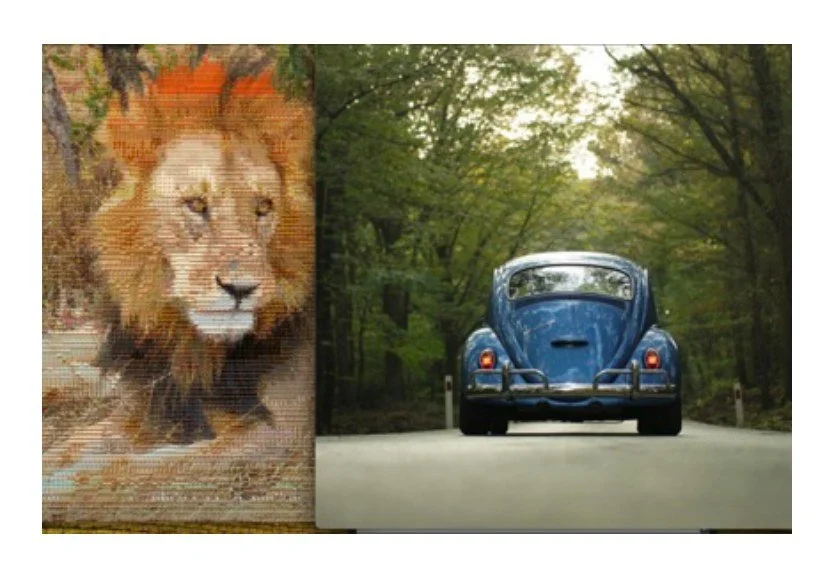
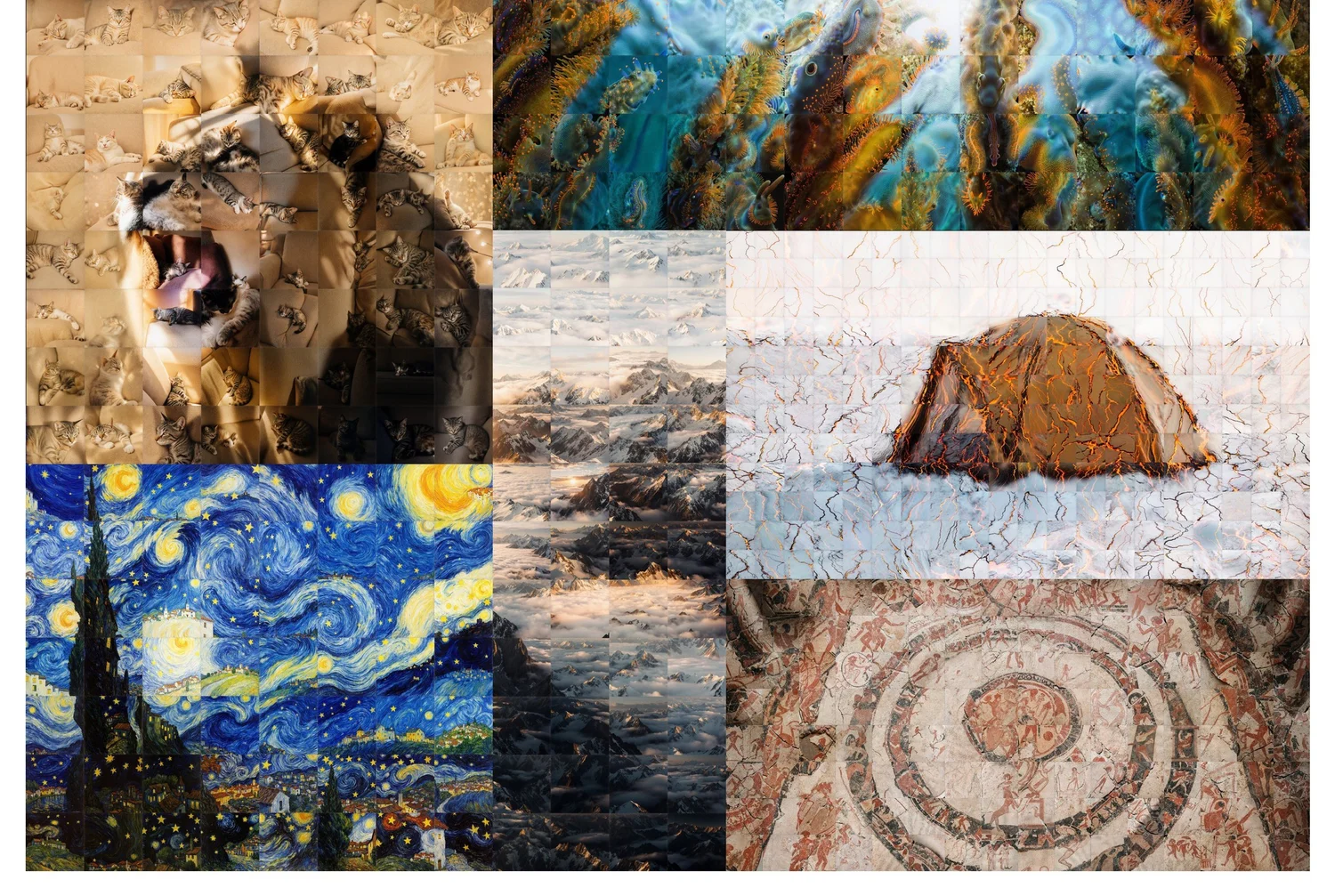
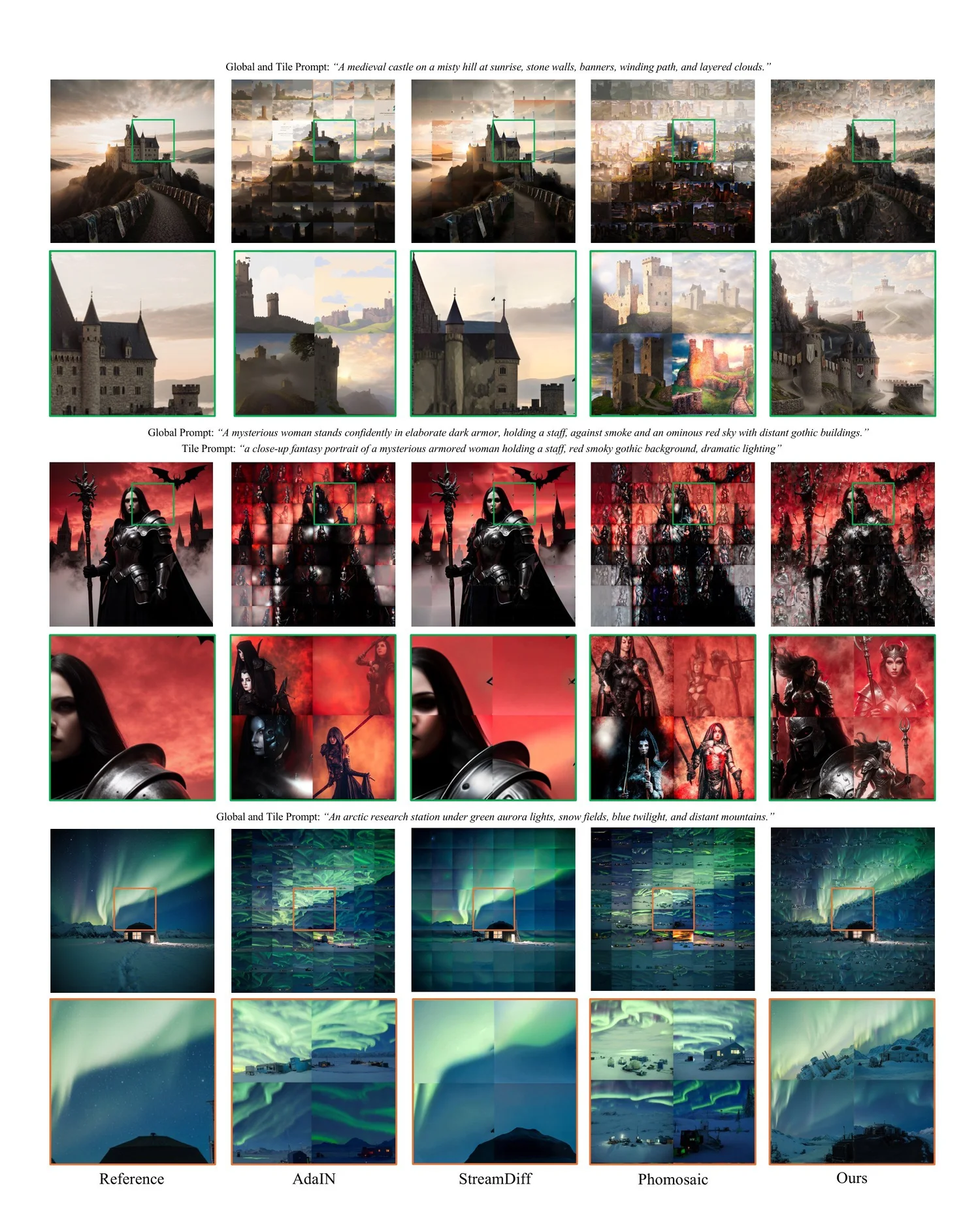
In Doyle and Mould’s Diffusion-based Image Mosaics (Graphics Interface, 2026), a model generates each tile for its intended position. Diffusion models build images through successive denoising steps; here a pretrained model is guided by a theme and by the colours each part of the target needs, and a custom loss balances colour matching against the quality and variety of the generated images, without fine-tuning. The library is replaced by a generative process. I am an optimist about these tools (I build my own software with AI every day), but notice what does not change: each small image still needs enough independence to convince you, while it serves the larger composition. No model removes that decision. It only moves it.
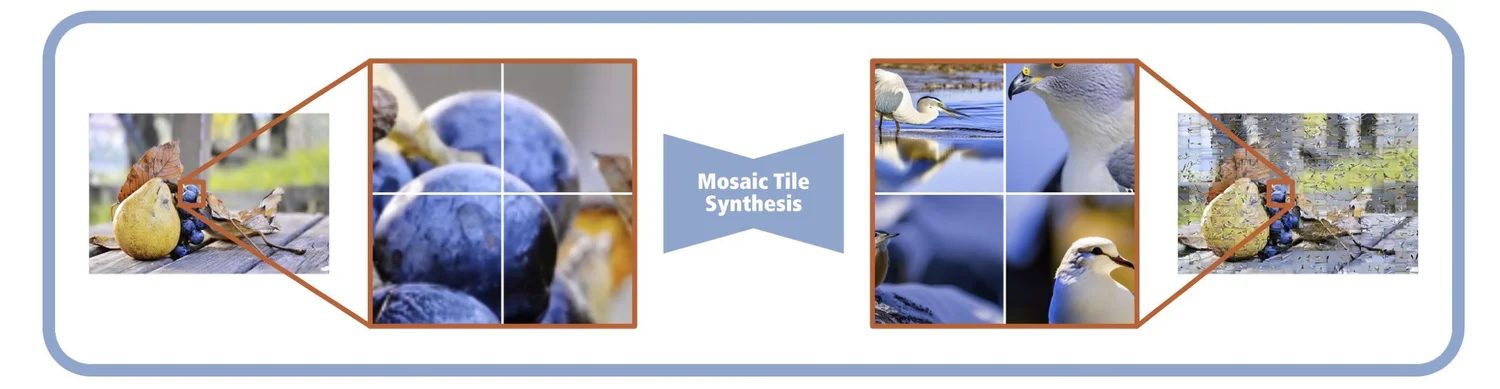
Chung, Son and Lee’s structure-aligned generative method (2026) separates broad structure from local detail through low-frequency conditioning. Low frequencies describe gradual changes and large tonal masses; high frequencies describe fine transitions and texture. Guide the broad structure and the generated tiles keep their place in the target while their content follows a prompt; few-shot personalisation uses a handful of examples to keep subjects or styles consistent. What I like here is that the method makes explicit a separation mosaic designers have always worked with by eye: the information that holds the whole together, and the information that makes each piece itself.
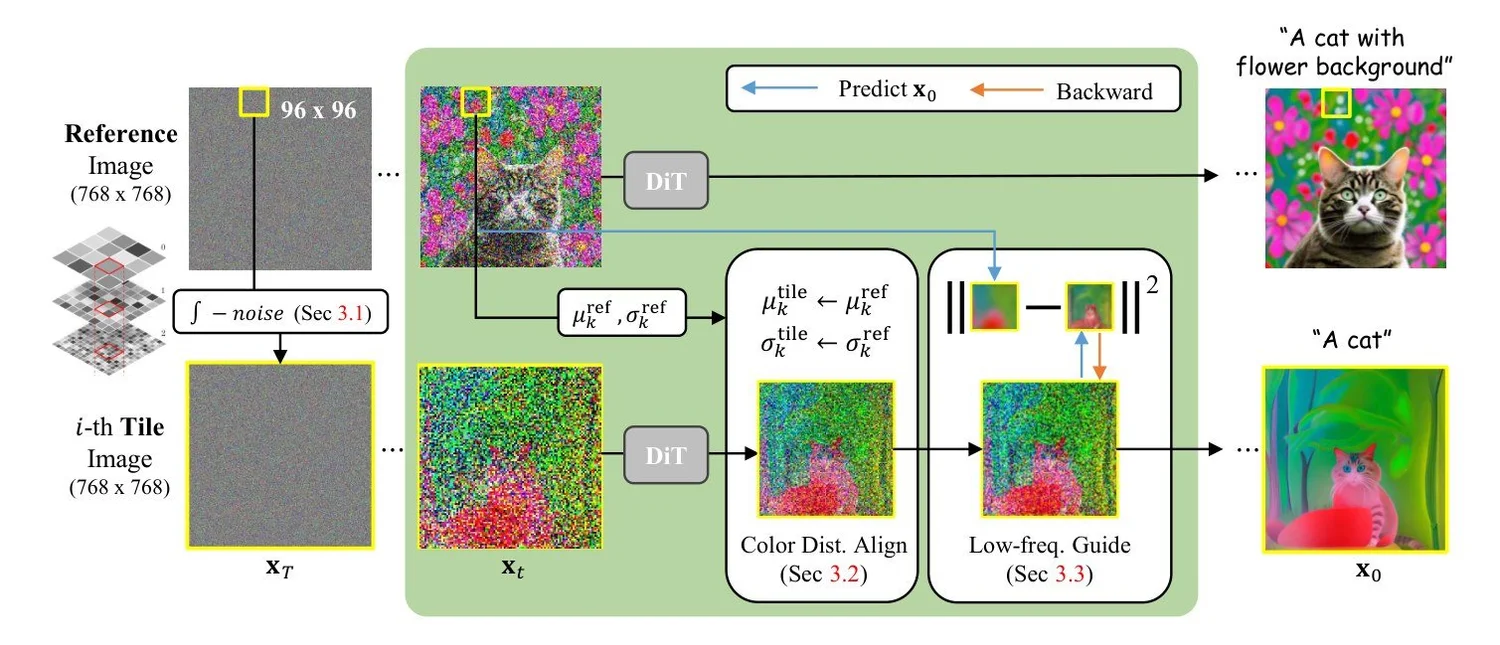
Making enough detail for a large mosaic is a computational problem of its own. Roohi, Rajabi, Fleet and Taati’s PhotoQuilt (2026) starts from a coarse global image, enlarges it, adds noise again and then denoises the tiles one by one while keeping track of the overall arrangement. This bootstrapped tiled denoising shares out the work of creating local detail. For the viewer, the goal is the familiar one: the picture should hold together from a distance and keep revealing small images up close, now at much larger sizes.
The ways we measure have grown with the methods. Pixel error records numerical differences; SSIM compares aspects of luminance, contrast and structure; learned measures such as LPIPS compare image features; generative work also asks whether the small images match their prompts and look convincing. Each measure answers one question. None of them replaces looking. A real assessment still has to judge separately how recognisable the target is, how visible the pieces are and what kind of composition you end up with. For a mosaic made from a family archive, keeping one particular photograph may matter more than any score. A generated mosaic will be judged by different expectations.
9. Mozaix: matching as a design decision (2023)
Which brings me to my own work. I started building Mozaix in 2023, with a lot of help from AI, and it has grown into a system of tens of thousands of lines of code. It does not have one matcher. It has twelve, because no single way of looking works for every image. Each one asks the same picture a different question, and if you have read this far, you will recognise many of them.
Some are homages. Average Color and Brightness are the honest baselines every mosaic program starts from. RS1996 is named after Robert Silvers and his 1996 thesis. It works on an 8 × 8 subgrid, with colour, brightness, contrast, gradients and edges measured in every cell: his sub-picture idea, thirty years on. Enhanced BK Edge Priority is a faithful reimplementation of William Kromydas’s edge-priority assignment: a 4 × 4 intensity match plus Canny edge templates, and a second tier in which a tile with the right edge wins only if its tones are close enough. Bill Atkinson Dither honours the man who wrote the dithering for the original Macintosh in 1984. It matches the average colour of each cell in OKLab and passes the error, the difference between the colour I wanted and the tile I placed, on to the cells that come next, exactly as a dithered pixel would. Caratheodory Measure, named after the Greek mathematician Constantin Carathéodory, brings indexed colour to mosaics: it clusters the library into a palette of 2 to 256 colours, dithers which colour each cell gets, and only then picks a tile from that colour’s bucket.
Two carry my name. Tsevis Mozaix compares a configurable Lab subgrid with CIEDE2000, the colour-difference formula built to follow human perception, together with the correlation of the luminance pattern inside each tile. Its options read like a summary of this article: Lee’s HSI intensity adjustment, error diffusion, a peripheral check that keeps the same photograph away from its neighbours, and a SoftAssign-inspired global step (softmax, Sinkhorn normalisation and a greedy readout; not the published algorithm). Tsevis Deep Mosaic is stricter about layout. It compares an 8 × 8 grid of colour inside every tile, the overall colour and the luminance pattern, with a luminance gate and special protection for dark regions, where one bright tile can ruin a shadow. Both can add a second stage with DINOv3, Meta’s self-supervised vision transformer. It re-ranks only the hundred most plausible tiles, inside their colour band, so it refines the order without ever promoting a tile with the wrong tone.
The Gestalt matchers start from structure, and their name is not an accident. At the Scuola Politecnica di Design in Milan I learned visual design through Gestalt psychology and Nino Di Salvatore’s Science of Vision, and I have taught those principles ever since. Gestalt Mono was written for tesserae such as glyphs, symbols and letters, which carry almost the same amount of ink and cannot be told apart by brightness. What separates them is where the ink is: a 7 × 7 occupancy grid read at three darkness levels, a log-polar shape signature borrowed from research on structure-based ASCII art, and an orientation histogram, with colour and tone as supporting voices. A vertical form, a diagonal and a curve finally stop looking the same. Gestalt Chroma adds colour on the a–b plane alone, weighted by how much colour the source actually has. SWD Color compares the whole colour distribution of a tile rather than its average, with a sliced Wasserstein distance in OKLab; by default it also takes position into account, so where the colours sit matters too. For me these distinctions matter, because the small image has a compositional role of its own. Its structure helps describe the subject, while its identity and its differences from its neighbours keep the surface alive.
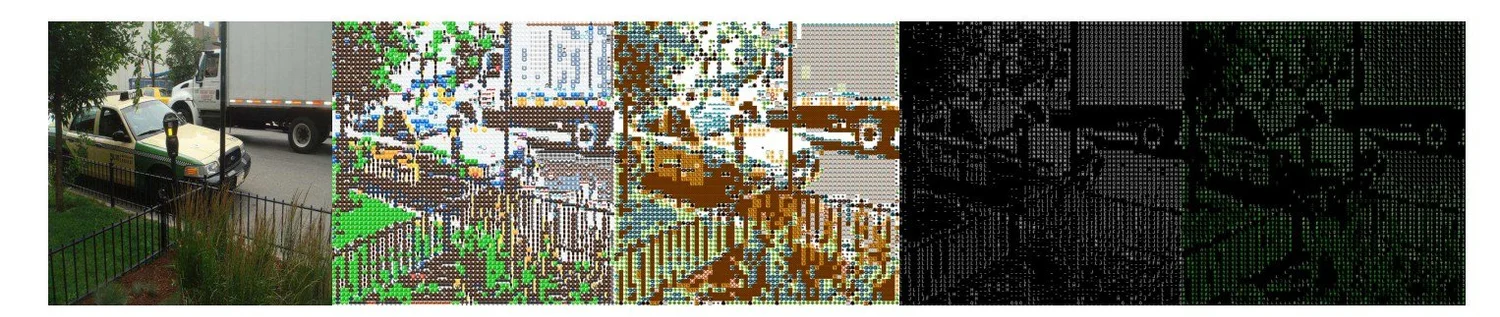
With silhouetted photographs, the background joins the calculation. JohnDaltonAlpha is named after John Dalton, the developer of Synthetik’s Studio Artist, a person I really admire: Studio Artist is the one commercial tool that builds mosaics from a library of alpha-channel images composited over a background. The matcher compares the silhouette recorded in the alpha channel (the image’s transparency mask) with the local structure of the target region, and it computes the tone each piece will really have once it is composited over the background, which by default is the region’s own colour. A thin dark object on a light ground makes a fairly light contribution, because so much of the ground stays visible. Shape, photographic content and background are three complementary sources of information. Combining them with free placement and the fitting of neighbouring silhouettes, the territory Kim and Pellacini opened in 2002, is where I want to take Mozaix next.
So here is the test I care about most. I took one portrait and one library of 1,113 illustrated tiles, patterns, flowers and ornaments, and gave them to all twelve matchers, with the same layout and settings. The one exception is Caratheodory Measure, shown on a plain grid of squares. Same face, same tiles, twelve different decisions about which tile belongs where. Look at the eyes, the hairline and the dark areas, and you will see each of the questions in this history answered in a different way.
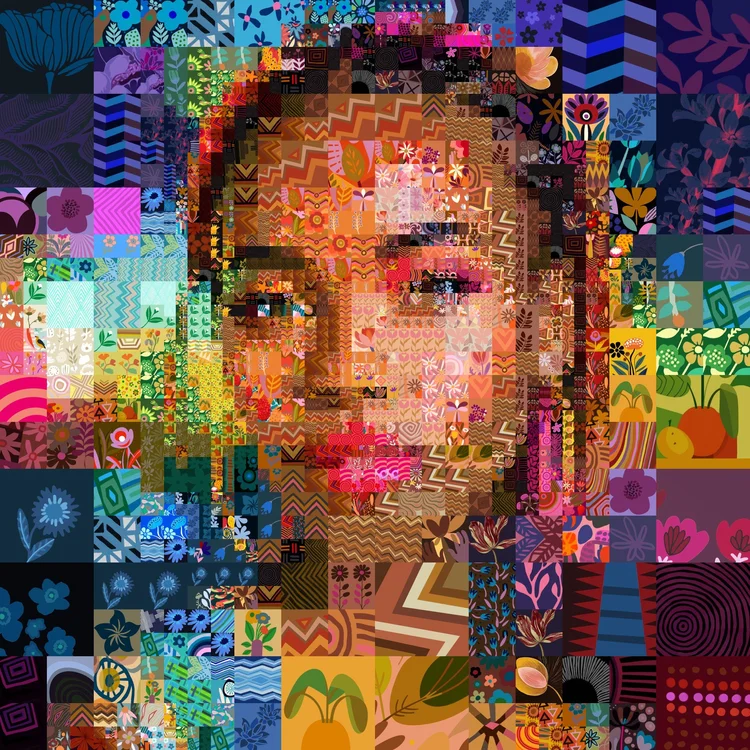
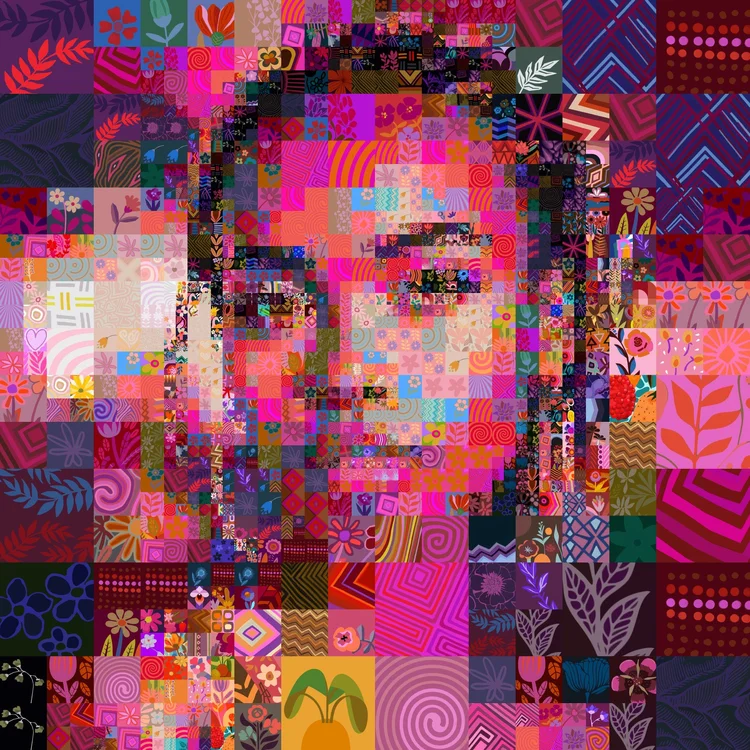
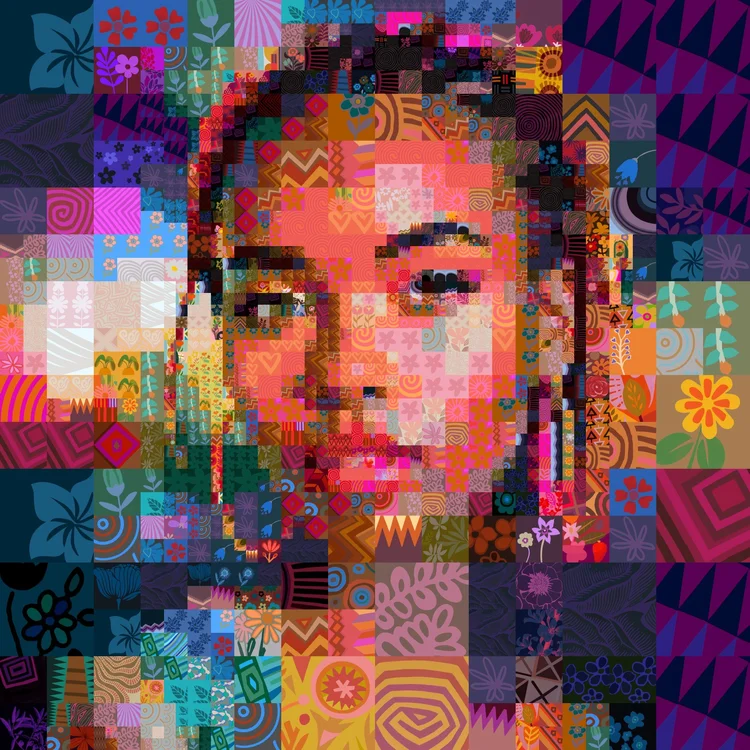
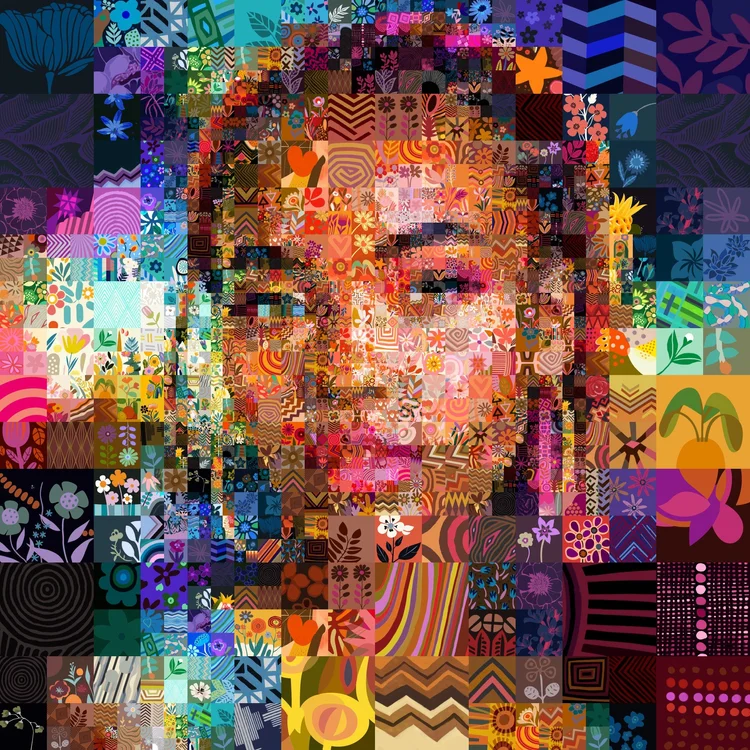
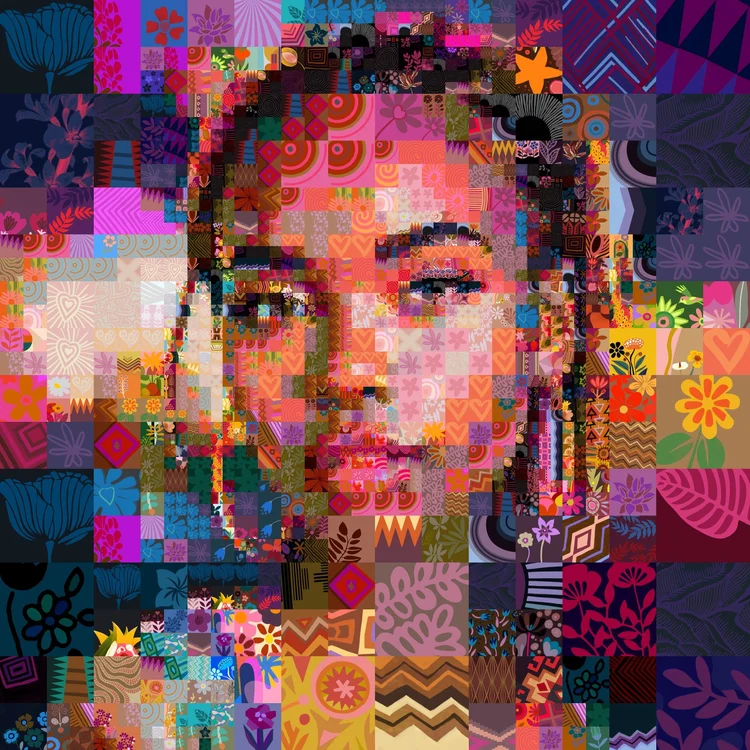
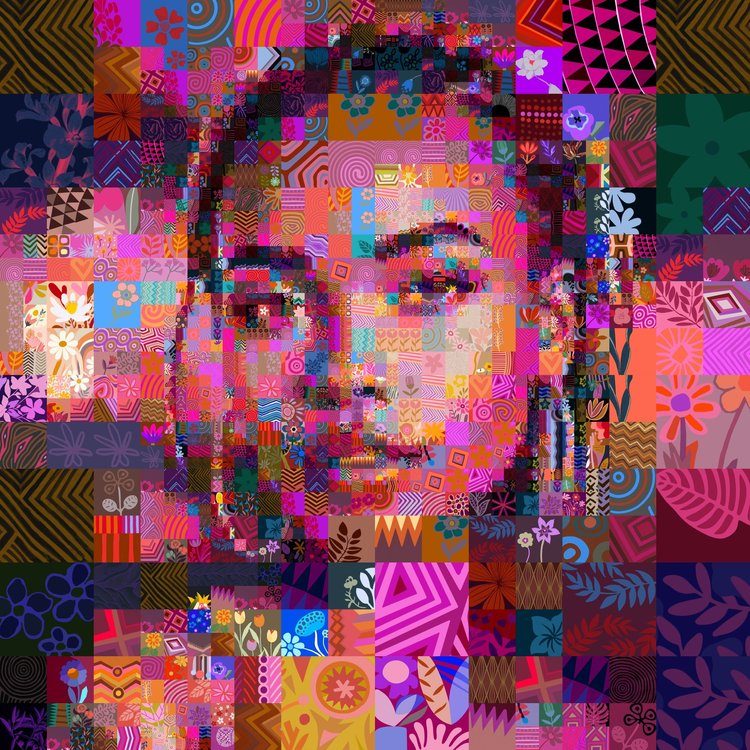
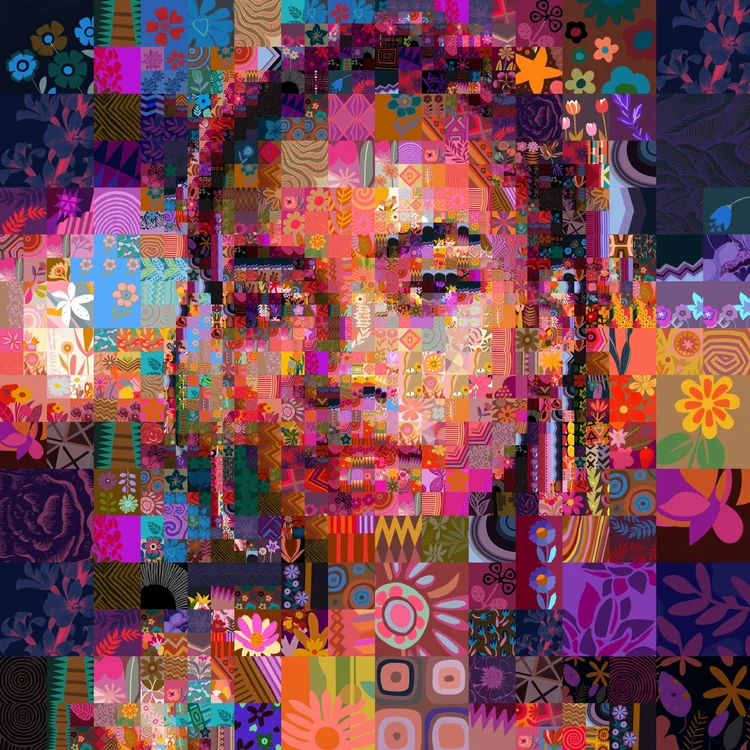
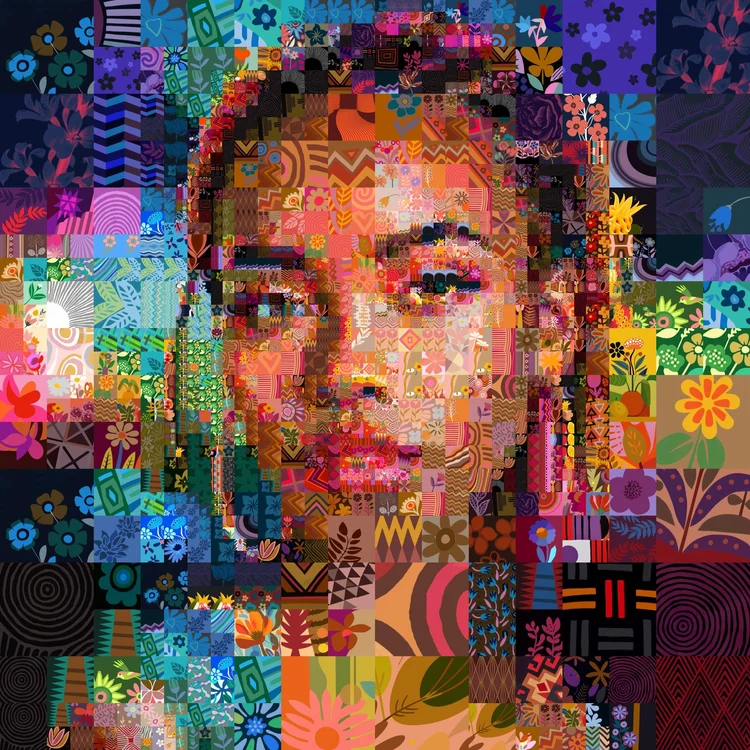
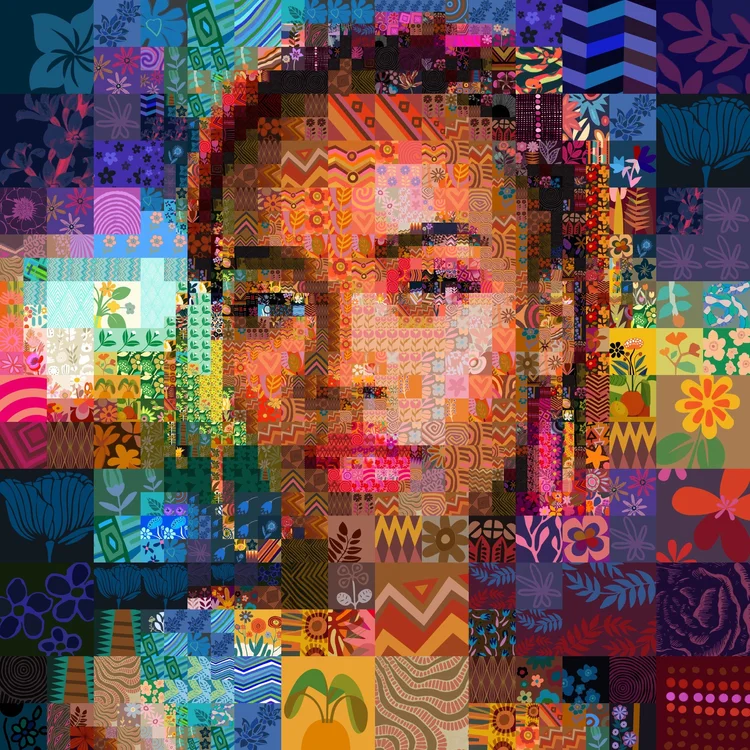
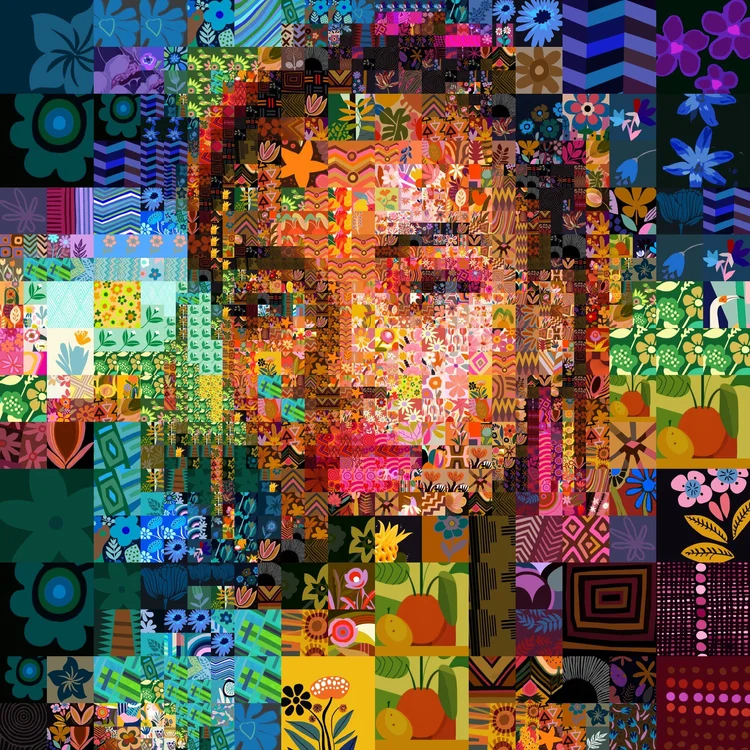
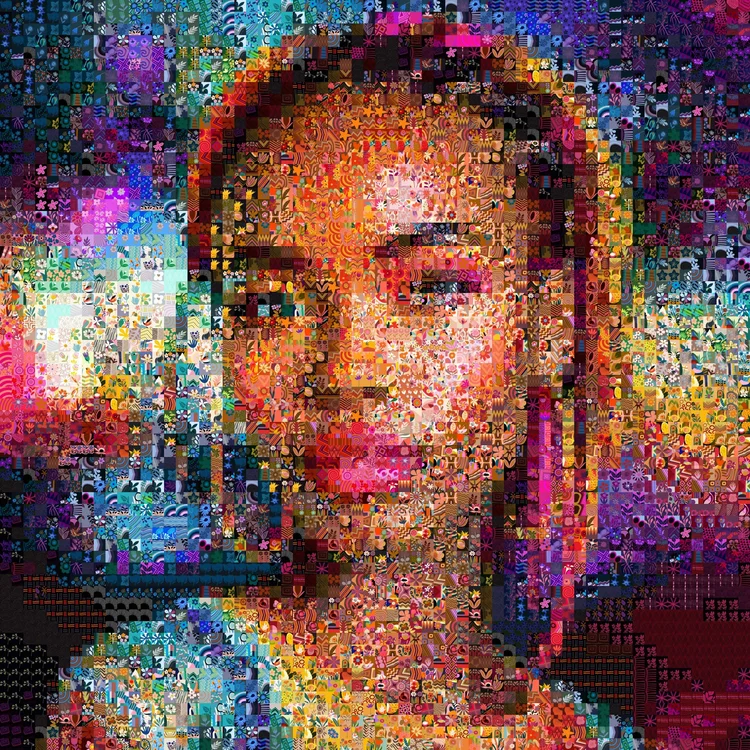
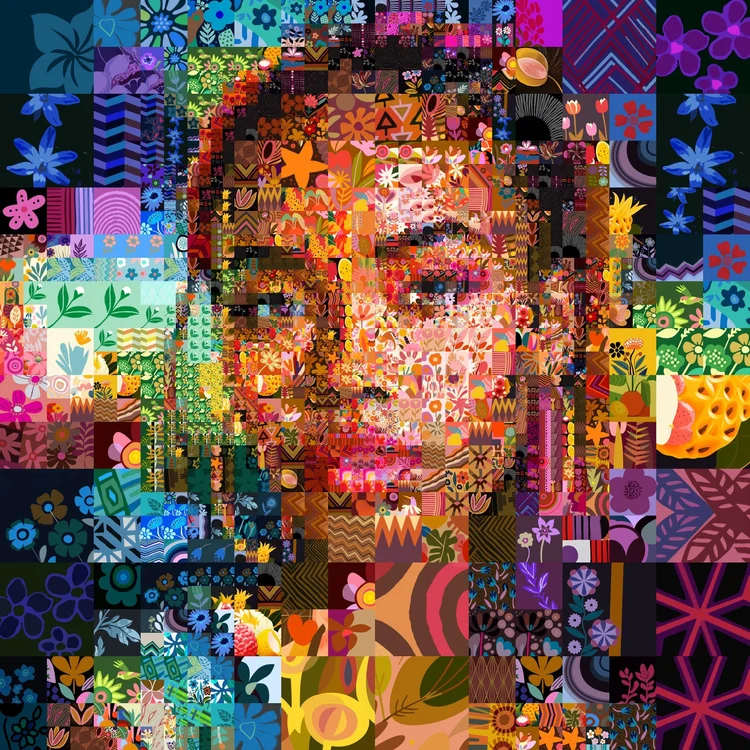
The three historical figures above come from the papers that first asked those questions. The gallery is Mozaix output.
The main changes at a glance
| Period | Layout | What is compared | How pieces are chosen | How the image is rendered |
|---|---|---|---|---|
| 1966–92 | Grids and arrangements of physical pieces | Symbol density and average tone | Closest tonal match, with inventory limits where needed | Symbols, dominoes and other physical pieces |
| 1993–2003 | Regular grids and early irregular packing | Colour within subgrids, wavelet descriptions and image features | Nearest matches, dynamic programming and combined error functions | Photographs with preserved or adjusted colour |
| 2004–08 | Adaptive grids, jigsaw layouts and animated forms | Indexed image descriptions and shape | Faster retrieval and searches through alternative arrangements | Cropped, adjusted or animated material |
| 2009–17 | Merged cells and directional arrangements | Visual features, social context and functional constraints | Coordinated assignment and reuse-limited search: SoftAssign, graph matching, randomised improvement | Source photographs, with adjustments or encoded information in some methods |
| 2017–21 | Adaptive arrangements of images and materials | Learned features, texture and edges | Neural methods, evolutionary search and linear optimisation | Photographs, overlays, generated textures and cut material |
| 2023–26 | Generated tiles and continued work on packing existing elements | Prompts, broad image structure and the rendered arrangement | Guided generation or optimisation of placement | Diffusion-generated images and collage from existing elements |
| Mozaix, 2023 | The layouts provided by the mosaic workflow | Subgrid colour (CIEDE2000, OKLab), luminance pattern, edges, ink structure, colour distributions and composited tone | Twelve matchers: reuse-limited nearest match, edge-priority tiers, tile-level error diffusion, palette dithering, optional DINOv3 re-ranking | Source tiles, optional HSI re-toning, alpha compositing over a background |
For me, the magic of a photographic mosaic lives in the relationship between the two images we see. The large subject gives the arrangement its structure; the small photographs bring their own forms, details and associations. An algorithm shapes that relationship through decisions about scale, colour, direction, repetition and alteration. I have spent more than thirty years inside that relationship, and I don’t believe an algorithm can decide it for us. What it can do is make the decisions visible, so we can choose what to keep and where to accept a compromise, whether the material is a photographic collection, a sheet of veneer or a generative model. It is also the ground on which every algorithmic mosaic from the studio is built.
Sixty years after Knowlton and Harmon, the pieces have changed beyond recognition. The question has not: how do you make something that holds together from across the room, and still rewards you when you come close? I hope we never stop asking it.
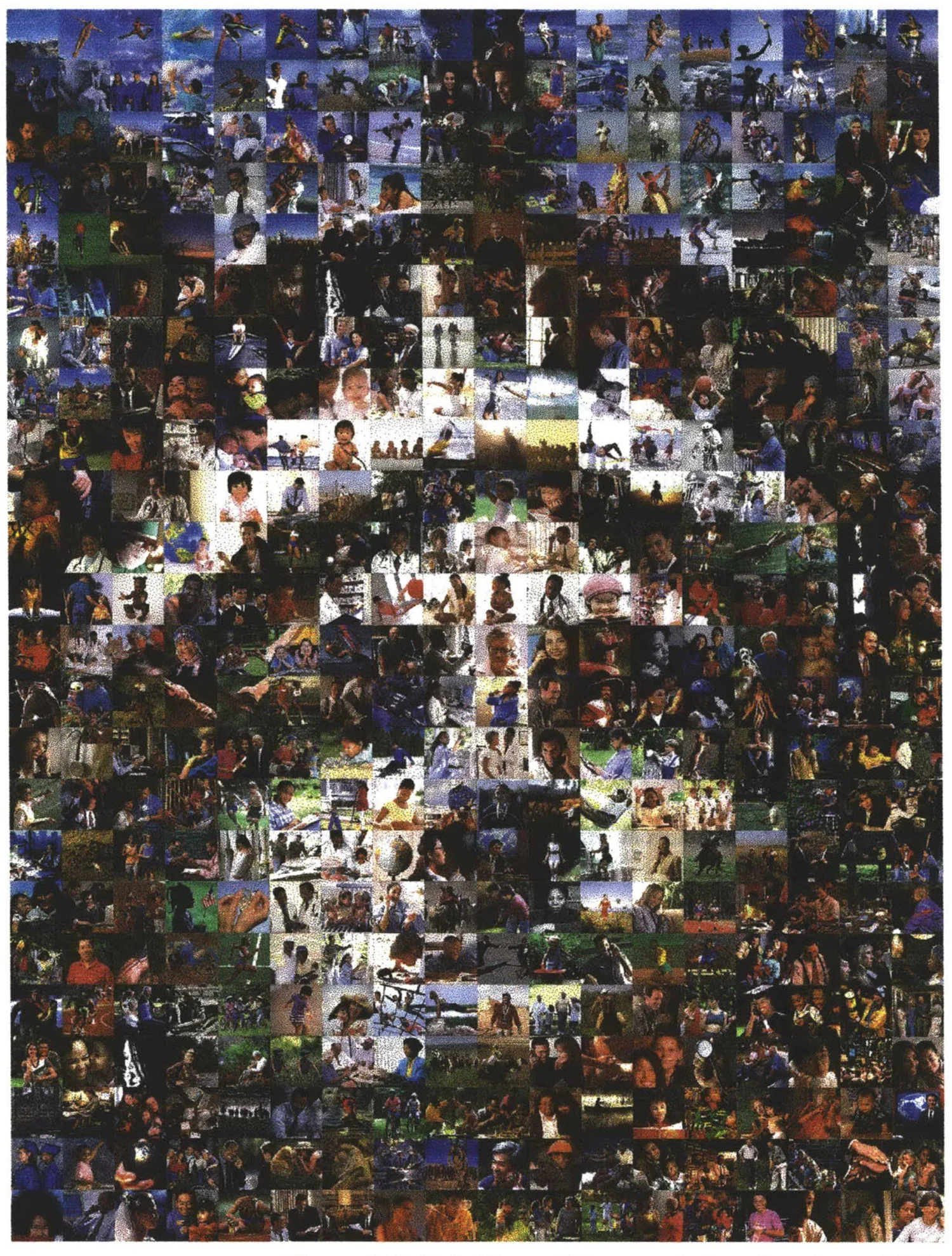
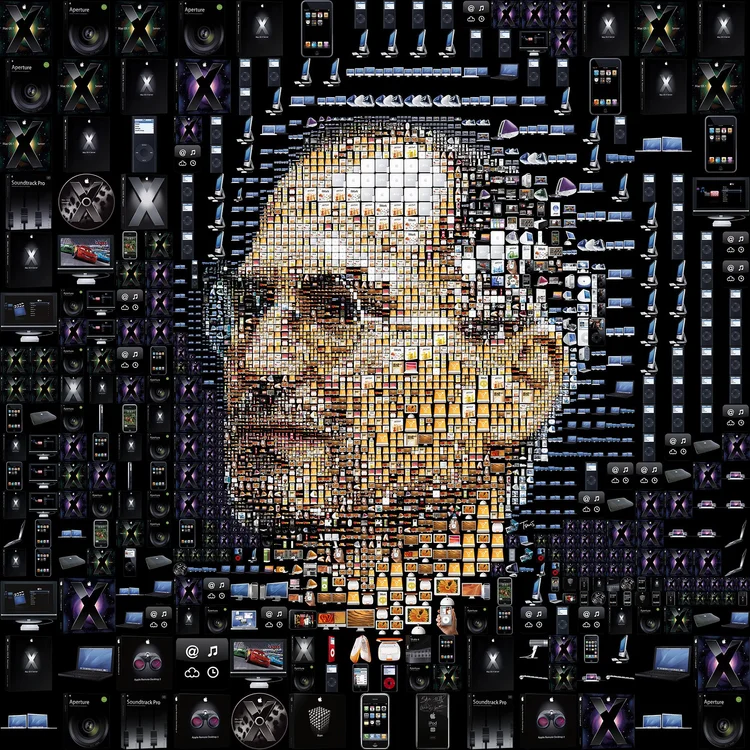
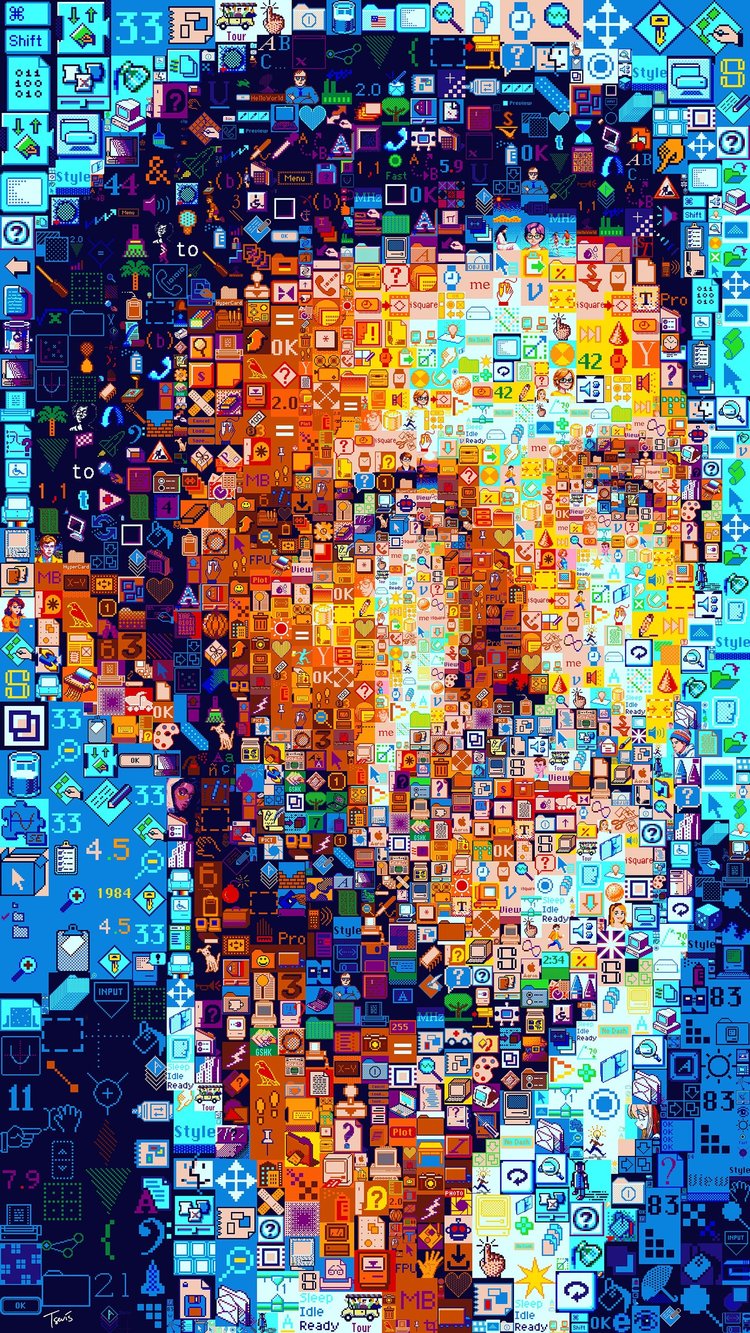
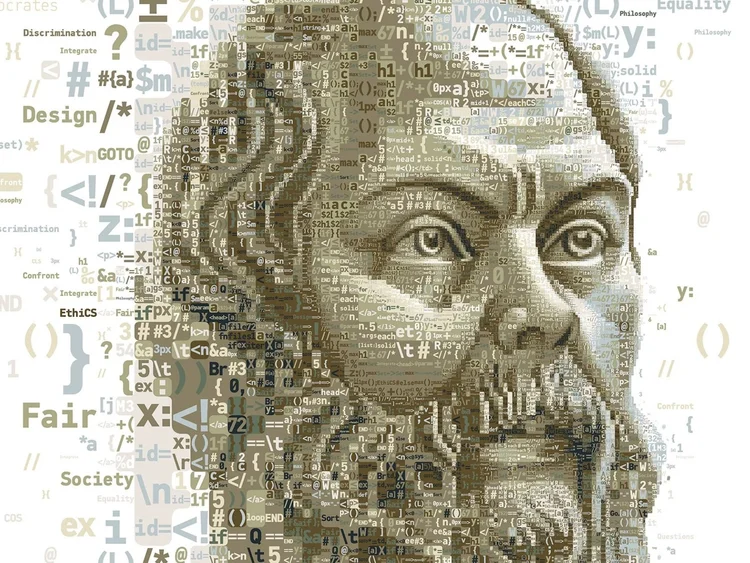
Three algorithmic mosaics from the studio, each built from a different material.
A note on sources
Dates in the text refer to the works or publications named. Peer-reviewed papers, preprints, theses, patents, practitioner accounts and software are different kinds of evidence, and I have tried to keep them apart. The figures are reproduced from the papers and theses named in their captions, for the purpose of discussion; the rights remain with their authors and publishers.
While preparing this history I checked an earlier compiled bibliography against the original papers and records, and several of its claims did not hold. A 1966 IBM conference paper on photographic mosaics could not be found. SoftAssign is older than the GPU study that applied it to mosaics. The Bell Labs researcher was Leon D. Harmon. And the 2026 diffusion papers do not report the DINO-based metrics that bibliography attributed to them.
Sources
- Kenneth C. Knowlton and Leon D. Harmon, Studies in Perception I, Bell Telephone Laboratories, 1967. collections.vam.ac.uk
- Leon D. Harmon, The Recognition of Faces, Scientific American 229(5): 70-82, November 1973. doi:10.1038/scientificamerican1173-70
- Salvador Dalí, Gala Contemplating the Mediterranean Sea, Which at Twenty Meters Becomes the Portrait of Abraham Lincoln (Homage to Rothko), The Dalí Museum, St. Petersburg, Florida, 1976. catalogues.salvador-dali.org
- Kenneth C. Knowlton, Representation of designs, US Patent 4,398,890, 1983. patents.google.com
- Robert Bosch, Constructing Domino Portraits, Optimization Online preprint, 2003. optimization-online.org
- Joseph Francis, History of Photo Mosaics, digitalartform.com, 2017. digitalartform.com
- Robert S. Silvers, Photomosaics: Putting Pictures in their Place, MS thesis, MIT Media Arts and Sciences, 1996. hdl.handle.net
- Robert Silvers, Photomosaics, edited by Michael Hawley, Henry Holt, New York, 1997. openlibrary.org
- Robert S. Silvers, Digital composition of a mosaic image, US Patent 6,137,498, 2000. patents.google.com
- Charles E. Jacobs, Adam Finkelstein and David H. Salesin, Fast Multiresolution Image Querying, Proc. SIGGRAPH '95 (22nd Annual Conference on Computer Graphics and Interactive Techniques), pp. 277-286, 1995. doi:10.1145/218380.218454
- Adam Finkelstein and Marisa Range, Image Mosaics, Electronic Publishing, Artistic Imaging, and Digital Typography (RIDT '98), Springer, 1998. doi:10.1007/BFb0053259
- Nicholas Tran, Generating Photomosaics: An Empirical Study, Proc. 1999 ACM Symposium on Applied Computing (SAC '99), San Antonio, pp. 105-109. doi:10.1145/298151.298213
- Yue Zhang, Mario A. Nascimento and Osmar R. Zaïane, Building Image Mosaics: An Application of Content-Based Image Retrieval, Proc. IEEE International Conference on Multimedia and Expo (ICME 2003), vol. III, p. III-317 onward. doi:10.1109/ICME.2003.1221312
- Allison W. Klein, Tyler Grant, Adam Finkelstein and Michael F. Cohen, Video Mosaics, Proc. 2nd International Symposium on Non-Photorealistic Animation and Rendering (NPAR 2002), pp. 21-28. doi:10.1145/508530.508534
- Junhwan Kim and Fabio Pellacini, Jigsaw Image Mosaics, ACM Transactions on Graphics 21(3) (Proc. SIGGRAPH 2002), July 2002, pp. 657-664. doi:10.1145/566570.566633
- Paul Haeberli, Paint by Numbers: Abstract Image Representations, Proc. SIGGRAPH '90 (Computer Graphics 24(4)), August 1990, pp. 207-214. doi:10.1145/97879.97902
- Alejo Hausner, Simulating Decorative Mosaics, Proc. SIGGRAPH 2001 (28th Annual Conference on Computer Graphics and Interactive Techniques), pp. 573-580. doi:10.1145/383259.383327
- Yoshinori Dobashi, Toshiyuki Haga, Henry Johan and Tomoyuki Nishita, A Method for Creating Mosaic Images Using Voronoi Diagrams, Eurographics 2002 - Short Presentations (Eurographics Association). doi:10.2312/egs.20021036
- Gershon Elber and George Wolberg, Rendering Traditional Mosaics, The Visual Computer 19(1): 67-78, March 2003. doi:10.1007/s00371-002-0175-x
- Gianpiero Di Blasi and Giovanni Gallo, Artificial Mosaics, The Visual Computer 21(6): 373-383, 2005. doi:10.1007/s00371-005-0292-4
- Geisa M. Faustino and Luiz Henrique de Figueiredo, Simple Adaptive Mosaic Effects, XVIII Brazilian Symposium on Computer Graphics and Image Processing (SIBGRAPI 2005), pp. 315-322. doi:10.1109/SIBGRAPI.2005.46
- Gianpiero Di Blasi and Maria Petralia, Fast Photomosaic, WSCG 2005 Posters, 13th International Conference in Central Europe on Computer Graphics, Visualization and Computer Vision, Plzeň, 31 Jan-4 Feb 2005, pp. 15-16. hdl.handle.net
- Gianpiero Di Blasi, Giovanni Gallo and Maria Pia Petralia, Fast Techniques for Mosaic Rendering, Computational Aesthetics in Graphics, Visualization and Imaging (CAe 2005), Girona, 18-20 May 2005, Eurographics Association, pp. 29-39. doi:10.2312/COMPAESTH/COMPAESTH05/029-039
- Gianpiero Di Blasi, Giovanni Gallo and Maria Pia Petralia, Smart Ideas for Photomosaic Rendering, 4th Eurographics Italian Chapter Conference, 2006, Eurographics Association, pp. 267-271. doi:10.2312/LocalChapterEvents/ItalianChapConf2006/267-271
- Sebastiano Battiato, Gianpiero Di Blasi, Giovanni Maria Farinella and Giovanni Gallo, Digital Mosaic Frameworks - An Overview, Computer Graphics Forum 26(4): 794-812, 2007. doi:10.1111/j.1467-8659.2007.01021.x
- Daryl D'Souza, Vic Ciesielski, Marsha Berry and Karen Trist, Generation of self-referential animated photomosaics, Proc. 15th ACM International Conference on Multimedia (MM '07), Augsburg, pp. 489-492, 2007. doi:10.1145/1291233.1291353
- Shahrul Badariah Mat Sah, Vic Ciesielski, Daryl D'Souza and Marsha Berry, Comparison between Genetic Algorithm and Genetic Programming Performance for Photomosaic Generation, Simulated Evolution and Learning (SEAL 2008), Springer LNCS 5361, pp. 259-268. doi:10.1007/978-3-540-89694-4_27
- Kaleigh Smith, Yunjun Liu and Allison W. Klein, Animosaics, Proc. 2005 ACM SIGGRAPH/Eurographics Symposium on Computer Animation (SCA '05), pp. 201-208. doi:10.1145/1073368.1073397
- Jeff Orchard and Craig S. Kaplan, Cut-Out Image Mosaics, Proc. 6th International Symposium on Non-Photorealistic Animation and Rendering (NPAR 2008), pp. 79-87. doi:10.1145/1377980.1377997
- Mark Probst, Metapixel - A Photomosaic Generator, software. complang.tuwien.ac.at
- Andrea Denzler, AndreaMosaic, software. andreaplanet.com
- Mazaika, Mazaika - photo mosaic software, software. mazaika.com
- Steffen Satrapa, Foto-Mosaik-Edda, software. fmedda.com
- Rich Pattis, Nifty Assignments 2005: Photomosaics, SIGCSE Nifty Assignments, 2005. nifty.stanford.edu
- Stephen Freund, Lab 7: Photomosaics, CS 326, Williams College. cs.williams.edu
- Darko Pavić, Ulf Ceumern and Leif Kobbelt, GIzMOs: Genuine Image Mosaics with Adaptive Tiling, Computer Graphics Forum 28(8): 2244-2254, December 2009. doi:10.1111/j.1467-8659.2009.01437.x
- Harikrishna Narasimhan and Sanjeev Satheesh, A Randomized Iterative Improvement Algorithm for Photomosaic Generation, 2009 World Congress on Nature & Biologically Inspired Computing (NaBIC 2009), pp. 777-781. doi:10.1109/NABIC.2009.5393882
- Marcos Slomp, Michihiro Mikamo, Bisser Raytchev et al., GPU-based SoftAssign for Maximizing Image Utilization in Photomosaics, International Journal of Networking and Computing 1(2): 211-229, July 2011. doi:10.15803/ijnc.1.2_211
- Yoon-Seok Choi, Bon-Ki Koo and Byung-Ro Moon, Optimization of an image set by genetic feature selection for real-time photomosaics, Proc. 12th Annual Conference on Genetic and Evolutionary Computation (GECCO '10), pp. 1309-1310, 2010. doi:10.1145/1830483.1830717
- I-Jen Lai and Wen-Hsiang Tsai, Secret-Fragment-Visible Mosaic Image - A New Computer Art and Its Application to Information Hiding, IEEE Transactions on Information Forensics and Security 6(3): 936-945, September 2011. doi:10.1109/TIFS.2011.2135853
- I-Jen Lai, Secret-fragment-visible Mosaic - a New Art and Its Applications to Information Hiding, Master's thesis, National Chiao Tung University, 2010. ir.lib.nycu.edu.tw
- Ramesh Kumar Lama, Seung-Jo Han and Goo-Rak Kwon, SVD based improved secret fragment visible mosaic image generation for information hiding, Multimedia Tools and Applications 73(2): 873-886, November 2014 (online February 2013). doi:10.1007/s11042-013-1381-4
- Dongwann Kang, Sang-Hyun Seo, Seung-Taek Ryoo and Kyung-Hyun Yoon, A Photomosaic Image Generation on Smartphone, In IT Convergence and Services (Springer, Lecture Notes in Electrical Engineering), 2011, pp. 687-693. doi:10.1007/978-94-007-2598-0_73
- Makoto Fujisawa, Toshiyuki Amano, Takafumi Taketomi et al., Interactive photomosaic system using GPU, Proc. 20th ACM International Conference on Multimedia (MM '12), pp. 1297-1298, 2012. doi:10.1145/2393347.2396451
- William Plant, Joanna Lumsden and Ian T. Nabney, The Mosaic Test: measuring the effectiveness of colour-based image retrieval, Multimedia Tools and Applications 64(3): 695-716, June 2013 (online January 2012). doi:10.1007/s11042-011-0951-6
- Hae-Yeoun Lee, Generation of Photo-Mosaic Images through Block Matching and Color Adjustment, International Journal of Computer and Information Engineering (WASET) 8(3): 457-460, 2014. doi:10.5281/zenodo.1337093
- Hae-Yeoun Lee, Automatic photomosaic algorithm through adaptive tiling and block matching, Multimedia Tools and Applications 76(22): 24281-24297, November 2017 (online December 2016). doi:10.1007/s11042-016-4175-7
- William Kromydas, Digital Composition of Mosaics using Edge Priority Tile Assignment, project report, Department of Electrical Engineering, Stanford University. slideshare.net
- Sanghyun Seo and Dongwann Kang, A photomosaic image generation method using photo annotation in a social network environment, Multimedia Tools and Applications 75(20): 12831-12841, October 2016 (online September 2015). doi:10.1007/s11042-015-2867-z
- Irene Luque Ruiz, Gonzalo Cerruela García and Miguel Ángel Gómez-Nieto, Interactive mosaic building and its application to marketing strategies using NFC, Multimedia Tools and Applications 77(12): 15291-15320, June 2018 (online August 2017). doi:10.1007/s11042-017-5115-x
- Sanghyun Seo and Sungdae Hong, Scattered Mosaic Rendering Using Unit Images, International Journal on Advanced Science, Engineering and Information Technology (IJASEIT) 7(5): 1742-1747, 2017. doi:10.18517/ijaseit.7.5.2696
- Yi Yang, Yasuaki Ito and Koji Nakano, Photomosaic Generation by Rearranging Subimages, with GPU Acceleration, 2017 IEEE International Parallel and Distributed Processing Symposium Workshops (IPDPSW), APDCM workshop, pp. 942-951. doi:10.1109/IPDPSW.2017.55
- Chin-Lin Li, Yancong Su and Ran-Zan Wang, Extended Photomosaic with QR Code Capability, 2017 IEEE International Conference on Multimedia & Expo Workshops (ICMEW), pp. 345-350. doi:10.1109/ICMEW.2017.8026225
- Chin-Lin Li, Yangcong Su and Ran-Zan Wang, Generating Photomosaics with QR Code Capability, Mathematics 8(9): 1613, September 2020. doi:10.3390/math8091613
- Nikolay Jetchev, Urs Bergmann and Calvin Seward, GANosaic: Mosaic Creation with Generative Texture Manifolds, NIPS 2017 Workshop on Machine Learning for Creativity and Design. arXiv:1712.00269
- Matthew Tesfaldet, Nariman Saftarli, Marcus A. Brubaker and Konstantinos G. Derpanis, Convolutional Photomosaic Generation via Multi-Scale Perceptual Losses, Computer Vision - ECCV 2018 Workshops (Springer LNCS, published 2019), pp. 75-83. doi:10.1007/978-3-030-11015-4_9
- Alaa Yaseen Taqa, Generating Mosaic Images Based On Texture Analysis, Journal of Education and Science (University of Mosul) 27(4): 69-101, 2018. doi:10.33899/edusj.2018.159299
- Yaodong He, Jianfeng Zhou and Shiu Yin Yuen, Composing photomosaic images using clustering based evolutionary programming, Multimedia Tools and Applications 78(18): 25919-25936, September 2019 (online June 2019). doi:10.1007/s11042-019-07798-5
- Tom Hudson, Creating photo mosaics from Instagram using Python, Linear Optimisation and Neural Networks, Medium, 2022. medium.com
- Julian Iseringhausen, Revealing the Invisible: On the Extraction of Latent Information from Generalized Image Data, doctoral dissertation, University of Bonn, 2019. hdl.handle.net
- Julian Iseringhausen, Michael Weinmann, Weizhen Huang and Matthias B. Hullin, Computational Parquetry: Fabricated Style Transfer with Wood Pixels, ACM Transactions on Graphics 39(2): 1-14, April 2020 (online February 2020). doi:10.1145/3378541
- Pengfei Xu, Jianqiang Ding, Hao Zhang and Hui Huang, Discernible image mosaic with edge-aware adaptive tiles, Computational Visual Media 5(1): 45-58, March 2019. doi:10.1007/s41095-019-0130-7
- Hongbo Zhang, Xin Gao, Jixiang Du et al., Tile selection method based on error minimization for photomosaic image creation, Frontiers of Computer Science 15(3): 153702, June 2021 (online December 2020). doi:10.1007/s11704-020-9242-6
- Yuseung Lee, Kunho Kim, Hyunjin Kim and Minhyuk Sung, SyncDiffusion: Coherent Montage via Synchronized Joint Diffusions, Advances in Neural Information Processing Systems 36 (NeurIPS 2023), pp. 50648-50660. arXiv:2306.05178
- Daniel Geng, Inbum Park and Andrew Owens, Visual Anagrams: Generating Multi-View Optical Illusions with Diffusion Models, Proc. IEEE/CVF Conference on Computer Vision and Pattern Recognition (CVPR 2024), pp. 24154-24163. doi:10.1109/CVPR52733.2024.02280
- Daniel Geng, Inbum Park and Andrew Owens, Factorized Diffusion: Perceptual Illusions by Noise Decomposition, Computer Vision - ECCV 2024 (Springer LNCS), pp. 366-384. doi:10.1007/978-3-031-72998-0_21
- Zhenyu Wang and Min Lu, Image-Space Collage and Packing with Differentiable Rendering, Proc. SIGGRAPH 2025 Conference Papers (ACM), pp. 1-11. doi:10.1145/3721238.3730690
- Kevin Li and Fulu Li, TalkMosaic: Interactive PhotoMosaic with Multi-modal LLM Q&A Interactions, arXiv:2409.13941 (v2), 20 September 2024. arXiv:2409.13941
- Lars Doyle and David Mould, Diffusion-based Image Mosaics, Graphics Interface 2026 (GI '26), Kitchener-Waterloo, ON (ACM), 10 pages. cs.uwaterloo.ca
- Jaeyoung Chung, Hyunjin Son and Kyoung Mu Lee, Generative Phomosaic with Structure-Aligned and Personalized Diffusion [sic], arXiv:2604.06989 (v1), 8 April 2026. arXiv:2604.06989
- Koorosh Roohi, Javad Rajabi, Andrew Fleet and Babak Taati, PhotoQuilt: Training-Free Arbitrary-Resolution Photomosaics via Bootstrapped Tiled Denoising, arXiv:2606.30968 (v1), 29 June 2026. arXiv:2606.30968
- Zhou Wang, Alan C. Bovik, Hamid R. Sheikh and Eero P. Simoncelli, Image quality assessment: from error visibility to structural similarity, IEEE Transactions on Image Processing 13(4): 600-612, April 2004. doi:10.1109/TIP.2003.819861
- Richard Zhang, Phillip Isola, Alexei A. Efros et al., The Unreasonable Effectiveness of Deep Features as a Perceptual Metric, Proc. IEEE/CVF Conference on Computer Vision and Pattern Recognition (CVPR 2018), pp. 586-595. doi:10.1109/CVPR.2018.00068
Continue: Algorithmic Mosaic · The Tradition We Work In · Research, Science and Technology
Version and how to cite
Version 1.1, 9 October 2026. An archival PDF (version 1.0, without third-party figures) is deposited at Zenodo: doi:10.5281/zenodo.23269192. This is a living text: corrections are listed below and the version number changes when they are made.
Cite as: Tsevis, Charis (ORCID: 0009-0009-0378-676X). "Photographic Mosaics: How the Algorithms Developed, 1966–2026." Tsevis Studio, version 1.1, 9 October 2026. https://www.tsevis.com/blog/history-of-mosaic-algorithms. Archival copy: https://doi.org/10.5281/zenodo.23269192
@misc{tsevis2026mosaics,
  author = {Tsevis, Charis},
  orcid  = {0009-0009-0378-676X},
  title  = {Photographic Mosaics: How the Algorithms Developed, 1966--2026},
  year   = {2026},
  note   = {Version 1.1, 9 October 2026},
  doi    = {10.5281/zenodo.23269192},
  url    = {https://www.tsevis.com/blog/history-of-mosaic-algorithms}
}
Changelog and corrections
- 1.1 (9 October 2026): added this box and the Zenodo DOI for the archival copy.
- 1.0 (9 October 2026): first publication.
To report an error, write to us through the contact page.