
The Photographic Mosaic
Photo Mosaic: History, Method and Art
A photographic mosaic, also called a photo mosaic or photomosaic, is a picture made of smaller photographs. Each photograph is chosen, by a person or by a program, because its colours and tones fit one place in the larger image, so that from a distance the small pictures merge into one and from close they become themselves again. In a good one the two readings belong together: the large image says who or what, the small ones say why.
How a photo mosaic is made
Every photographic mosaic comes from four decisions, the same four layers that make any mosaic:
- The main image. The picture the viewer should see from across the room: a face, a building, a symbol. It needs clear areas of light and shadow, because those are what survive when it is broken into pieces.
- The tesserae. The library of small photographs. Its colours set the palette the picture can be built from, and its subjects decide what the viewer finds on coming closer.
- The grid. How the main image is cut into cells: a regular grid of squares, as in most photo mosaics, or cells that change in size and shape.
- The matching rule. How a photograph is chosen for each cell, and how often the same photograph may return.
The simplest programs reduce each cell of the main image, and each photograph, to one average colour, and put the nearest photograph in each cell. Robert Silvers showed in his 1996 thesis at MIT why that is not enough: an average throws away where the colours are.1 A photograph that is dark at the top and light at the bottom has the same average as one that is the other way round. Comparing a small grid of samples inside each cell keeps that information, so the shadows and edges inside the small photographs help to draw the large one.
Nicholas Tran proposed judging a photo mosaic by three qualities, similarity, granularity and variety, and found that they are linked: improving one often costs another.2 Smaller pieces make a sharper face, but they become too small to recognise. Reusing the closest-matching photograph improves the tones, but the surface turns repetitive.
The four layers are shown one at a time in The Four Layers of a Mosaic, and the matching problem is written out as equations in The Mathematics of the Mosaic.
The library is the content
A photo mosaic can be made from any photographs that have the right colours. That is the shortcut, and it is where a picture and a work part ways. Silvers already let different parts of the main image ask for different kinds of photograph, with a semantic map: birds for a sky, for example.1 For me the library is where the meaning is. I have written it before and I will write it again: when I build a mosaic, I’m not just placing shapes; I’m placing meaning.
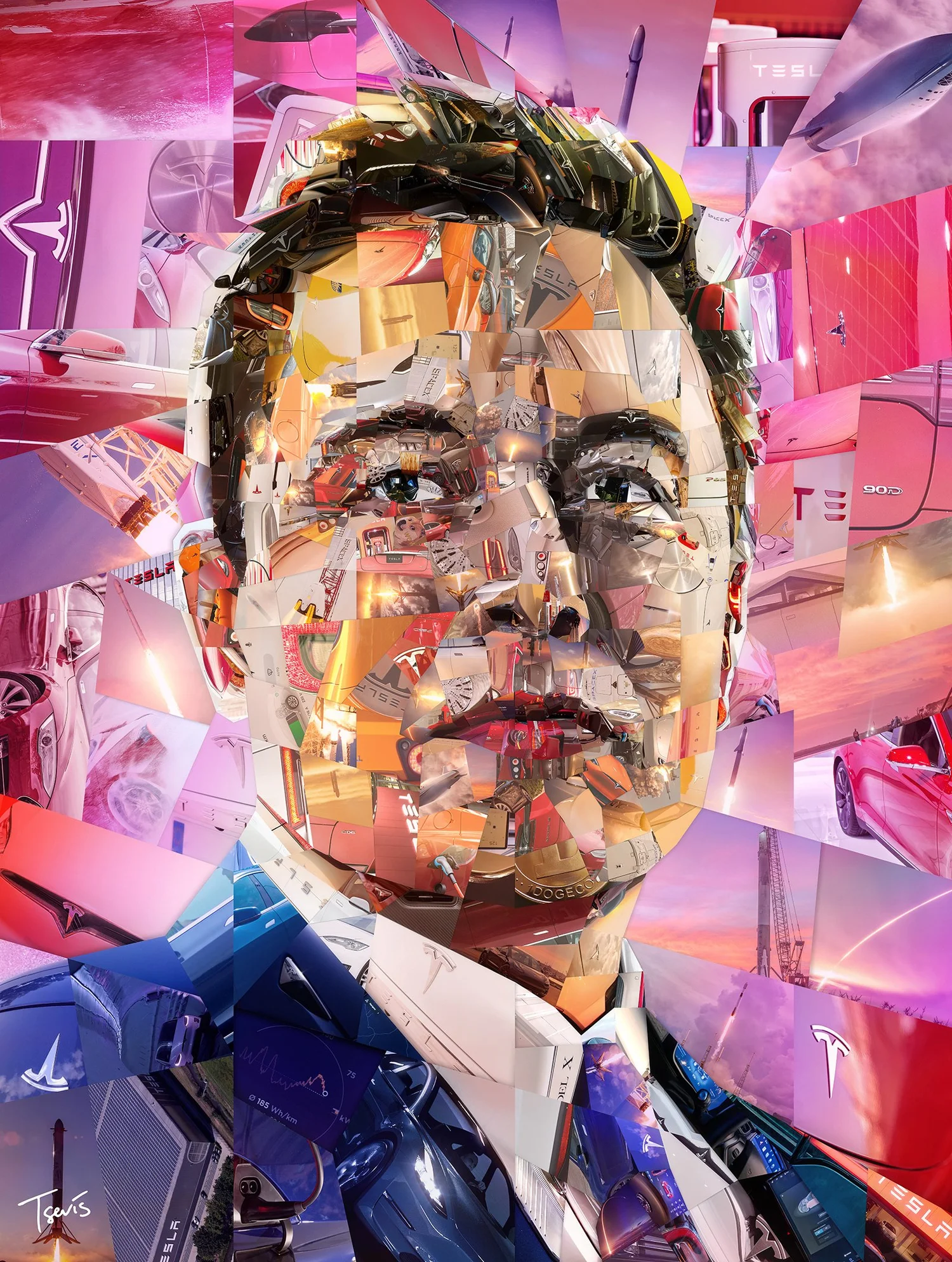
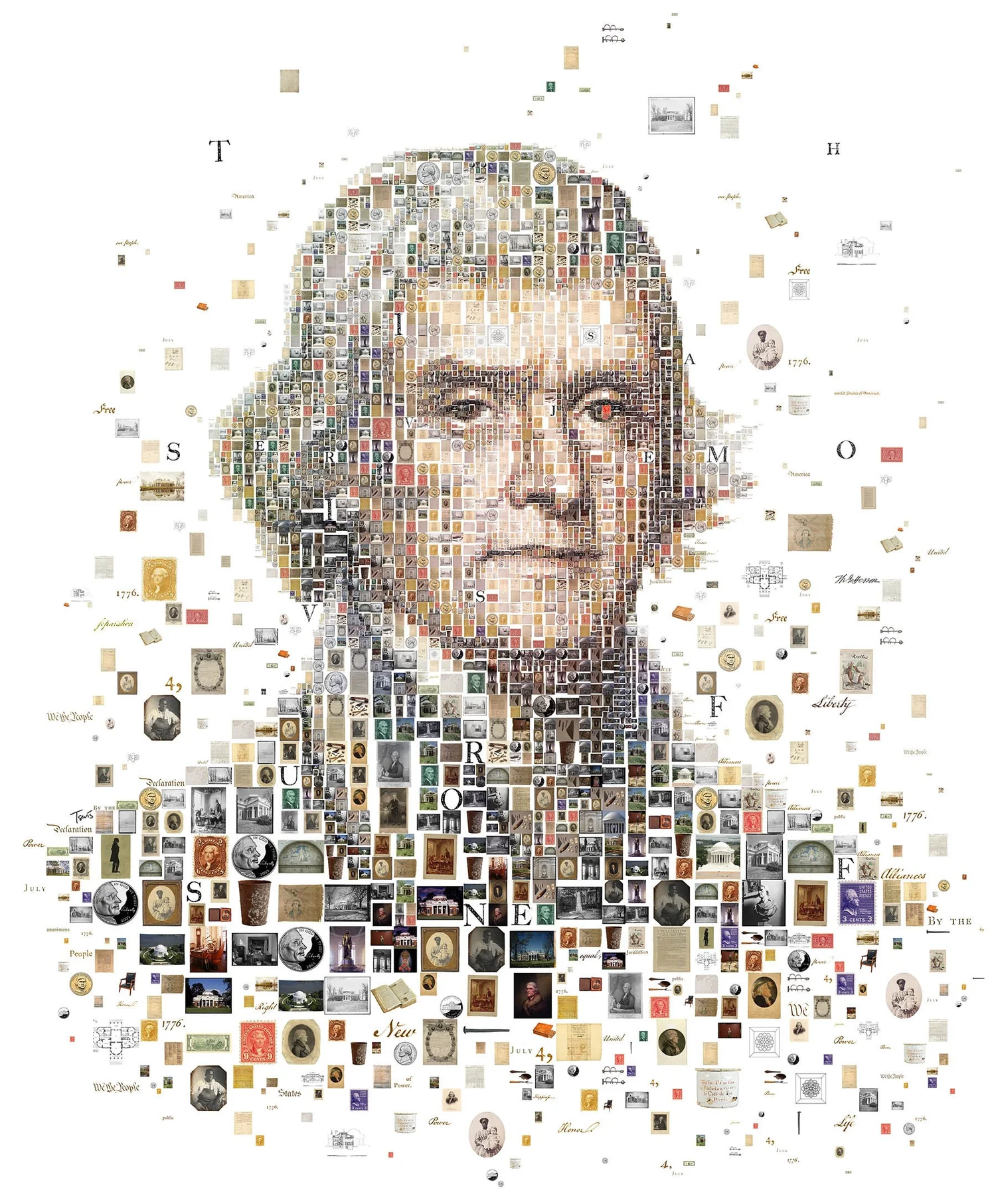
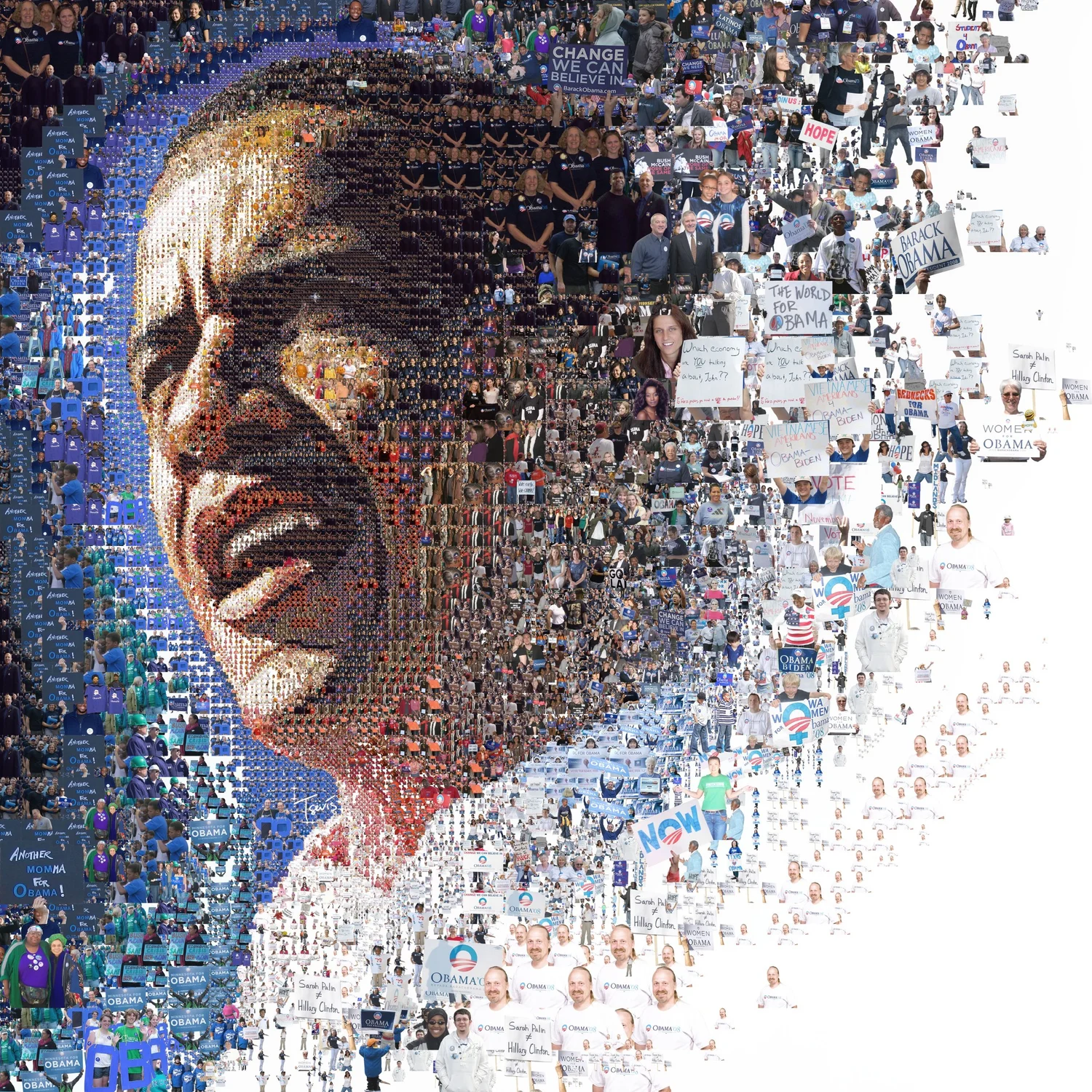
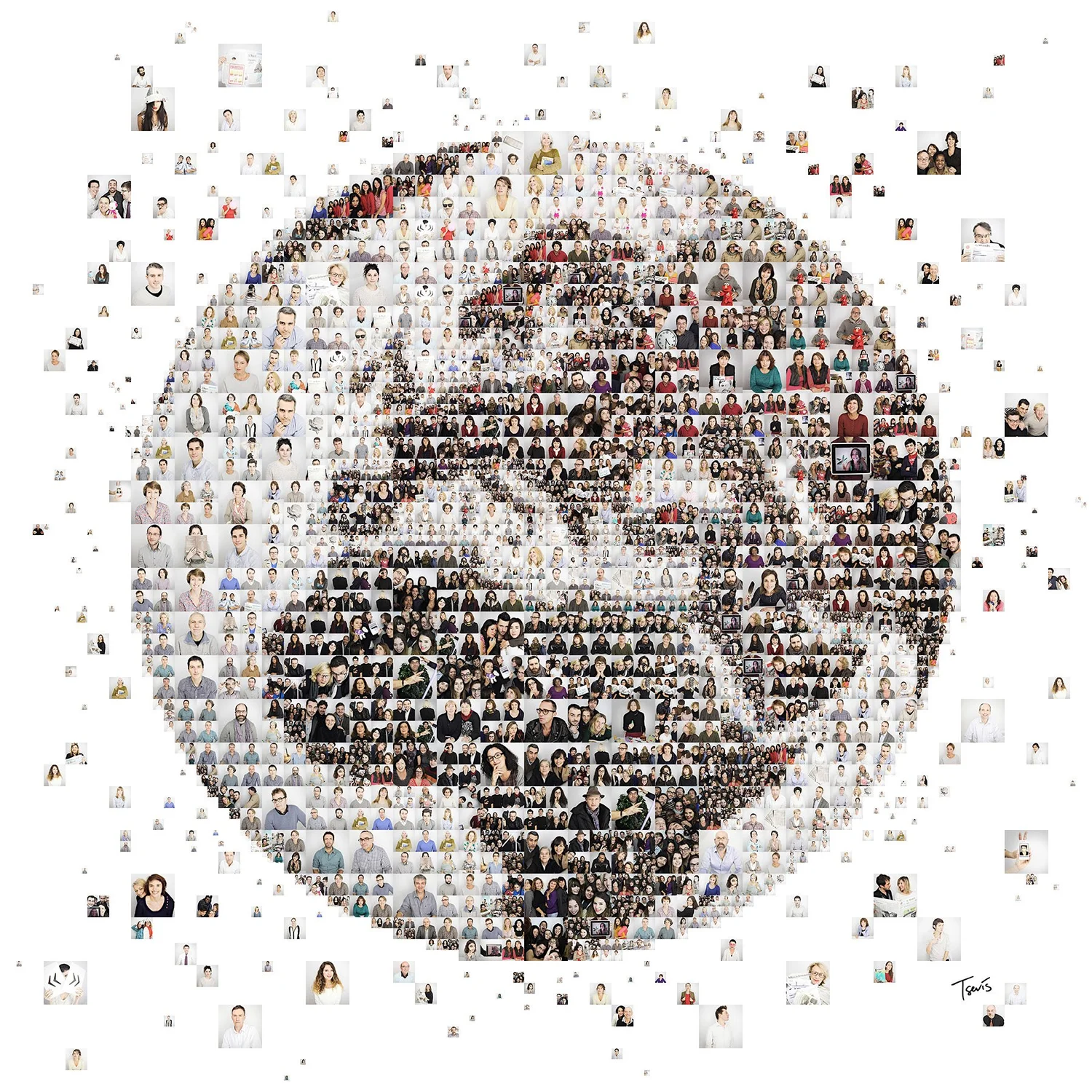
So the photographs are chosen for the subject before they are chosen for their colour. Elon Musk is built from the cars, rockets and machines of his companies. Thomas Jefferson is built from his own archives. Barack Obama is built from his supporters, and the globe for Le Monde from the people who make the newspaper. A viewer who comes close finds the reason for the portrait in its pieces.
Variable sizes and organic grids
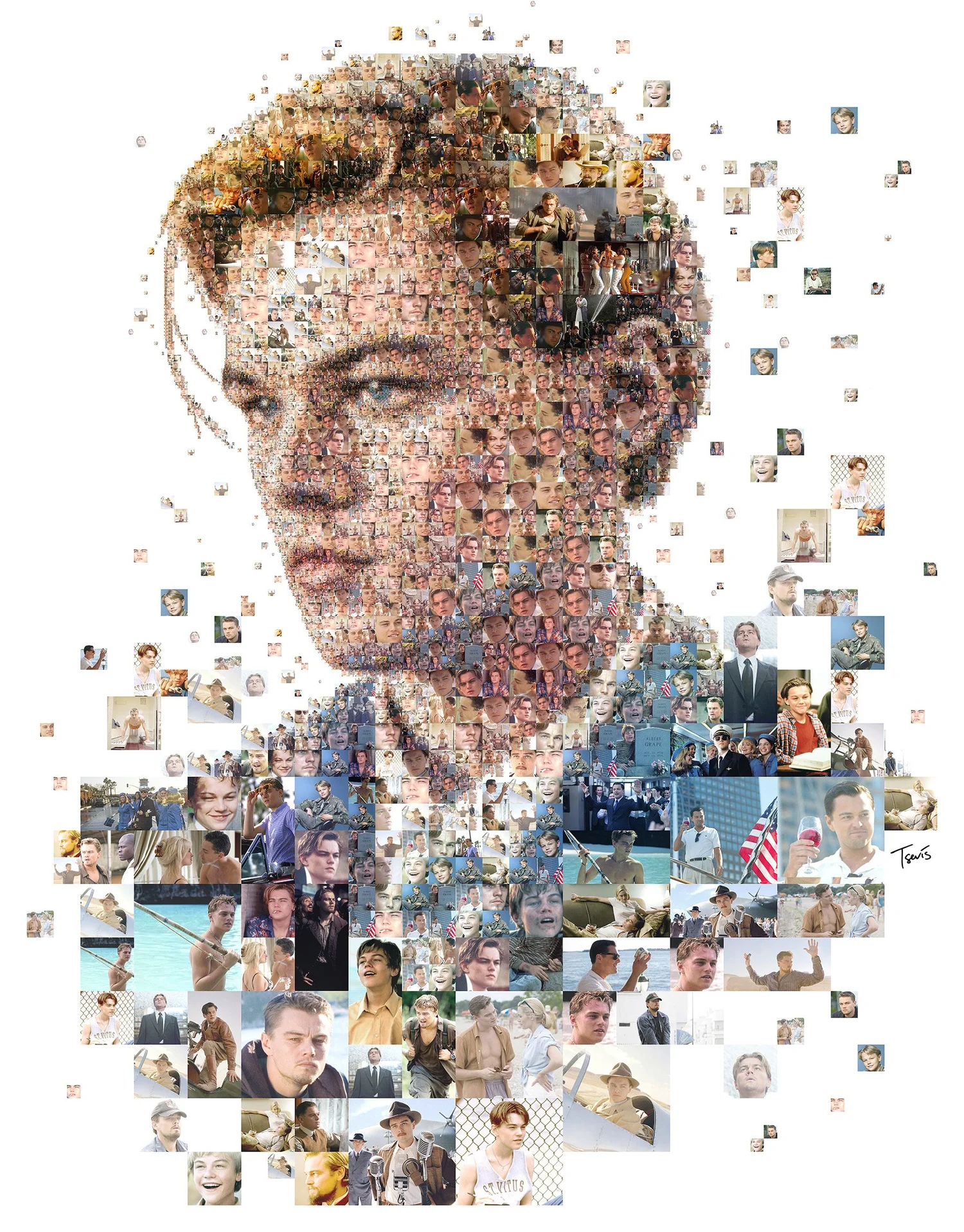
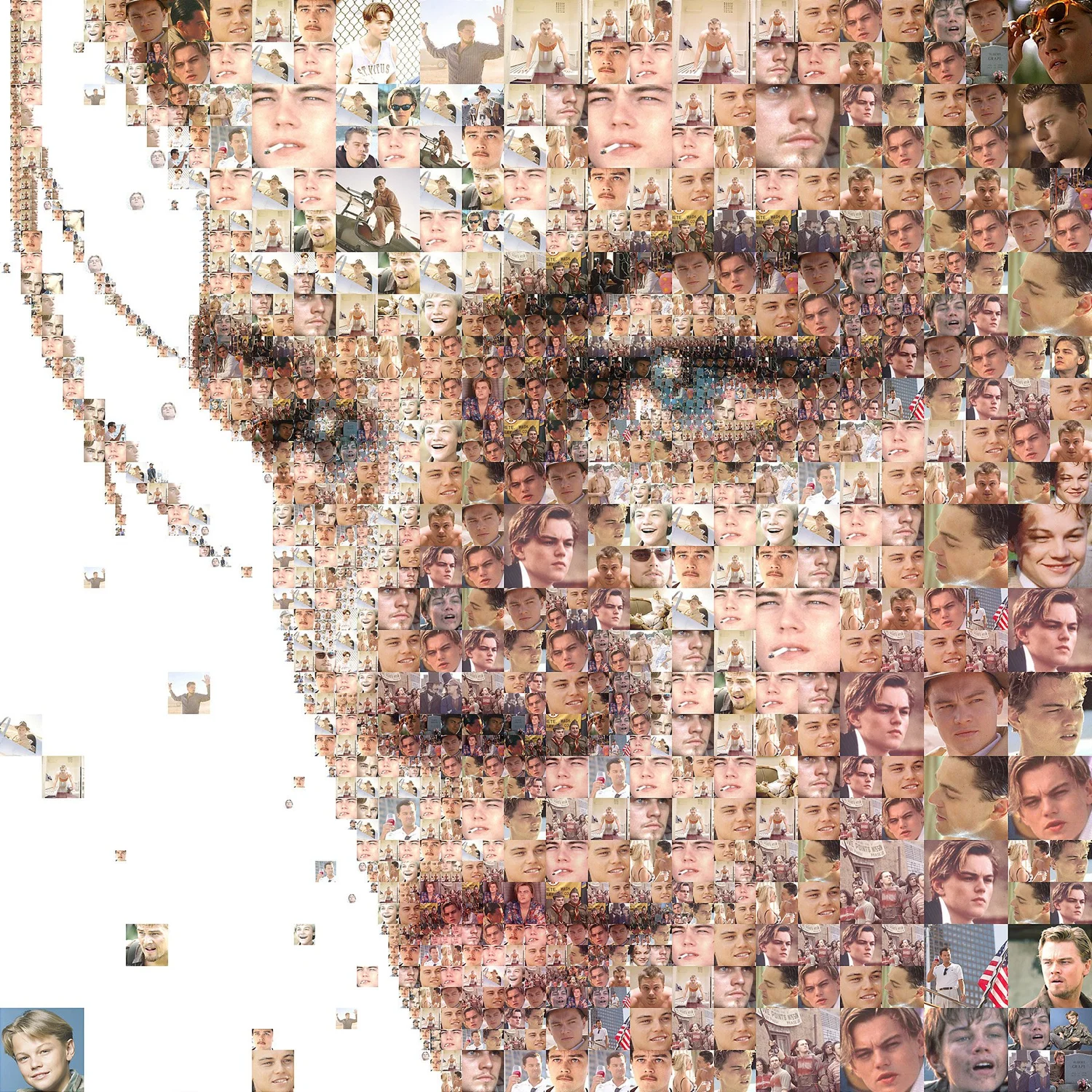
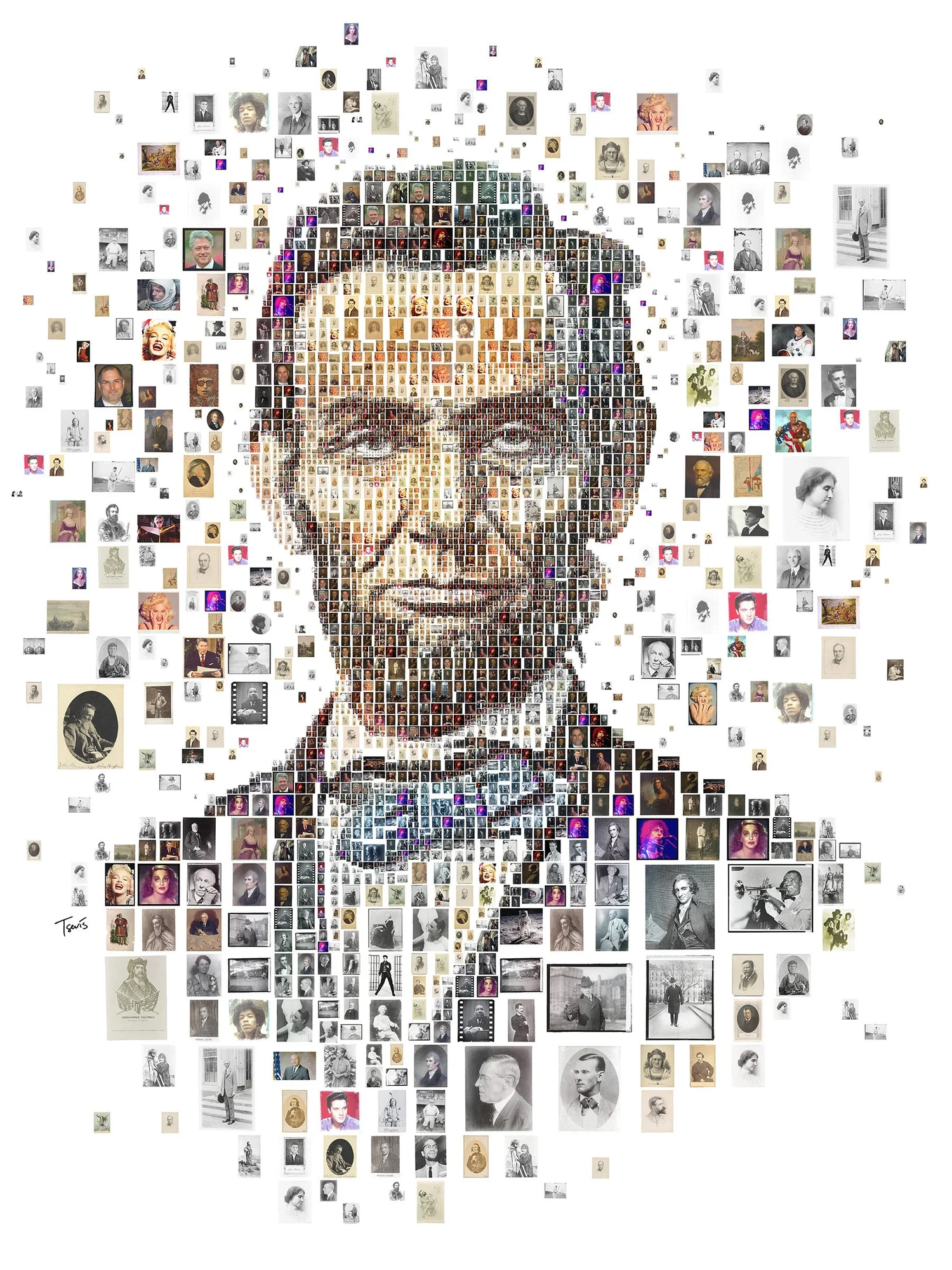
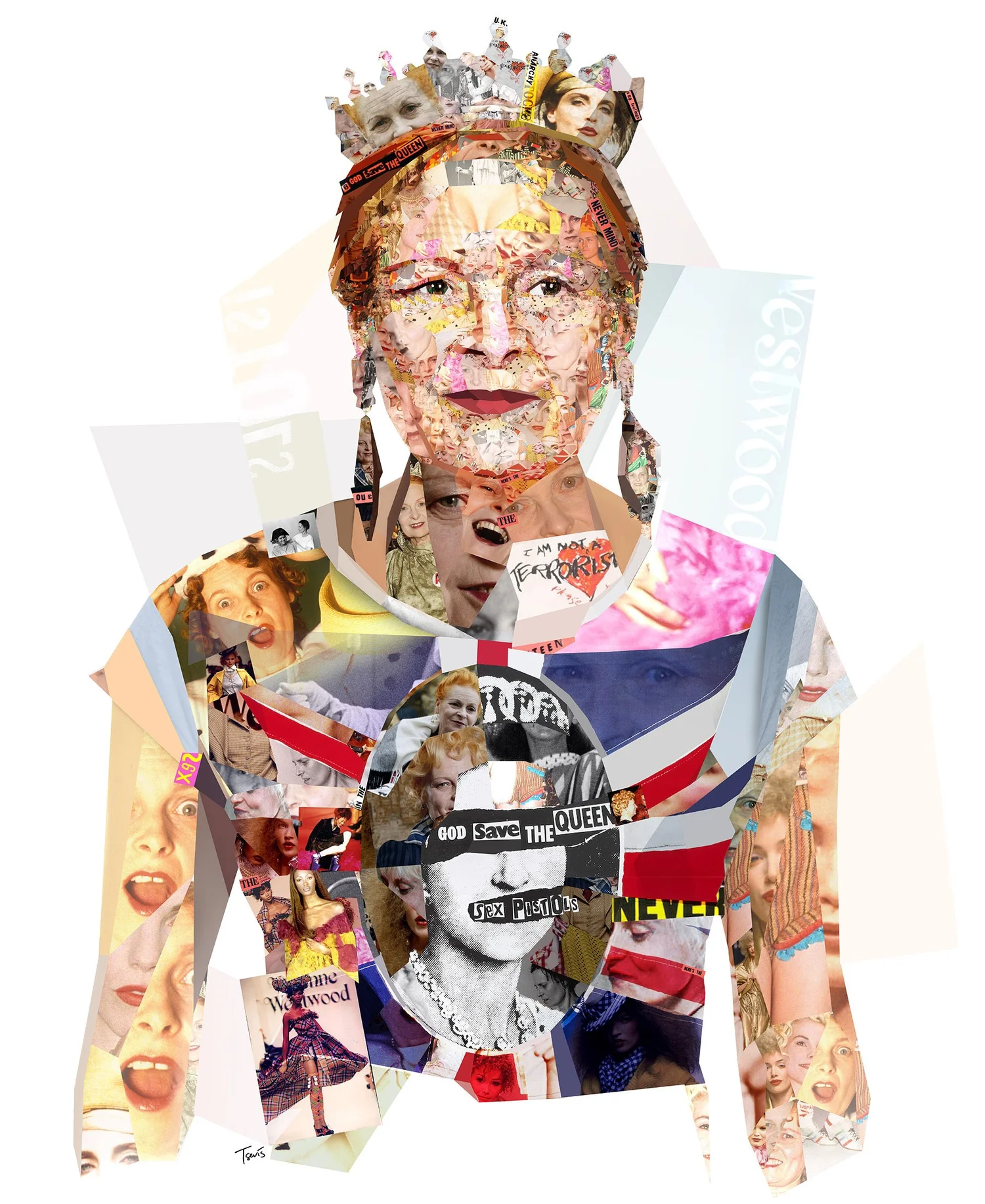
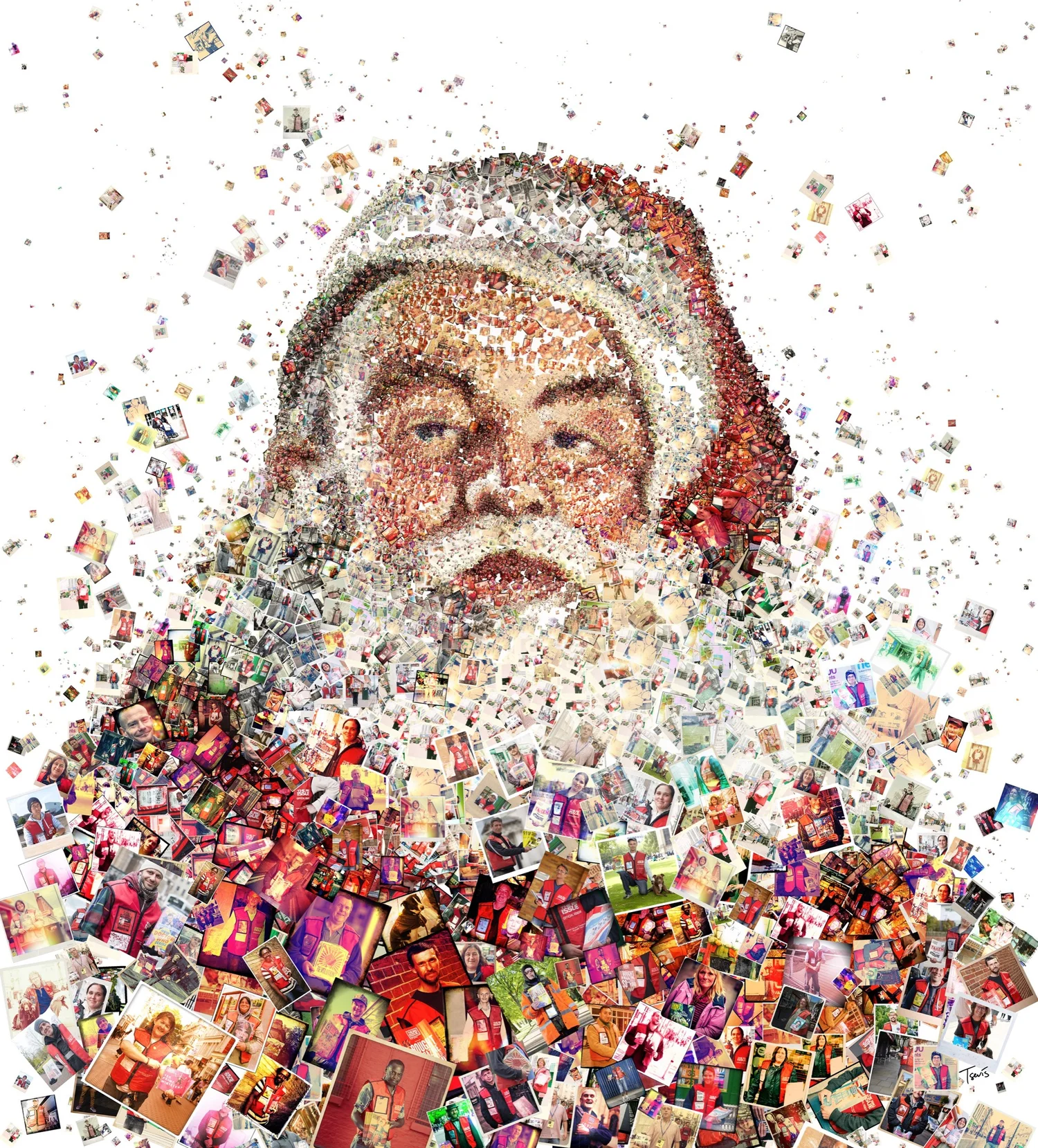
Most photo mosaics, then and now, are built on a regular grid: every photograph the same size, in rows and columns. I began varying the size of the pieces in my digital mosaics in the late 1990s, and as far as I know I was the first to do so. Small photographs gather where the image needs detail, around the eyes and the mouth; large ones carry the quiet areas and the edges. The portraits of Leonardo DiCaprio and Abraham Lincoln on this page are built that way: the face is made of the smallest pieces, the shoulders of the largest. So are the Steve Jobs portrait for Fortune (2008), the portraits for the IKEA campaign Long Live Diversity (2009) and the Big Santa for The Big Issue (2013) below. In the research literature, mosaics with pieces of different sizes appear in the 2000s, in jigsaw mosaics and in adaptive subdivisions such as quadtrees.3, 4
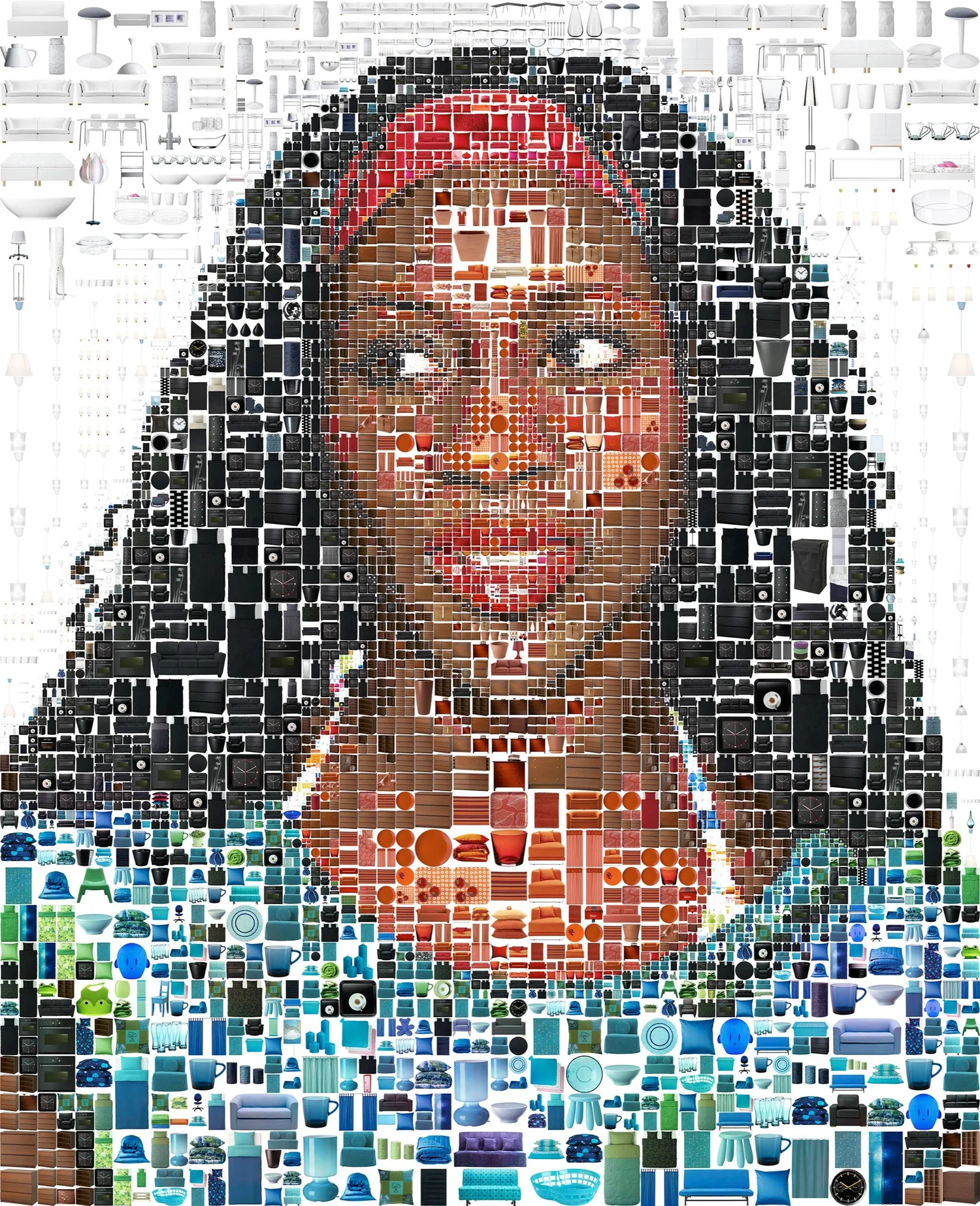
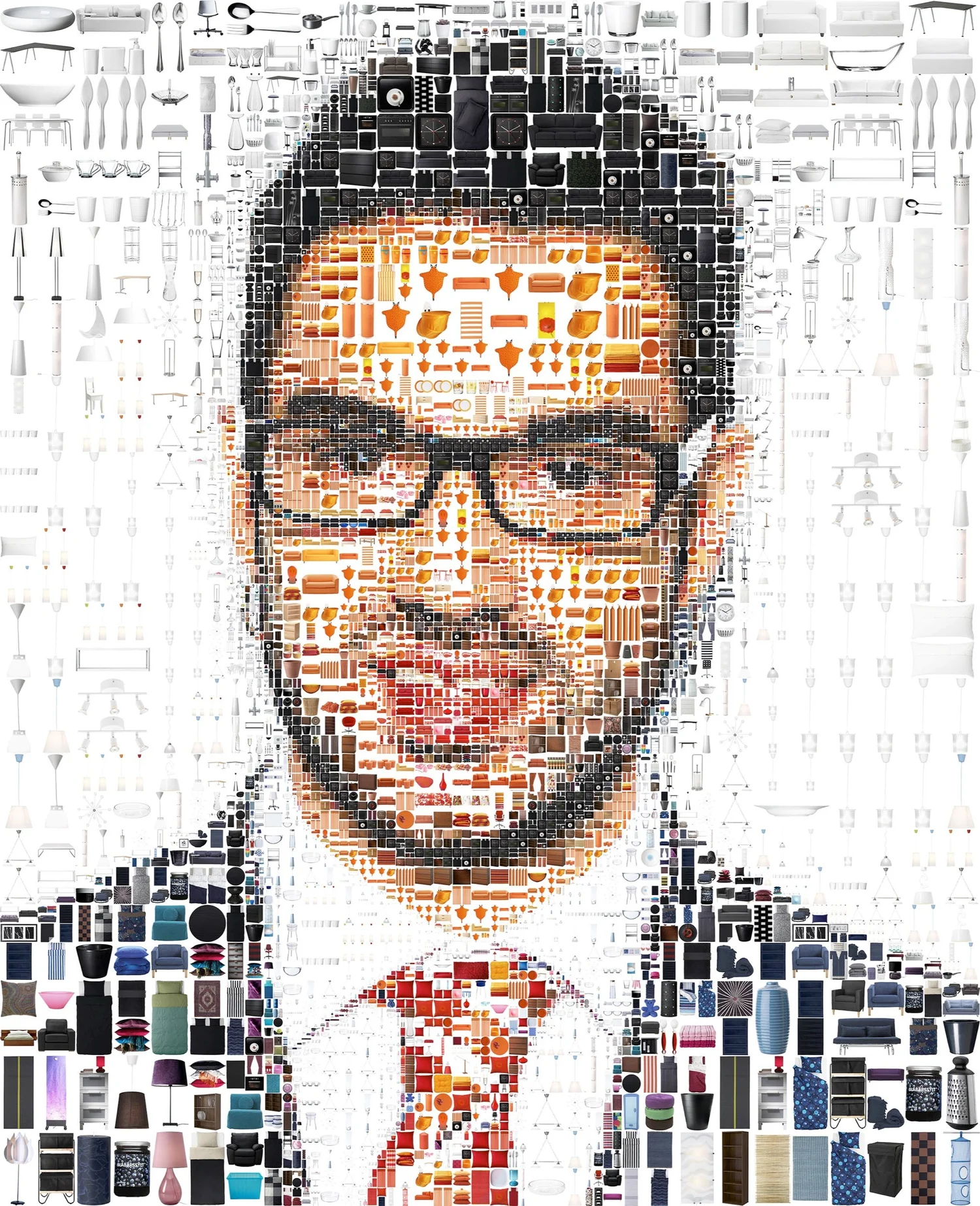
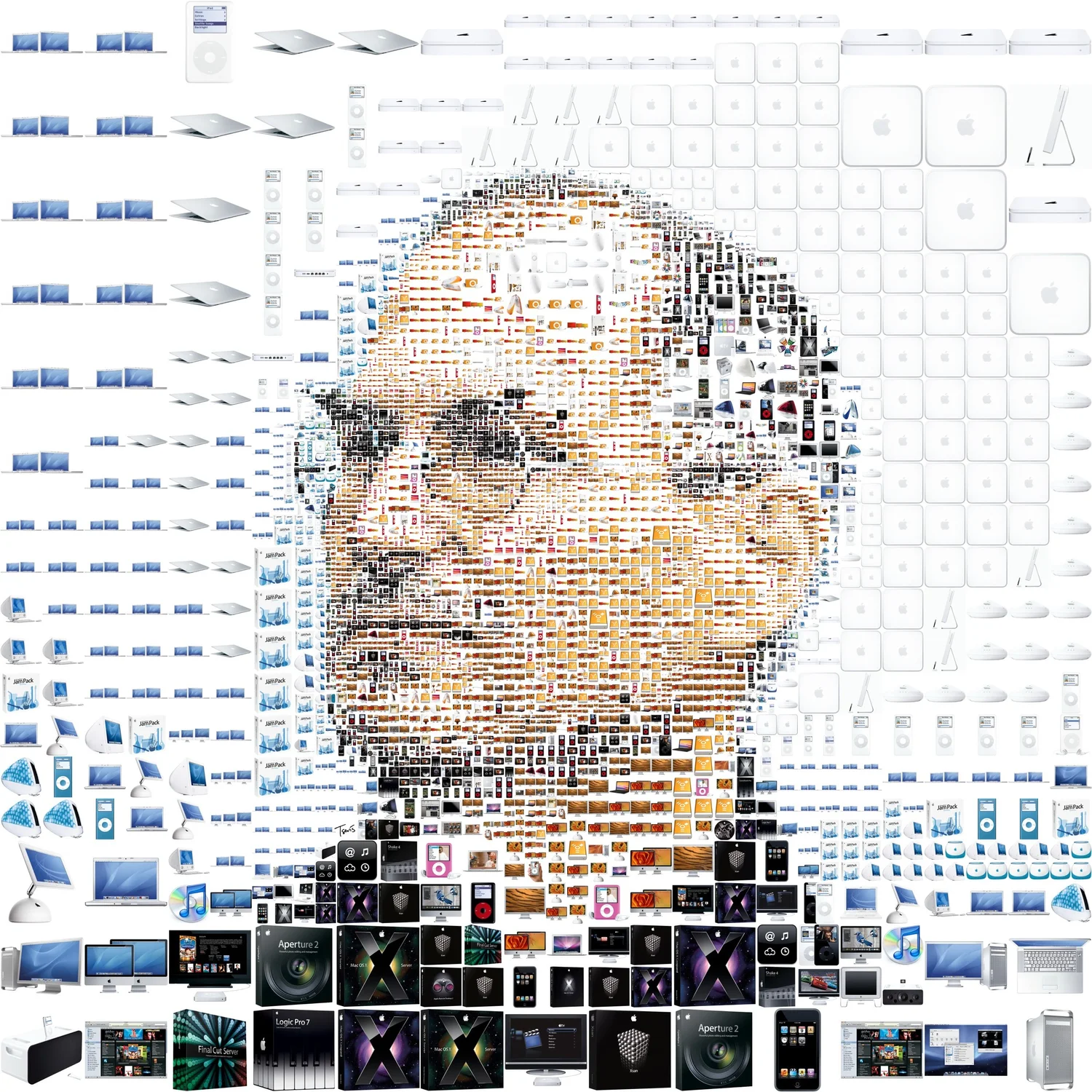
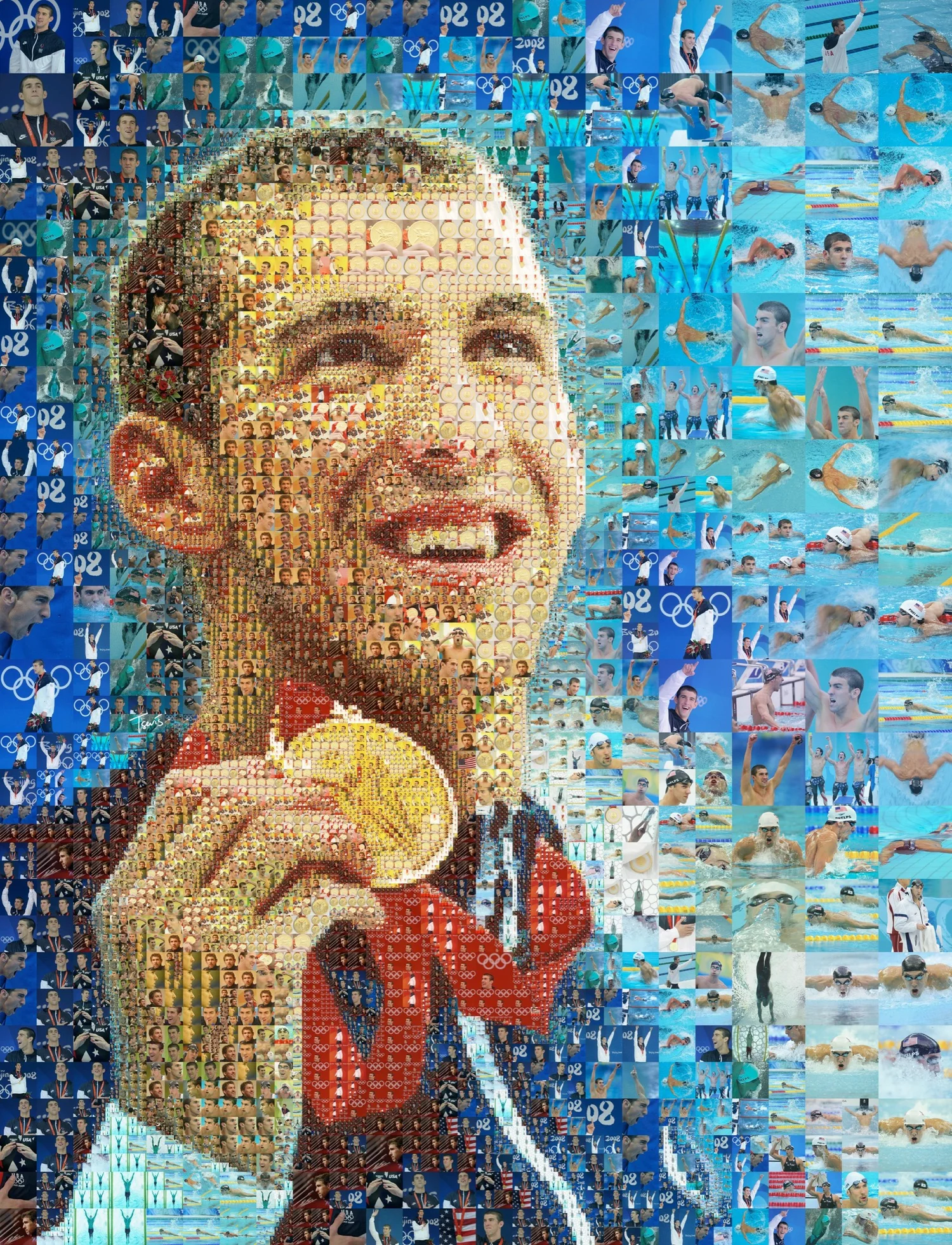
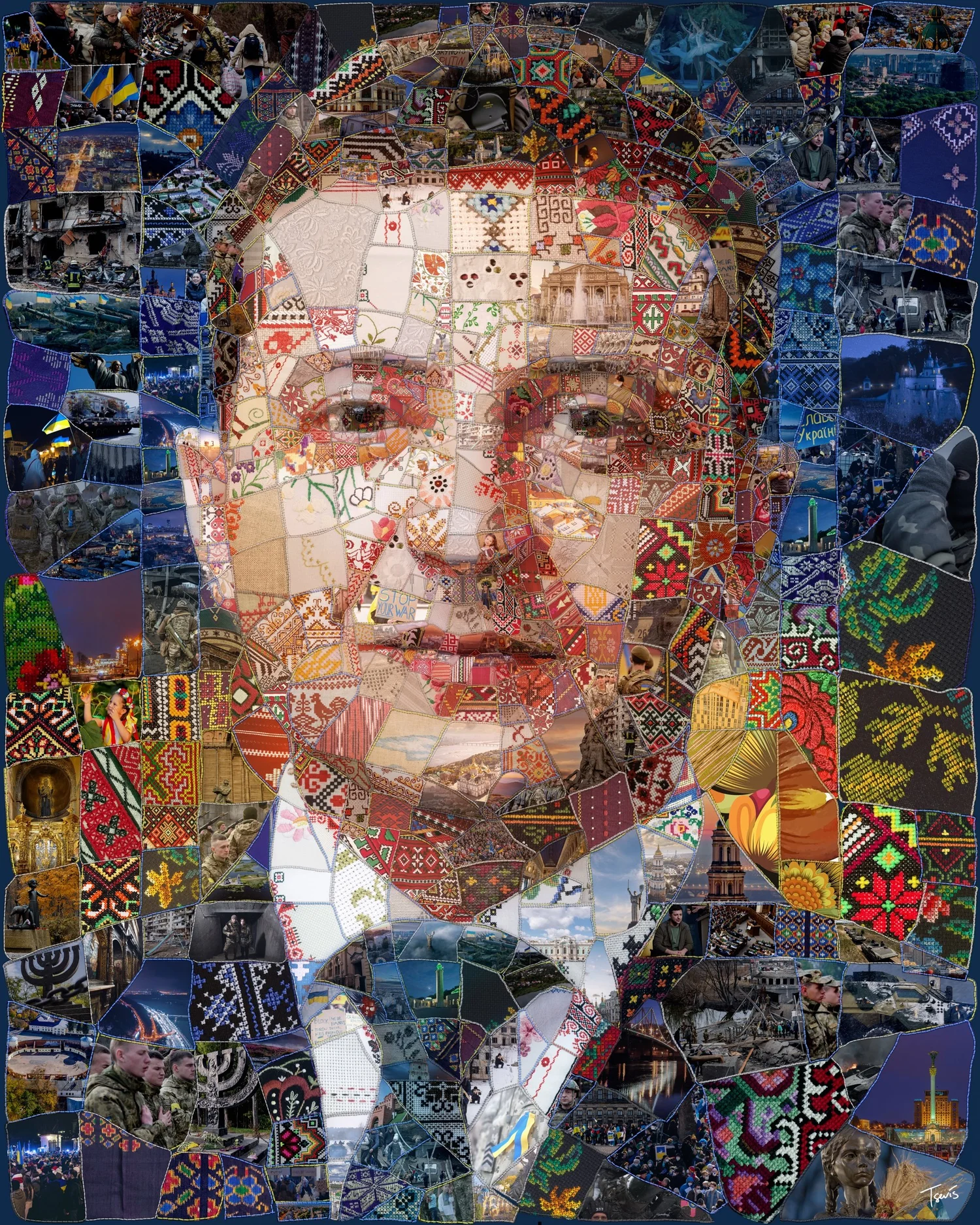
I have also built mosaics on grids that are not geometric. Instead of squares in rows, the cells follow the forms of the image, its contours and the direction of its lines, or they look grown rather than drawn, the way the andamento of an ancient mosaic follows the curve of a face or a robe. The grid then stops being a neutral container and becomes part of what the picture says. The portrait of Volodymyr Zelenskyy (2022) is one of them: its cells are irregular patches, stitched together like a quilt.
Several of these grids are compared on one portrait in The Four Layers of a Mosaic. How variable sizes and irregular cells are computed is in The Mathematics of the Mosaic, and why pieces of different sizes guide the eye is the subject of Why a Mosaic Works.
Accuracy and discernibility
Jeff Orchard and Craig Kaplan describe every image mosaic as a balance between two opposing goals, accuracy and discernibility.5 The more exactly the pieces reproduce the main image, the harder it becomes to recognise what each piece shows, and the reverse.
Many photo mosaic programs settle it in one direction. They lay a faint copy of the main image over the tiles, or tint each tile towards the colour of its cell, with a setting for how much; open-source tools and commercial graphics software both offer it.6, 7 Adam Finkelstein and Marisa Range studied a careful form of the same idea in 1998, adjusting the colours of the chosen images towards the target.8 Used heavily, it makes the large picture look sharp at once, but the small photographs turn into coloured squares and the second reading is lost. The viewer who walks up to the work finds nothing there.
Whenever someone compares methods, I want to know whether the photographs were recoloured, cropped or blended with the main image, and by how much. These are the questions I would ask of any photographic mosaic, ours included:
- Can you read the small photographs? From close, each one should still be a photograph of something.
- Were they blended with the main image or recoloured? And if so, how far. When the main image can be seen lying over the photographs, the photographs have stopped working.
- How often does one photograph repeat? Repetition is easy to see across a large surface.
- Do the photographs belong to the subject? Chosen for their meaning, or only for their colour.
- Does it hold at its real size? A mosaic for a magazine page and one for a wall are designed differently.
A short history
The idea is older than the photographs in it. At Bell Labs in 1967, Kenneth Knowlton and Leon Harmon rebuilt a photograph of a reclining figure from small symbols of different density in Studies in Perception I: a mosaic whose pieces were not yet pictures.9 In 1973 Harmon showed in Scientific American that a portrait of Lincoln reduced to coarse blocks can still be recognised.10 Salvador Dalí answered in paint, around 1976, with a canvas whose title describes it: Gala looking at the Mediterranean, which from twenty metres becomes a portrait of Abraham Lincoln.11, 1
By the early 1990s the pieces were becoming photographs. Joseph Francis describes his Live from Bell Labs poster, made early in 1993 at R/Greenberg Associates, as the first image his mosaic software produced.12 Silvers’s thesis followed in 1996, with a book, Photomosaics, in 1997 and a US patent granted in 2000.1, 13, 14 Research since then has given the pieces irregular outlines,3 set them in motion in video15 and, most recently, generated them with diffusion models.
That story is told paper by paper in How Mosaic Algorithms Developed, 1966–2026, and its sources are listed in the Annotated Bibliography of Artistic Image Mosaics, 1967–2026.
Photo mosaic, algorithmic mosaic and image mosaic
A photographic mosaic is one member of a larger family, and surveys of digital mosaics treat it as one kind among several.16 When the pieces can be anything, such as numbers, letters, icons, objects or shapes, and a program places them by rules, we speak of an algorithmic mosaic. A photo mosaic is the case in which every piece is a photograph. The terms are defined in the Mosaic Glossary.
In mapping and remote sensing, “photo mosaic” also means something else: overlapping aerial or satellite photographs of the ground joined into one continuous image. It is a technique of assembly, not of representation, and it shares only the name.
From a magazine page to a wall
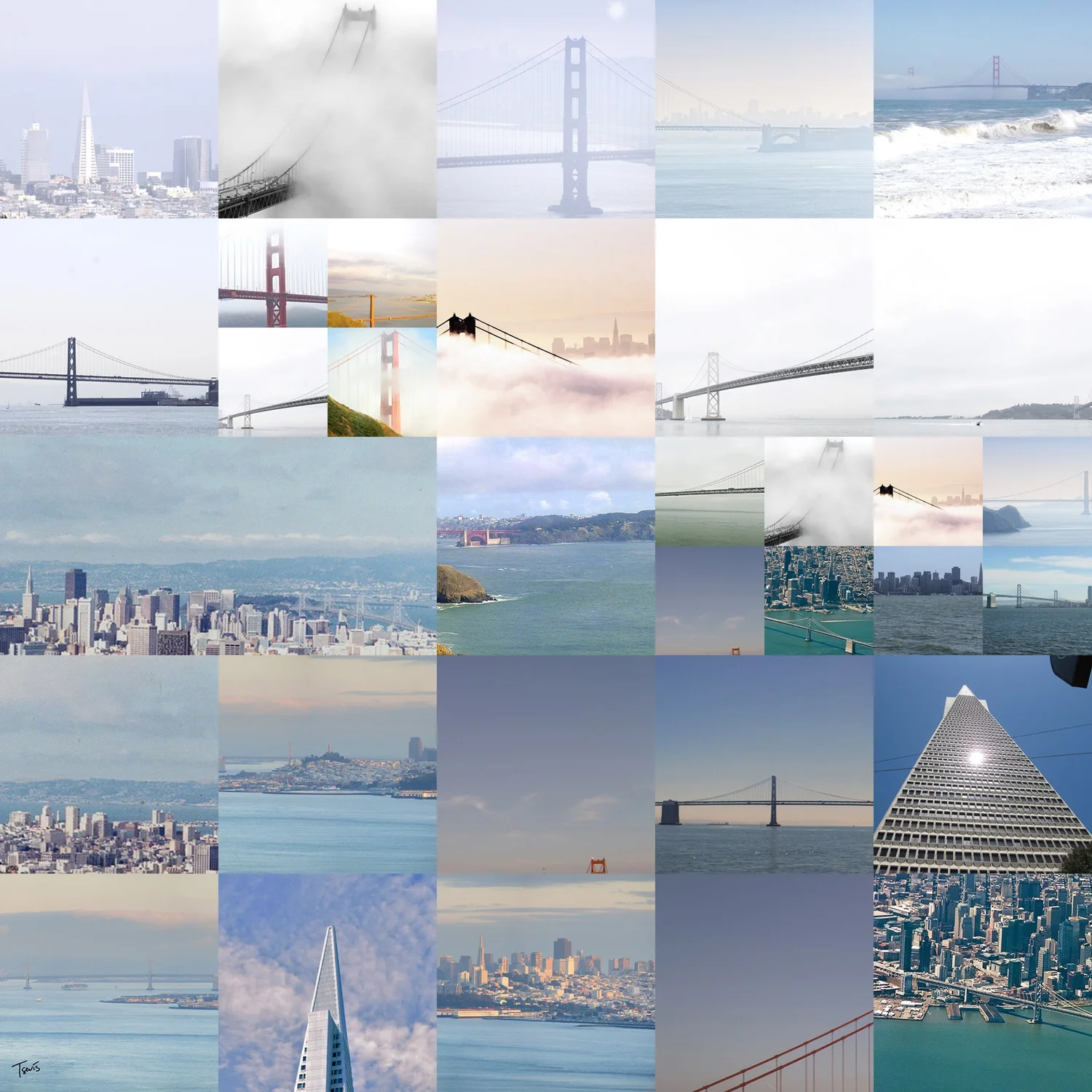
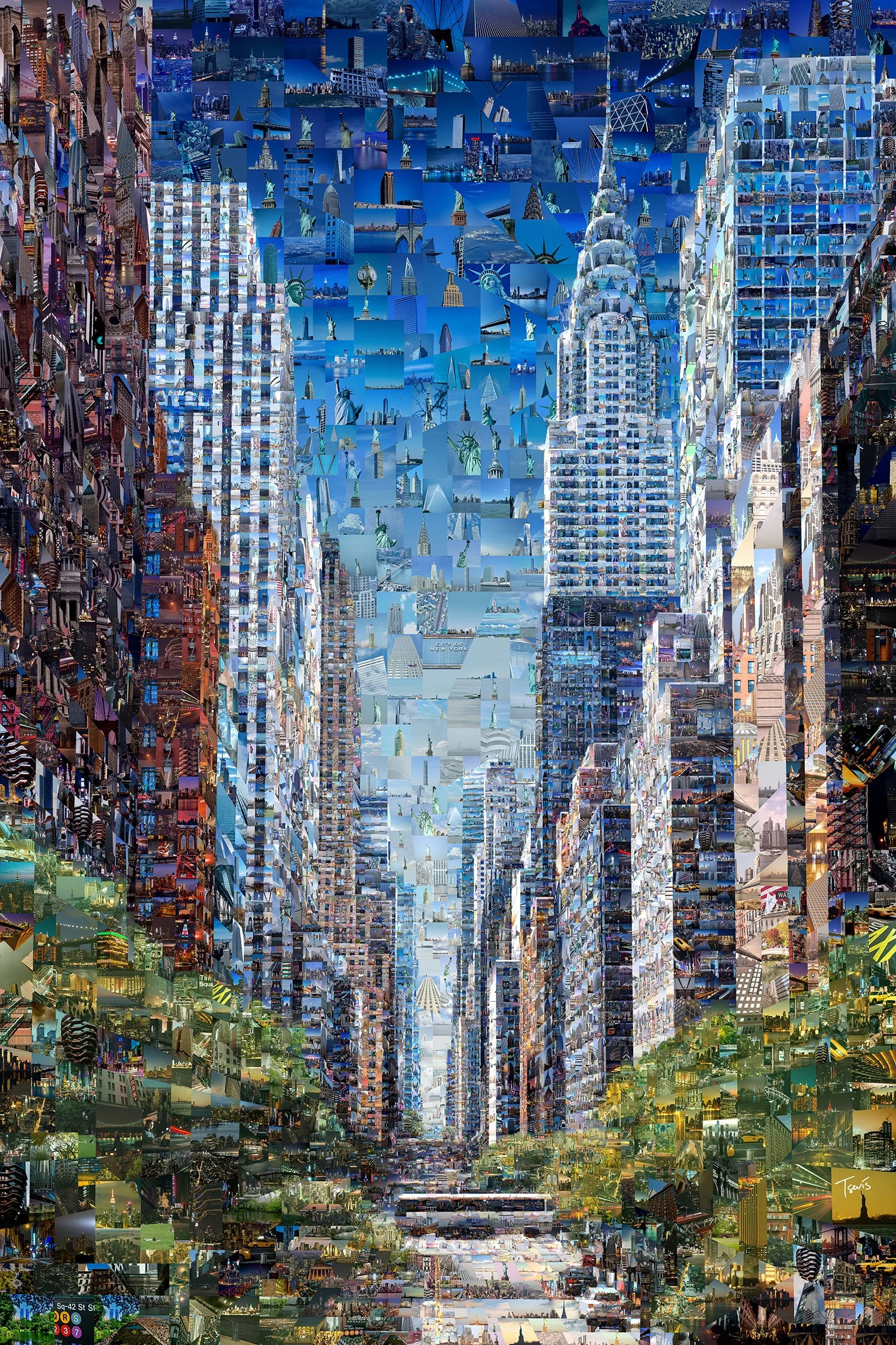
The same rules hold at every size, but the distances change. A magazine cover is read at arm’s length, so the main image has to appear at once and the photographs reward a second look. A mural in an airport lounge is seen from across the room, from a chair and from a step away. For Moments Gate, the Golden Gate Bridge we made for the Delta Air Lines Sky Club at San Francisco International Airport in 2015, the small photographs had to hold up at the closest of those distances.
Why the eye finds the figure in the fragments, and how distance changes what it sees, is the subject of Why a Mosaic Works.
Questions
What is a photo mosaic?
A picture made of smaller photographs, each chosen because its colours and tones match one part of a larger image. From a distance the small photographs merge into the large picture; from close they can be seen one by one.
Are photo mosaic, photographic mosaic and photomosaic the same thing?
Yes, they are three names for the same technique. Robert Silvers used the word in the title of his 1996 MIT thesis, Photomosaics: Putting Pictures in their Place, and as the title of his 1997 book.
Who invented the photo mosaic?
No single person. Kenneth Knowlton and Leon Harmon built a picture from small symbols at Bell Labs in 1967. Joseph Francis made a computer-made photographic mosaic poster early in 1993. Robert Silvers described a matching method in his 1996 MIT thesis and patented it.
How is a photo mosaic made?
Choose a main image, gather a library of photographs, divide the main image into cells, and choose a photograph for each cell by comparing colours and tones, with limits on how often one photograph may repeat. A program does the matching; the image and the library are the designer’s choice.
What is a variable-size photo mosaic?
A photo mosaic whose photographs change in size across the picture: small where the image needs detail, large in the quiet areas, so that the construction itself guides the eye. Charis Tsevis has made them since the late 1990s.
What makes a good photo mosaic?
Both readings work. The main image is clear from a distance, and the small photographs can still be recognised from close, without an overlay of the main image hiding them. Photographs chosen for their meaning, not only for their colour, make the work say something.
What is the difference between a photo mosaic and an algorithmic mosaic?
A photo mosaic uses photographs as its pieces. An algorithmic mosaic is the wider family: its pieces can be photographs, numbers, letters, icons or shapes, placed by rules that a program follows.
What is a photo mosaic in mapping?
In aerial photography and remote sensing, a photo mosaic is a set of overlapping photographs of the ground joined into one continuous image. It is a different technique with the same name.
Can I commission a photographic mosaic?
Yes. Tsevis Studio makes photographic mosaics on commission for publications, brands and public spaces, among them TIME, Smithsonian, Glamour UK, Le Monde, Harper’s Bazaar and Delta Air Lines. Contact the studio.
Further reading
- What Is a Mosaic?Meaning, materials, techniques, types and history: the answer, from pebbles to algorithms.
- The Four Layers of a MosaicOne portrait, twenty-seven mosaics: the grid, the tiles and the matching rule, changed one at a time.
- Why a Mosaic WorksPerception, Gestalt and distance: why the eye finds the figure in the fragments.
- The Mathematics of the MosaicTessellation, Voronoi cells, matching and dithering, written down as equations.
- Mosaic GlossaryThe words of the mosaic, from tessera and andamento to matching rule.
- The Tradition We Work InThe history of the mosaic, from the clay cones of Uruk to Bell Labs.
- Research, Science and TechnologyMatching, importance, Gestalt and geometry: the knowledge behind our instruments.
- Algorithmic MosaicWhat an algorithmic mosaic is, and how we make one.
- ApplicationsWhere mosaics work today: campaigns, editorial, architecture, corporate art and gifts.
- Algorithmic Mosaic ArtistsThe people who shaped the mosaic made with computers, from Bell Labs to today.
- Photographic Mosaics: How the Algorithms DevelopedSixty years of mosaic algorithms, from Bell Labs to diffusion models.
- Mosaic StylesThe styles of our digital work, from classic grids to maps and stained glass.
References
- Robert S. Silvers, Photomosaics: Putting Pictures in their Place, MS thesis, Program in Media Arts and Sciences, Massachusetts Institute of Technology, 1996. hdl.handle.net
- Nicholas Tran, “Generating Photomosaics: An Empirical Study,” in Proceedings of the 1999 ACM Symposium on Applied Computing (San Antonio, 1999), 105–109. doi:10.1145/298151.298213
- Junhwan Kim and Fabio Pellacini, “Jigsaw Image Mosaics,” ACM Transactions on Graphics 21, no. 3 (Proceedings of SIGGRAPH 2002): 657–664. doi:10.1145/566570.566633
- Gianpiero Di Blasi, Giovanni Gallo and Maria Pia Petralia, “Smart Ideas for Photomosaic Rendering,” in Proceedings of the 4th Eurographics Italian Chapter Conference (Eurographics Association, 2006), 267–271. doi:10.2312/LocalChapterEvents/ItalianChapConf2006/267-271
- Jeff Orchard and Craig S. Kaplan, “Cut-Out Image Mosaics,” in Proceedings of the 6th International Symposium on Non-Photorealistic Animation and Rendering (NPAR 2008), 79–87. doi:10.1145/1377980.1377997
- Mopy, a photographic mosaic tool, documentation of the alpha blending option, accessed 22 October 2026. mopy.sourceforge.net
- Corel, CorelDRAW help, “Bitmap mosaics (PhotoCocktail effect),” blending option, accessed 22 October 2026. product.corel.com
- Adam Finkelstein and Marisa Range, “Image Mosaics,” in Electronic Publishing, Artistic Imaging, and Digital Typography, Lecture Notes in Computer Science 1375 (Berlin: Springer, 1998), 11–22. doi:10.1007/BFb0053259
- Victoria and Albert Museum, Ken Knowlton and Leon Harmon, Studies in Perception I (also titled Computer Nude), screenprint, 1967, collection record E.35-2020. collections.vam.ac.uk
- Leon D. Harmon, “The Recognition of Faces,” Scientific American 229, no. 5 (November 1973): 70–82. doi:10.1038/scientificamerican1173-70
- Fundació Gala-Salvador Dalí, Catalogue Raisonné of Paintings, no. P 871, Painting of Gala looking at the Mediterranean sea which from a distance of 20 meters is transformed into a portrait of Abraham Lincoln (Homage to Rothko), c. 1976, The Dalí Museum, St. Petersburg, Florida. catalogues.salvador-dali.org
- Joseph Francis, “History of Photo Mosaics,” digitalartform.com, 5 January 2017 (repost of an earlier blog entry). digitalartform.com
- Robert Silvers, Photomosaics, edited by Michael Hawley (New York: Henry Holt, 1997).
- Robert S. Silvers, “Digital composition of a mosaic image,” US Patent 6,137,498, assigned to Runaway Technology, priority 2 January 1997, filed 27 October 1997, granted 24 October 2000. patents.google.com
- Allison W. Klein, Tyler Grant, Adam Finkelstein and Michael F. Cohen, “Video Mosaics,” in Proceedings of the 2nd International Symposium on Non-Photorealistic Animation and Rendering (NPAR 2002), 21–28. doi:10.1145/508530.508534
- Sebastiano Battiato, Gianpiero Di Blasi, Giovanni Maria Farinella and Giovanni Gallo, “Digital Mosaic Frameworks – An Overview,” Computer Graphics Forum 26, no. 4 (2007): 794–812. doi:10.1111/j.1467-8659.2007.01021.x
About the author
Charis Tsevis is a Greek visual designer and computational artist educated in Athens and Milan. A designer since the late 1980s, he has worked with mosaics for more than three decades and builds his own tools for them. He has taught design thinking, colour theory and Gestalt psychology at art colleges since 1996. With Vira Konstanta he runs Tsevis Studio, which makes photographic and algorithmic mosaics on commission for publications, brands and public spaces. About the studio.
Version and how to cite
Version 1.0, 2026-10-23. Corrections are listed here with their dates.
Tsevis, Charis. “The Photographic Mosaic: Photo Mosaic History, Method and Art.” Tsevis Studio, 2026-10-23. https://www.tsevis.com/photographic-mosaic