
Tsevis Studio
Algorithmic Mosaic Artists, from Bell Labs to Today
A rule decides where each piece goes. Up close, the parts; from afar, the whole.Tsevis Studio
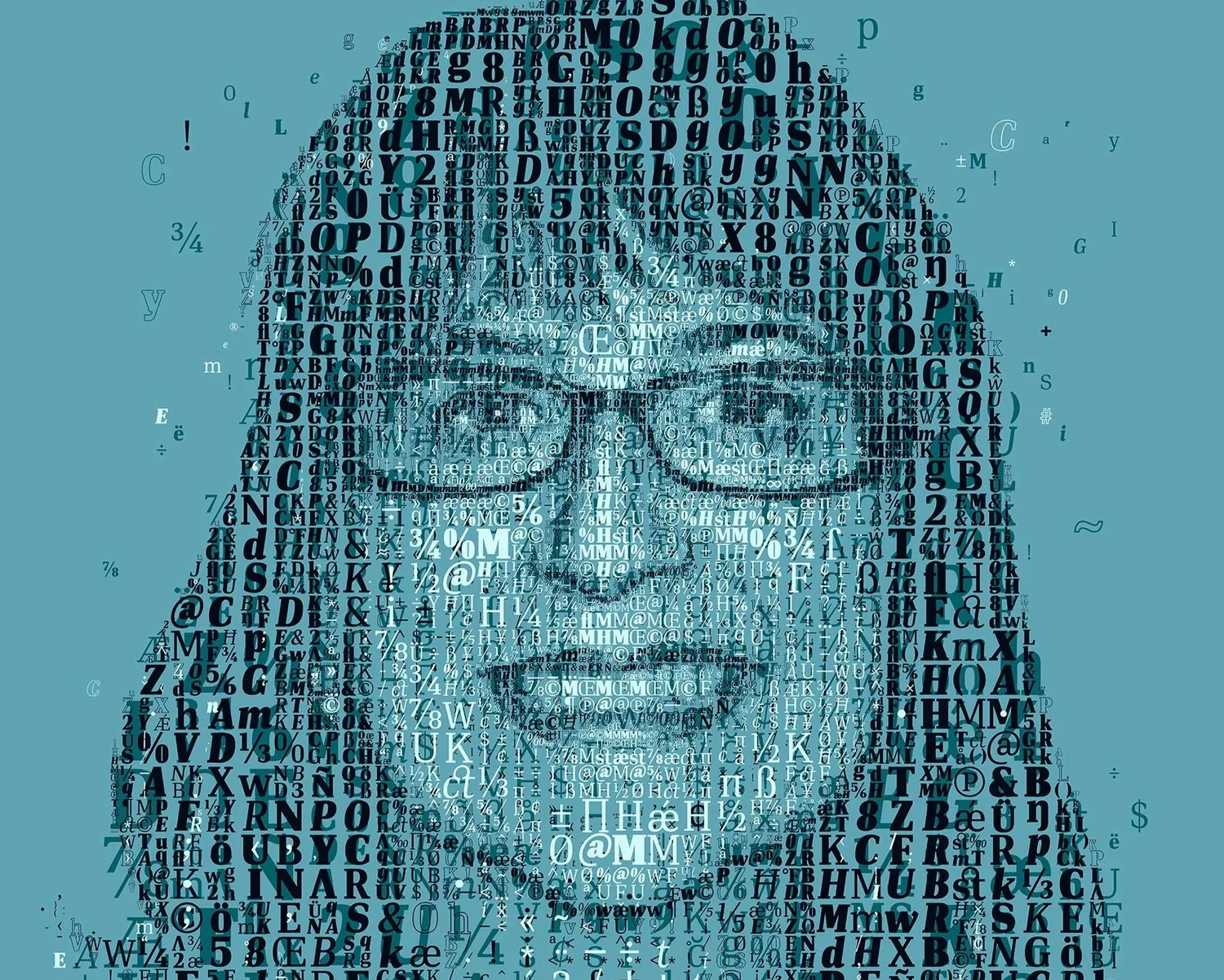
Opening image: Mary Higgins, typographic portrait for Emerson College, Tsevis Studio, 2024.
The algorithmic mosaic was made by a short line of artists and scientists. Ken Knowlton and Leon Harmon built the first computer mosaic at Bell Labs in 1967. Lillian Schwartz worked with Knowlton’s tools for artists. Salvador Dalí turned Harmon’s Lincoln into a painting in 1976. In the 1990s, researchers made photographs the pieces. Today Charis Tsevis and Tsevis Studio, in Paphos, Cyprus, continue the practice. A designer since the late 1980s, Charis Tsevis has worked with mosaics for more than three decades. In the 1990s he was a pioneer in freeing the digital mosaic from a single tile size and from the rectangular grid, with tesserae of many sizes that follow the Gestalt theory of perceptual space. The studio builds its own software for this work. Other artists working today whose images are built from many pieces include Invader, Daniel Rozin, Robert Bosch, Joan Fontcuberta, and Françoise Lombaers with Guillaume Slizewicz.
This page follows that line, with dates and sources. It covers the people whose published work defined the method, our own practice, and a selection of other artists working today. It is not a ranking.
Ken Knowlton and Leon Harmon: Studies in Perception I (Bell Labs, 1967)
At Bell Telephone Laboratories, Kenneth C. Knowlton and Leon D. Harmon scanned a photograph of a reclining nude, the dancer Deborah Hay, and rebuilt it from small symbols chosen for how much black they contain. Up close you see symbols; from across the room you see a body. Studies in Perception I is about twelve feet wide.
It was shown in The New York Times on 11 October 1967, and from 27 November 1968 at the Museum of Modern Art in The Machine as Seen at the End of the Mechanical Age. A print is in the collection of the Victoria and Albert Museum. Some later sources give 1966; the dated documents we found give 1967.
The principle is the one every algorithmic mosaic still uses: a rule decides which piece goes where, so that many small marks describe one large image.
Lillian Schwartz: tools made for artists (from the late 1960s)
Lillian Schwartz came to Bell Labs as a resident visitor in the late 1960s. Knowlton wrote the EXPLOR language for her, because the existing tools had been built for engineers, not artists. That idea matters to us as much as any image: the instrument should serve the artist’s intent, not define it.
Leon Harmon’s Lincoln (1973) and Salvador Dalí (1976)
In “The Recognition of Faces” (Scientific American, November 1973), Harmon reduced a portrait of Abraham Lincoln to a coarse grid of grey blocks. The face stays recognisable, because the arrangement of light and dark survives. In 1976 Salvador Dalí painted Gala Contemplating the Mediterranean Sea Which at Twenty Meters Becomes the Portrait of Abraham Lincoln (Homage to Rothko), built on Harmon’s image. The question it asks, what you see near and what you see far, is the central question of the mosaic.
Ken Knowlton’s physical mosaics (from around 1980)
Knowlton spent the rest of his working life on the idea. From around 1980 he made portraits from dominoes, seashells, dice and pottery shards. With complete sets of dominoes, each piece can be used only once, so every placement limits the next; his patent Representation of designs (filed 1981, granted 1983) addresses it. He later named the practice computer-assisted mosaic tessellation, the title of his 2001 talk to the Society of American Mosaic Artists.
Photographs become the pieces (1993–1998)
In the early 1990s the pieces became photographs, and several people arrived there at about the same time.
- Joseph Francis, 1993: by his own account, the Live from Bell Labs poster, made at R/Greenberg Associates, was the first image his mosaic software produced.
- Charles Jacobs, Adam Finkelstein and David Salesin, 1995: Fast Multiresolution Image Querying (SIGGRAPH ‘95), a method for finding images that match a target. Finkelstein and Marisa Range followed with Image Mosaics (1998).
- Robert Silvers, 1996: the MIT thesis Photomosaics: Putting Pictures in their Place. It compared a small grid of samples inside each photograph instead of one average colour, and it let parts of the target ask for different kinds of pictures, so that resemblance and meaning became two criteria in one image.
The full history of these methods, from Bell Labs to diffusion models, is in our article Photographic Mosaics: How the Algorithms Developed, 1966–2026.
Today: Charis Tsevis and Tsevis Studio
Charis Tsevis is a Greek visual designer and computational artist, educated in Athens and at the Scuola Politecnica di Design in Milan. A designer since the late 1980s, he has worked with mosaics for more than three decades. He calls the practice algorithmic mosaic. Tsevis Studio, which he runs with the mixed-media artist Vira Konstanta in Paphos, Cyprus, makes algorithmic mosaics for brands, publications and institutions.
In the 1990s Charis Tsevis was a pioneer in freeing the digital mosaic from a single tile size and from the rectangular grid: he used tesserae of many sizes within one mosaic, sized according to the Gestalt theory of perceptual space. In his words: “It seemed boring to me, and in the end limiting, to see digital art kept inside such narrow frames.” The idea is explained in Psychology of Variable-Size Mosaic Art. He has also brought into the mosaic dozens of techniques from the wider history of art, from before and after the digital turn, with the digital underground at their centre: the character-based art described in The Tradition We Work In.
Some dated works:
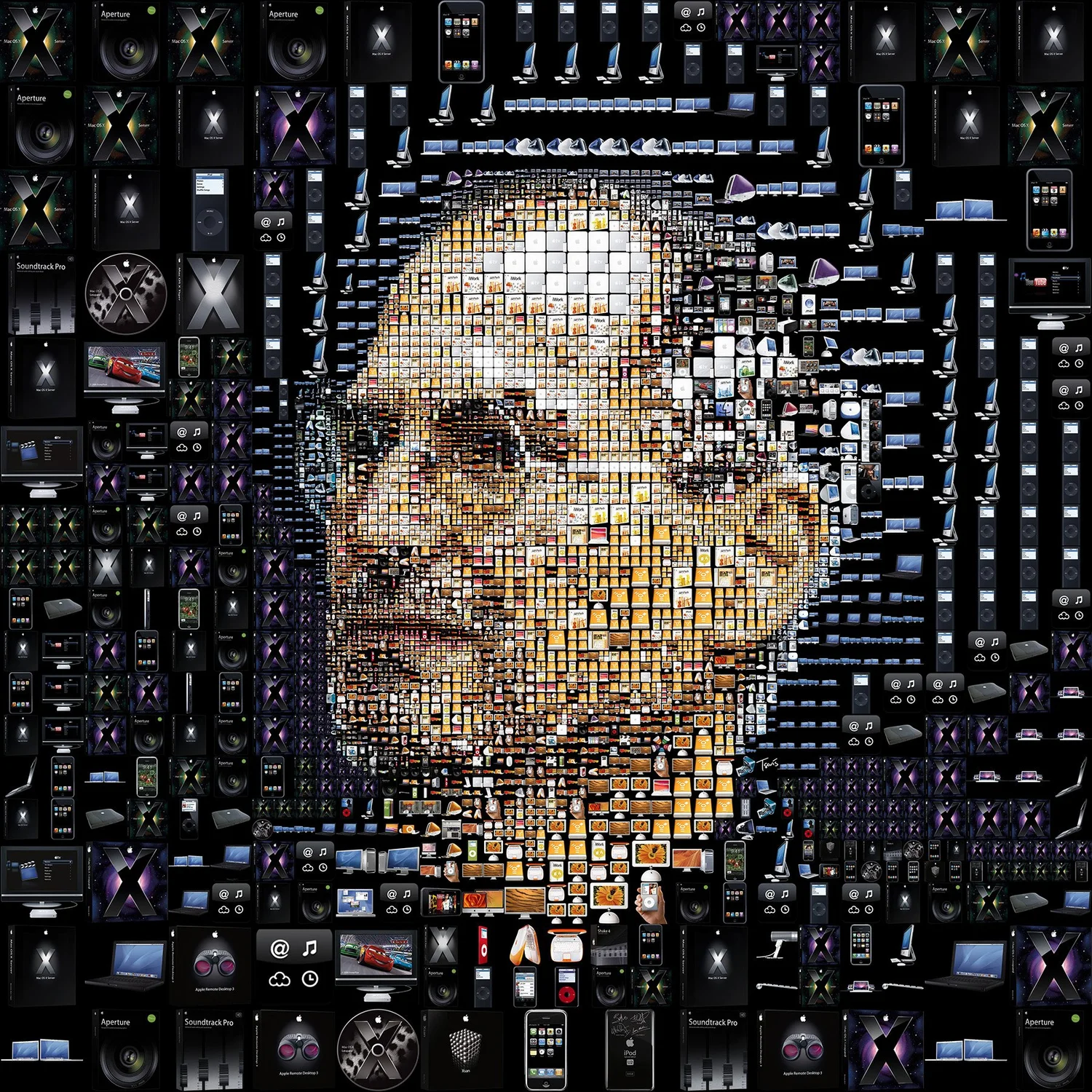
- 2008: Steve Jobs for Fortune, built from Apple products.
- 2016: Murals for the USA House at the Rio Olympics, for the United States Olympic Committee: athletes in action, after Brazilian azulejos, thirteen metres wide.
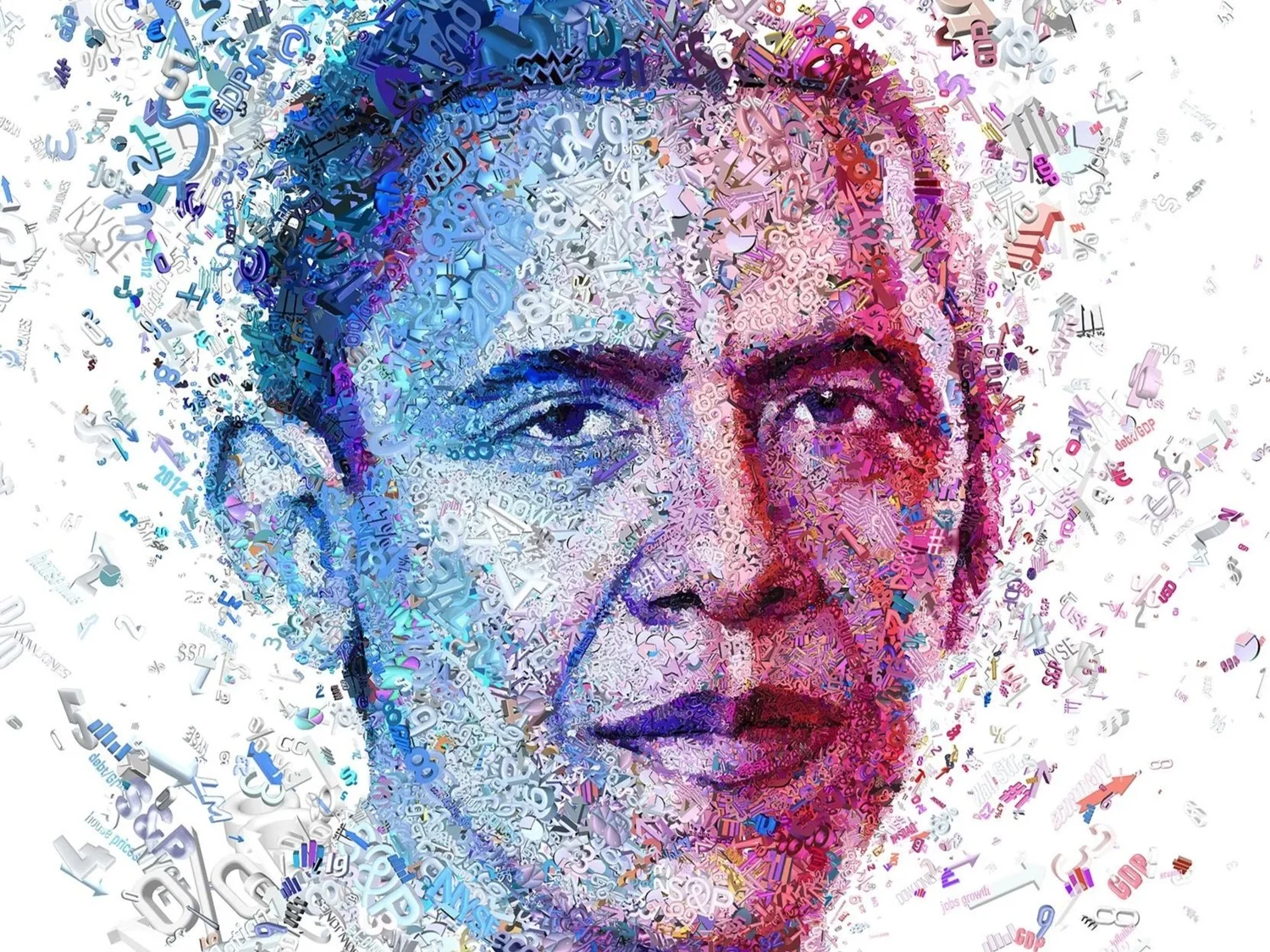
- 2016: Barack Obama for the New York Observer, built from numbers, statistics and financial symbols.
- 2019: Socrates for Communications of the ACM, built from code.
- 2023: Singularis mixed-media mosaics by Vira Konstanta and Charis Tsevis, such as The African Bricks: “And fire” (151 × 110 cm).
- 2024: Mary Higgins for Emerson College, a portrait built entirely from typographic characters.
- 2026: Hello to What Comes Next, portraits built from vintage Macintosh pixel icons and macOS symbols.
We build our own instruments, as Knowlton did for Schwartz. Since 2023 Charis Tsevis has developed Mozaix, a mosaic engine with twelve matching methods; two of them are named in homage to Silvers and to John Dalton, developer of Synthetik Studio Artist. CGMCreator generates the grids. The frameworks we use to design a mosaic, Algorithmic Gestalt, the Macro-Micro Narrative and the Four Layers, come out of the perception studies of Milan and three decades of commissions. They are described in The Tradition We Work In.
Charis Tsevis has taught design, colour theory and Gestalt psychology at art colleges since 1996, and has spoken at Adobe MAX, TEDx Athens and OFFF. Independent records: Wikipedia and Wikidata.
Other artists working today
Our selection of other contemporary artists whose images are built from many pieces, in order of their first work of this kind.
- Invader, from the 1990s: the French street artist turns the pixels of 8-bit video games into ceramic tile mosaics, one tile for each pixel, installed in cities around the world; he has also made mosaics from Rubik’s Cubes and from readable QR codes. His work is not made by an algorithm, but it is the best-known translation of the digital image back into the oldest medium.
- Daniel Rozin, from 1999: the New York artist’s “mechanical mirrors”, beginning with Wooden Mirror, are made of hundreds of small pieces, each turned by its own motor; a camera and a computer move them so that together they form the reflection of the viewer standing in front of them. A mosaic that rebuilds itself in real time.
- Robert Bosch, from 2003: the Oberlin College mathematician makes portraits from complete sets of dominoes. Every piece is placed by integer programming, so the whole arrangement is solved at once within the limits of each set. He calls the practice “Opt Art”. It is the direct heir of Knowlton’s domino mosaics.
- Joan Fontcuberta, 2005: in the series Googlegrams, the Spanish artist rebuilt well-known photographs as mosaics of thousands of images returned by Google searches, made with freely available mosaic software. The search terms are part of the work: for his image of Abu Ghraib they were the names of officials.
- Françoise Lombaers and Guillaume Slizewicz, 2025: in Tesselles, shown at the Maison Hannon in Brussels, a mosaic restorer and a designer who works with algorithms lay out four algorithms (fungal networks, spanning trees, the Game of Life and waves) in square porcelain tesserae. The patterns are abstract: the rule itself is the image.
What connects them
From the Bell Labs symbols to a portrait made of code, the work has the same two parts: a rule that decides where each piece goes, and pieces that can be read on their own. Up close, the parts; from afar, the whole. What an algorithmic mosaic is, and how it differs from a photomosaic, pixel art and generative art, is on Algorithmic Mosaic.
About this page
This page names the people whose published work, in museums, journals, theses and patents, defined the method, the practice of our own studio, and a selection of other artists working today, chosen by us. It does not rank anyone. Each fact about other artists is linked to its source below; facts about our work are linked to the work.
Published 21 October 2026.
Sources
- Victoria and Albert Museum, Kenneth C. Knowlton and Leon D. Harmon, Studies in Perception I, collection record. https://collections.vam.ac.uk/item/O1488652/
- A. Michael Noll, “First-Hand: Harmon-Knowlton’s ‘The Nude’ Overshadows All”, IEEE Engineering and Technology History Wiki, 2022. https://ethw.org/First-Hand:Harmon-Knowlton%27s_%22The_Nude%22_Overshadows_All
- “Art and Science Proclaim Alliance in Avant-Garde Loft”, The New York Times, 11 October 1967.
- The Museum of Modern Art, The Machine as Seen at the End of the Mechanical Age, 27 November 1968 – 9 February 1969. https://www.moma.org/calendar/exhibitions/2776
- Computer History Museum, “Lillian F. Schwartz”. https://computerhistory.org/profile/lillian-f-schwartz/
- Leon D. Harmon, “The Recognition of Faces”, Scientific American 229(5), November 1973. https://doi.org/10.1038/scientificamerican1173-70
- Salvador Dalí, Gala Contemplating the Mediterranean Sea Which at Twenty Meters Becomes the Portrait of Abraham Lincoln (Homage to Rothko), 1976, catalogue raisonné. https://catalogues.salvador-dali.org/catalogues/en/heritageobject/533-2265/
- Kenneth C. Knowlton, Representation of designs, US Patent 4,398,890, 1983. https://patents.google.com/patent/US4398890
- Ken Knowlton, “Ken Knowlton, in brief” (including the 2001 talk “Computer Assisted Mosaic Tessellations”). https://kenknowlton.com/pages/03shortbio.htm
- Joseph Francis, “History of Photo Mosaics”, 2017. https://digitalartform.com/2017/01/05/history-of-photo-mosaics/
- Charles E. Jacobs, Adam Finkelstein and David H. Salesin, “Fast Multiresolution Image Querying”, Proc. SIGGRAPH ‘95, 1995. https://doi.org/10.1145/218380.218454
- Adam Finkelstein and Marisa Range, “Image Mosaics”, RIDT ‘98, Springer, 1998. https://doi.org/10.1007/BFb0053259
- Robert S. Silvers, Photomosaics: Putting Pictures in their Place, MS thesis, MIT, 1996. https://hdl.handle.net/1721.1/29135
- Charis Tsevis, “Photographic Mosaics: How the Algorithms Developed, 1966–2026”, Tsevis Studio, version 1.2, 2026. https://doi.org/10.5281/zenodo.23269192
- “Invader (artist)”, Wikipedia. https://en.wikipedia.org/wiki/Invader_(artist)
- “Danny Rozin”, Wikipedia. https://en.wikipedia.org/wiki/Danny_Rozin
- Robert Bosch, artist statement, Bridges 2008 art exhibition. https://static1.bridgesmathart.org/art-exhibits/bridges2008/bosch.html
- Robert Bosch, “Constructing Domino Portraits”, Optimization Online, 2003. https://optimization-online.org/2003/09/722/
- “Joan Fontcuberta”, Wikipedia. https://en.wikipedia.org/wiki/Joan_Fontcuberta
- Belgium is Design, “Tesselles: Françoise Lombaers and Guillaume Slizewicz”. https://belgiumisdesign.be/designers/tesselles