
Tsevis Studio
Collage or Mosaic?
When the Pieces Become the Picture
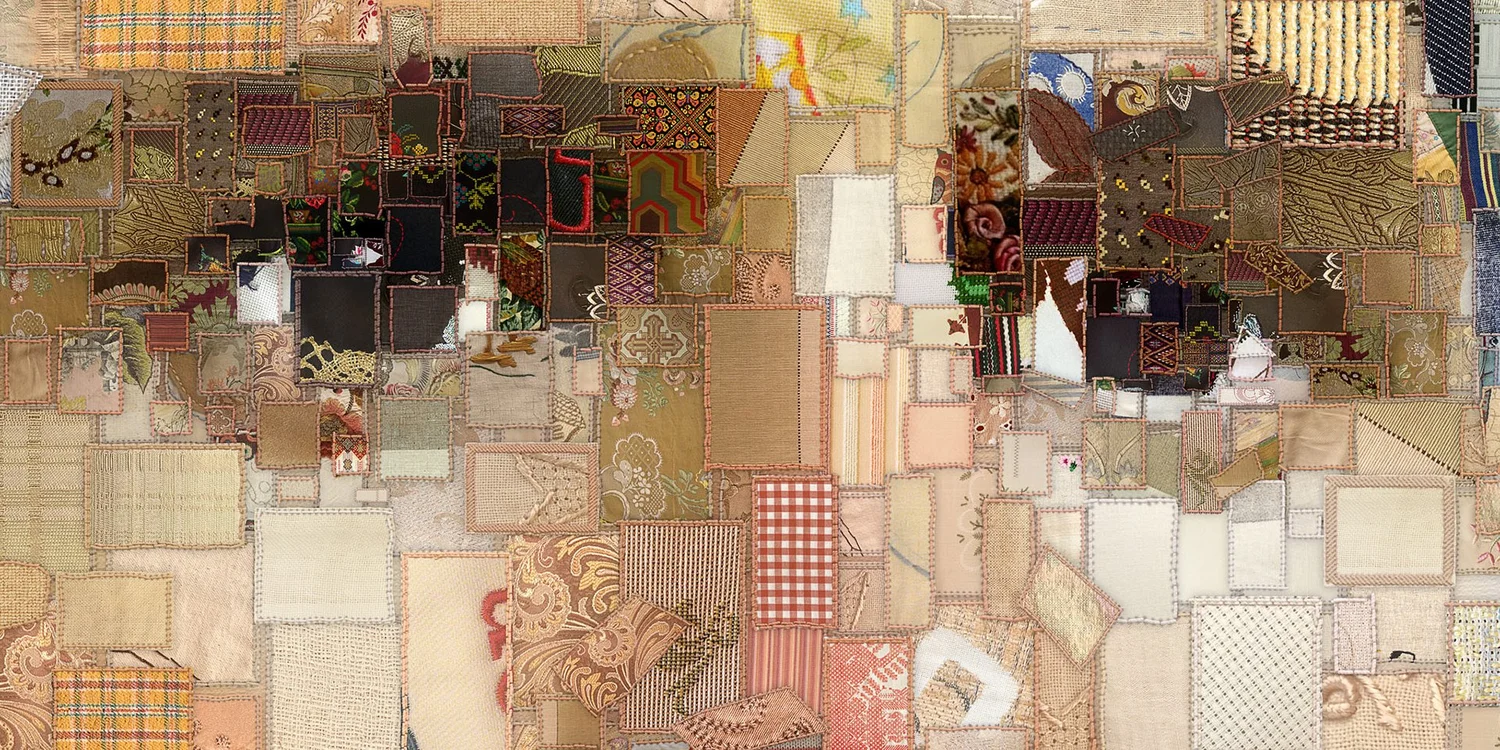
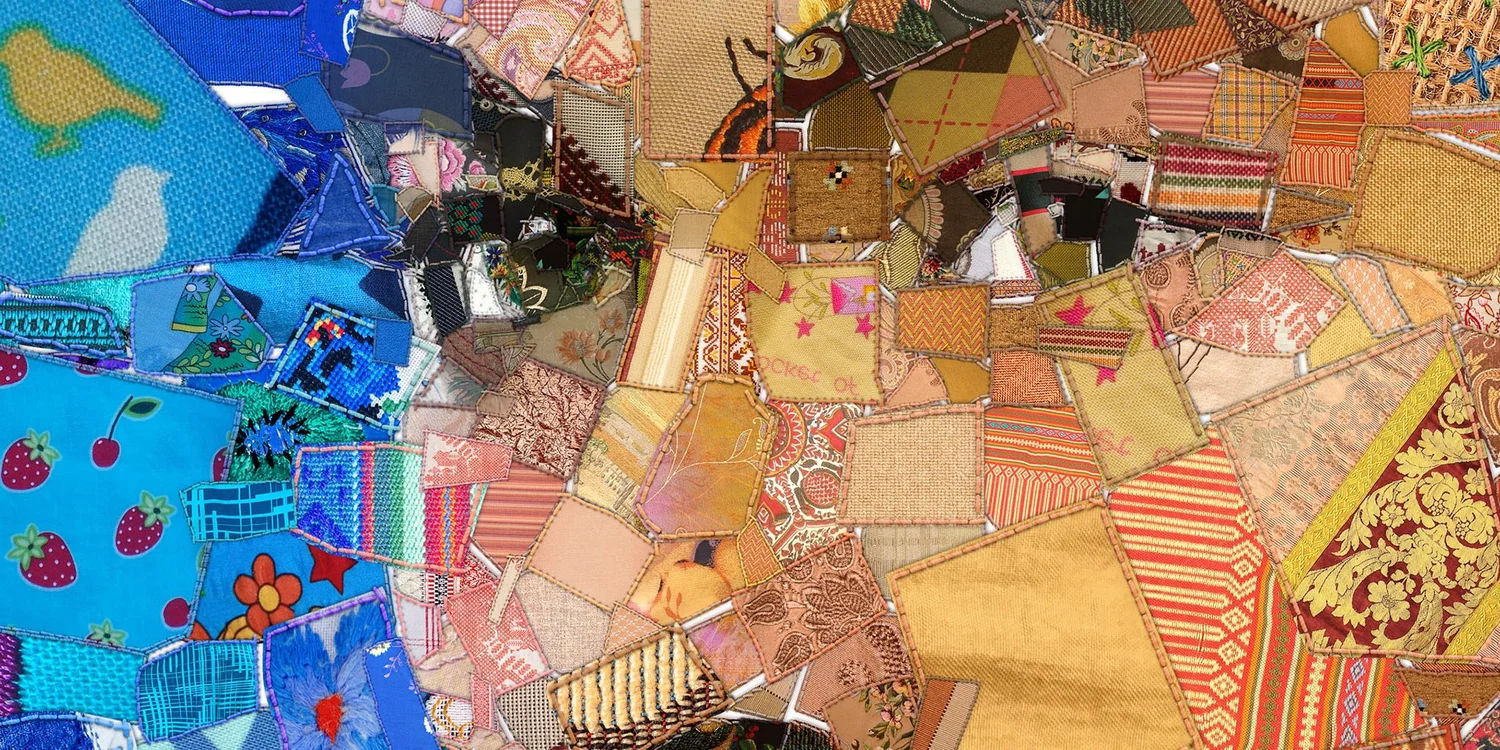
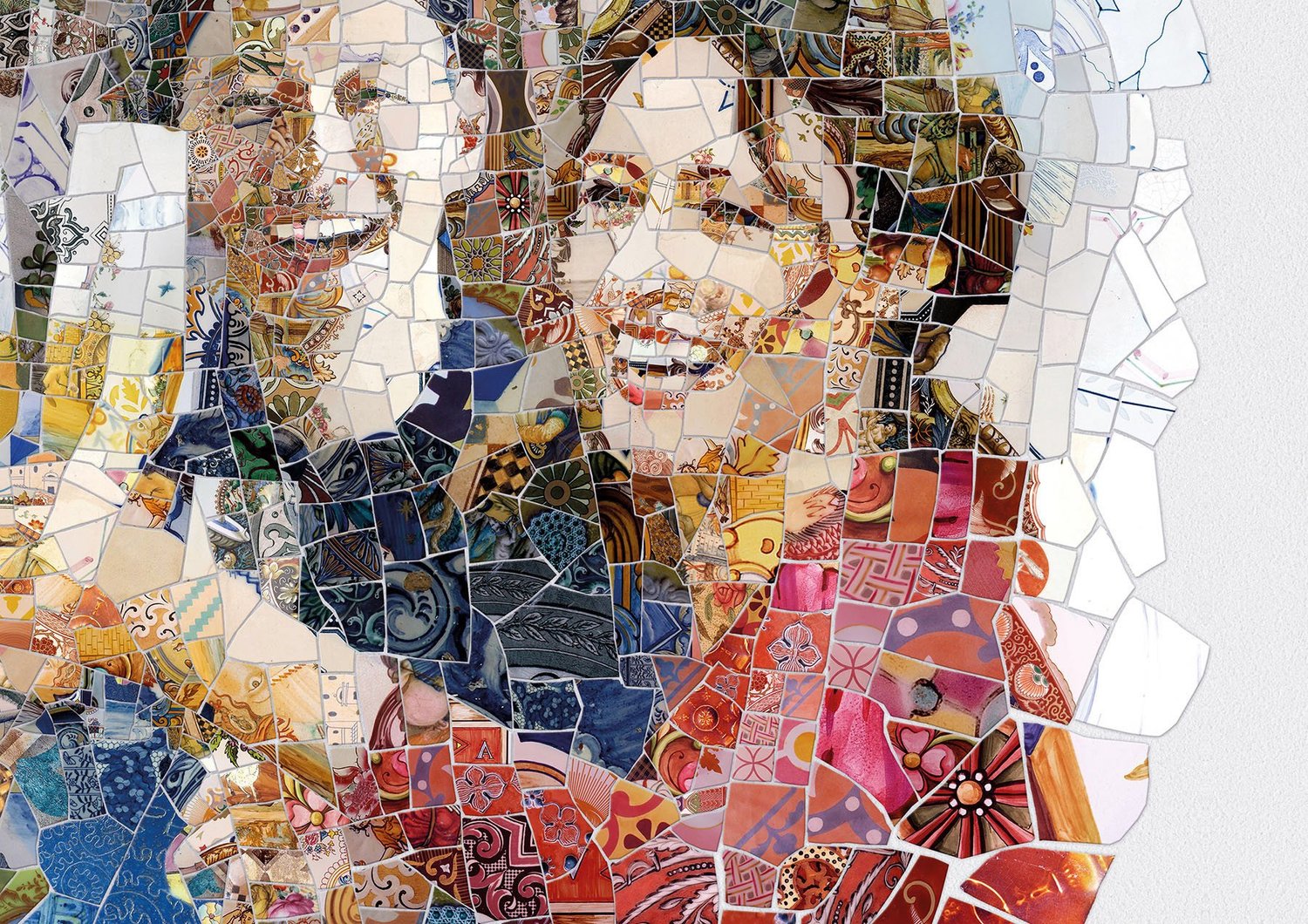
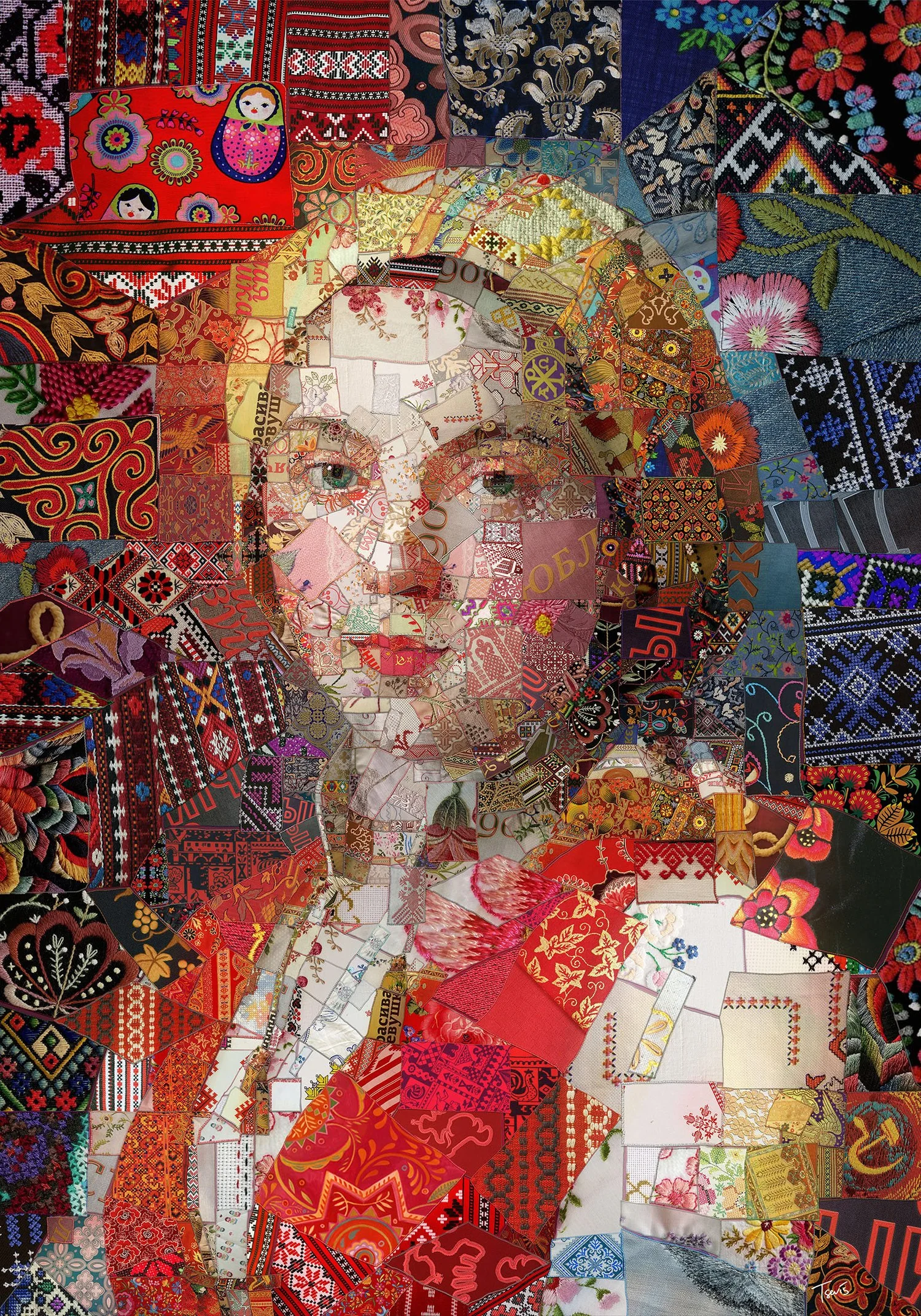
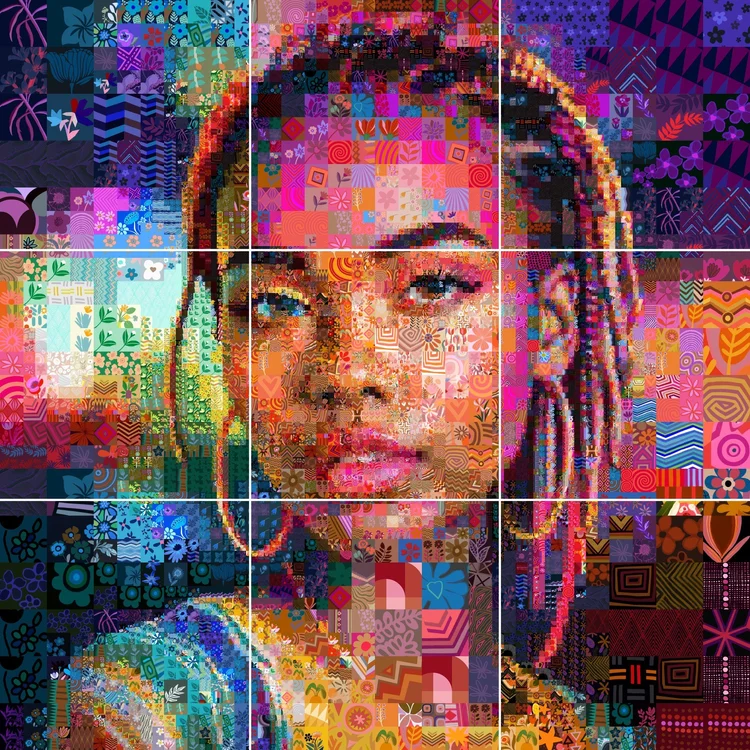
Opening image: Russia 2018, a detail: a portrait pieced from fabric in the manner of Russian patchwork. See the work.
A collage and a mosaic are both made of pieces. The difference is what the pieces do. In a collage, each piece keeps its own identity, and the meaning comes from how the pieces meet. In a mosaic, the pieces give themselves up to a larger image: from a distance they disappear into it, and from close they return. One question sorts a whole family of techniques, from quilts to jigsaw puzzles: what is the relationship between the pieces and the picture?
What is a collage?
A collage is a work made by gluing pieces of paper, photographs, fabric or other materials onto a surface. The word comes from the French papier collé, pasted paper. Pablo Picasso and Georges Braque brought it into modern art in 1912: Picasso glued a printed oilcloth onto Still Life with Chair Caning, and Braque pasted strips of faux-wood wallpaper into Fruit Dish and Glass, his first papier collé.1, 2
What makes a collage a collage is that its pieces stay recognisable as what they are: a ticket, a newspaper headline, a photograph of a face. The work speaks through their meeting, through contrast, surprise and juxtaposition. Collage is a full art with its own masters, from the Cubists and the Dadaists to Romare Bearden.
What makes a mosaic different
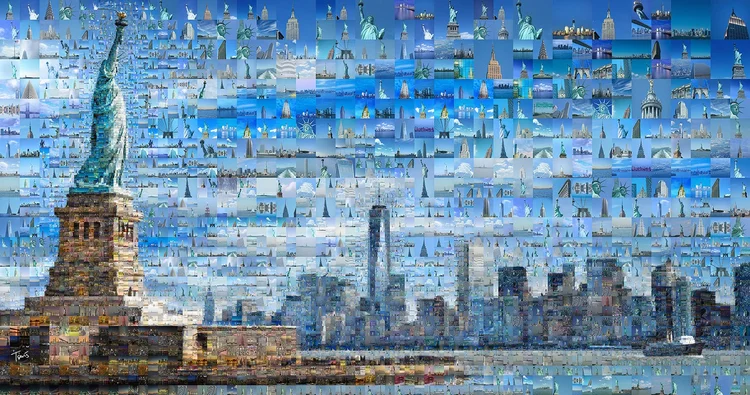
A mosaic is an image built from many small pieces, the tesserae, set side by side. Each piece is chosen for one place in the larger picture. From a distance the eye joins them into one image; from close they separate again into stones, glass, or, in a photographic mosaic, into small photographs.
The mosaic has two readings, and they happen in a fixed order: the whole is seen before its parts. A collage invites the eye to move from piece to piece. A mosaic first hides its pieces in the picture, then reveals them to the viewer who comes closer. In a good mosaic the two readings belong together: the large image says who or what, the small pieces say why. The full definition is on What Is a Mosaic?.
One question, four answers
Many techniques are made of pieces. They differ in what the pieces do:
Four answers
- The pieces become the picture
- Mosaic, pointillism, stained glass, marquetry and intarsia, cross stitch, pictorial quilts, halftone, pixel art, character art, trencadís. One image from afar, its pieces from close.
- The pieces remain pieces
- Collage, photomontage, assemblage, decoupage, geometric patchwork. The meeting of recognisable fragments.
- The picture comes first
- Jigsaw puzzle, paint by numbers, painted azulejo panels. A picture divided, then rebuilt.
- The pieces make a pattern
- Tessellation, zellige and girih, terrazzo, patterned azulejos. A surface, rhythm and order.
Tiles move between the groups, and have a section of their own below. One case stands apart: kintsugi, where the pieces are the fragments of one broken object, and the break itself becomes the image.
1. When the pieces become the picture
Pointillism and divisionism. In the 1880s Georges Seurat and Paul Signac painted with small separate touches of pure colour, intending the eye to blend them at a distance. They called the method divisionism, the separation of colour; pointillism, the popular name taken from its dots, is one Signac rejected.3 Seurat’s A Sunday on La Grande Jatte — 1884 (1884–86) is its most famous example.4 It is the closest relative of the mosaic in painting: the dot is a tessera of paint.
Stained glass. Pieces of coloured glass, joined by strips of lead, with faces and folds painted on the glass and fired. The windows of medieval cathedrals are mosaics of light: their pieces are cut to the shapes of the figures rather than set as small, regular tesserae.5 Our portrait of Pete Buttigieg (2020) borrows the language of stained glass.
Marquetry and intarsia. Pictures made of wood. Marquetry glues thin veneers of different woods onto a surface; intarsia sets pieces of wood into a solid ground. The studiolo of Federico da Montefeltro, made for his palace at Gubbio around 1478–82 and now at the Metropolitan Museum, turns inlaid wood into bookshelves, instruments and open cupboard doors seen in perspective.6
Cross stitch and needlepoint. Each stitch fills one cell of the fabric’s woven grid, so the design is drawn on squared paper before a thread is used. In the nineteenth century, patterns for Berlin woolwork were printed on squared paper whose squares matched those of the canvas; they were made in Berlin and exported in large numbers to Britain.7 Read today, a cross-stitch chart is a bitmap: a picture made of cells, a century before the screen.
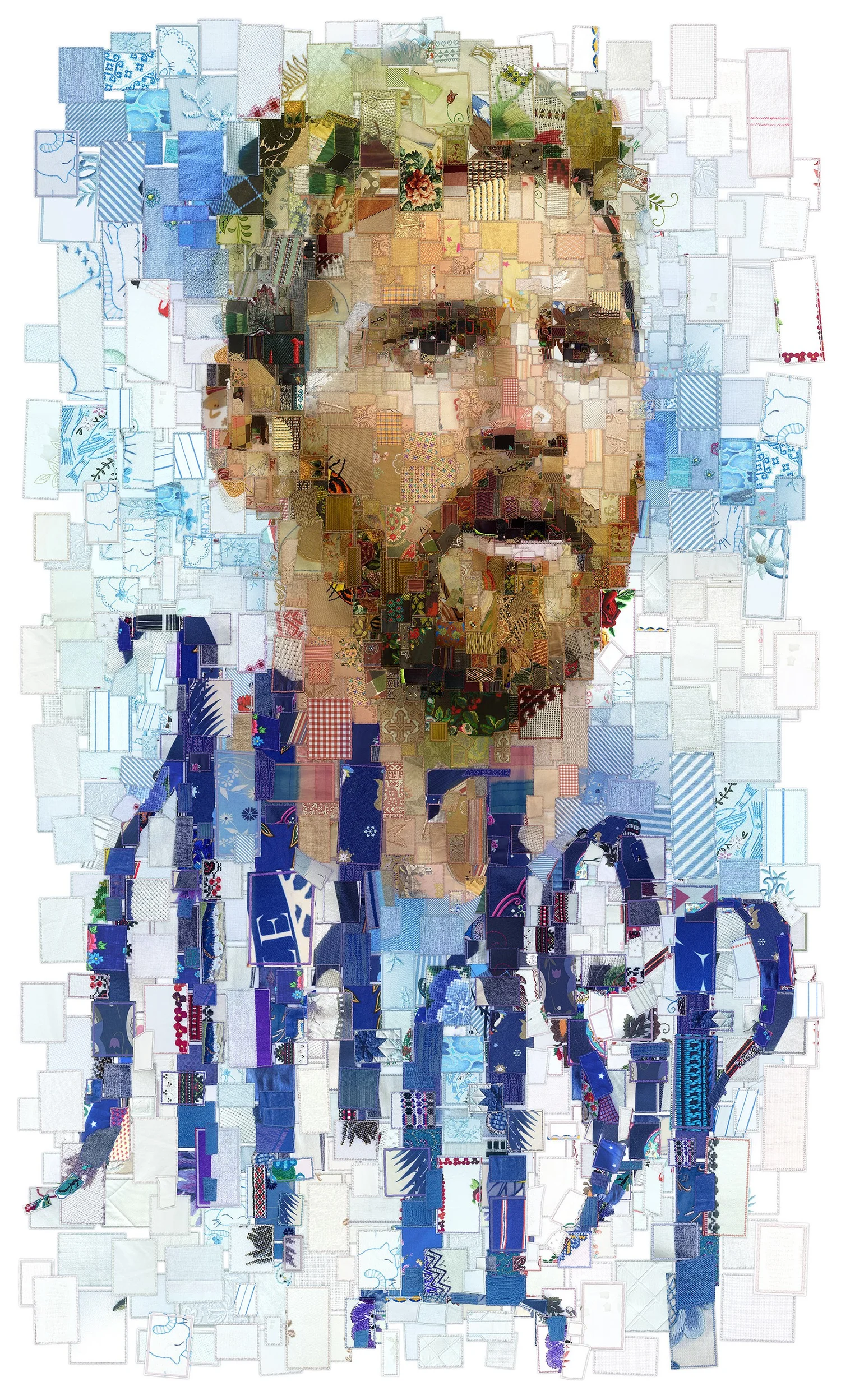
Pictorial quilts. A quilt is three layers, a top, a filling and a backing, stitched together. When its top is pieced or appliquéd into figures, it becomes a picture of fabric. Harriet Powers, born into slavery in Georgia in 1837, made the two quilts of hers that survive, the Bible Quilt (1885–86) and the Pictorial Quilt (1895–98), whose appliquéd panels tell stories from scripture, local legend and remembered events.8 Our series Russia 2018 is digital quilting: football portraits built on the patterns of traditional Russian patchwork, with Vyaz, the ornamental Cyrillic calligraphy, in compositions by Vira Konstanta. Chroma Grace builds colour-first portraits from patchworks of prints on textiles, freer in form. The same technique as Russia 2018 made the Russia cover for Womankind (issue 11), a portrait built from traditional Russian, Ukrainian and other Slavic patterns. Our portrait of Volodymyr Zelenskyy (2022) is built on a grid of irregular patches, stitched together like a quilt.
Halftone. Printing tone with dots of varying size. On 4 March 1880 the New York Daily Graphic printed a photograph of a shantytown in halftone, the first news photograph reproduced that way in an American newspaper.9 Every printed photograph since then is, at close range, a field of dots.
Pixel art. Images drawn pixel by pixel on a coarse grid. One early printed use of the term is a 1982 article by Adele Goldberg and Robert Flegal of Xerox PARC.10 The pixel is the tessera of the screen; we wrote about this in Every Pixel Is a Tessera.
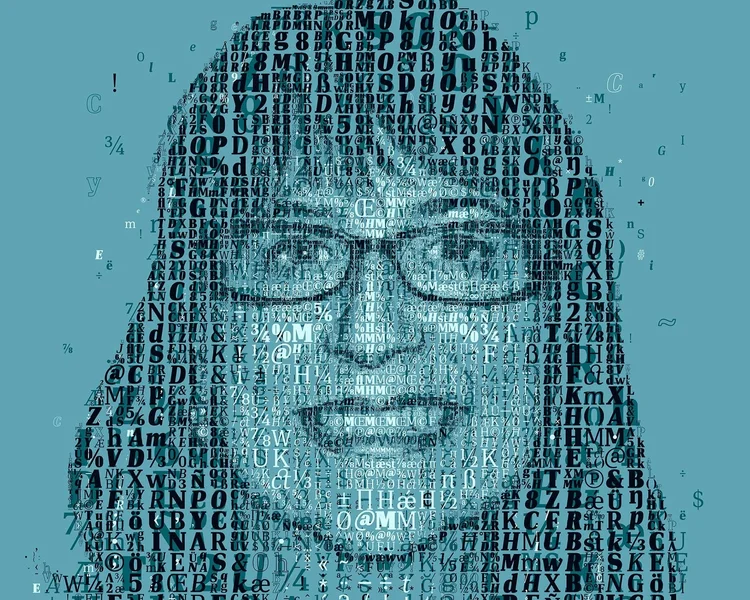
Character art. Pictures made of letters and symbols, each chosen for how dark it looks: typewriter art, from Flora Stacey’s butterfly of 1898, and ASCII art.11 Two older forms use words for their meaning as well as their shape. In micrography, scribes of Hebrew manuscripts wrote tiny lines of text that form ornaments and figures.12 In the calligram, Guillaume Apollinaire set poems in the shape of what they describe, in Calligrammes (1918).13 Typographic portraits run through many of our projects and belong to this line, letters as tesserae: among them the portraits of Steve Jobs made of the 1-bit fonts of the first Macintosh, and the typographic tribute to Mary Higgins at Emerson College.
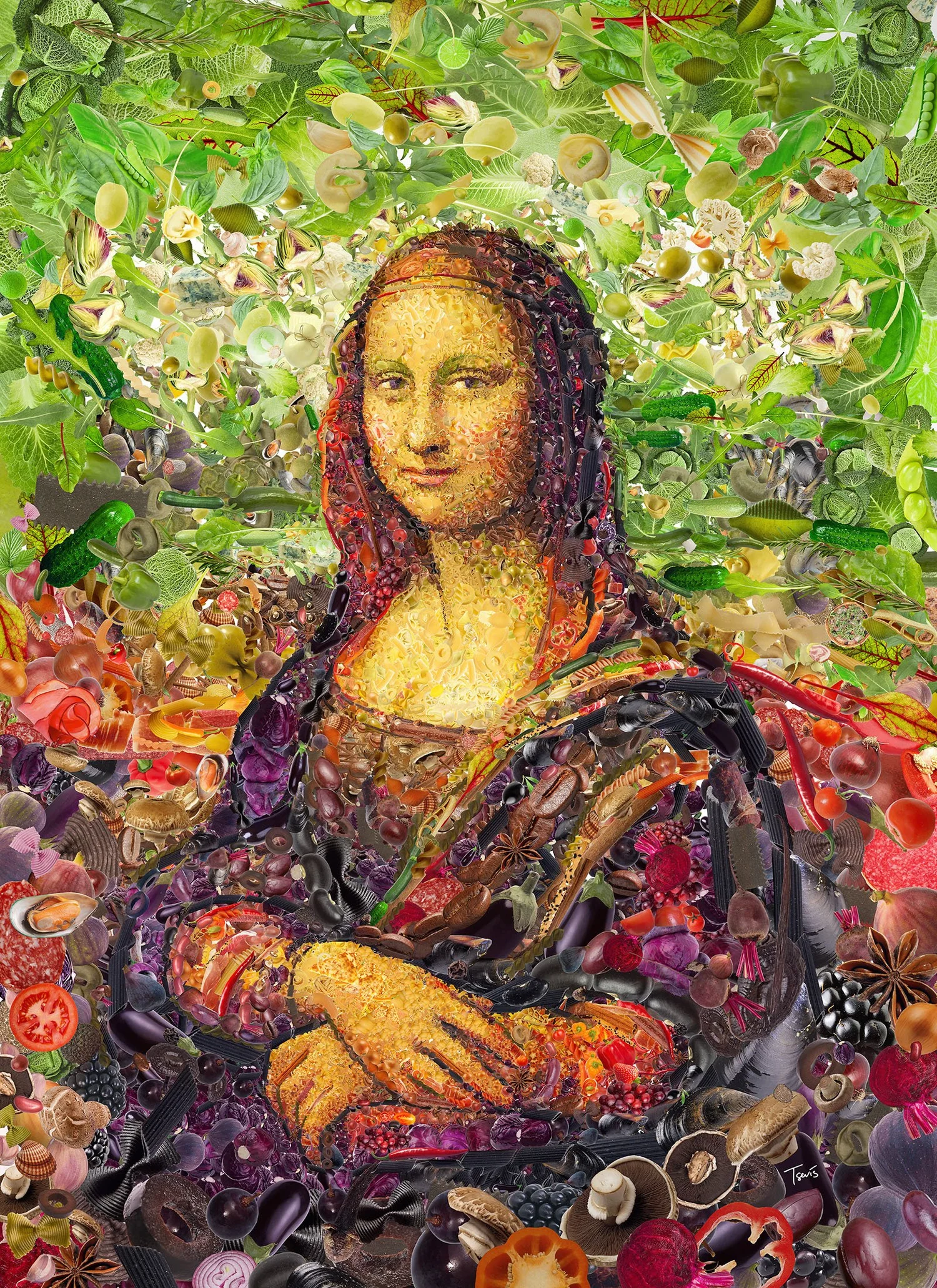
Objects as pieces. Any object of the right colour can become a tessera: bricks of plastic, cubes of a puzzle toy, products on a shelf. The test is the same as for stone: does the object give itself to the picture and return when the viewer comes closer? Our portraits for the IKEA campaign Long Live Diversity (2009) are made of thousands of IKEA products. Painters did this long before mosaic software: in the late sixteenth century Giuseppe Arcimboldo painted heads composed of fruit, vegetables and flowers.14 Our Mona Lisa for the cover of Womankind is built the same way, from fruit and vegetables.
2. When the pieces remain pieces
Collage. As above: pieces glued to a surface, kept recognisable, meaning from their meeting.
Photomontage. A collage of photographs, or a single image composed from several. The Berlin Dadaists, among them Hannah Höch, Raoul Hausmann and John Heartfield, made it a political art from around 1918–20; Höch’s Cut with the Kitchen Knife dates from 1919–20.15 A photomontage combines photographs into a scene; a photographic mosaic uses hundreds or thousands of them as tesserae of one image.
Assemblage. Collage in three dimensions: found objects joined into a work. The term was used by Jean Dubuffet in the 1950s, and The Museum of Modern Art’s exhibition The Art of Assemblage (1961) gave it a wide audience.16
Decoupage. From the French découper, to cut out: cut paper images glued onto furniture or objects and covered with layers of varnish, a fashion that reached its height in the eighteenth century.17
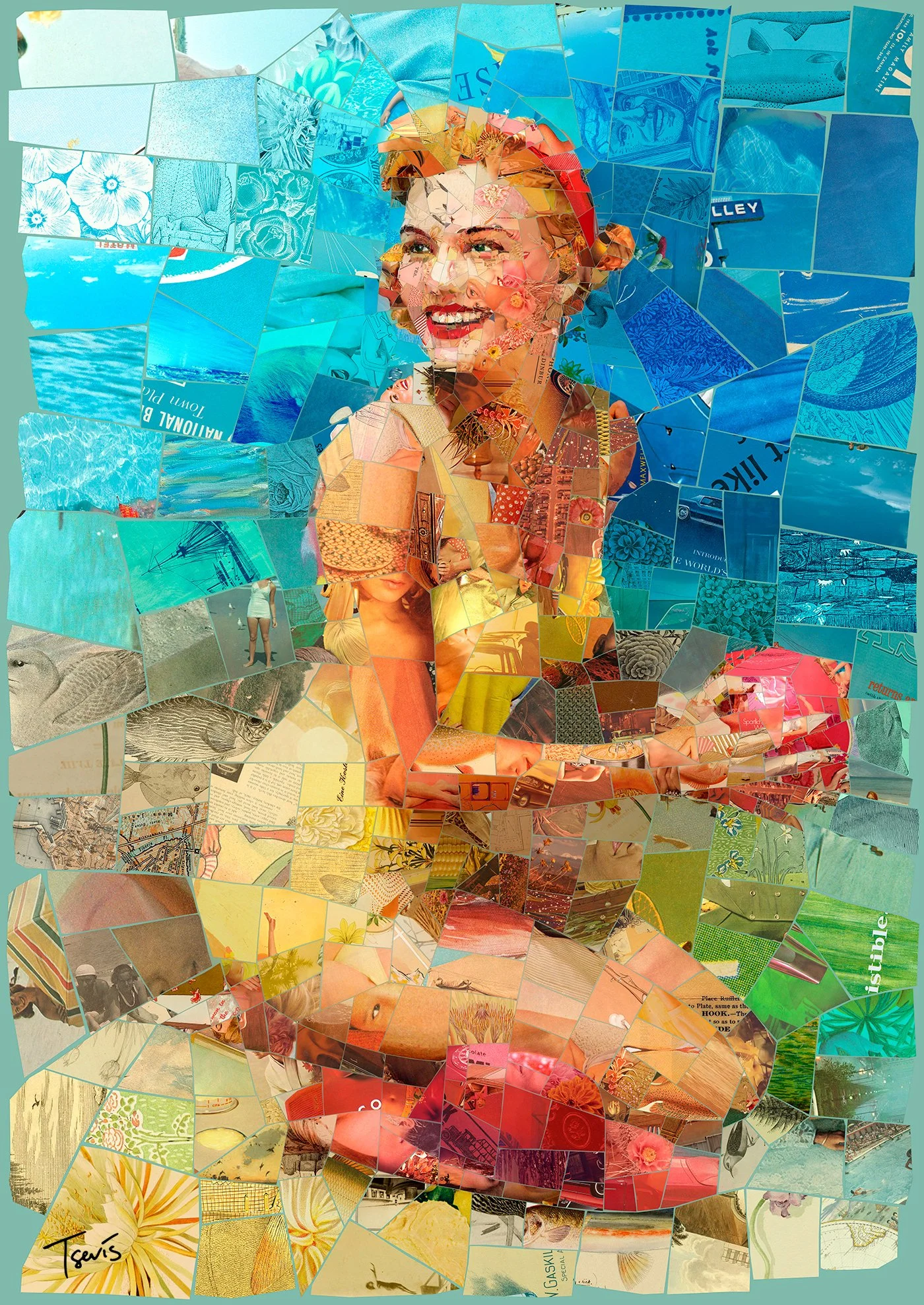
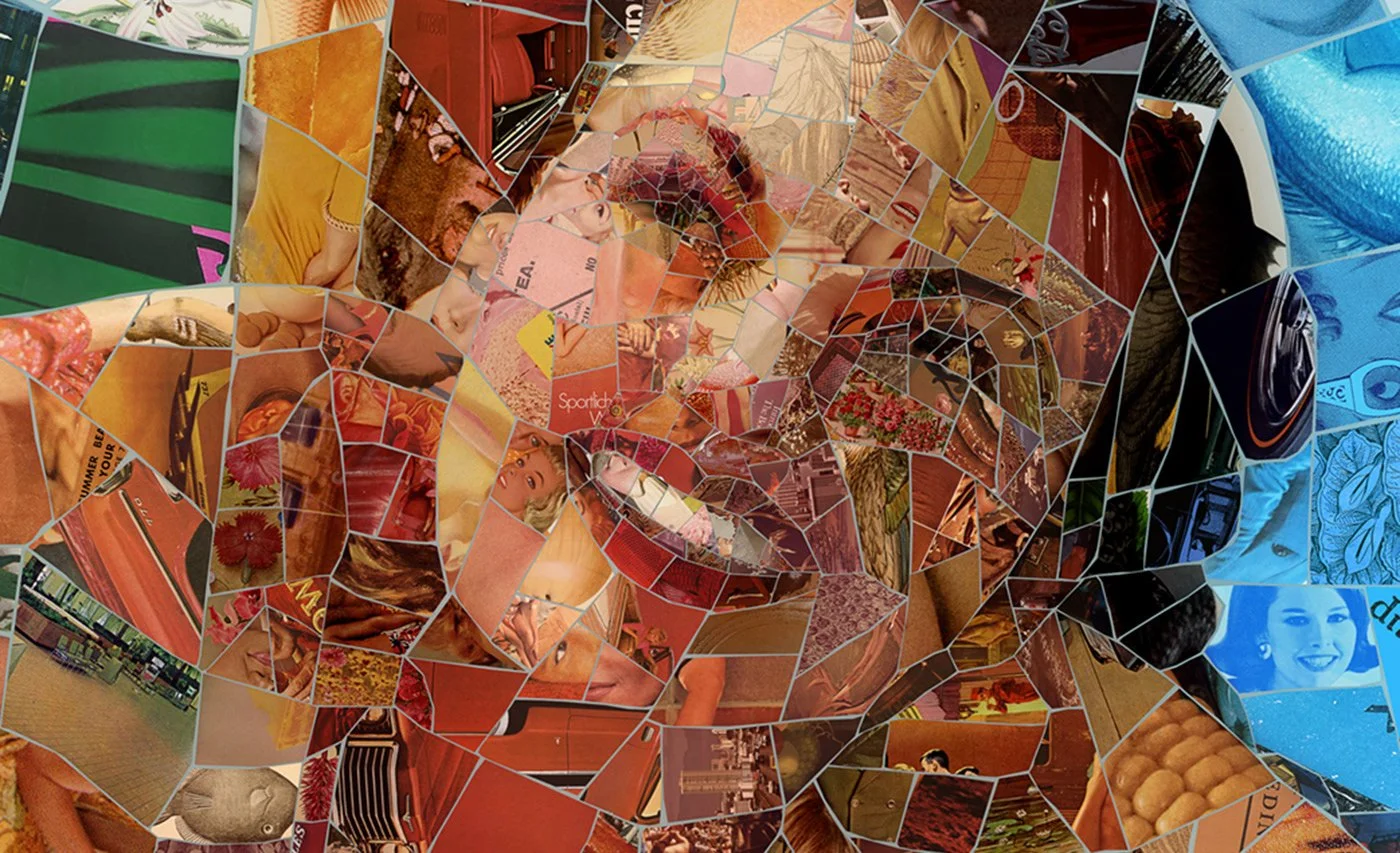
Endless Summer 2.0, on the border. Some works stand between the two groups. In Endless Summer 2.0, magazine pages and advertisements of the 1950s and 1960s are cut into irregular shards and set with dark joints, the way trencadís sets broken tile. Each piece keeps its printed image, as in a collage, yet together they build one portrait, as in a mosaic: trencadís, made of paper.
Geometric patchwork. Pieced fabric in squares, triangles and strips. Its art is pattern, colour and rhythm rather than a picture, which is why the same quilt-maker’s hand can stand in this group and, with a pictorial quilt, in the first.
3. When the picture comes first
The jigsaw puzzle is the mosaic in reverse. A mosaic starts with pieces and arrives at a picture; a puzzle starts with a picture and cuts it into pieces, so that someone can find the picture again. Among the first were maps, mounted on wood and cut along the borders of countries by the London engraver and mapseller John Spilsbury in the 1760s, to teach geography. They were called dissected maps; the name jigsaw came in the twentieth century.18 The pieces of those early puzzles were not chosen: they were whatever part of the picture the saw left them.
Paint by numbers divides a picture into numbered areas, each to be filled with one colour. Dan Robbins designed the first kits for the Palmer Paint Company, which put them on national sale as Craft Master in 1951.19 Like the puzzle, it returns a picture that was finished before the first brushstroke.
The mosaic shares their grid but not their direction. In a mosaic, nothing exists before the choices: each piece is selected for its place, and the picture is made by those choices.
4. When the pieces make a pattern
Tessellation. A covering of a surface by shapes with no gaps and no overlaps. M. C. Escher turned it into an art of interlocking birds, fish and lizards. A tessellation can carry a picture, but its subject is the order of the surface itself. The glossary explains the difference.
Terrazzo. Chips of marble, and later of glass, set in a binder, then ground and polished into a floor. Its craft was organised in Venice by the sixteenth century: in 1583 the Council of Ten allowed a group of Friulian terrazzo makers to found their own guild school.20 Its pieces are scattered, not placed: a texture rather than an image.
5. Tiles: Islamic geometry, azulejos and trencadís
Tiles cross every border on this page. The same glazed piece can carry a pattern, a part of a painted scene, or, once broken, a fragment of a new image. Three traditions show how, and they are related to one another.
Zellige and girih. In Morocco, zellige is a mosaic of small pieces of glazed terracotta, cut by hand and fitted together into star-and-polygon patterns. Across the Islamic world, tilework, carved wood and stone carry girih, the strapwork of interlacing stars and polygons; the Persian word means “knot”. In 2007 Peter Lu and Paul Steinhardt showed that some girih patterns were built from a set of five decorated tiles.21 The subject of this art is the order of the surface itself: a pattern that could continue without end. See girih and zellige in the glossary.
In our portraits for the Kingdom of Bahrain, that pattern tradition became the tessera. Each portrait in The Royal Mosaics of Bahrain is built from 450 tiles carrying Islamic geometry, girih, Al-Sadu weaving and Bahraini architecture; every tile was cut, its edges bent and its sides given gold varnish, so that it has the presence of a glazed ceramic tile. The portrait of King Hamad in Bahrain Mosaic Marvels is built from hand-cut tiles with Islamic geometric patterns, gold lines and gold leaf. Qatar 2022 draws football portraits in arabesque geometry and writes the players’ names in Latin letters shaped after Bannai, the geometric Kufic script of Iranian architecture.


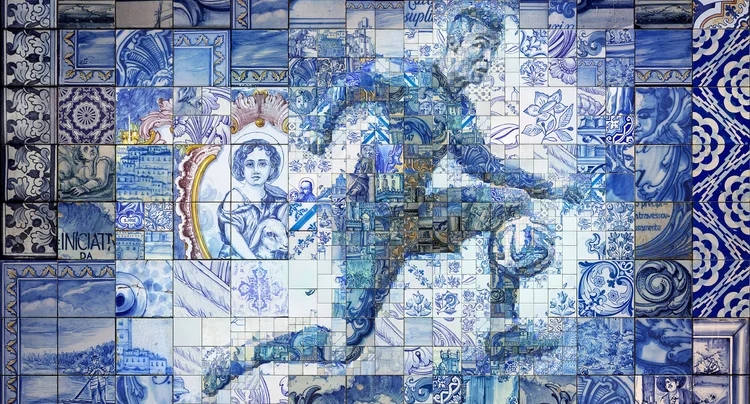
Azulejos. Glazed ceramic tiles, the great tile tradition of Portugal and Spain. The word azulejo comes from Andalusian Arabic, from the same root as zellige,22 and Islamic art was the first great reference for azulejos in Portugal. There they began as mosaic: from the thirteenth century, floors were paved with plain coloured geometric pieces of glazed ceramic, as at the Monastery of Alcobaça. In the early sixteenth century, tiles made in Seville came to line whole interiors with patterns, in the old cathedral of Coimbra, commissioned in 1503, and in the royal palace at Sintra, ordered by King Manuel I in 1508.23 Later, painters spread single scenes across hundreds of tiles. The entrance hall of São Bento station in Porto, inaugurated in 1916, is lined with about 20,000 tiles painted by Jorge Colaço, who began the panels in 1905.24 In such a panel the picture comes first and the tiles divide it, as in a puzzle; on a patterned wall, the tiles make a pattern.
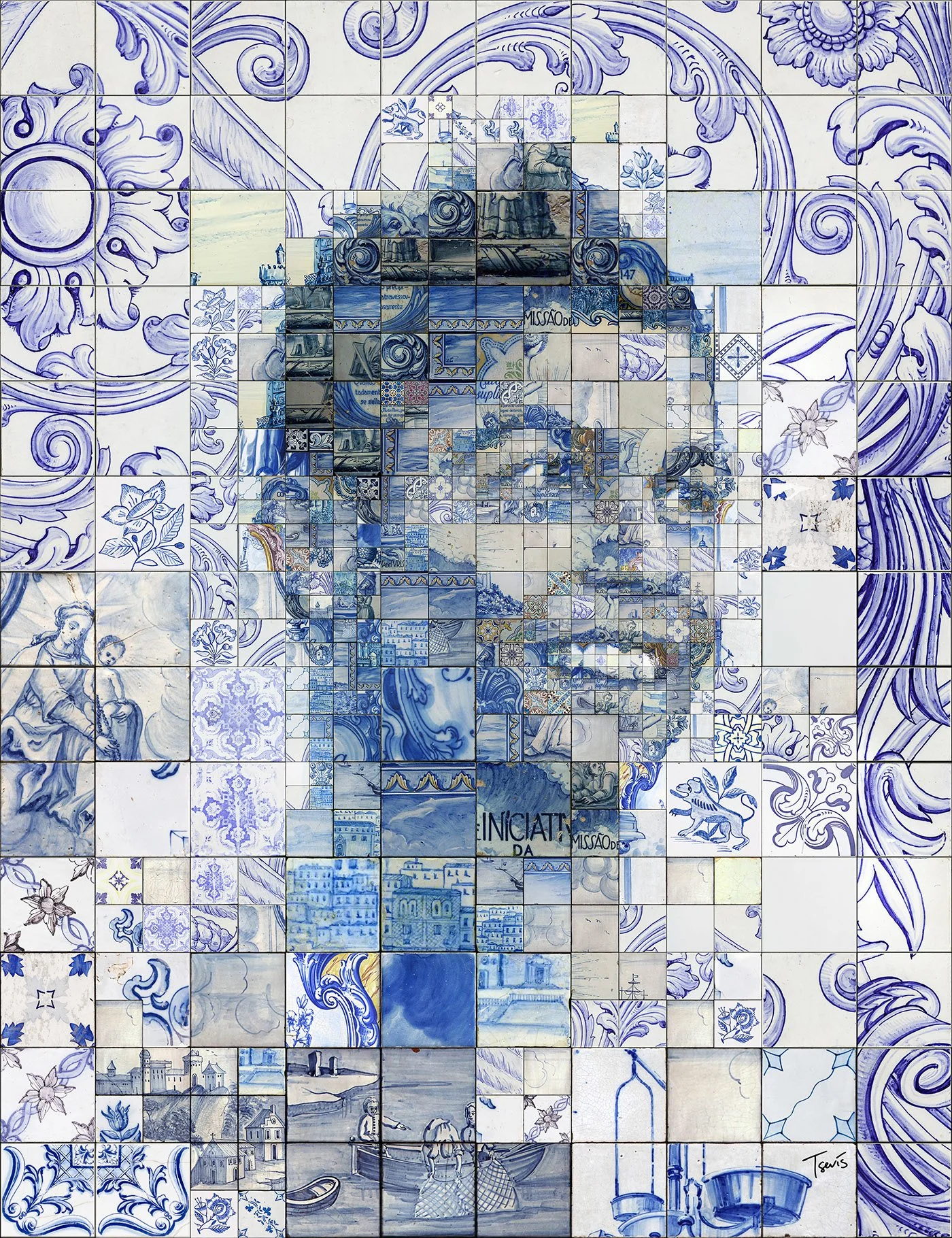
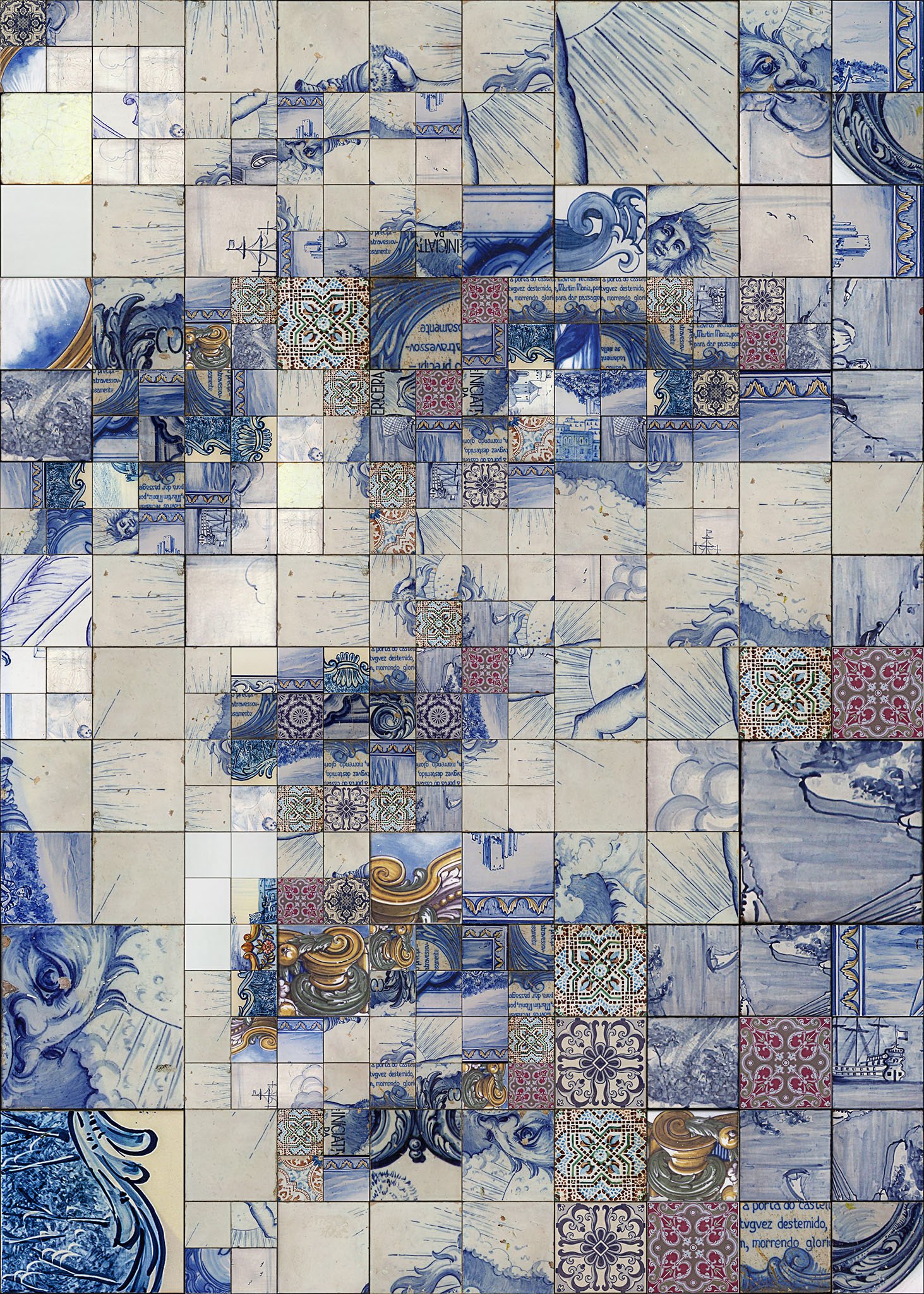
Our portraits of Cristiano Ronaldo turn that relationship around. Whole azulejo paintings, angels, ships, street-name tiles and floral borders, are the tesserae, and together they build his face: O Orgulho de Portugal.
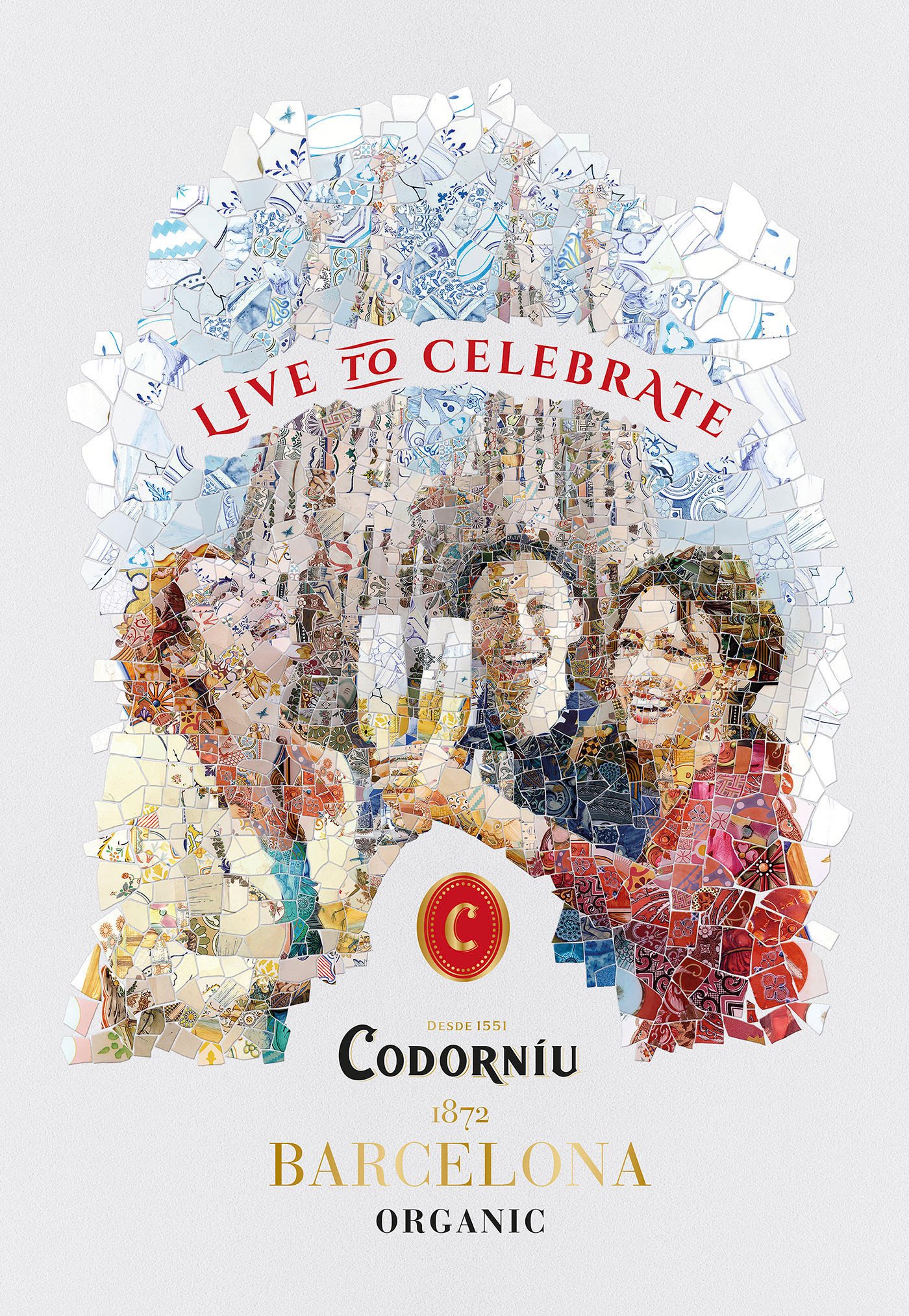
Trencadís. From the Catalan trencar, to break: mosaic of broken tiles and ceramic, made famous by Antoni Gaudí and Josep Maria Jujol in Barcelona. At Park Güell (1900–1914) it covers benches, roofs and walls with colour and rhythm; in places it forms emblems and figures.25 See also the glossary.
Our digital trencadís breaks azulejo-like tiles into fragments and sets each fragment for its place in an image, as in the Codorníu Trencadís, Lionel Messi: Els fragments de Barcelona and Bulgari Mediterranea. The broken tile, which in Gaudí’s work mostly makes pattern, becomes the tessera of a picture.
6. When the break is kept
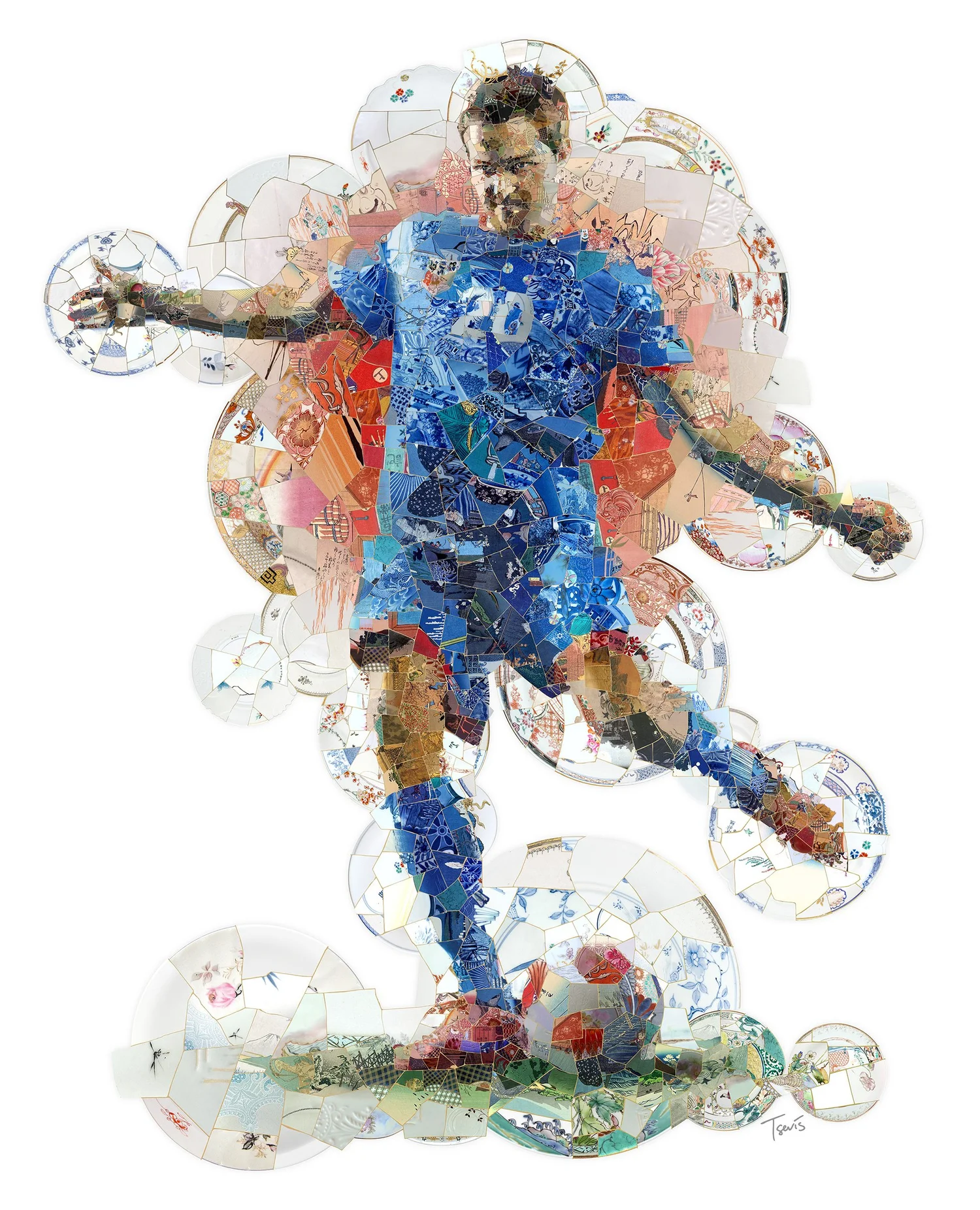
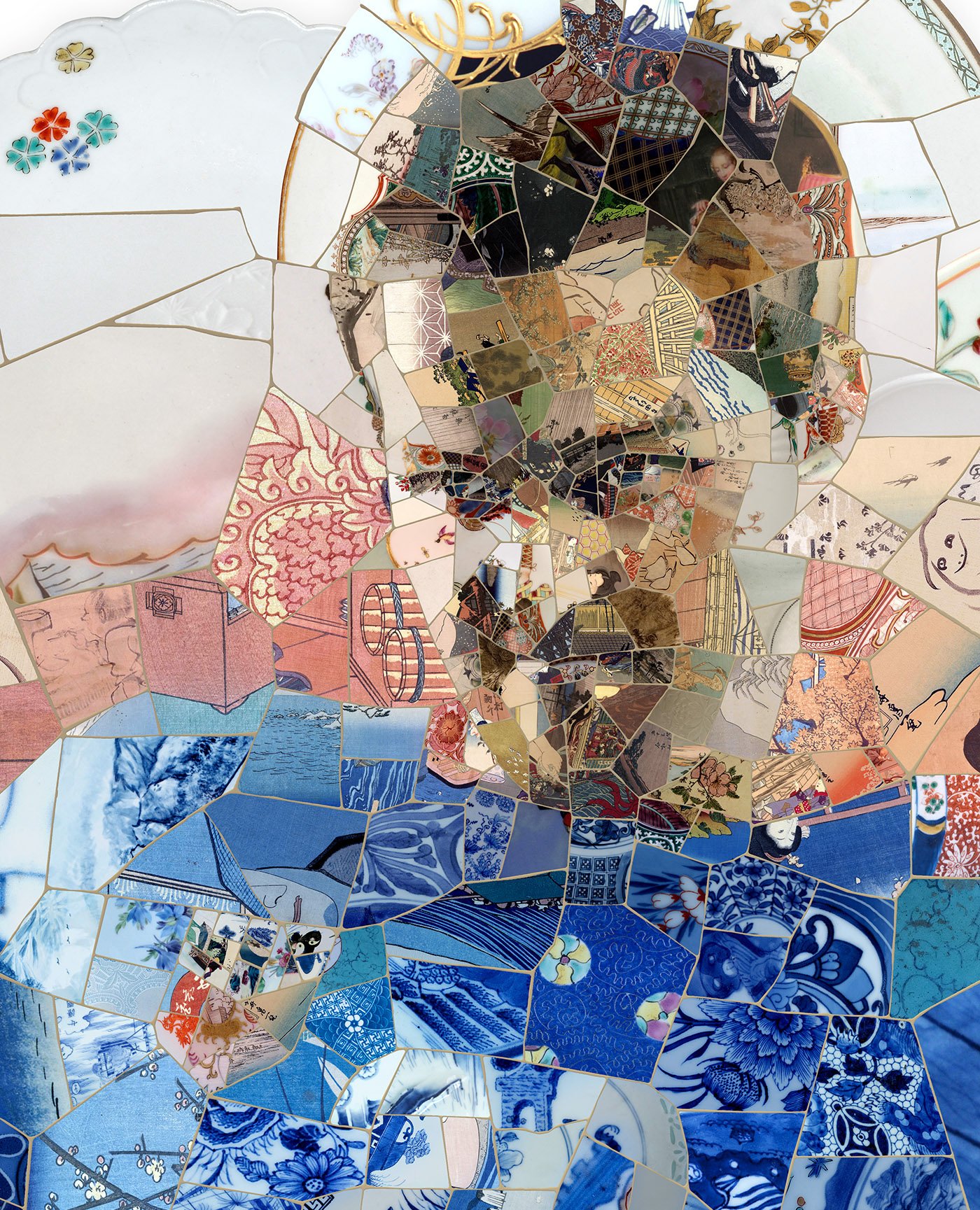
Kintsugi is the Japanese repair of broken ceramics with lacquer sprinkled with powdered gold. The fragments return to their old form, and the lines of the break, now golden, become part of the object’s beauty and its history.26 It is the opposite of hiding the seams, and close to what a mosaic does: it lets the pieces be seen inside the whole.
In Kintsugi 2020 we used the idea digitally: fragments of porcelain and ceramics, bound together with digital gold.
Where our work belongs
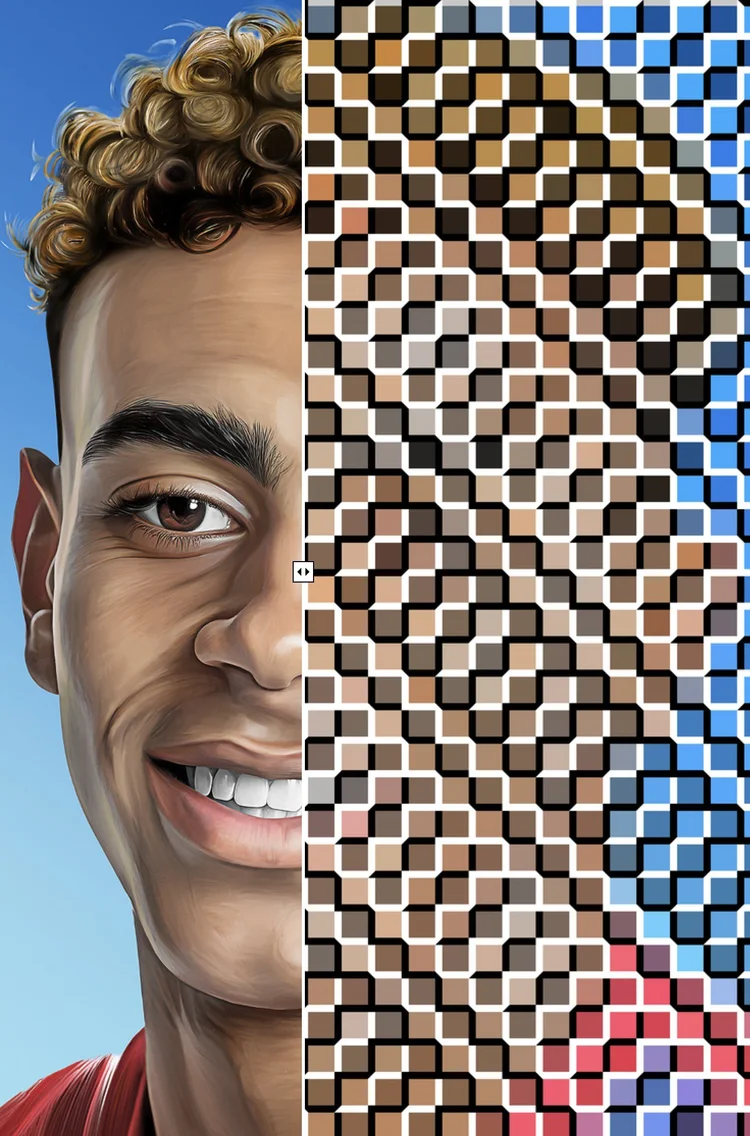
Our work belongs to the first group. We build algorithmic mosaics: images whose pieces are chosen, one by one, for their place in the picture and for what they mean. Thomas Jefferson built from his own archives, Barack Obama from his supporters, the globe for Le Monde from the people who make the newspaper. The large image says who or what; the pieces say why.
What we take from the other techniques is their questions. From the quilt, a grid that follows the form; from pointillism, colour that mixes in the eye; from the puzzle, the pleasure of finding the picture again; from kintsugi, the respect for the seam. How we build them is shown in The Four Layers of a Mosaic and in The Algorithmic Mosaic.
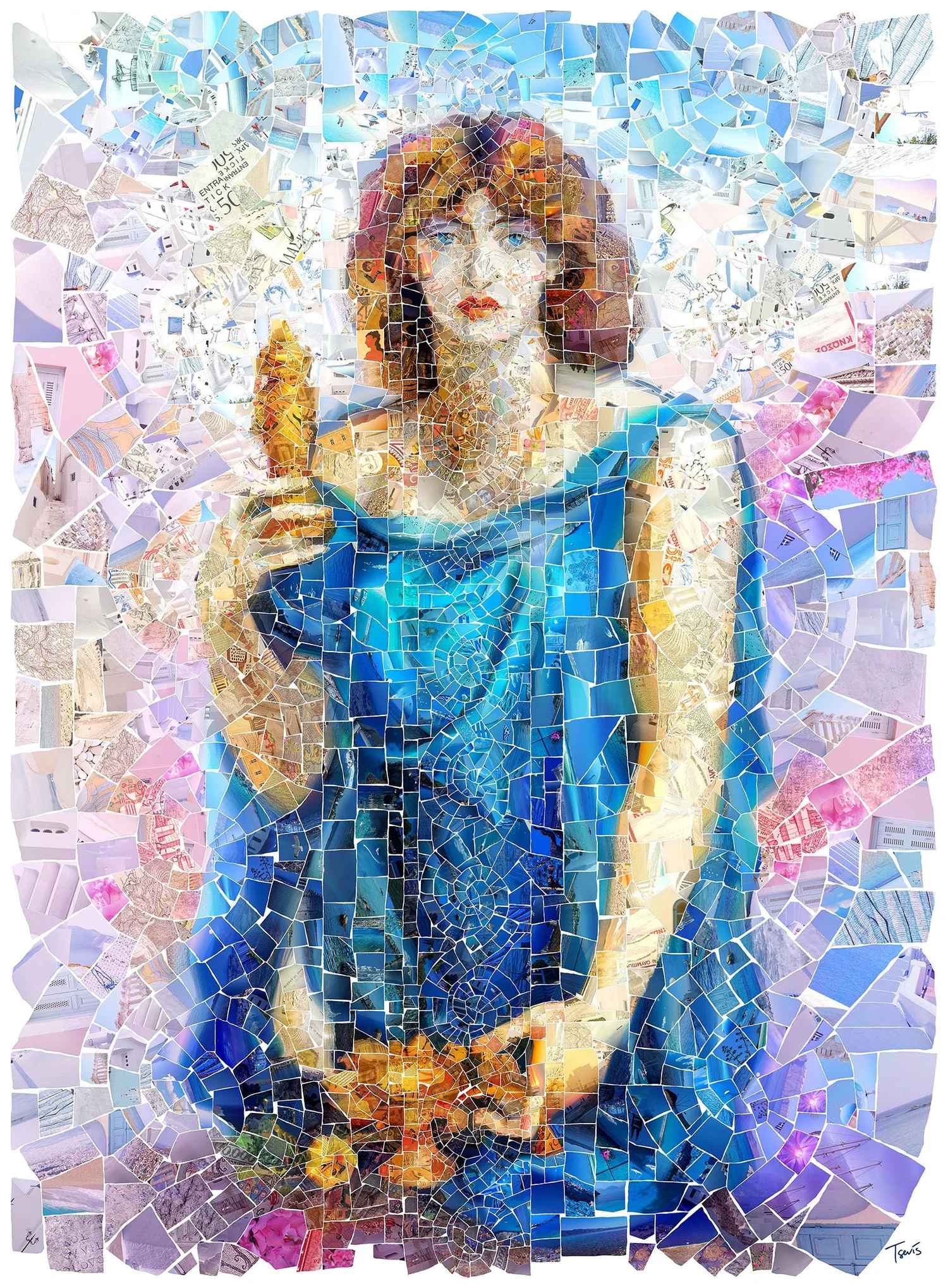
Sometimes a whole series is a tour of these techniques. For Womankind, an Australian magazine, we made the covers of twelve issues, each dedicated to a different country, era and person, and each borrowed the technique of its place: cracked tile patterns from Cyprus, Macedonia and other Greek regions for Persephone; Slavic quilting for the Russia issue; Victorian patterns and stained glass fragments for the Pre-Raphaelite muse Sophy Gray; hieroglyph and relief fragments for Nefertiti; reggae record labels and African textiles for issue 7.
Questions
Is a mosaic a kind of collage?
No. Both use pieces, but in a collage the pieces keep their own identity and meaning, while in a mosaic they are chosen to build a single larger image. A collage is read piece by piece; a mosaic is seen whole first, then piece by piece.
What do you call a picture made of many small pictures?
A photographic mosaic, also called a photo mosaic. When the small pieces are letters, it is character art or a typographic mosaic; when they are objects, an object mosaic. See The Photographic Mosaic.
Is a quilt a mosaic?
A pictorial quilt works like one: pieces of fabric chosen to form a figure. A geometric patchwork quilt is closer to tessellation, an art of pattern.
Is a jigsaw puzzle a mosaic?
It is its mirror. A puzzle cuts an existing picture into pieces; a mosaic chooses pieces to make a picture.
Is pointillism a kind of mosaic?
It is its closest relative in painting. Seurat’s dots, like tesserae, are separate touches of colour that the eye joins at a distance.
Is pixel art a mosaic?
In structure, yes: a picture made of uniform cells, each with one colour. The pixel is the tessera of the screen.
Further reading
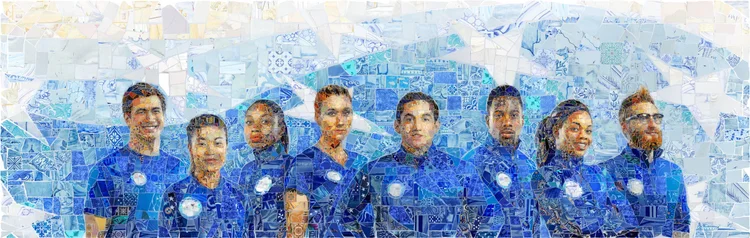 What Is a Mosaic?Meaning, materials, techniques, types and history: the answer, from pebbles to algorithms.
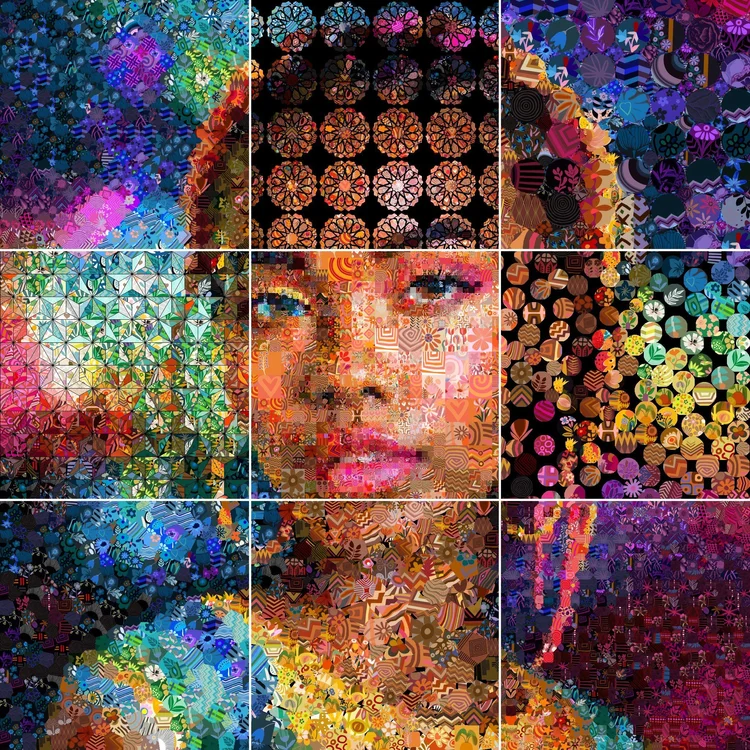 The Four Layers of a MosaicOne portrait, twenty-seven mosaics: the grid, the tiles and the matching rule, changed one at a time.
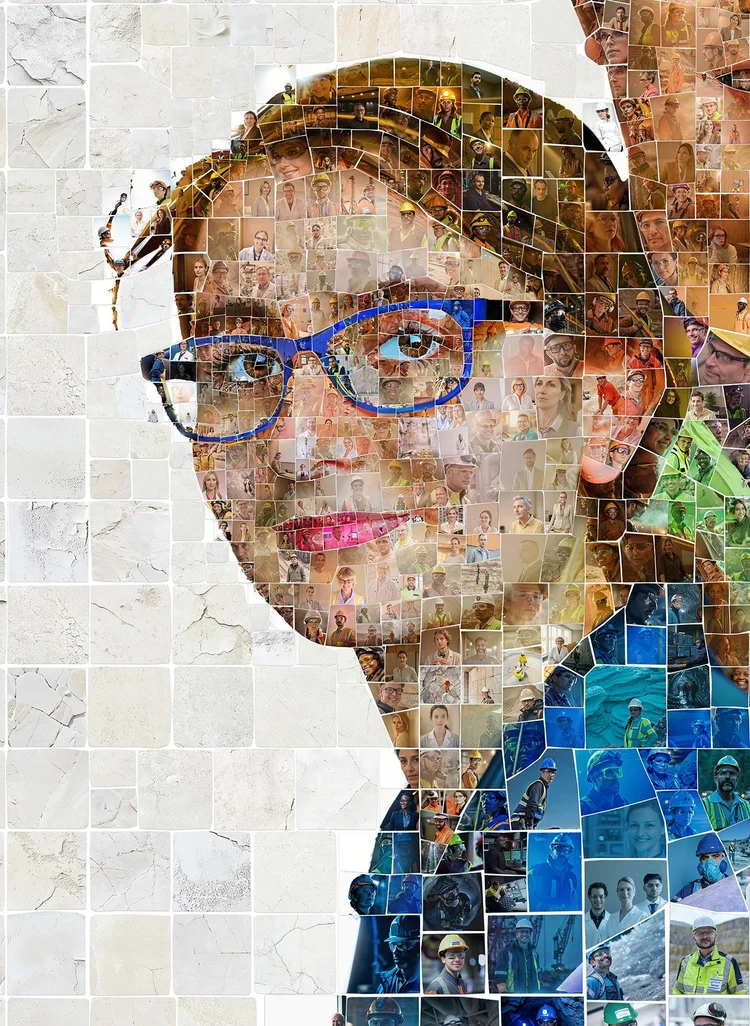 Why a Mosaic WorksPerception, Gestalt and distance: why the eye finds the figure in the fragments.
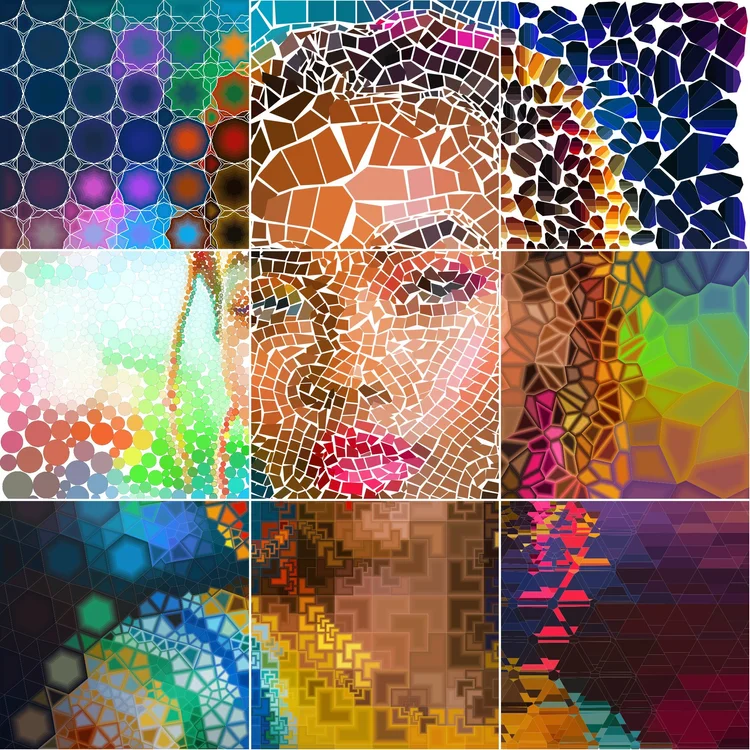 The Mathematics of the MosaicTessellation, Voronoi cells, matching and dithering, written down as equations.
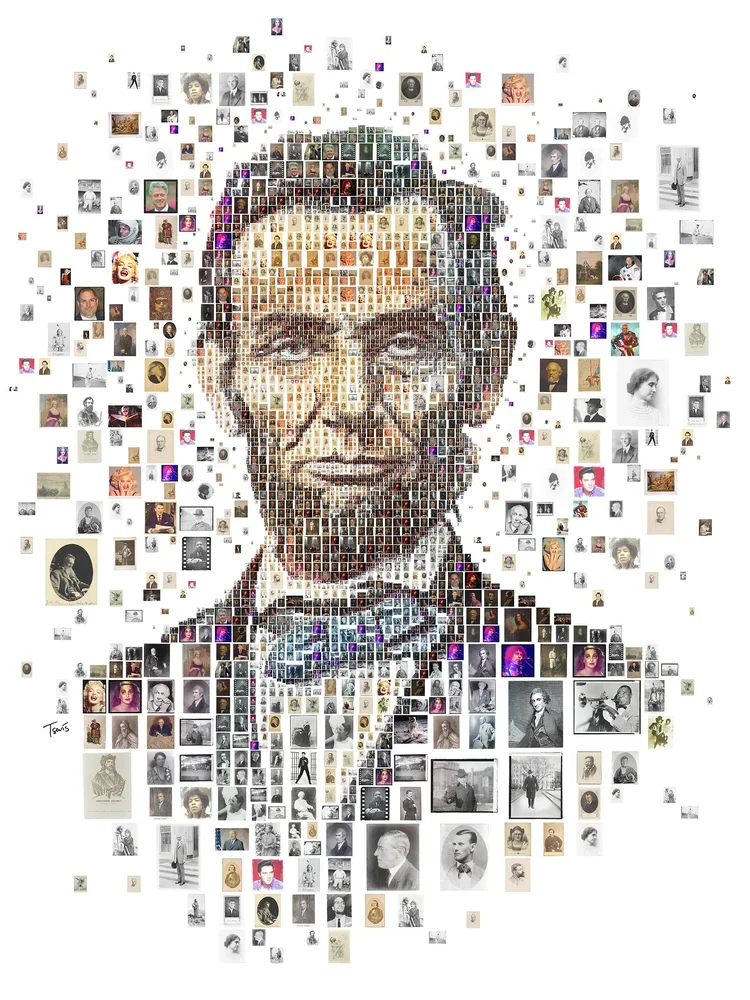 The Photographic MosaicPhoto mosaics: how they are made, why the library of photographs matters, and what to look for.
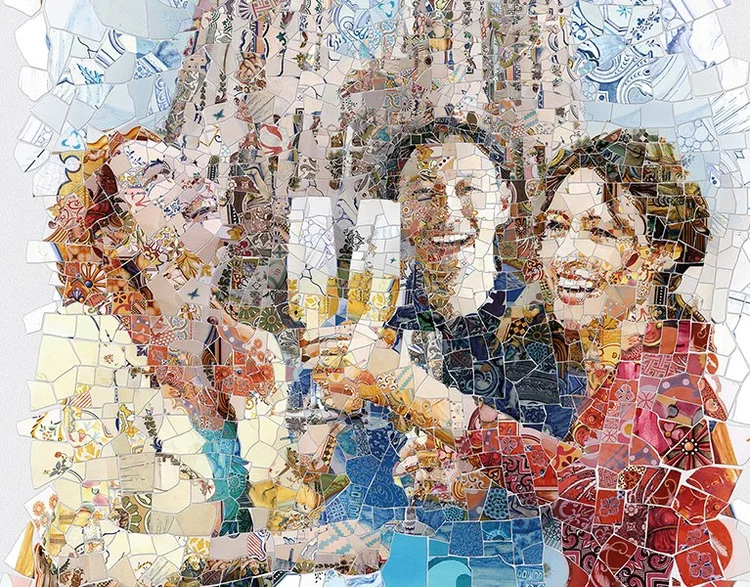 Mosaic GlossaryThe words of the mosaic, from tessera and andamento to matching rule.
 The Tradition We Work InThe history of the mosaic, from the clay cones of Uruk to Bell Labs.
 Research, Science and TechnologyMatching, importance, Gestalt and geometry: the knowledge behind our instruments.
 Algorithmic MosaicWhat an algorithmic mosaic is, and how we make one.
 ApplicationsWhere mosaics work today: campaigns, editorial, architecture, corporate art and gifts.
 Algorithmic Mosaic ArtistsThe people who shaped the mosaic made with computers, from Bell Labs to today.
 Photographic Mosaics: How the Algorithms DevelopedSixty years of mosaic algorithms, from Bell Labs to diffusion models.
 Mosaic StylesThe styles of our digital work, from classic grids to maps and stained glass.
References
- Tate, “Collage,” Art Terms. tate.org.uk ; The Metropolitan Museum of Art, Georges Braque, Fruit Dish and Glass, Sorgues, autumn 1912, 2016.237.33. metmuseum.org ; Musée national Picasso-Paris, Pablo Picasso, Nature morte à la chaise cannée, 1912, MP36. museepicassoparis.fr
- The Metropolitan Museum of Art, “Cubism,” Essays. metmuseum.org
- Tate, “Neo-impressionism,” Art Terms. tate.org.uk
- The Art Institute of Chicago, Georges Seurat, A Sunday on La Grande Jatte — 1884, 1884–86 (border added 1888–89), 1926.224. artic.edu
- Victoria and Albert Museum, “Stained glass: an introduction.” vam.ac.uk
- The Metropolitan Museum of Art, Studiolo from the Ducal Palace in Gubbio, ca. 1478–82, 39.153. metmuseum.org
- Victoria and Albert Museum, “Embroidery styles: an illustrated guide” (Berlin woolwork). vam.ac.uk
- National Museum of American History, Harriet Powers, Bible Quilt, 1885–86. si.edu ; Museum of Fine Arts, Boston, Harriet Powers, Pictorial Quilt, 1895–98, 64.619. collections.mfa.org ; New Georgia Encyclopedia, “Harriet Powers (1837–1910).” georgiaencyclopedia.org
- History of Information, “The ‘Daily Graphic’ of New York Publishes the First Halftone of a News Photograph in a U.S. Newspaper.” historyofinformation.com
- Adele Goldberg and Robert Flegal, “ACM President’s Letter: Pixel Art,” Communications of the ACM 25, no. 12 (December 1982): 861–862. doi:10.1145/358728.358731
- Flora F. F. Stacey, typewriter butterfly, Pitman’s Phonetic Journal, 15 October 1898; Barrie Tullett, Typewriter Art: A Modern Anthology (London: Laurence King, 2014).
- Library of Congress, International Collections blog, “Micrography in the Jewish Tradition,” February 2018. blogs.loc.gov
- Guillaume Apollinaire, Calligrammes: poèmes de la paix et de la guerre (1913–1916) (Paris: Mercure de France, 1918).
- Skokloster Castle, Giuseppe Arcimboldo, Vertumnus (Emperor Rudolf II as the god of the seasons), 1590. skoklostersslott.se ; University of Oxford, Cabinet, “Arcimboldo, Rudolf II as Vertumnus (1590–1591).” cabinet.ox.ac.uk
- Tate, “Photomontage,” Art Terms. tate.org.uk ; Encyclopaedia Britannica, “Hannah Höch.” britannica.com
- Tate, “Assemblage,” Art Terms. tate.org.uk ; William C. Seitz, The Art of Assemblage (New York: The Museum of Modern Art, 1961), exhibition catalogue, 2 October–12 November 1961. moma.org
- Encyclopaedia Britannica, “Decoupage.” britannica.com ; “Cutting up Berchems, Watteaus, and Audrans,” Metropolitan Museum Journal 31 (1996). resources.metmuseum.org
- London Museum, John Spilsbury, A New Dissected Map of the World, collection object 42820. londonmuseum.org.uk
- Smithsonian National Museum of American History, Paint by Number: Accounting for Taste in the 1950s (exhibition, 6 April 2001–27 January 2002). si.edu
- Javier P. Grossutti, “From Guild Artisans to Entrepreneurs: The Long Path of Italian Marble Mosaic and Terrazzo Craftsmen (16th c. Venice – 20th c. New York City),” International Labor and Working-Class History 100 (2021): 60–86. doi:10.1017/S0147547920000253
- Peter J. Lu and Paul J. Steinhardt, “Decagonal and Quasi-Crystalline Tilings in Medieval Islamic Architecture,” Science 315, no. 5815 (2007): 1106–1110. doi:10.1126/science.1135491
- Real Academia Española, “azulejo,” Diccionario de la lengua española. dle.rae.es ; “Zellij,” Wikipedia. en.wikipedia.org
- Museu Nacional do Azulejo, Lisbon, “15th and 16th centuries – The Hispanic-Moresque Azulejo,” Google Arts & Culture. artsandculture.google.com
- Infraestruturas de Portugal, “100 anos da Estação de São Bento.” infraestruturasdeportugal.pt ; “São Bento railway station,” Wikipedia (tile count). en.wikipedia.org
- UNESCO World Heritage Centre, Works of Antoni Gaudí; Fundació Catalunya La Pedrera, Park Güell (1900–1914). whc.unesco.org · lapedrera.com
- Freer Gallery of Art, Smithsonian Institution, Golden Seams: The Japanese Art of Mending Ceramics (exhibition, 8 November 2008–29 November 2009). si.edu
About the author
Charis Tsevis is a Greek visual designer and computational artist educated in Athens and Milan. A designer since the late 1980s, he has worked with mosaics for more than three decades and builds his own tools for them. He has taught design thinking, colour theory and Gestalt psychology at art colleges since 1996. With Vira Konstanta he runs Tsevis Studio, which makes photographic and algorithmic mosaics on commission for publications, brands and public spaces. About the studio.
Version and how to cite
Version 1.0, 2026-11-06. Corrections are listed here with their dates.
Tsevis, Charis. “Collage or Mosaic? When the Pieces Become the Picture.” Tsevis Studio, 2026-11-06. https://www.tsevis.com/collage-or-mosaic