Pete Buttigieg: A Mosaic of Messages
Six typographic mosaic portraits by Charis Tsevis, 2026
Pete Buttigieg: A Mosaic of Messages is a series of six typographic mosaic portraits of Pete Buttigieg, Mayor Pete to many, made by the Greek artist and designer Charis Tsevis at Tsevis Studio in October 2026. Each one is a portrait made of words: between 4,068 and 5,556 cut-paper pieces carrying slogans, the names of the fifty states, single letters, lines from his speeches and small images. From a distance you see a face. Up close you read a crowd of messages: Hope. Freedom. Common Decency. Neighbors, Not Enemies. Let's Win the Era.
- Artist: Charis Tsevis, Tsevis Studio
- Series: six portraits and seven animations, October 2026
- Technique: typographic mosaic, a digital collage of cut-paper pieces placed by Mozaix
- Pieces: 4,068 to 5,556 per portrait, from a library of 5,955
- Size: at least 8,192 × 12,826 pixels, about 69 × 109 cm at 300 dpi
- License: CC BY-NC-ND 4.0, free to share for non-commercial use with credit
- Full resolution: Flickr · Animations: Vimeo
- Also on: Behance
The six portraits
Quiet Confidence
Bearded, he looks up and to the side with a quiet smile. Warm reds and pinks build the face against a field of blue and violet words. 5,110 pieces, 2,790 of them different.
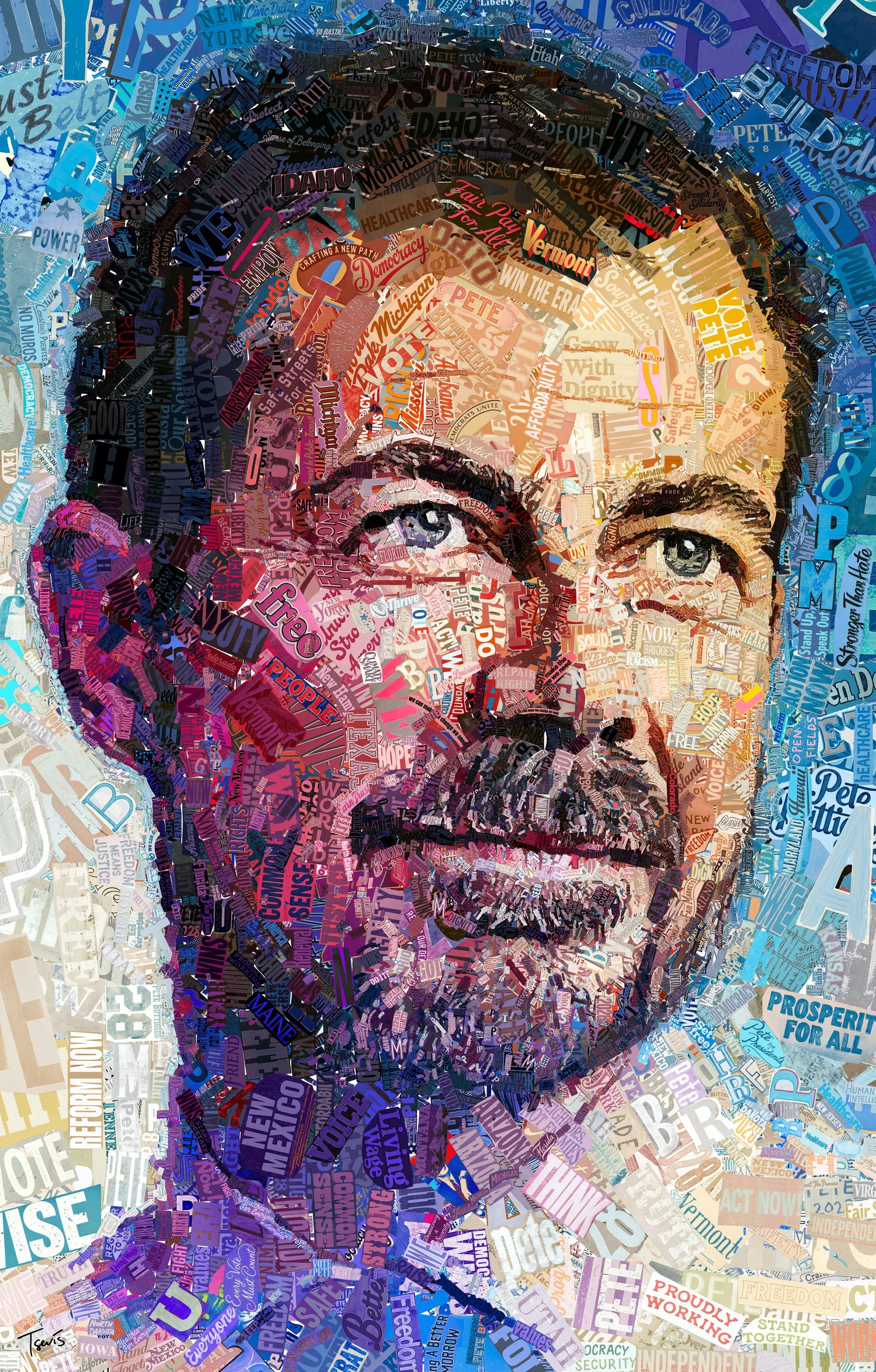
Pete Buttigieg: Quiet Confidence, 2026. High-resolution image can be downloaded from here.
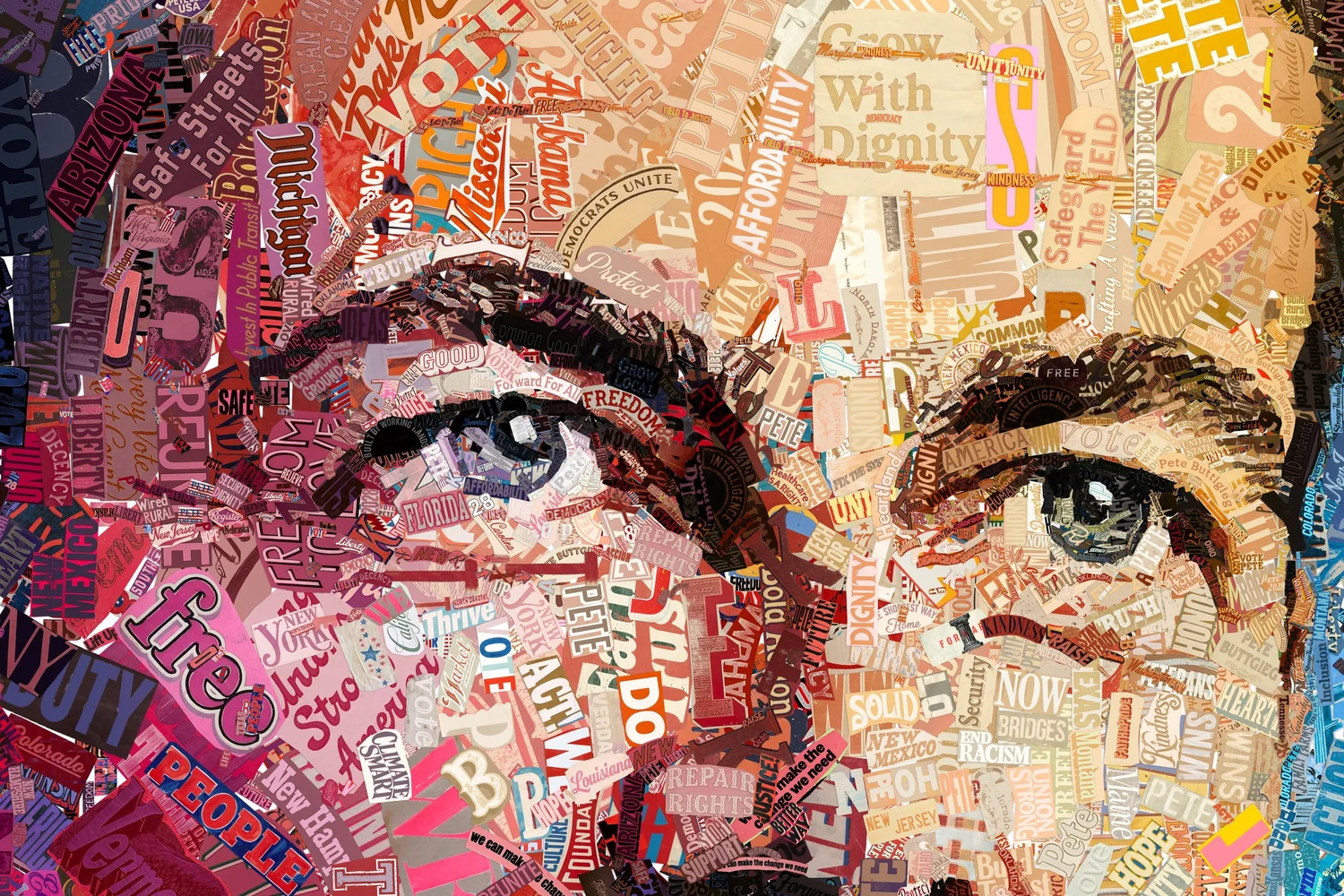
Detail at half size.
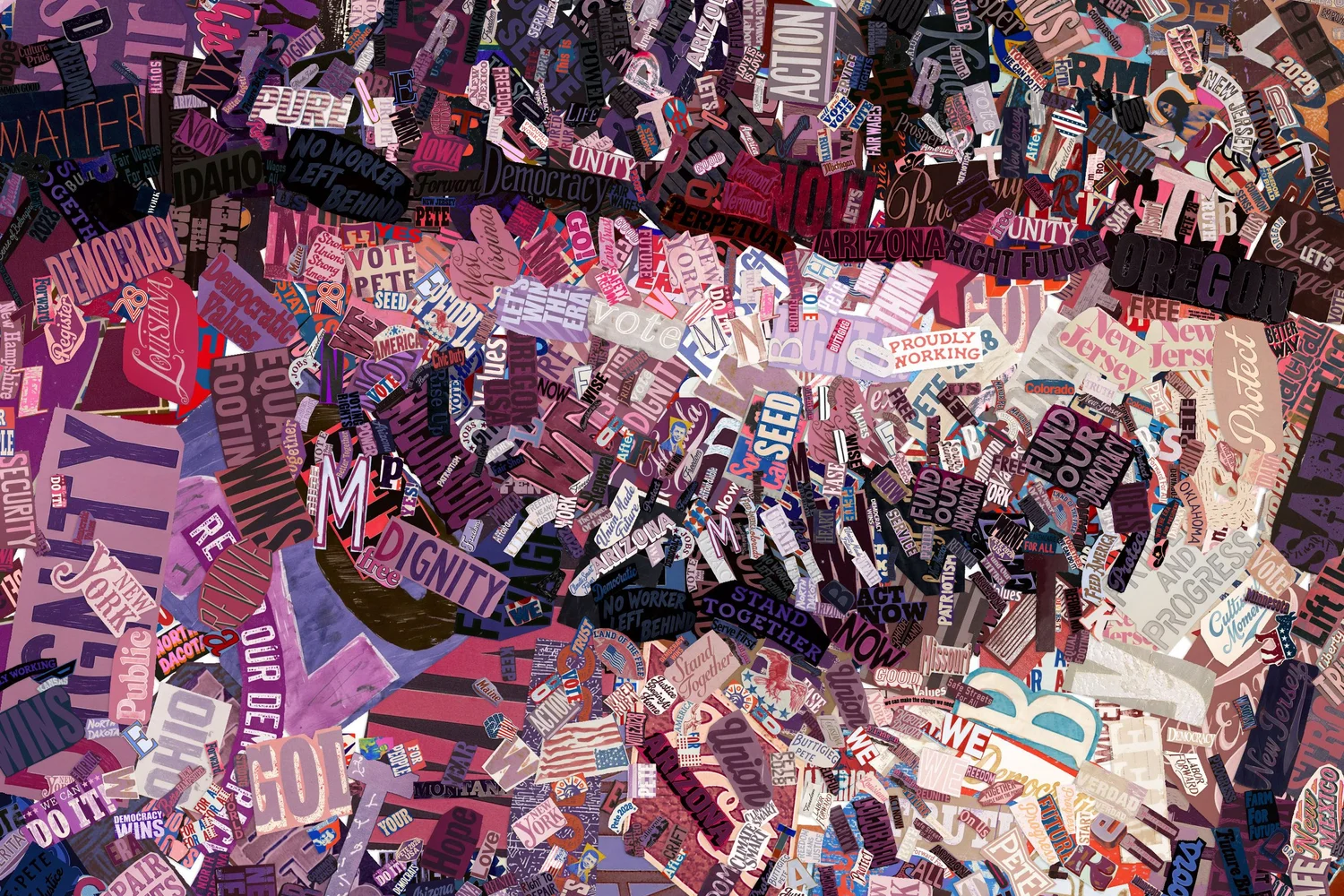
Detail at full size: every word is a piece of paper.
Quiet Confidence in motion: the pieces spiral in from the centre and settle into the portrait. Also on Vimeo.
Eyes on the Horizon
He looks up and into the distance, his face lit in warm oranges and creams against violet and blue slogans. The densest of the six: 5,556 pieces, 3,020 of them different.
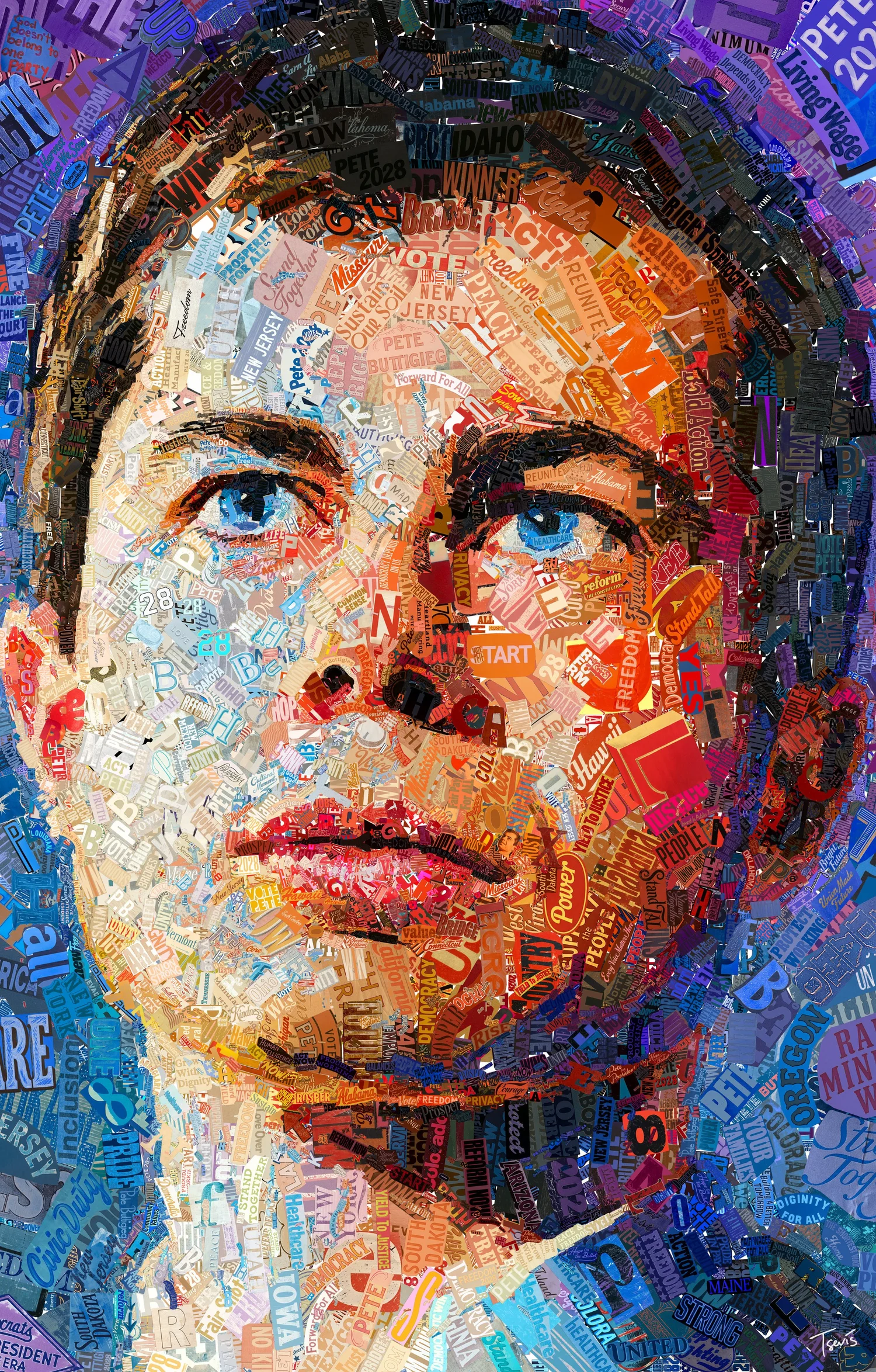
Pete Buttigieg: Eyes on the Horizon, 2026. High-resolution image can be downloaded from here.
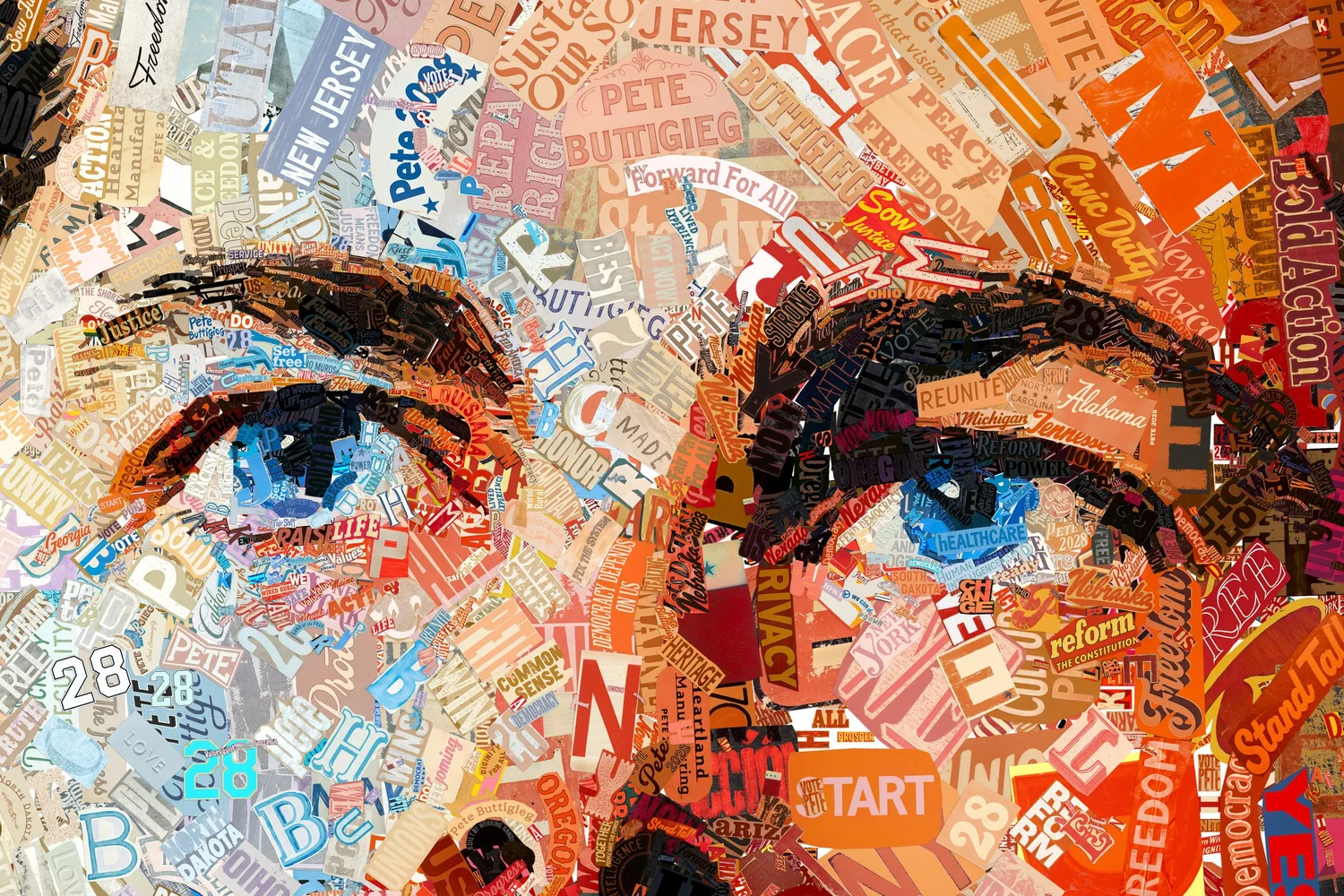
Detail at half size.
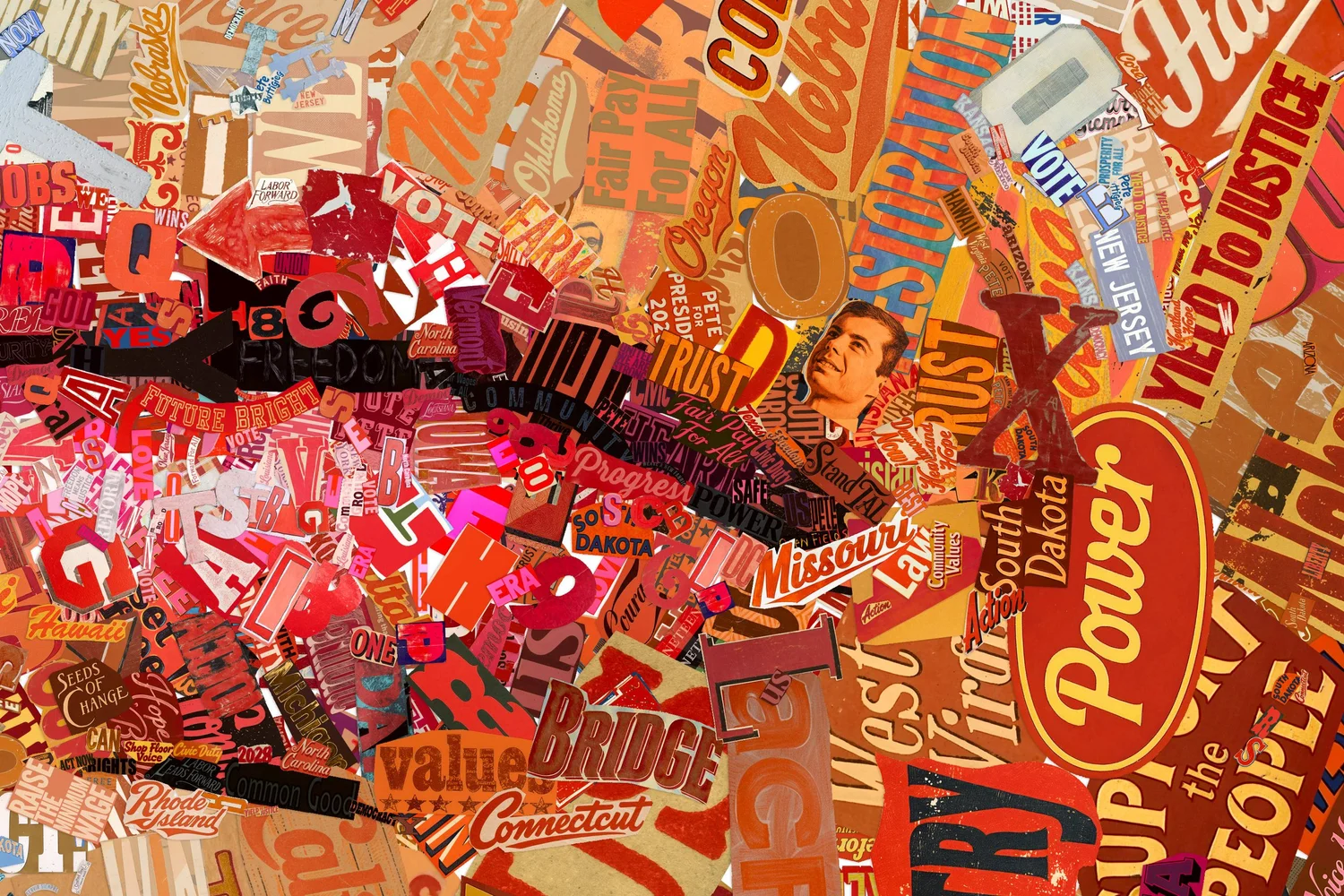
Detail at full size: every word is a piece of paper.
Eyes on the Horizon in motion: the portrait grows from the centre of the face outwards. Also on Vimeo.
Looking Up
He looks upward, blue eyes catching the light. The pieces follow flow lines drawn for this face, the way the stones of a classical mosaic follow the shape they describe. 4,780 pieces.
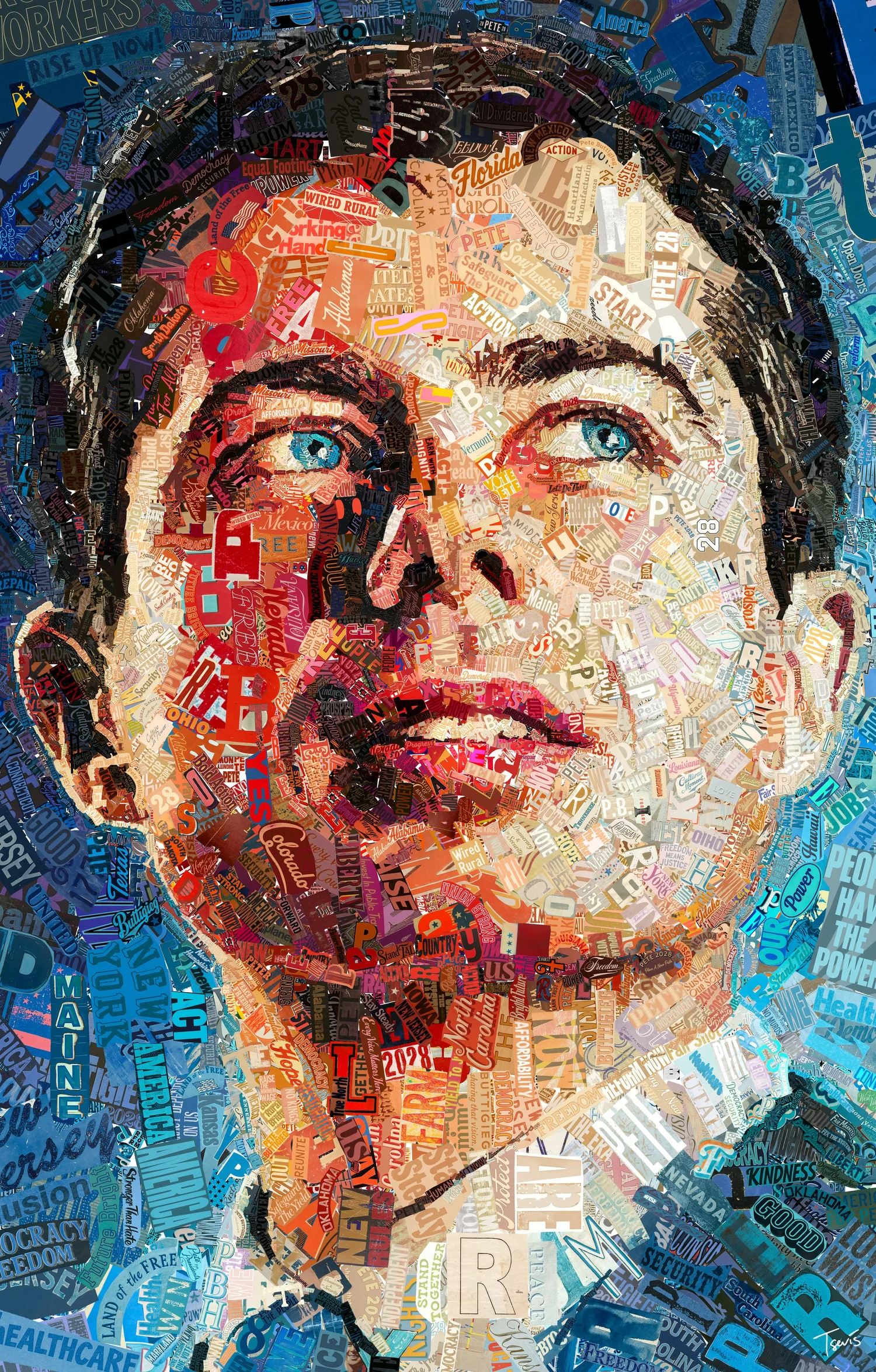
Pete Buttigieg: Looking Up, 2026. High-resolution image can be downloaded from here.
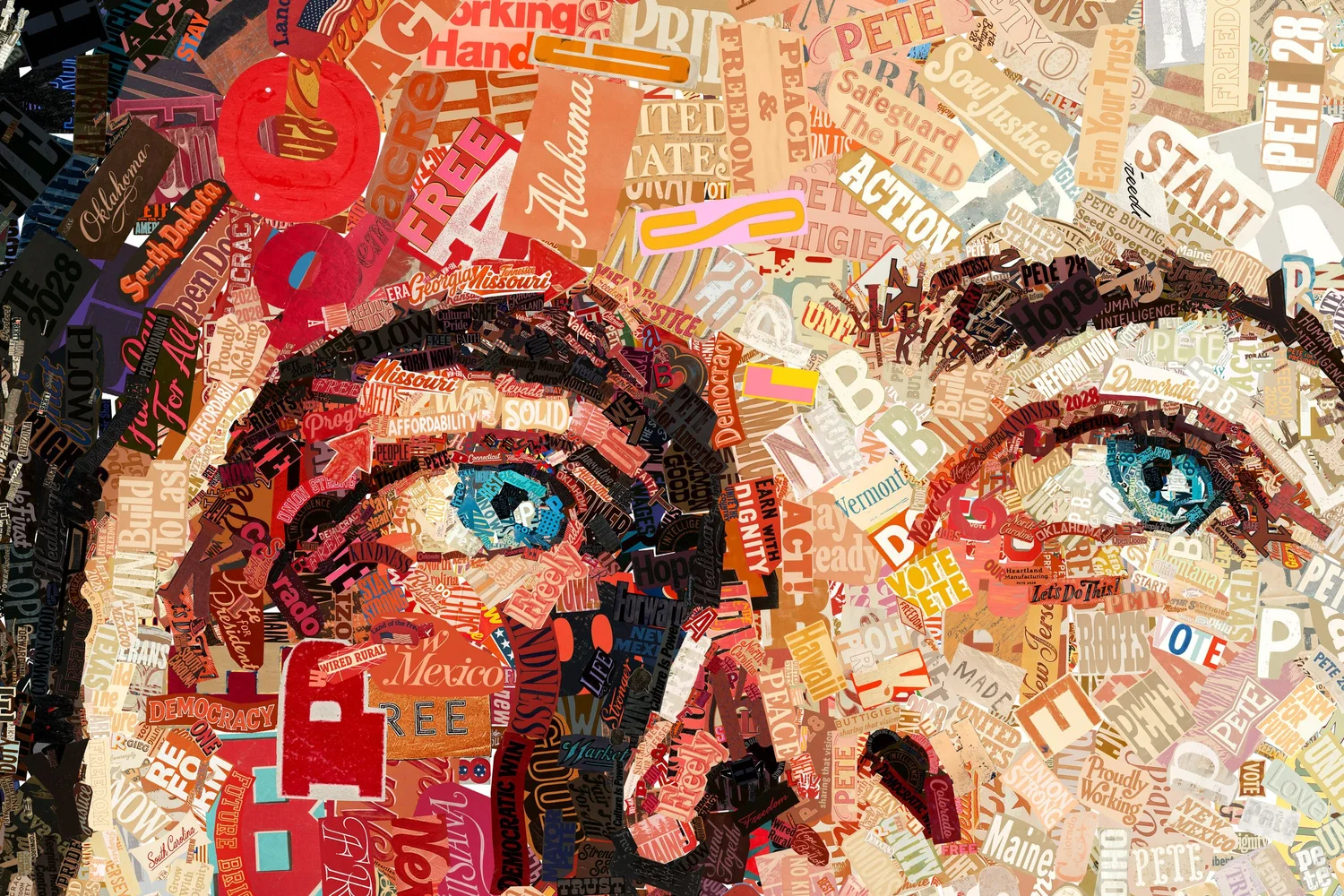
Detail at half size.
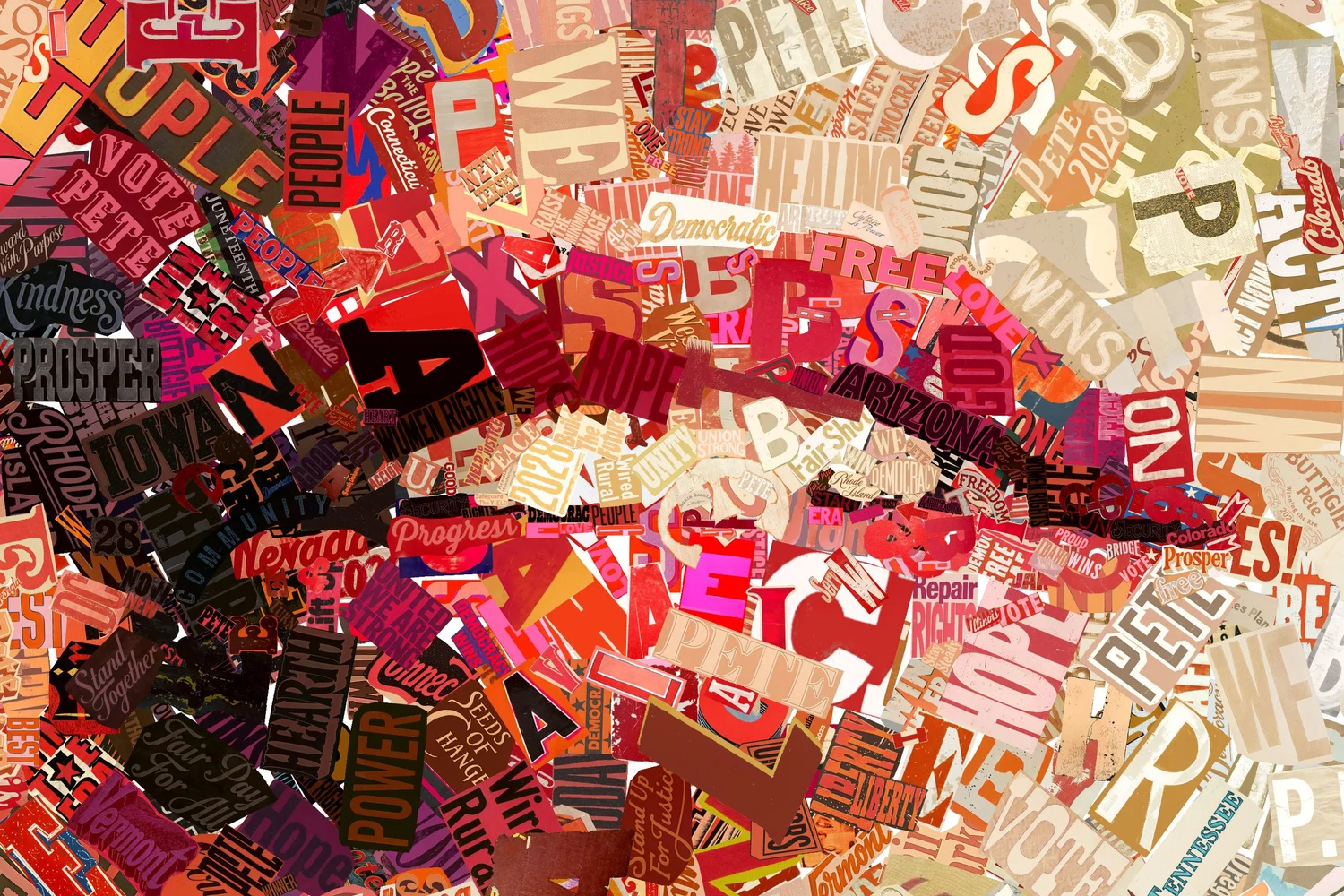
Detail at full size: every word is a piece of paper.
Looking Up in motion: one continuous glide across the finished portrait. Also on Vimeo.
Steady Resolve
Seen from slightly below, calm and resolute. Red and orange campaign letters crown the portrait above a field of blue, and here too the pieces follow flow lines drawn for the face. 4,732 pieces.
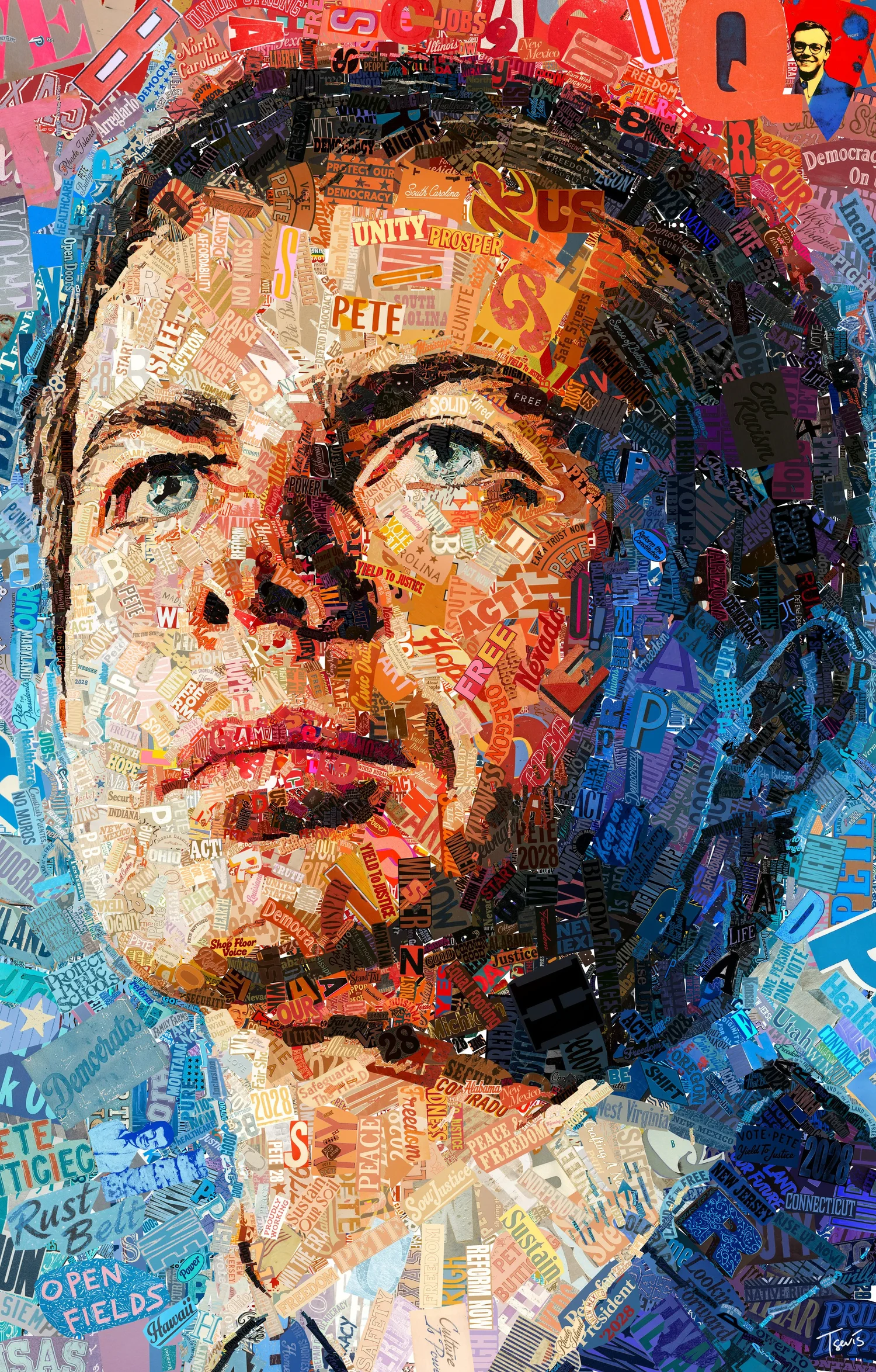
Pete Buttigieg: Steady Resolve, 2026. High-resolution image can be downloaded from here.
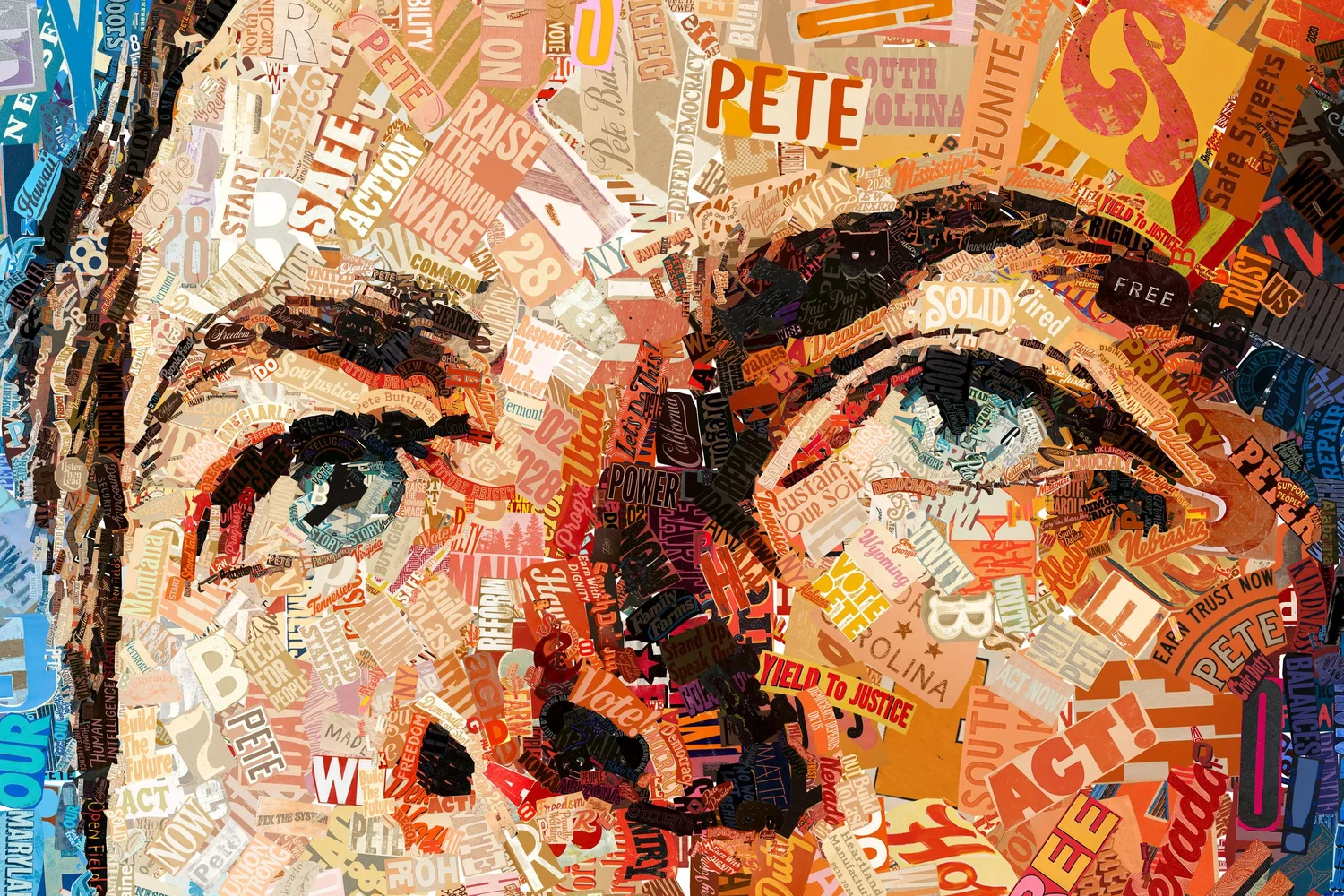
Detail at half size.
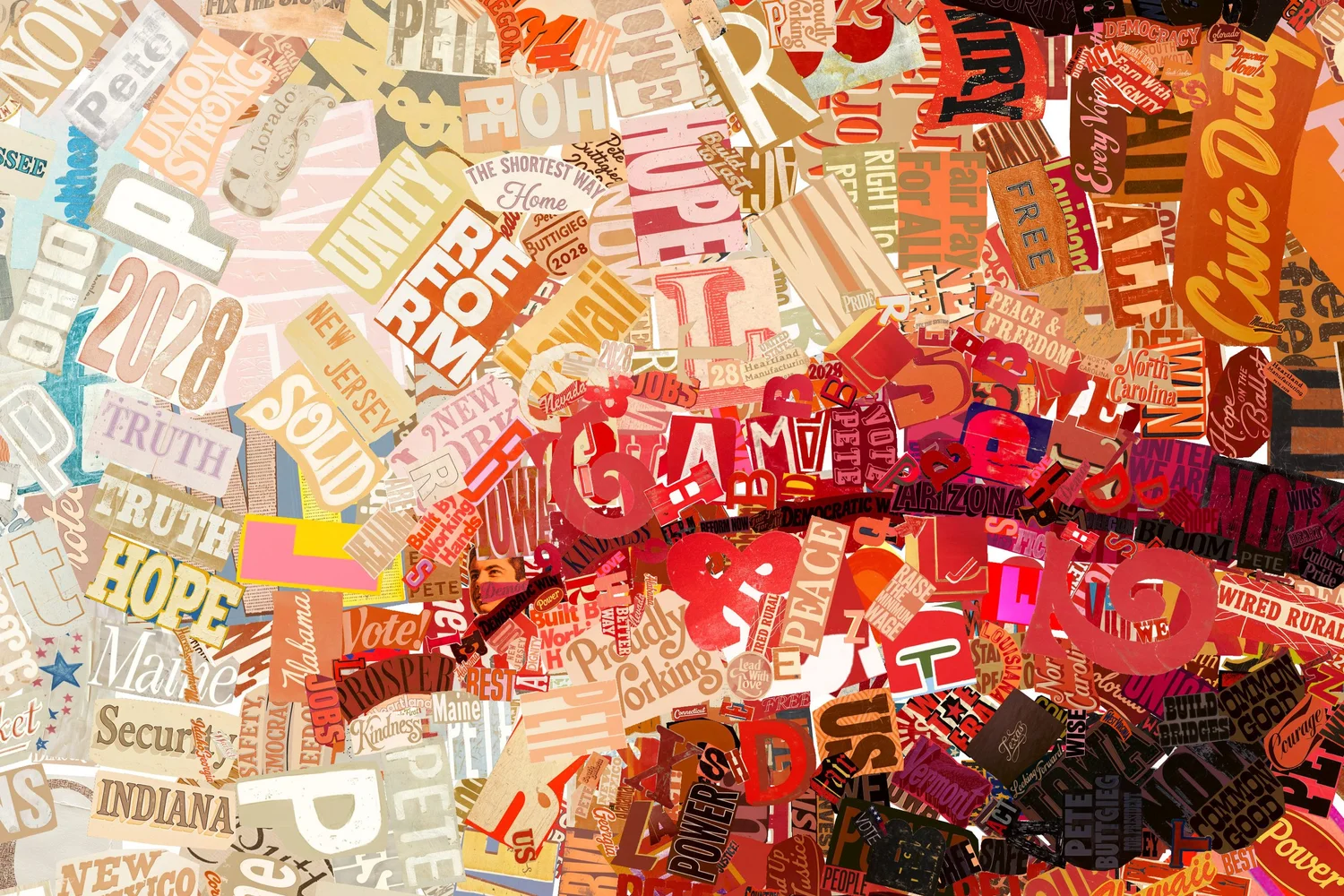
Detail at full size: every word is a piece of paper.
Steady Resolve in motion: the layers sweep across the frame like waves. Also on Vimeo.
Common Ground
He smiles straight at the viewer, his face in cool blues and creams inside a frame of reds, pinks and purples. Its pieces also follow flow lines drawn for the face. The most open of the six: 4,068 pieces, the largest of them 2,044 pixels across.
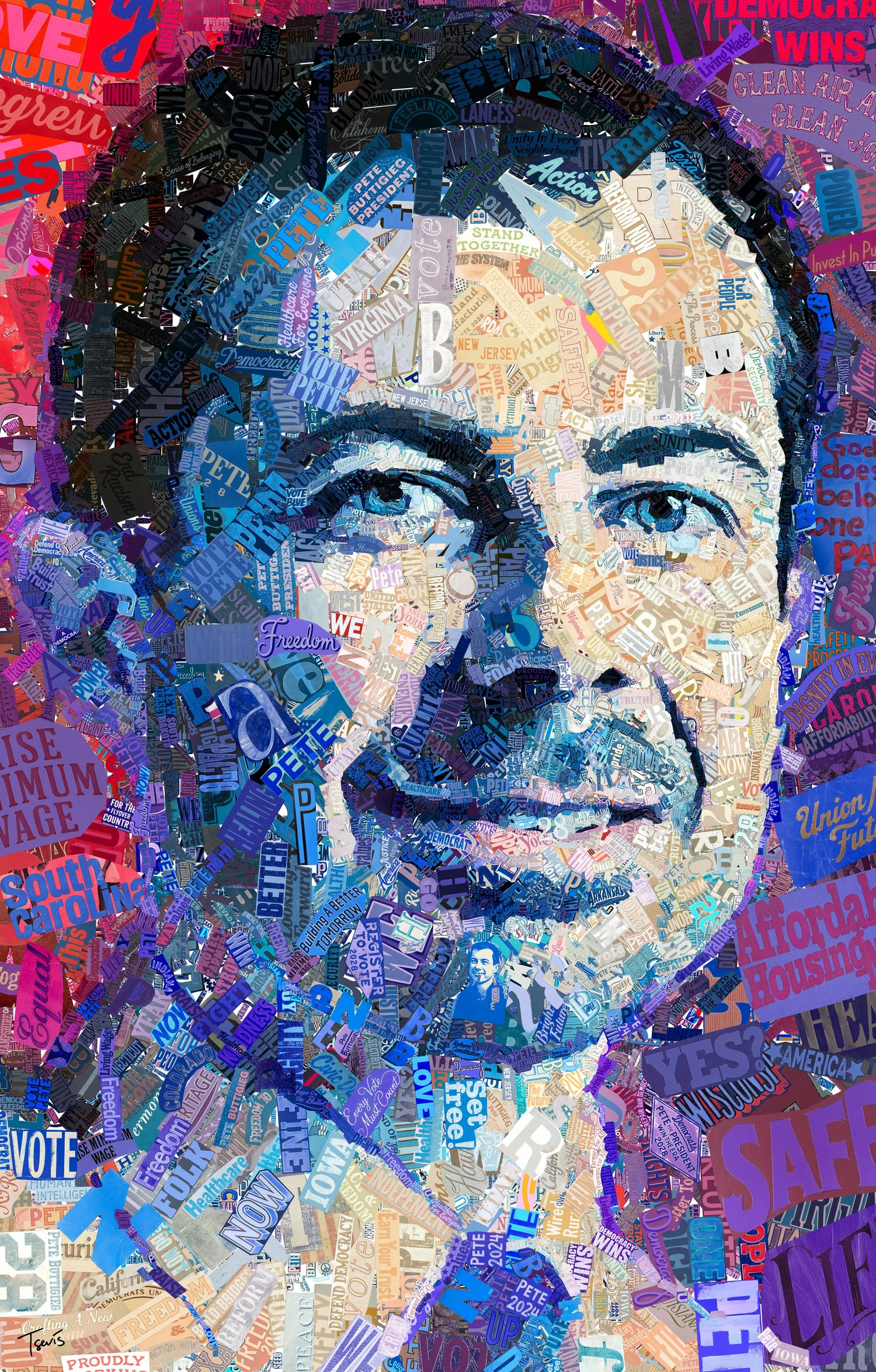
Pete Buttigieg: Common Ground, 2026. High-resolution image can be downloaded from here.
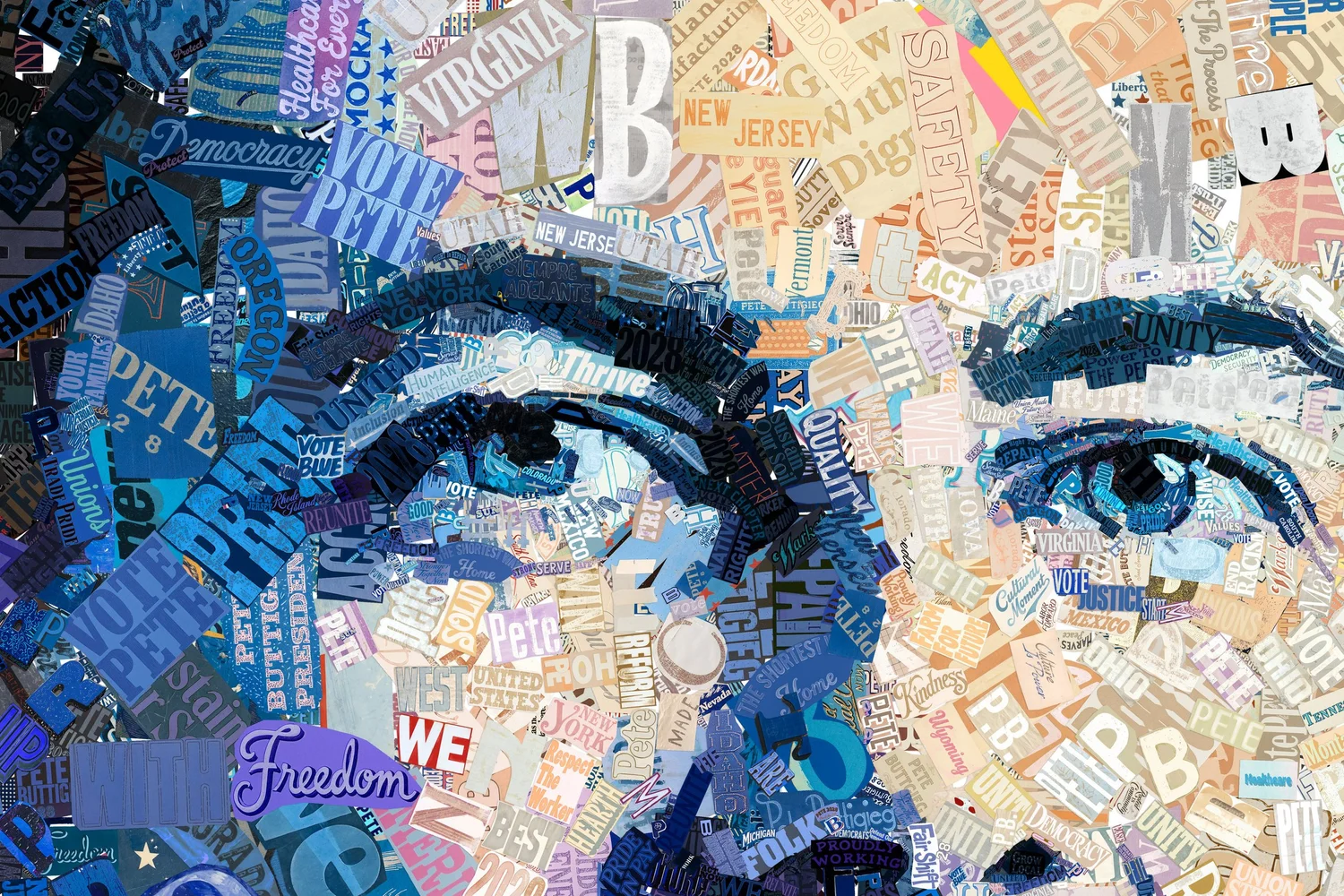
Detail at half size.
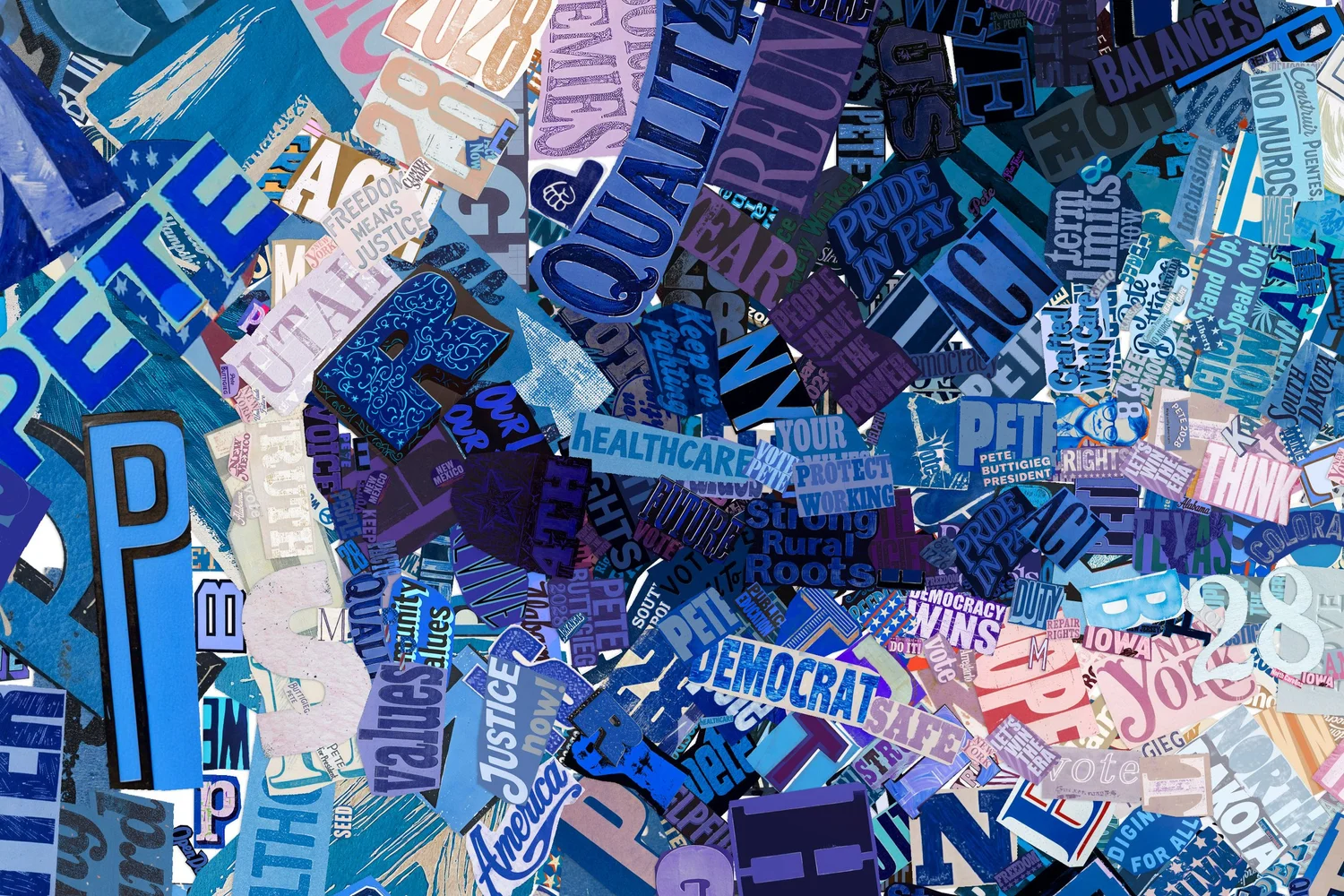
Detail at full size: every word is a piece of paper.
Common Ground in motion: the camera cuts between the nine places with the densest detail, then the whole portrait comes into view. Also on Vimeo.
Red, Blue and Every Color Between
One side of his face in blues, the other in reds, the two meeting in every color between: the two colors of American politics in one face. 4,930 pieces on the widest canvas of the series, 8,551 pixels.
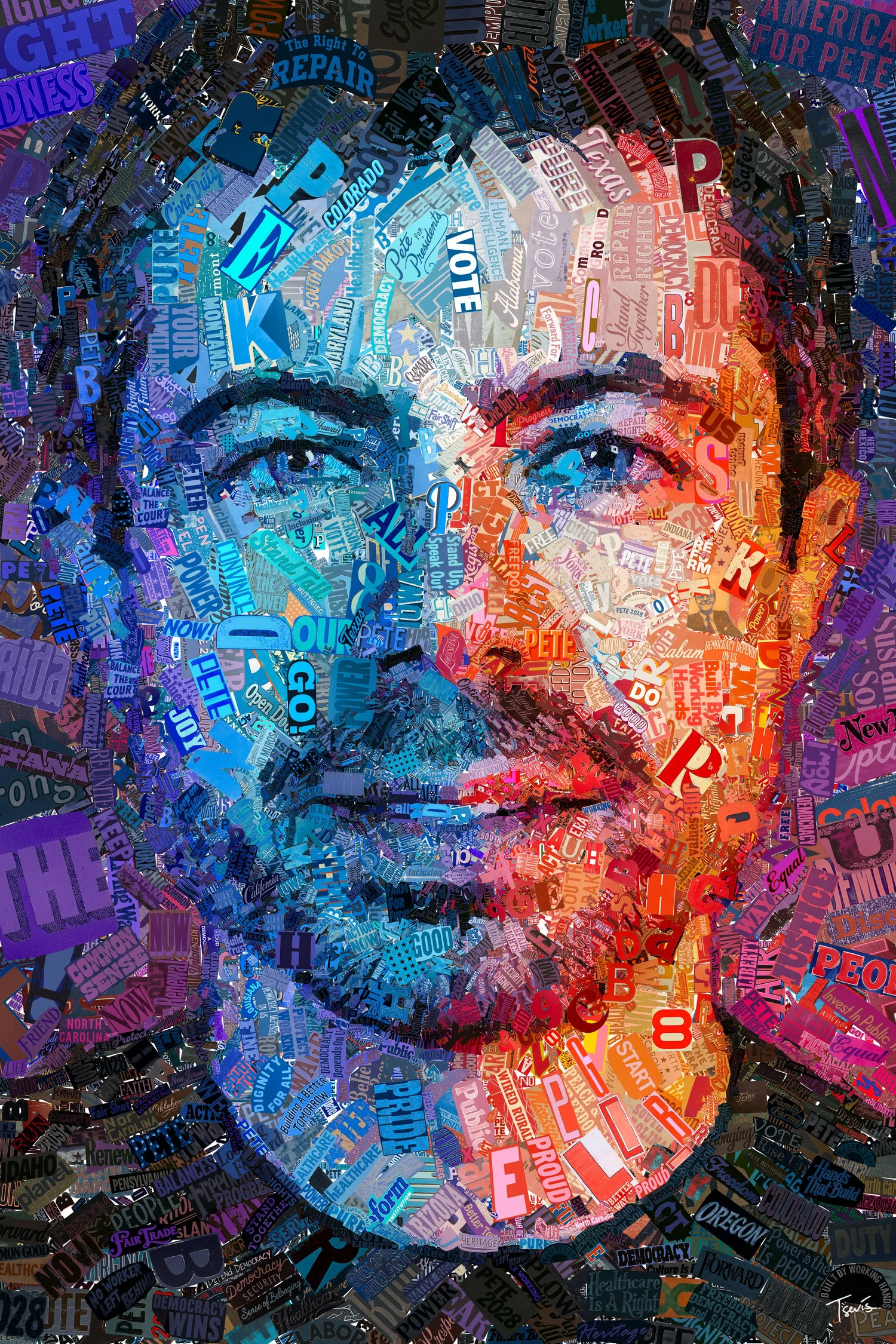
Pete Buttigieg: Red, Blue and Every Color Between, 2026. High-resolution image can be downloaded from here.
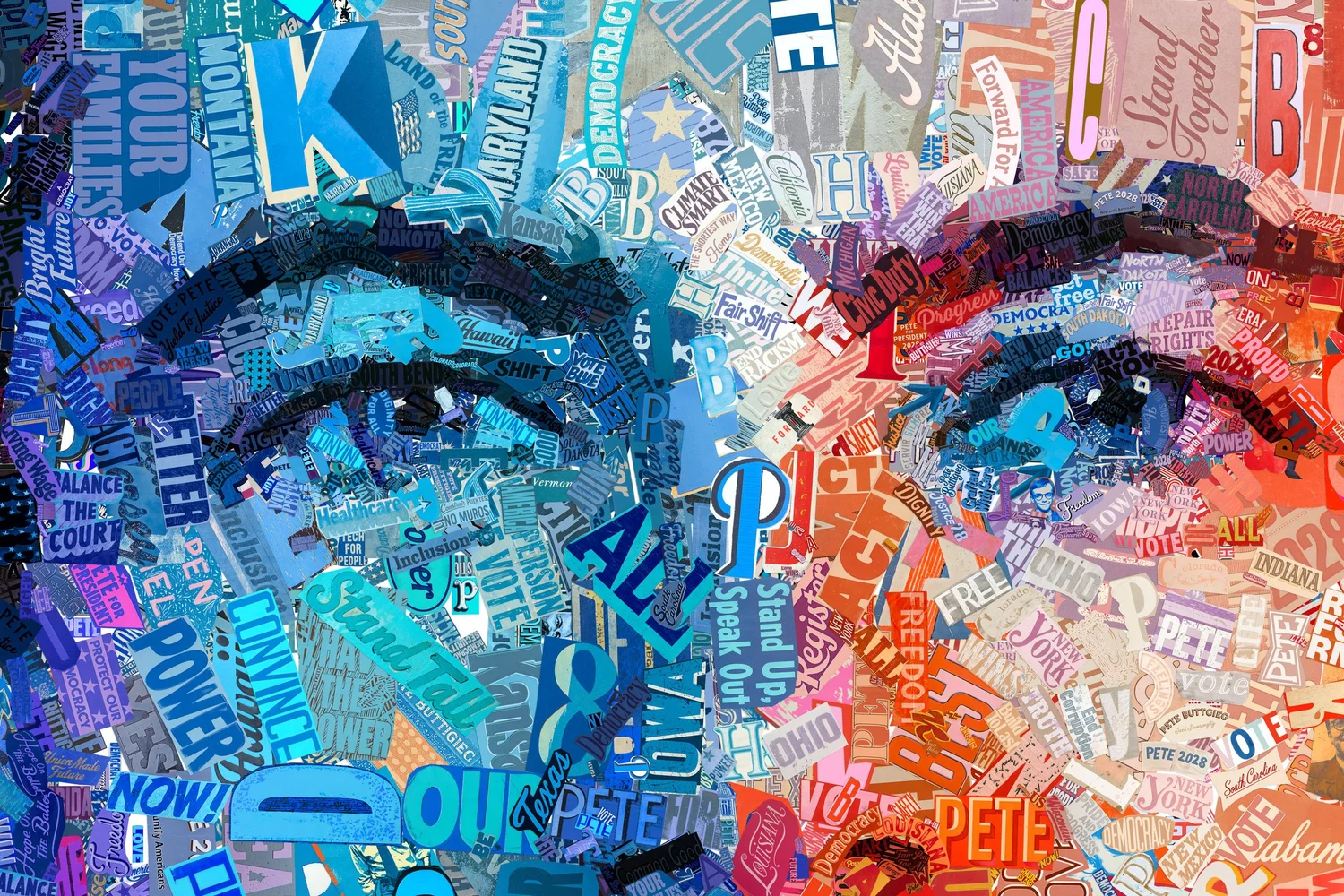
Detail at half size.
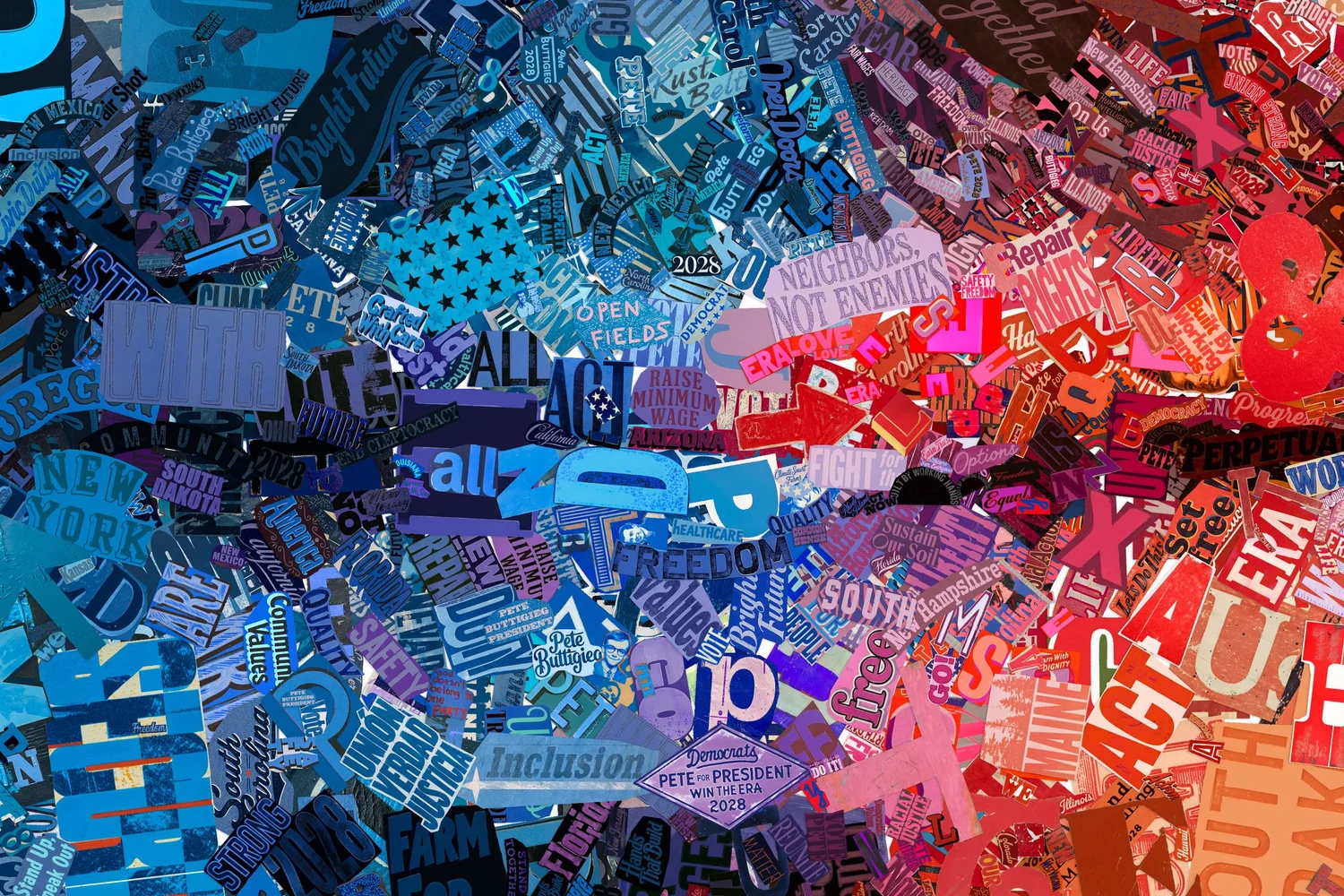
Detail at full size: every word is a piece of paper.
Red, Blue and Every Color Between in motion: the camera breathes in to the eye, the mouth and the hair, and out to the whole face. Also on Vimeo.
All six portraits in one minute: each one dissolves to build the next. Also on Vimeo.
Why Pete
I have supported Pete Buttigieg since 2019. In 2020 I made a series of portraits for his presidential campaign, and I still see in him what I saw then: a calm listener, a debate opener and one of the finest political minds of our time. As mayor of South Bend and as U.S. Secretary of Transportation he showed that politics can be competent, patient and kind at the same time.
I am not partisan. I am not a member of any party, but I always vote, and I openly support a party or a candidate when I choose one: not as a fan, but as a choice for a specific challenge. I believe every society needs all of its parties, because each one represents a real part of it: classes, interests, professions, beliefs and every other social group. Politics is the art of synthesis, and for me the best state is a dynamic equilibrium.
To me, politics is the highest art and science of a society. It has to orchestrate every other discipline: the arts, the sciences, technology, the economy. When politics does not work, societies do not work, and today this is plain to see. Many of our political systems still rest on assumptions and norms that belong to the past, or that simply no longer work.
This is where Pete and I meet. Since his first presidential campaign he has put structural reform first, from reshaping the Supreme Court to amending the Constitution to end the Electoral College. Not as an end in itself, but as the ground for new social contracts: new ways to find common ground, to reach the compromises a democracy needs, and to build synthesis within a nation and between nations.
I have also decided how I support the people I believe in: only in a positive way. I wrote about it in My Art for Politics. These portraits attack no one. Every piece in them says what we could be for, not who we should be against. Some pieces carry the year 2028. Read it as a hope, not as news.
The pieces: a library of 5,955 messages
A person is never one message. We are made of countless tiles: our history, our work, the hopes of the people around us. In these portraits every tile is a message of its own, chosen from a library of 5,955 pieces designed for the series. Each portrait draws between 2,560 and 3,020 different pieces from it, and in its three main layers no piece is used twice.
The fifty states
761 pieces. Every state name, in many voices: script and wood type, sports lettering, sign painting and travel-poster type. Iowa, Michigan, Indiana, New Hampshire and the rest are scattered across each face.
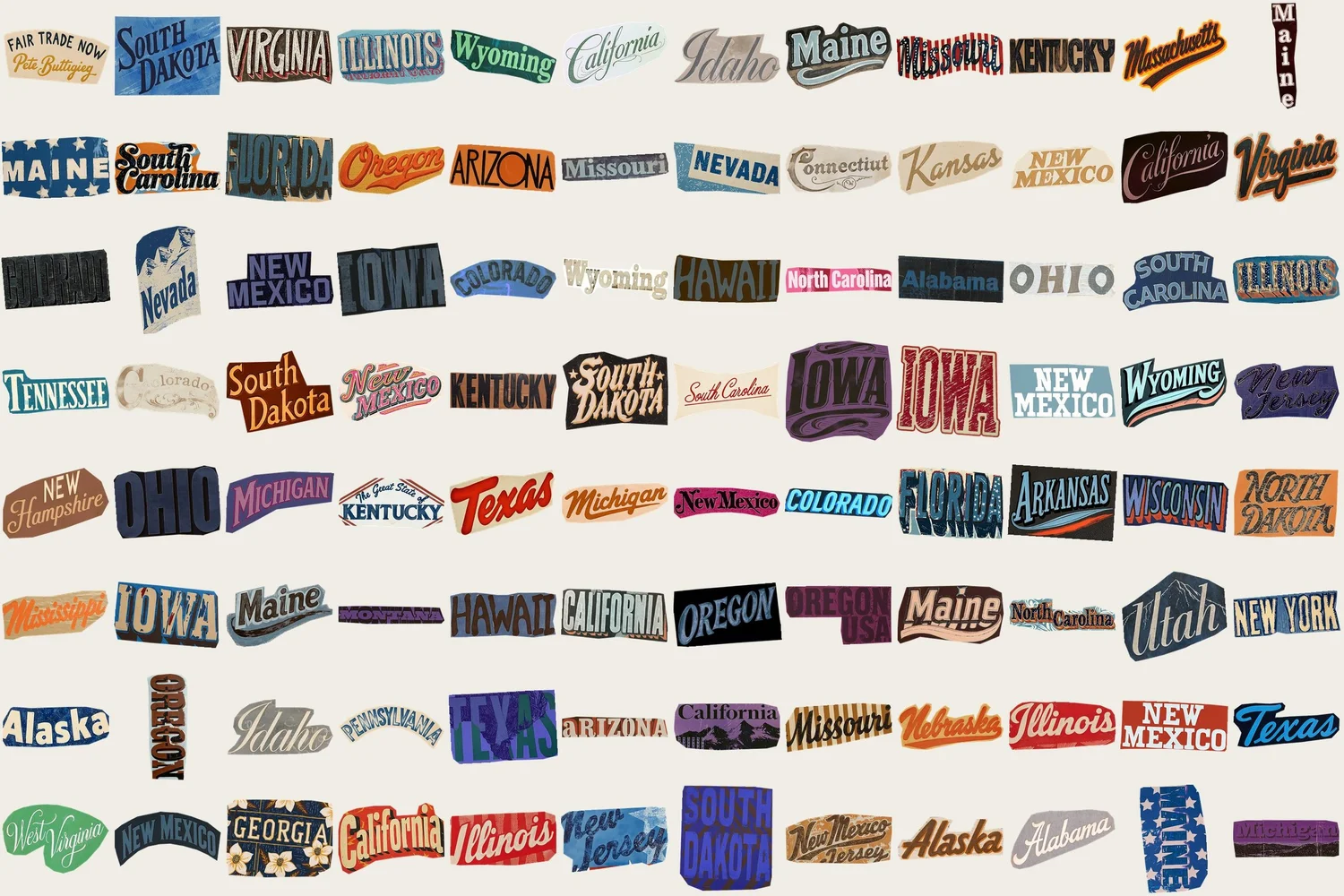
State names from the library.
One word
Hope. Freedom. Dignity. Justice. Kindness. Vote. Single words, the shortest messages a campaign has, set large and bold.
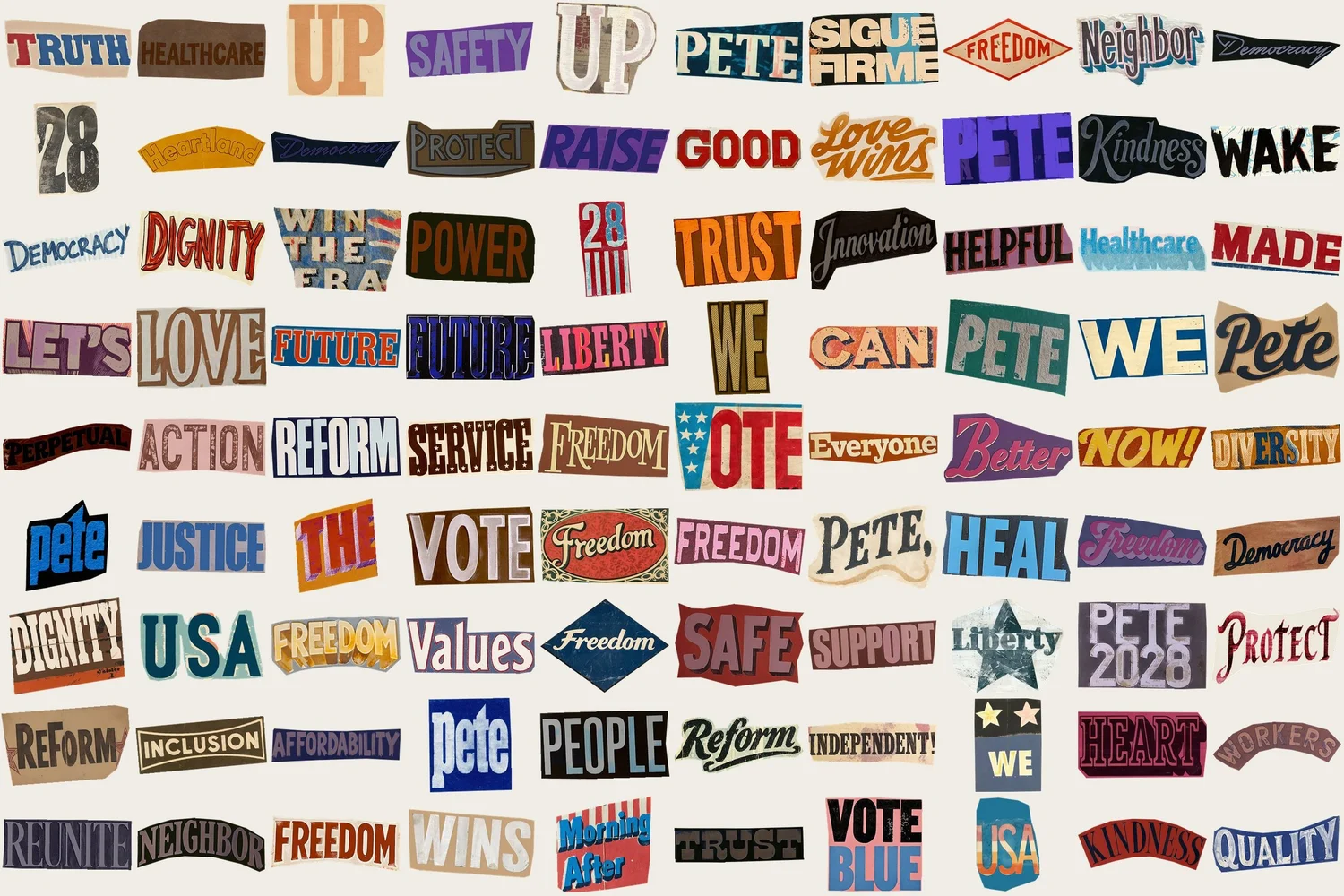
Single words, and a few pairs.
Messages of several words
Healthcare Is a Right. Unity in Every Neighborhood. Fix the System. Every Vote Must Count. Repair Our Democracy. Reform the Constitution. Some speak Spanish: Una Nueva Generación, Construir Puentes, No Muros.
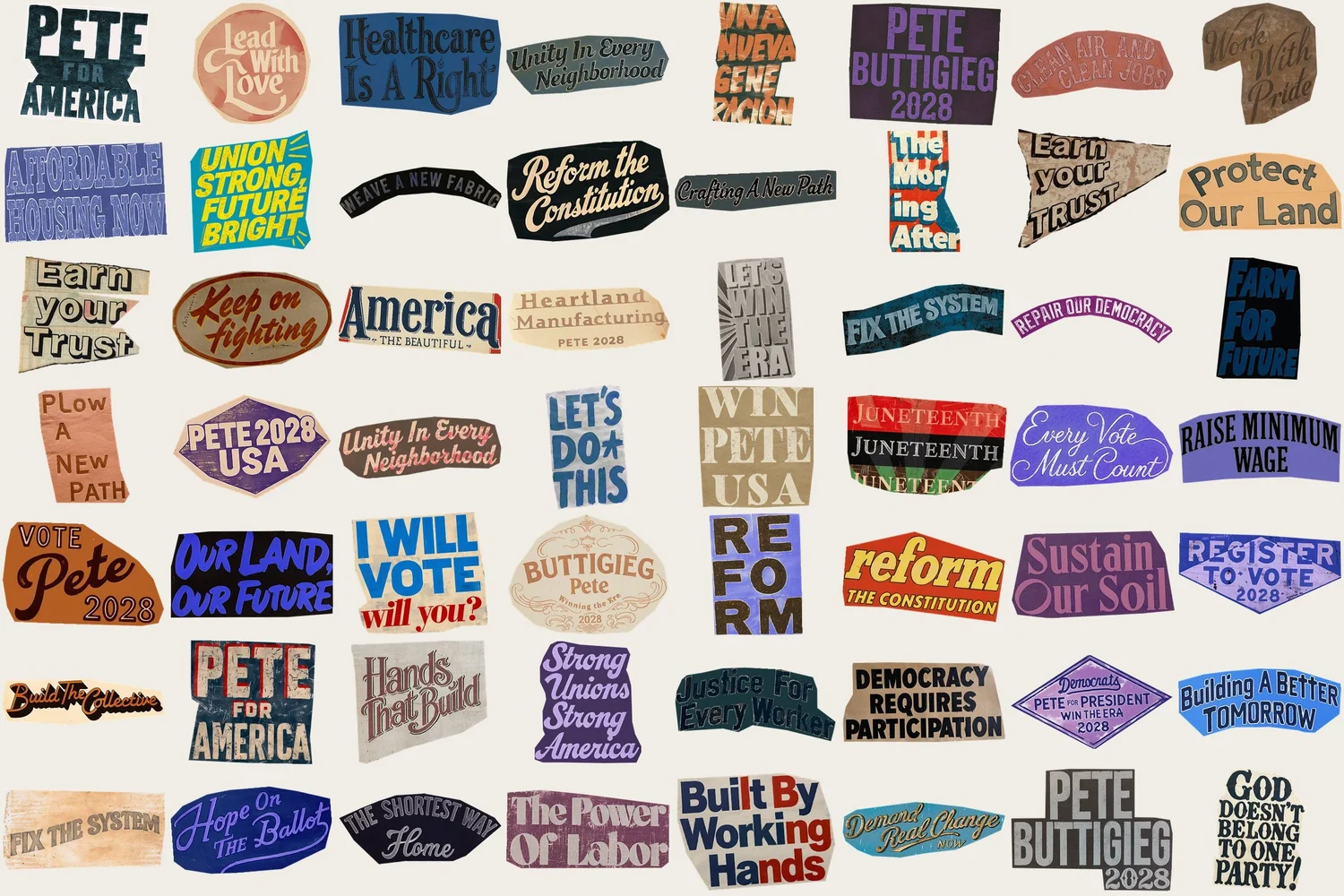
Messages of several words.
From Pete 2020
Pete for America and Win the Era came back from his first presidential campaign.
From his speeches
Lines such as “God doesn’t belong to one party” and “We can fix the political system”. All of the word pieces together: 3,406.
Images made for Pete
273 pieces. Small images made especially for the series: Pete, Pete with Chasten, flags, raised fists, the Statue of Liberty, the White House, columns, eagles and arrows.
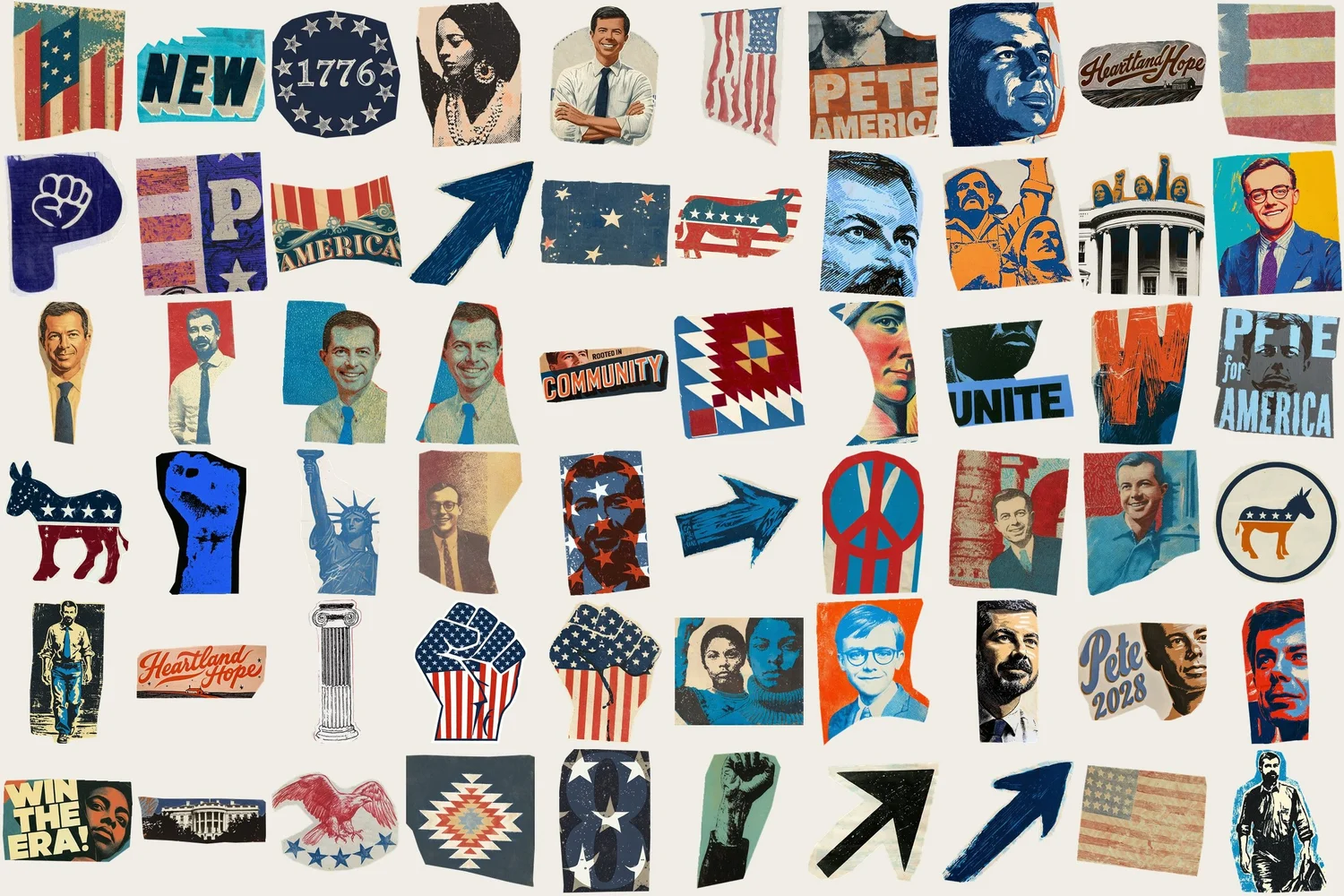
Images made for the series.
Single letters
1,515 pieces. Letters cut from posters and signs fill the smallest gaps, where a whole word would not fit.
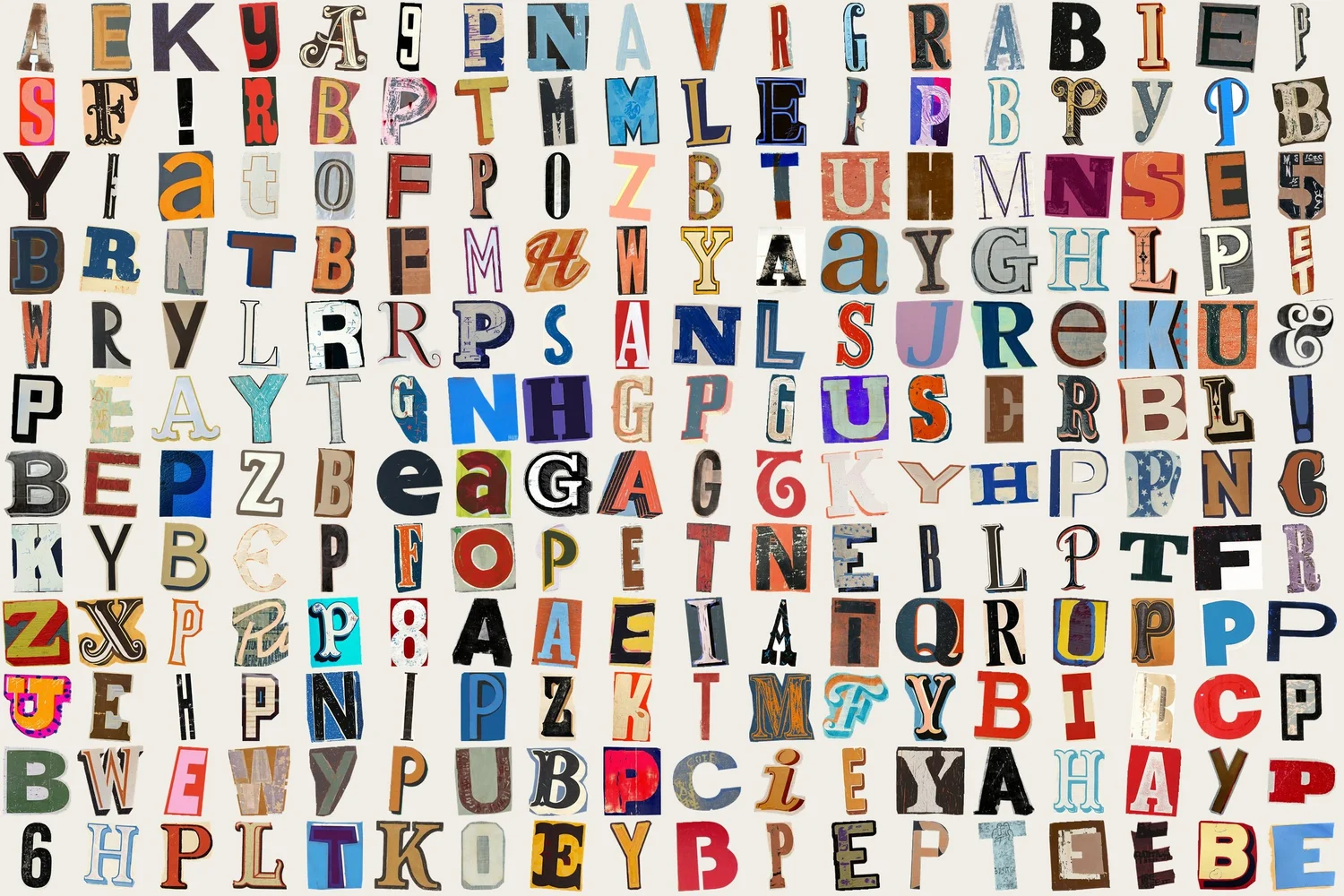
Single letters.
How it was made
The library
Every piece was designed in the studio from a study of American political posters, signs and print, with the look of letterpress, screen print, hand-painted signs and campaign buttons. I worked with Adobe Creative Cloud and a ComfyUI model that simulates paper, ink and other materials, so that each piece looks cut from a real poster. Each piece is cut out along its own outline, and that outline is the shape Mozaix packs.
Reading the face
Mozaix first finds the face and 106 points around the eyes, nose and lips. The smallest pieces and the strongest contrasts go where we read a face.
Five layers, one on top of the other
A portrait is built like a collage on a table, layer by layer. The numbers below are for Eyes on the Horizon.
- The main layer. First, 252 pieces mark the darkest and lightest points of the face. Then 343 pieces line up along 37 axes that follow its shape, like the andamento of a classical mosaic. Six waves of pieces follow, from the largest size down to the smallest, then repairs, and last a relax step that nudges pieces into place: 752 pieces in all. Mozaix's Jigsaw Packing fits their irregular outlines edge to edge, like a puzzle.
- Two backing layers. 541 and 405 pieces are laid underneath, filling the cracks between the pieces above. They never overlap each other. After these three layers, 99.3% of the canvas is covered.
- The background. 951 pieces go under everything and cover the last open ground, so no bare canvas shows.
- The detail layer. 2,911 thin strips on top, in the colors of the lines, shadows and lights of the face: eyelids, pupils, nostrils, the line of the lips.
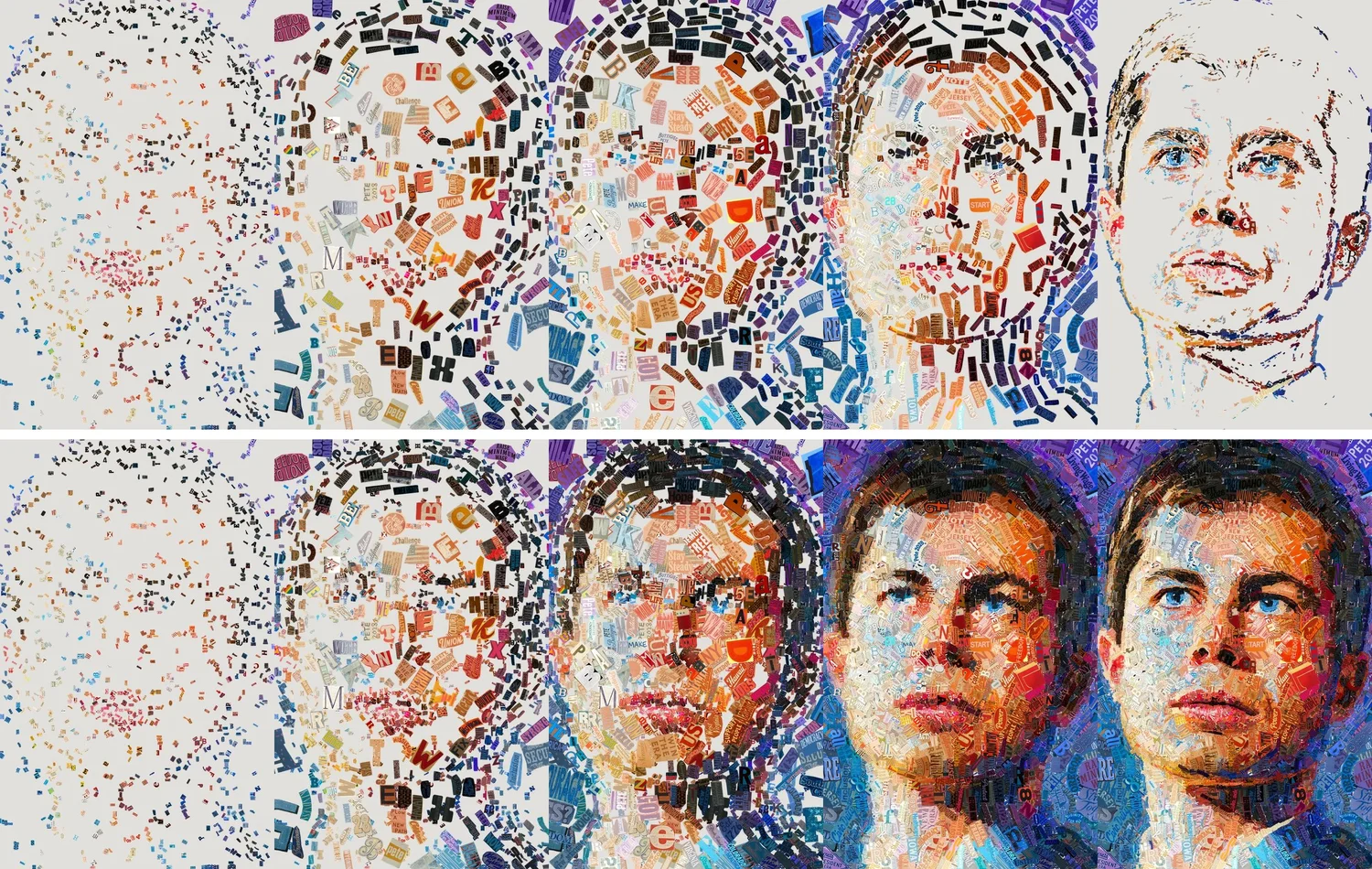
Eyes on the Horizon, layer by layer. Top: each layer alone, from the background up to the detail strips. Bottom: the same layers stacked, until the portrait is complete.
Depth
Paper laid on paper casts a shadow. Each of the five layers carries the same drop shadow: 2 pixels at 30 degrees, 5 pixels soft, 22% multiply. A layer's shadow falls on the layers below it, never on its own pieces, so the eye reads the portrait as a stack of real paper. In the animations, a piece still in the air casts a larger shadow that shrinks as it lands.
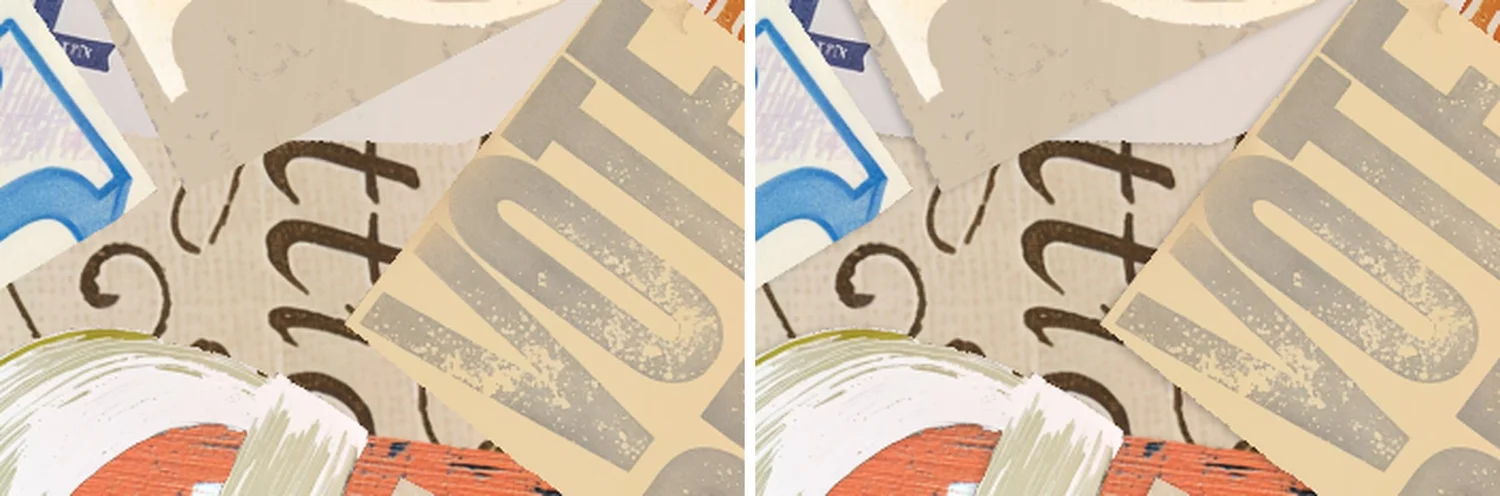
The same spot at 400%: the layers without shadows (left) and the finished portrait (right).
Size
Each portrait is at least 8,192 × 12,826 pixels, enough for a print of about 69 × 109 cm at 300 dpi.
Free to share
These portraits are free to share for non-commercial use with credit, under CC BY-NC-ND 4.0. The full-resolution files are on my Flickr. Please don't use them for hate or anything negative. For any other use, see Image licensing.
Wishing you the best, Pete.
Questions
Who made the Pete Buttigieg mosaic portraits?
Charis Tsevis, a Greek artist and designer, at Tsevis Studio, in October 2026.
What are they made of?
Thousands of cut-paper pieces carrying words, slogans, state names, letters and small images, placed by Mozaix, the mosaic software he builds.
Can I share them?
Yes, for non-commercial use with credit, under CC BY-NC-ND 4.0. Full-resolution files are on Flickr.
Is this an official campaign artwork?
No. It is an independent tribute by the artist, not made for or with Pete Buttigieg or any campaign.