Annotated Bibliography of Artistic Image Mosaics, 1967–2026
I have been making mosaics since the end of the 1980s. When I started building my own software for them, Mozaix, I went looking for the research, and I found it scattered. Some of it sits in computer graphics journals, some in conference proceedings, some in a master's thesis from the 1990s, some in patents, some on web pages that may not last. I did not find it in one place, and certainly not in a form written for people who make mosaics, as opposed to people who write papers about them.
This is that place. It is a working list of the literature on artistic image mosaics, the kind that makes one picture out of many small ones, and it has 86 entries, from 1967 to 2026. It began as the source list behind my history of the algorithms, and I have extended it with 11 papers published after the 2007 survey of Battiato and colleagues, the most recent general survey I have found.
What to expect
The entries run in order of date, so you can follow the field from the Bell Labs prints of the 1960s through the drawing programs of the 1990s, the optimisation and GPU work of the 2000s and 2010s, and the neural and diffusion methods of the last few years. Each entry carries a label that says what kind of thing it is: a journal article, a conference paper, a thesis, a patent, a preprint, a book, a piece of software. I find that distinction matters. A patent claims, a thesis explains, a preprint has not been reviewed yet, and a software page can disappear.
The note under an entry is the sentence from my history that cites it. I did it this way so that the list says what I have actually written about each work and no more. For the papers I added afterwards, I checked the bibliographic record and not the paper, and the note says so. I would rather mark a gap than pretend to have read something.
What is left out
The words "mosaic" and "image mosaic" also name something else: stitching many photographs of a coral reef, a stretch of land or the surface of Mars into one survey image. That is a different field, and it fills the search results. I have left it out.
The list is not complete, and I do not expect it to be. If you know a paper, a thesis or a piece of software that belongs here, or if I have got something wrong, please tell me. Every change is recorded in the changelog at the end.
Before 1990
- Artwork (computer-processed print) Kenneth C. Knowlton and Leon D. Harmon, Studies in Perception I, Bell Telephone Laboratories, 1967. collections.vam.ac.uk
At Bell Labs in 1967, Ken Knowlton and Leon Harmon digitised a photograph of a reclining figure and rebuilt it from small black-and-white symbols: Studies in Perception I.
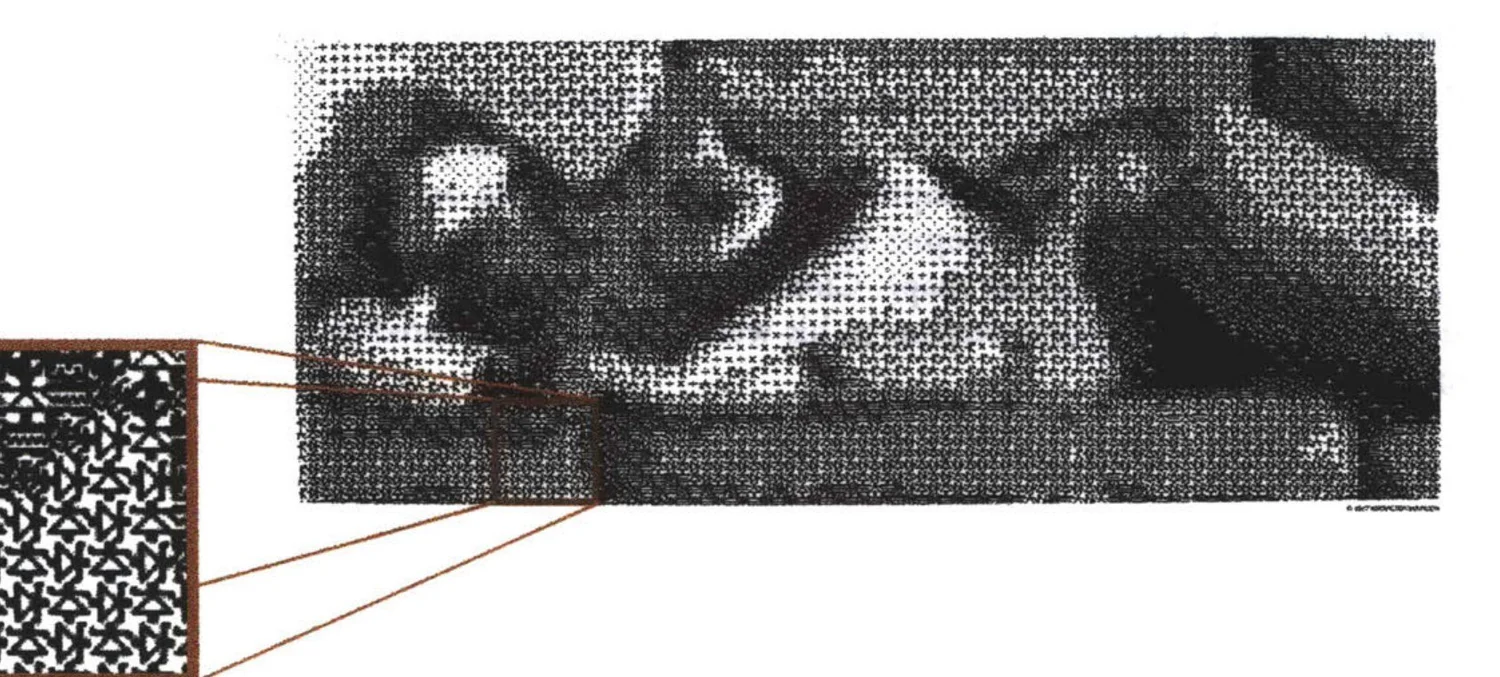
Ken Knowlton and Leon Harmon, the reclining figure of Studies in Perception I (Bell Labs, 1967), built from small symbols, with an enlarged detail. Some later sources give 1966; the dated documents I found give 1967. (reproduced in Silvers (1996), Fig. 2.10) - Journal article Leon D. Harmon and Kenneth C. Knowlton, Picture Processing by Computer, Science 164(3875): 19-29, 4 April 1969. doi:10.1126/science.164.3875.19
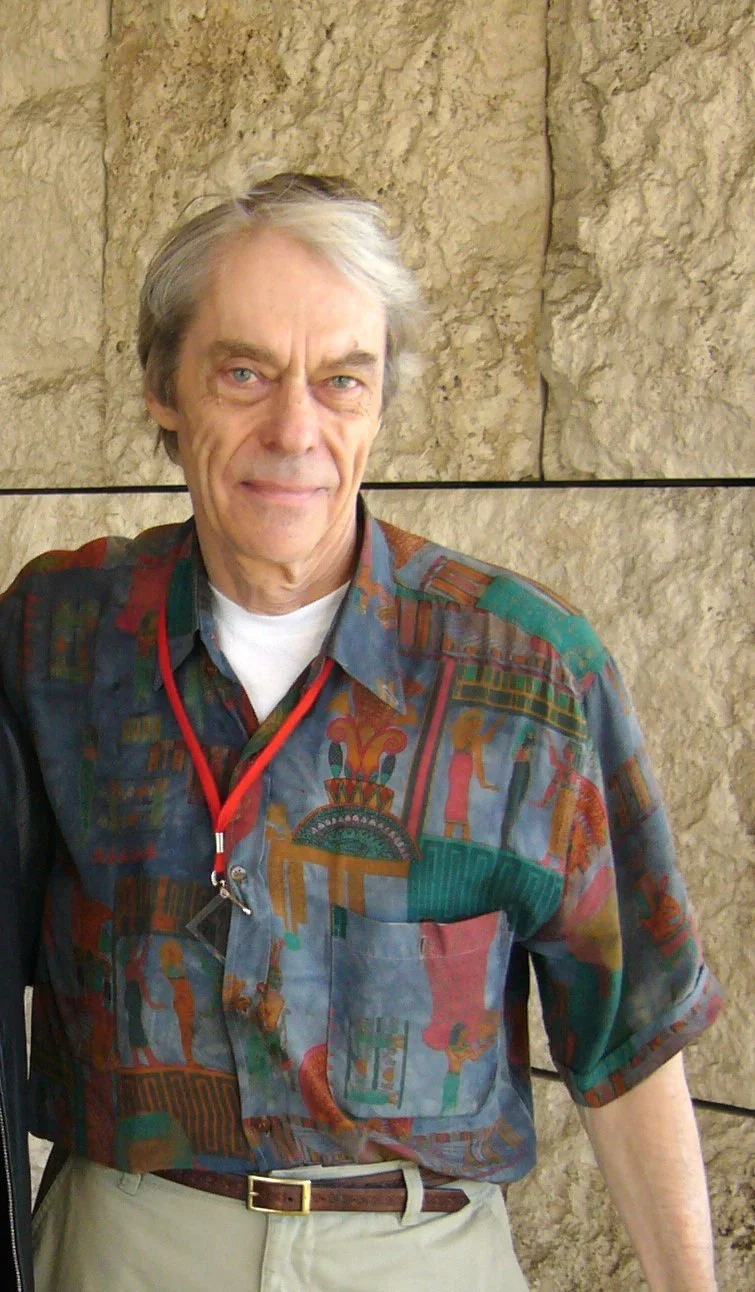
Ken Knowlton in 2007. (photograph by Golan Levin, Wikimedia Commons, CC0) - Journal article Leon D. Harmon, The Recognition of Faces, Scientific American 229(5): 70-82, November 1973. doi:10.1038/scientificamerican1173-70
In “The Recognition of Faces” (Scientific American, 1973) he showed a portrait of Lincoln reduced to a coarse grid, usually illustrated at about 16 × 16 blocks.
- Artwork Salvador Dalí, Gala Contemplating the Mediterranean Sea, Which at Twenty Meters Becomes the Portrait of Abraham Lincoln (Homage to Rothko), The Dalí Museum, St. Petersburg, Florida, 1976. catalogues.salvador-dali.org
Salvador Dalí saw Harmon's image and turned it into a painting in 1976, Gala Contemplating the Mediterranean Sea…, which became a lithograph a year later as Lincoln in Dalivision.
- Patent Kenneth C. Knowlton, Representation of designs, US Patent 4,398,890, 1983. patents.google.com
Knowlton's domino pictures, and his patent Representation of designs (filed 1981, granted 1983), worked with complete sets.
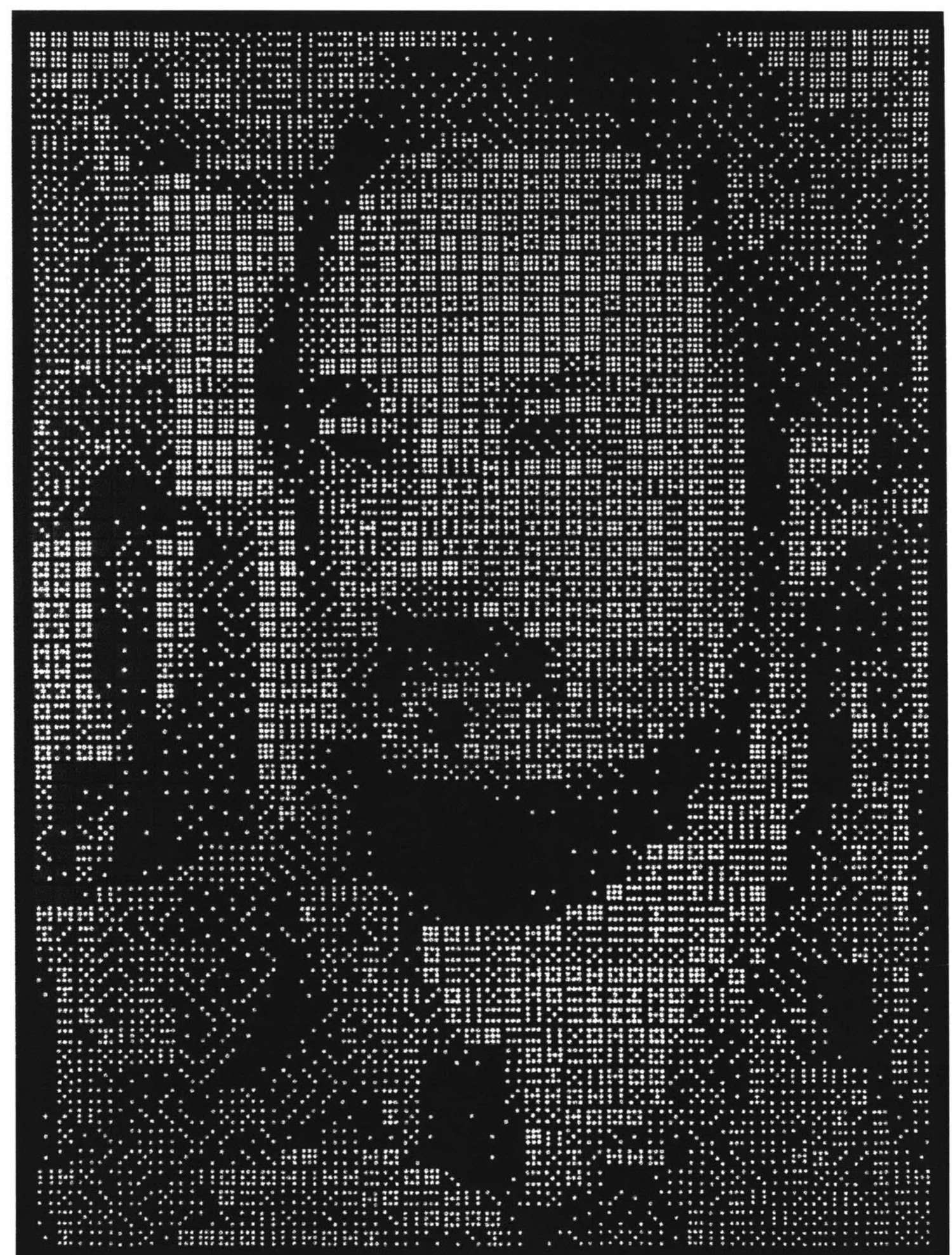
Ken Knowlton, Domino Player (1980): a portrait made from a limited inventory of dominoes. (reproduced in Silvers (1996), Fig. 2.13)
1990–1999
- Conference paper Paul Haeberli, Paint by Numbers: Abstract Image Representations, Proc. SIGGRAPH '90 (Computer Graphics 24(4)), August 1990, pp. 207-214. doi:10.1145/97879.97902
Haeberli (1990), Hausner (2001), Dobashi and colleagues (2002), Elber and Wolberg (2003), Di Blasi and Gallo (2005) and Faustino and de Figueiredo (2005) all studied how pieces can follow an image's contours; Hausner's centroidal-Voronoi approach is a beautiful example.
- Conference paper Charles E. Jacobs, Adam Finkelstein and David H. Salesin, Fast Multiresolution Image Querying, Proc. SIGGRAPH '95 (22nd Annual Conference on Computer Graphics and Interactive Techniques), pp. 277-286, 1995. doi:10.1145/218380.218454
The multiresolution image-querying work of Jacobs, Finkelstein and Salesin (1995) offered related tools for describing images compactly at several scales.
- Thesis Robert S. Silvers, Photomosaics: Putting Pictures in their Place, MS thesis, MIT Media Arts and Sciences, 1996. hdl.handle.net
His 1996 MIT thesis, Photomosaics: Putting Pictures in their Place, followed by a book in 1997 and a patent, explains something that sounds obvious once you hear it: an average colour throws away where the colours are.
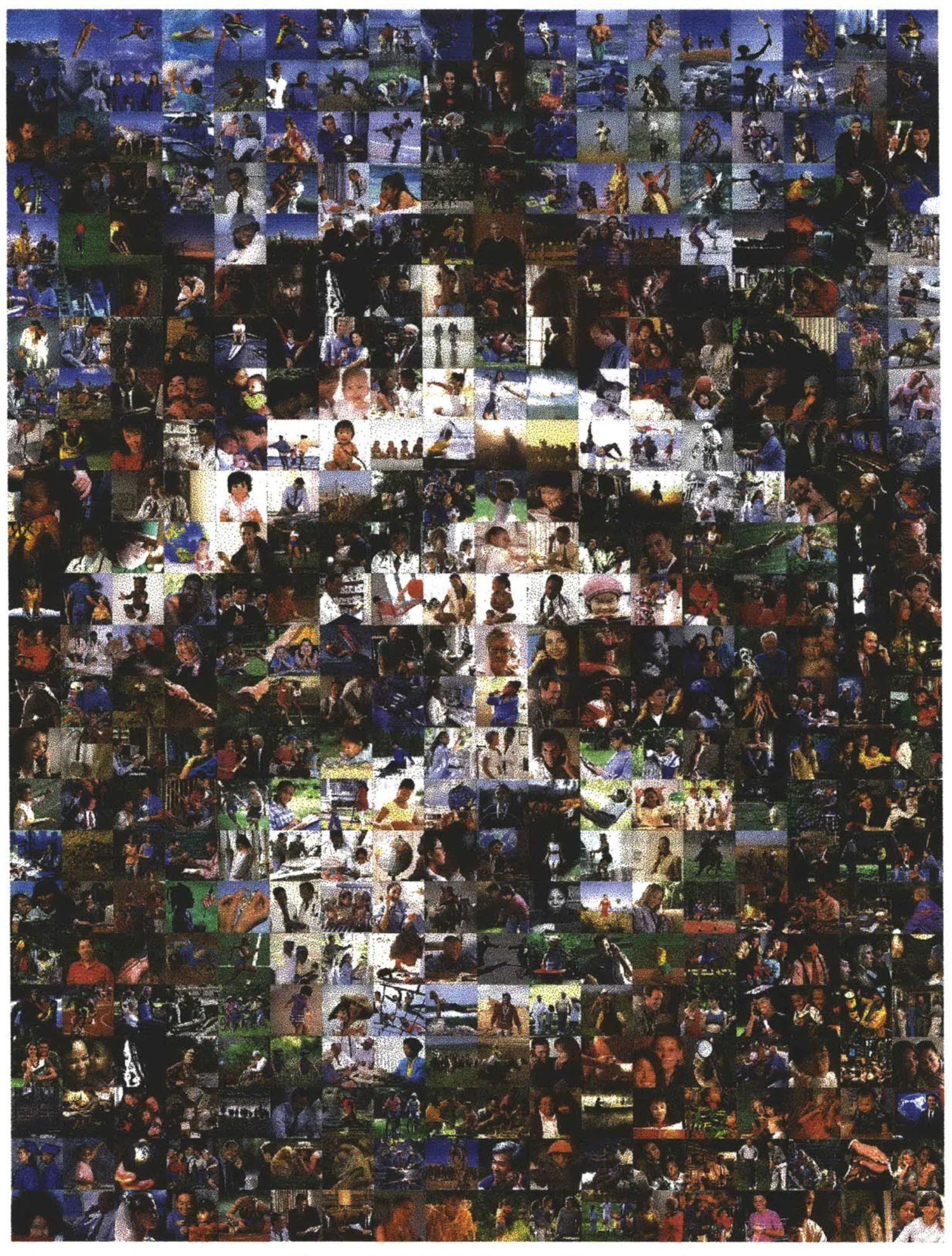
Rob Silvers, Liberty made from Americans (1996): the photographs relate to the figure they form. (Silvers (1996), Fig. 3.17) 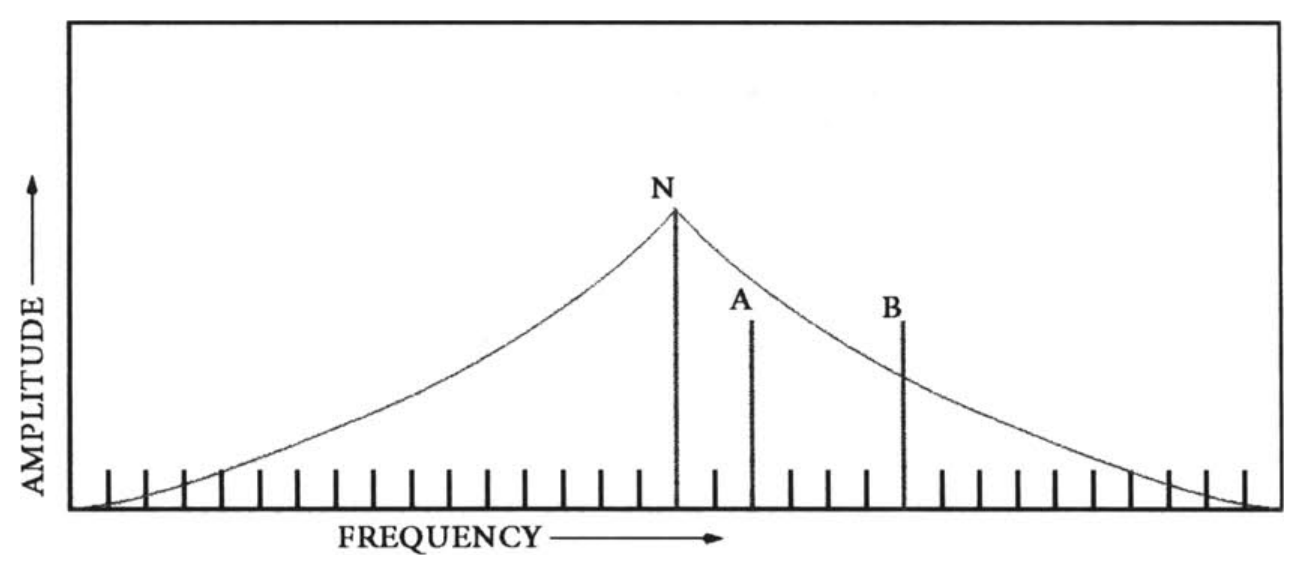
Critical-band masking, after Harmon: noise N interferes more with signal A, which lies close to it in spatial frequency, than with the more distant signal B. (Silvers (1996), Fig. 3.20) - Book Robert Silvers, Photomosaics, edited by Michael Hawley, Henry Holt, New York, 1997. openlibrary.org
His 1996 MIT thesis, Photomosaics: Putting Pictures in their Place, followed by a book in 1997 and a patent, explains something that sounds obvious once you hear it: an average colour throws away where the colours are.
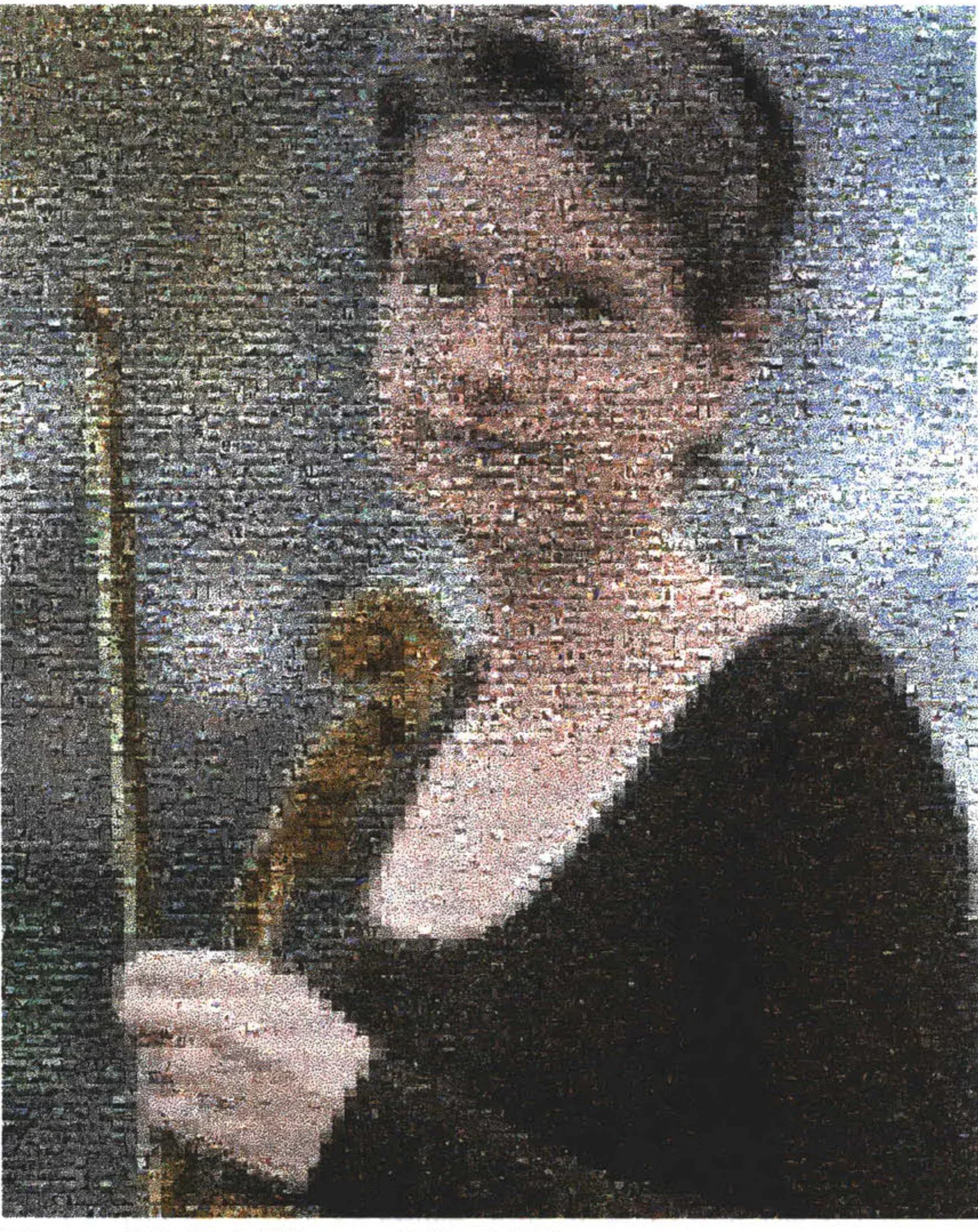
Rob Silvers, Julia (1995), from the early years of mosaics made of photographs. (reproduced in Silvers (1996), Fig. 3.1) - Conference paper Adam Finkelstein and Marisa Range, Image Mosaics, Electronic Publishing, Artistic Imaging, and Digital Typography (RIDT '98), Springer, 1998. doi:10.1007/BFb0053259
Finkelstein and Range's Image Mosaics (1998) answered by nudging the chosen images towards the target colours.
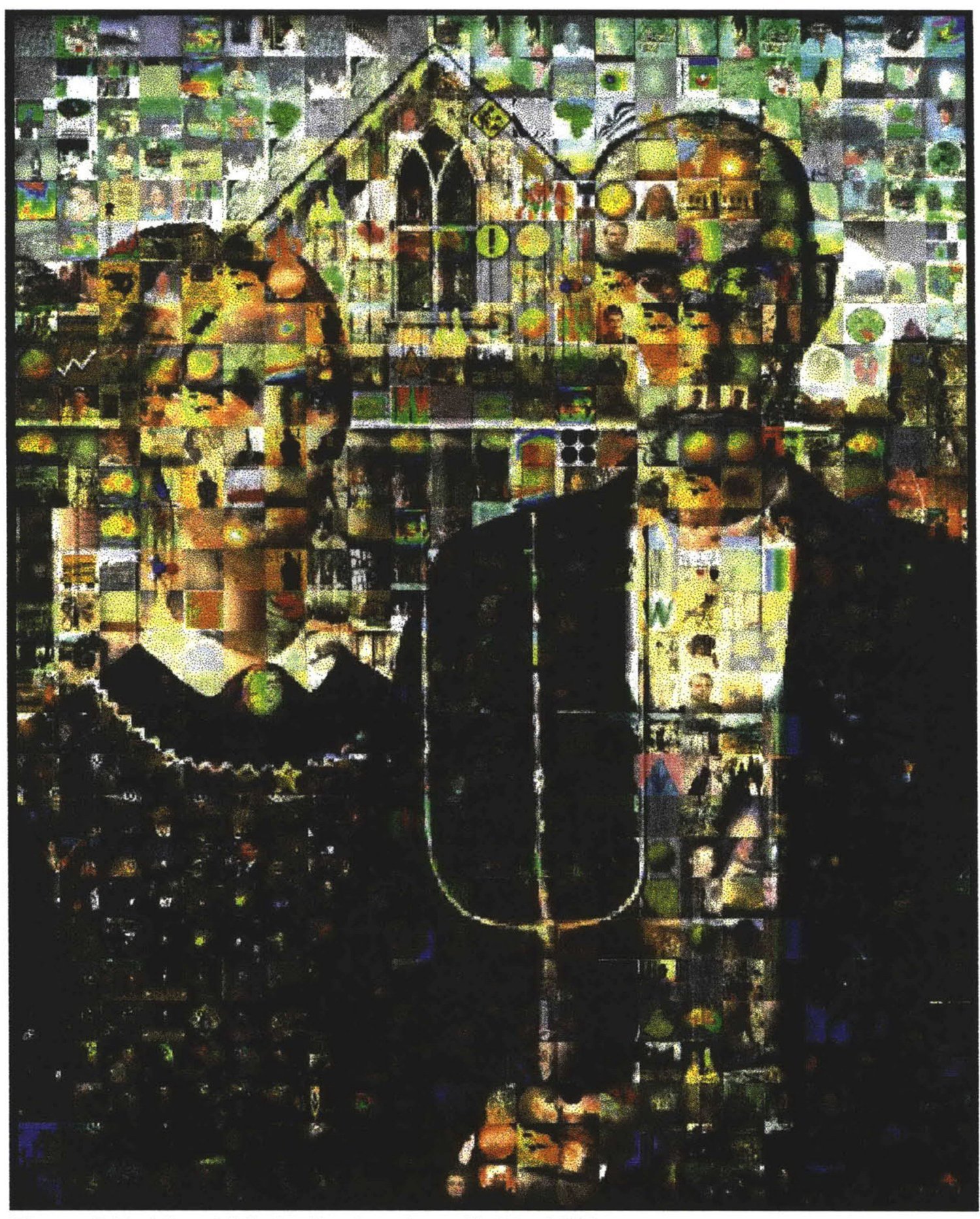
Adam Finkelstein, American Gothic (1995): an early example of photographic material recoloured towards the target, three years before the Finkelstein–Range paper. (reproduced in Silvers (1996), Fig. 2.5) - Conference paper Nicholas Tran, Generating Photomosaics: An Empirical Study, Proc. 1999 ACM Symposium on Applied Computing (SAC '99), San Antonio, pp. 105-109. doi:10.1145/298151.298213
Nicholas Tran's Generating Photomosaics: An Empirical Study (ACM SAC, 1999) matched image rows as sequences, using dynamic programming.
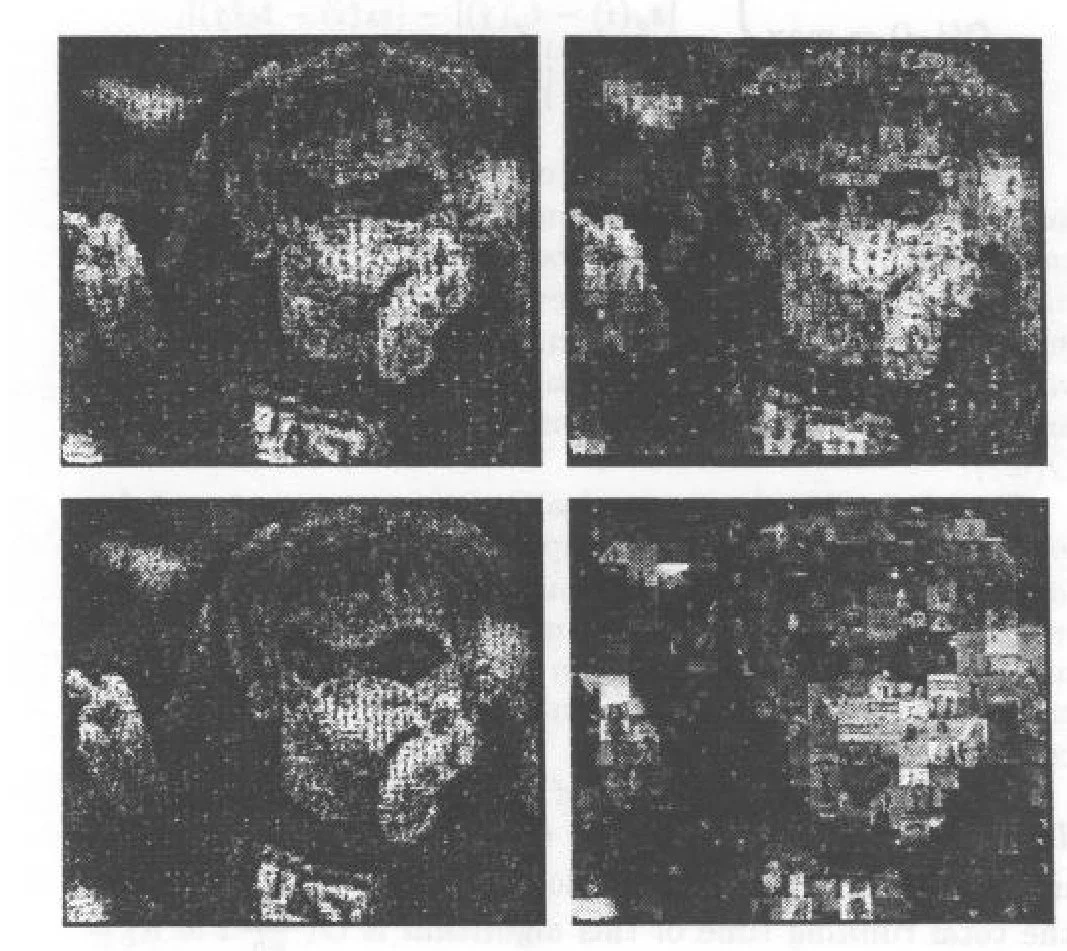
The same subject built at four grid resolutions: tile size changes how readable the larger image is. (Tran (1999), Fig. 4) 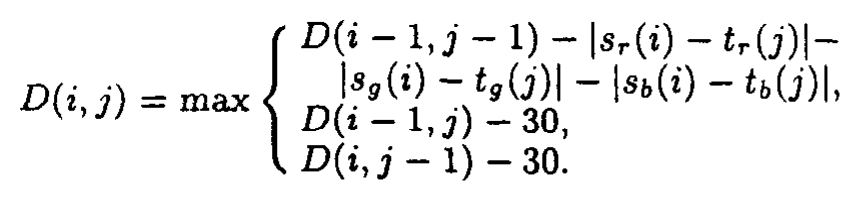
The dynamic-programming recurrence for D(i, j), the optimal alignment score between the first i and j pixels of two pixel rows, built from absolute red, green and blue differences and a gap penalty of 30. (Tran (1999), Recurrence, p. 3)
2000–2009
- Patent Robert S. Silvers, Digital composition of a mosaic image, US Patent 6,137,498, 2000. patents.google.com
His 1996 MIT thesis, Photomosaics: Putting Pictures in their Place, followed by a book in 1997 and a patent, explains something that sounds obvious once you hear it: an average colour throws away where the colours are.
- Conference paper Alejo Hausner, Simulating Decorative Mosaics, Proc. SIGGRAPH 2001 (28th Annual Conference on Computer Graphics and Interactive Techniques), pp. 573-580. doi:10.1145/383259.383327
Haeberli (1990), Hausner (2001), Dobashi and colleagues (2002), Elber and Wolberg (2003), Di Blasi and Gallo (2005) and Faustino and de Figueiredo (2005) all studied how pieces can follow an image's contours; Hausner's centroidal-Voronoi approach is a beautiful example.
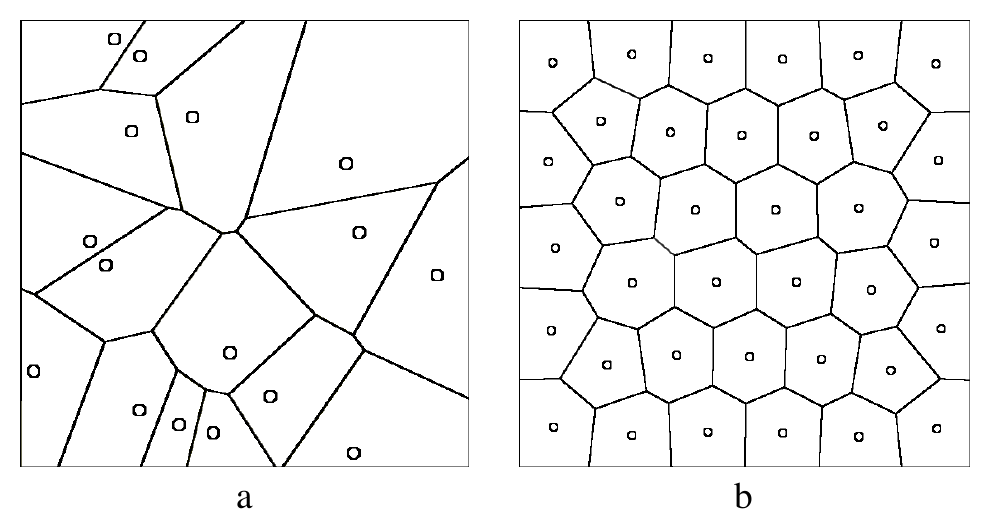
(a) A Voronoi diagram of scattered sites and (b) a centroidal Voronoi diagram, in which each site lies at the centroid of its own region. (Hausner (2001), Fig. 4) - Conference paper Allison W. Klein, Tyler Grant, Adam Finkelstein and Michael F. Cohen, Video Mosaics, Proc. 2nd International Symposium on Non-Photorealistic Animation and Rendering (NPAR 2002), pp. 21-28. doi:10.1145/508530.508534
In Klein, Grant, Finkelstein and Cohen's Video Mosaics (NPAR, 2002), the tiles are video clips described with three-dimensional wavelet signatures, which record change across frames as well as across the image.
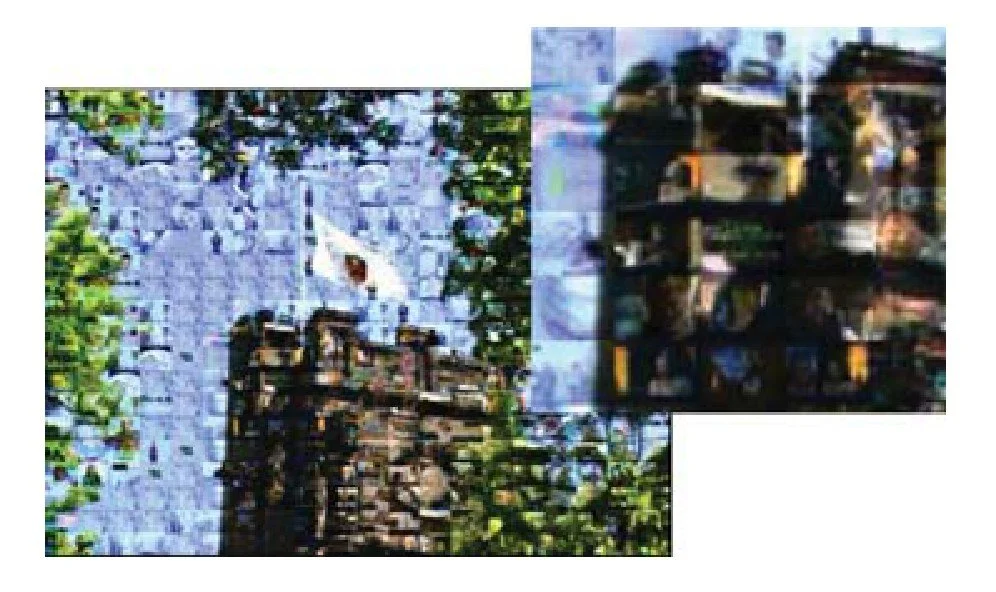
A video mosaic: the tiles are clips, so a match has to hold across time as well as across the image. (Battiato et al. (2007), Fig. 10, after Klein et al. (2002)) - Conference paper Junhwan Kim and Fabio Pellacini, Jigsaw Image Mosaics, ACM Transactions on Graphics 21(3) (Proc. SIGGRAPH 2002), July 2002, pp. 657-664. doi:10.1145/566570.566633
Kim and Pellacini's Jigsaw Image Mosaics (SIGGRAPH, 2002) is a paper I keep going back to.

The energy minimised by a Jigsaw Image Mosaic: a weighted sum of colour, gap, overlap and tile-deformation terms, Eq. (1). (Kim and Pellacini (2002), Eq. (1)) - Conference paper Yoshinori Dobashi, Toshiyuki Haga, Henry Johan and Tomoyuki Nishita, A Method for Creating Mosaic Images Using Voronoi Diagrams, Eurographics 2002 - Short Presentations (Eurographics Association). doi:10.2312/egs.20021036
Haeberli (1990), Hausner (2001), Dobashi and colleagues (2002), Elber and Wolberg (2003), Di Blasi and Gallo (2005) and Faustino and de Figueiredo (2005) all studied how pieces can follow an image's contours; Hausner's centroidal-Voronoi approach is a beautiful example.

E_color, the sum of squared differences between corresponding pixel colours of the Voronoi image and the reference image, over all positions and the R, G, B channels, Eq. (1). (Dobashi et al. (2002), Eq. (1)) - Journal article Gershon Elber and George Wolberg, Rendering Traditional Mosaics, The Visual Computer 19(1): 67-78, March 2003. doi:10.1007/s00371-002-0175-x
Haeberli (1990), Hausner (2001), Dobashi and colleagues (2002), Elber and Wolberg (2003), Di Blasi and Gallo (2005) and Faustino and de Figueiredo (2005) all studied how pieces can follow an image's contours; Hausner's centroidal-Voronoi approach is a beautiful example.
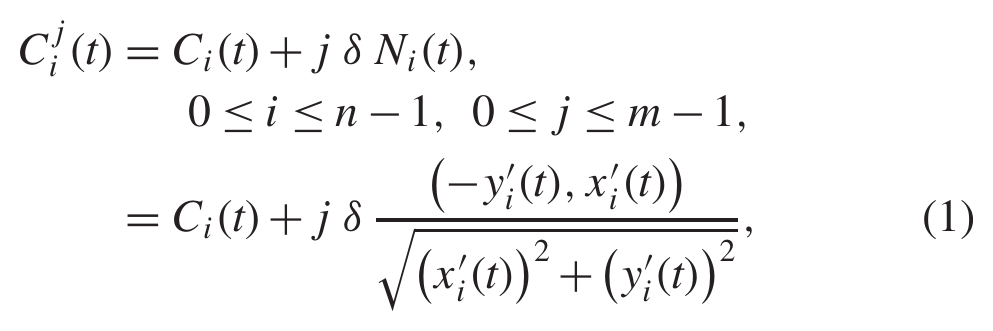
The m offset curves along which rows of tiles are laid, each displaced a multiple of the distance delta along the unit normal of a feature curve, Eq. (1). (Elber and Wolberg (2003), Eq. (1)) - Preprint Robert Bosch, Constructing Domino Portraits, Optimization Online preprint, 2003. optimization-online.org
Robert Bosch later treated all those choices together with integer programming, solving the whole arrangement under explicit inventory limits.
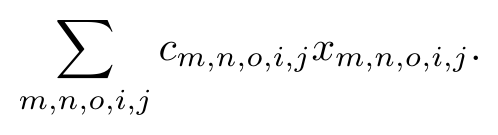
The objective of the integer program: minimise the total penalty, the sum of the costs c of placing each domino (m, n) in orientation o at canvas square (i, j), times the binary placement variables x (Sec. 4.2). (Bosch (2003), Objective, Sec. 4.2) 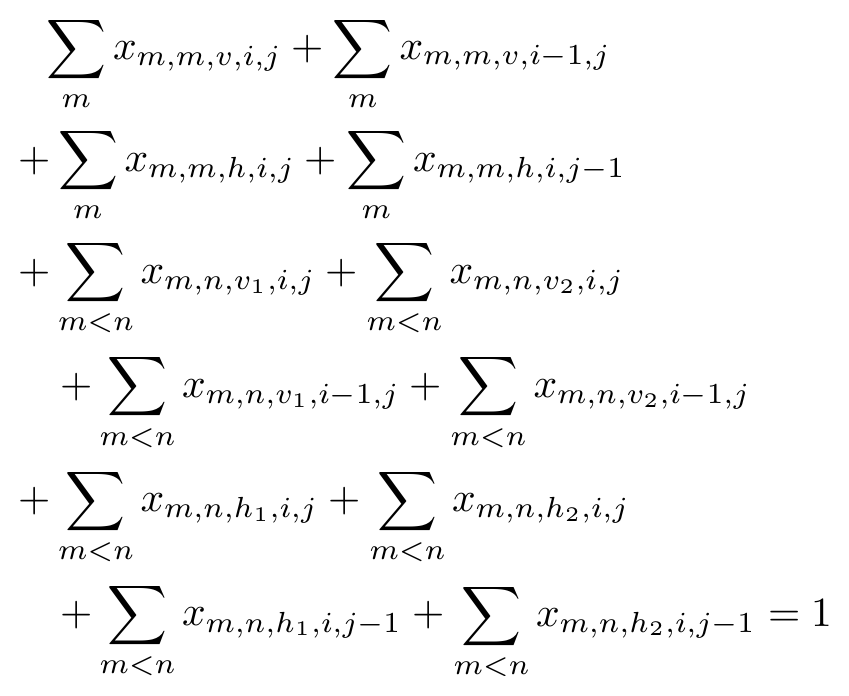
The type-two constraint of the integer program: every square of the canvas must be covered by exactly one domino, double or non-double, placed vertically or horizontally (Sec. 4.3). (Bosch (2003), Type-two constraint, Sec. 4.3) - Conference paper Yue Zhang, Mario A. Nascimento and Osmar R. Zaïane, Building Image Mosaics: An Application of Content-Based Image Retrieval, Proc. IEEE International Conference on Multimedia and Expo (ICME 2003), vol. III, p. III-317 onward. doi:10.1109/ICME.2003.1221312
In 2003, Zhang, Nascimento and Zaïane treated mosaic building as content-based image retrieval: searching a collection by what its pictures look like.
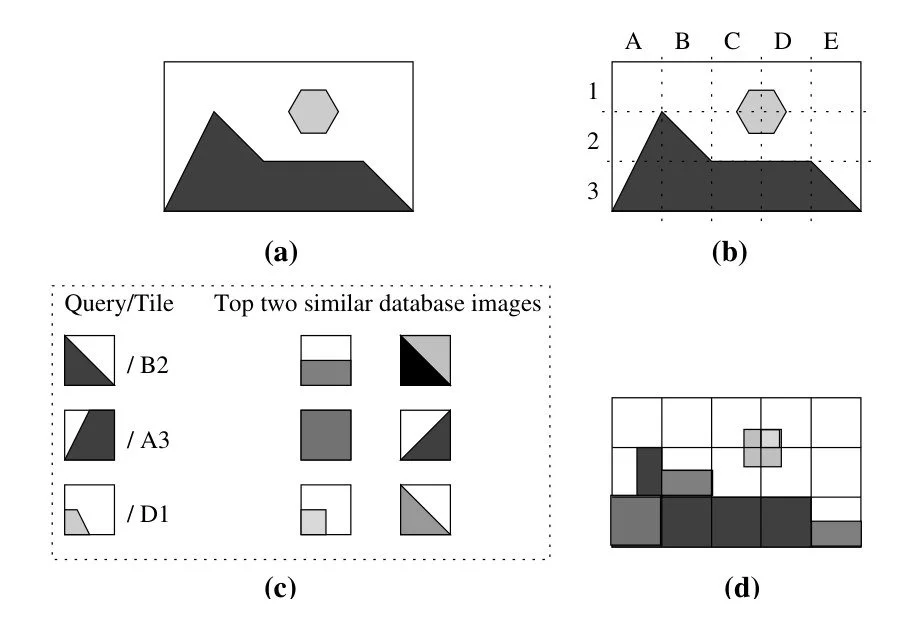
Mosaic construction as image retrieval: subdivide the target, find the most similar library images, assemble the result. (Zhang, Nascimento and Zaïane, Fig. 1) 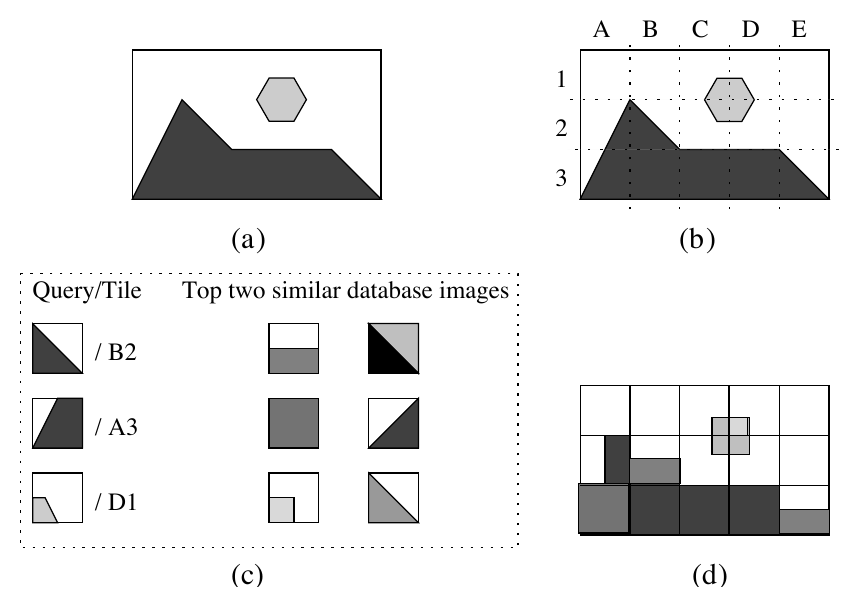
The mosaic construction process: the target image (a) is divided into a grid of tiles (b), each tile is used as a query to retrieve similar database images (c), and the retrieved images replace the tiles (d). (Zhang et al. (2003), Fig. 1) - Conference paper Geisa M. Faustino and Luiz Henrique de Figueiredo, Simple Adaptive Mosaic Effects, XVIII Brazilian Symposium on Computer Graphics and Image Processing (SIBGRAPI 2005), pp. 315-322. doi:10.1109/SIBGRAPI.2005.46
Haeberli (1990), Hausner (2001), Dobashi and colleagues (2002), Elber and Wolberg (2003), Di Blasi and Gallo (2005) and Faustino and de Figueiredo (2005) all studied how pieces can follow an image's contours; Hausner's centroidal-Voronoi approach is a beautiful example.
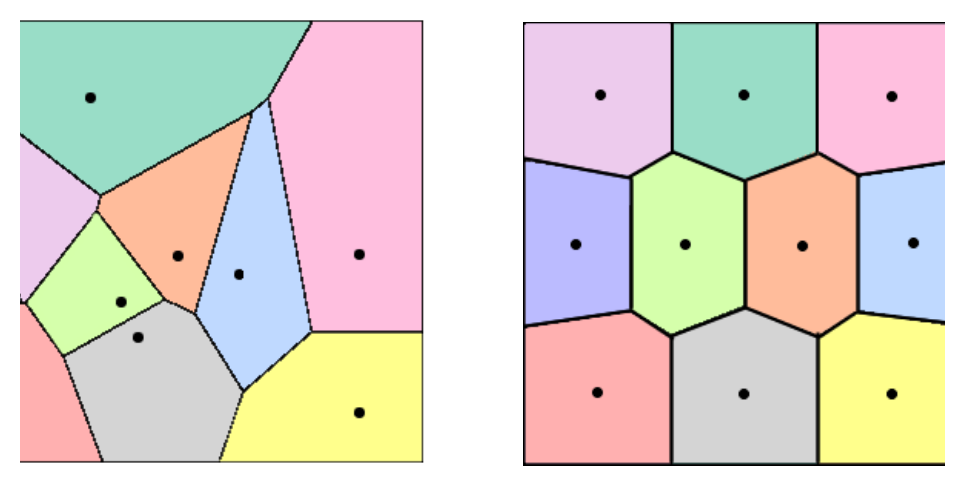
A Voronoi diagram (left) and a centroidal Voronoi diagram (right), the structure the method uses to place tiles. (Faustino and Figueiredo (2005), Fig. 2) - Journal article Gianpiero Di Blasi and Giovanni Gallo, Artificial Mosaics, The Visual Computer 21(6): 373-383, 2005. doi:10.1007/s00371-005-0292-4
Haeberli (1990), Hausner (2001), Dobashi and colleagues (2002), Elber and Wolberg (2003), Di Blasi and Gallo (2005) and Faustino and de Figueiredo (2005) all studied how pieces can follow an image's contours; Hausner's centroidal-Voronoi approach is a beautiful example.
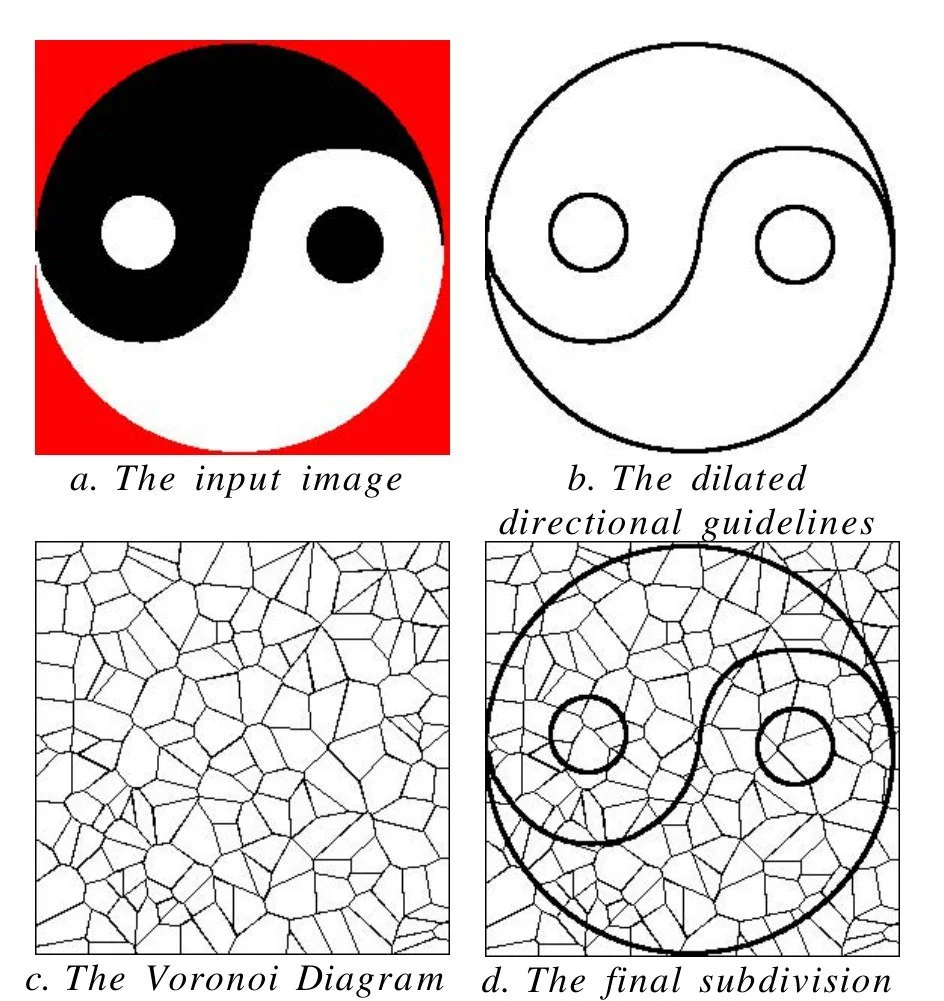
Directional guidelines, a Voronoi diagram and the final puzzle-mosaic subdivision. (Di Blasi, Gallo and Petralia (2005), Fig. 7) - Conference paper Gianpiero Di Blasi and Maria Petralia, Fast Photomosaic, WSCG 2005 Posters, 13th International Conference in Central Europe on Computer Graphics, Visualization and Computer Vision, Plzeň, 31 Jan-4 Feb 2005, pp. 15-16. hdl.handle.net
Di Blasi and Petralia's Fast Photomosaic (WSCG, 2005) organised candidates in an antipole tree by their distances in a feature space, so far fewer comparisons were needed.
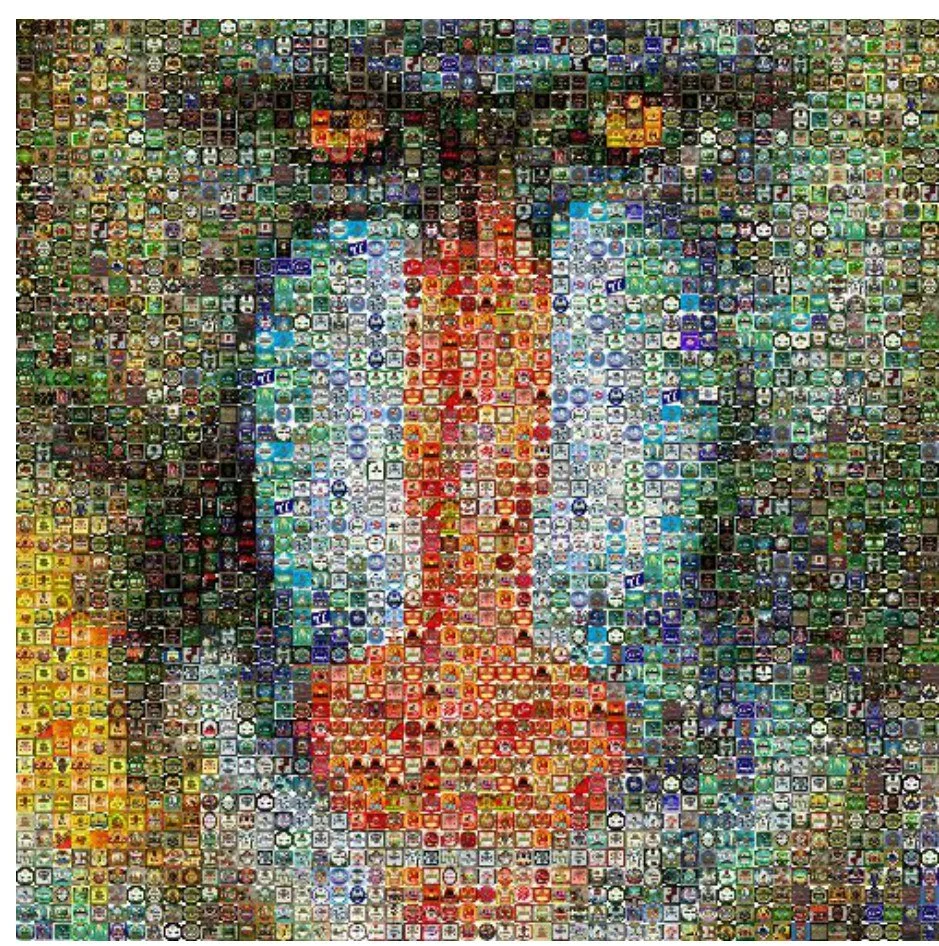
A mosaic produced by the Fast Photomosaic method, which speeds up the search through the library. (Di Blasi and Petralia (2005), Fig. 1) - Conference paper Gianpiero Di Blasi, Giovanni Gallo and Maria Pia Petralia, Fast Techniques for Mosaic Rendering, Computational Aesthetics in Graphics, Visualization and Imaging (CAe 2005), Girona, 18-20 May 2005, Eurographics Association, pp. 29-39. doi:10.2312/COMPAESTH/COMPAESTH05/029-039
Di Blasi, Gallo and Petralia then carried the idea to other mosaic families and, a year later, to adaptive subdivisions such as quadtrees, which split a region into four and keep splitting wherever more detail is needed.
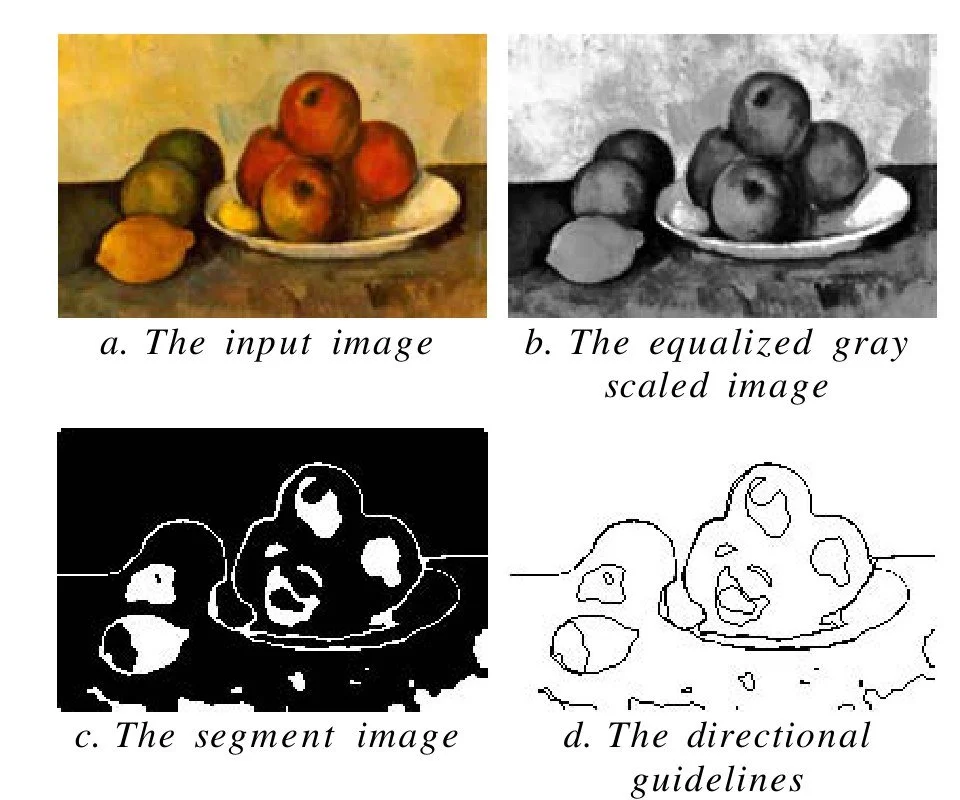
Directional guidelines extracted from a still life: input, equalised grey image, segmentation and the guidelines the tiles will follow. (Di Blasi, Gallo and Petralia (2005), Fig. 3) - Conference paper Kaleigh Smith, Yunjun Liu and Allison W. Klein, Animosaics, Proc. 2005 ACM SIGGRAPH/Eurographics Symposium on Computer Animation (SCA '05), pp. 201-208. doi:10.1145/1073368.1073397
Animation had its own line of work too: Smith, Liu and Klein's Animosaics (2005) packed irregular tiles into moving shapes, frame after frame.
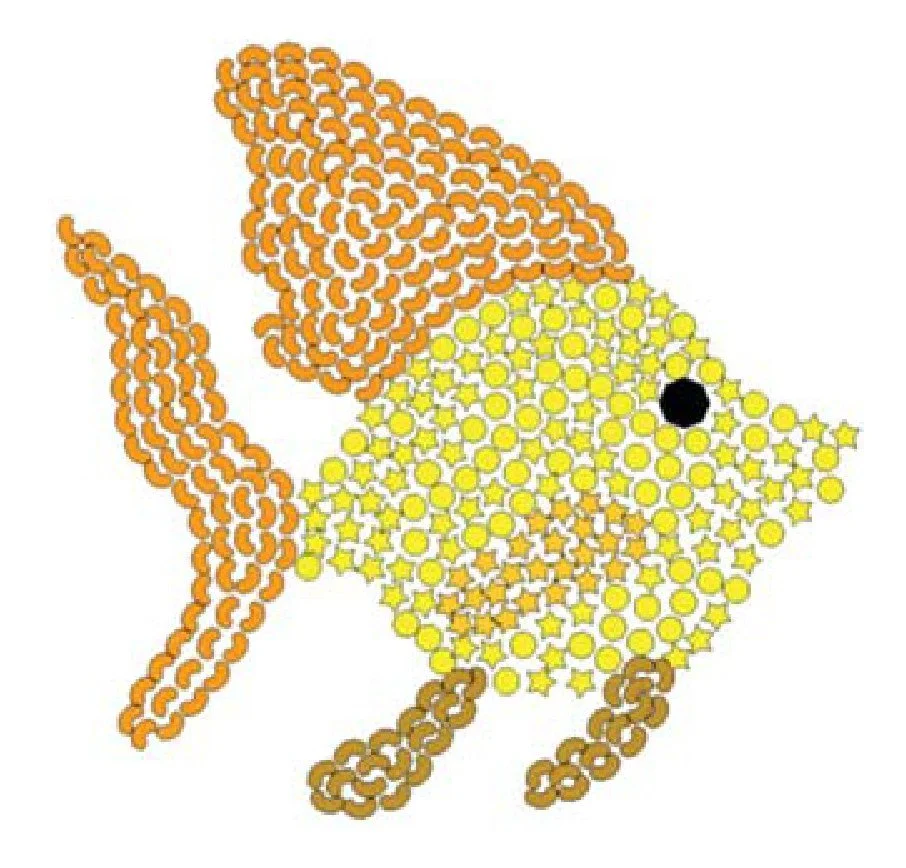
A frame from an animated mosaic, or animosaic, by Smith, Liu and Klein (2005): irregular tiles packed into a moving shape. (Battiato et al. (2007), Fig. 15) - Conference paper Gianpiero Di Blasi, Giovanni Gallo and Maria Pia Petralia, Smart Ideas for Photomosaic Rendering, 4th Eurographics Italian Chapter Conference, 2006, Eurographics Association, pp. 267-271. doi:10.2312/LocalChapterEvents/ItalianChapConf2006/267-271
Di Blasi, Gallo and Petralia then carried the idea to other mosaic families and, a year later, to adaptive subdivisions such as quadtrees, which split a region into four and keep splitting wherever more detail is needed.
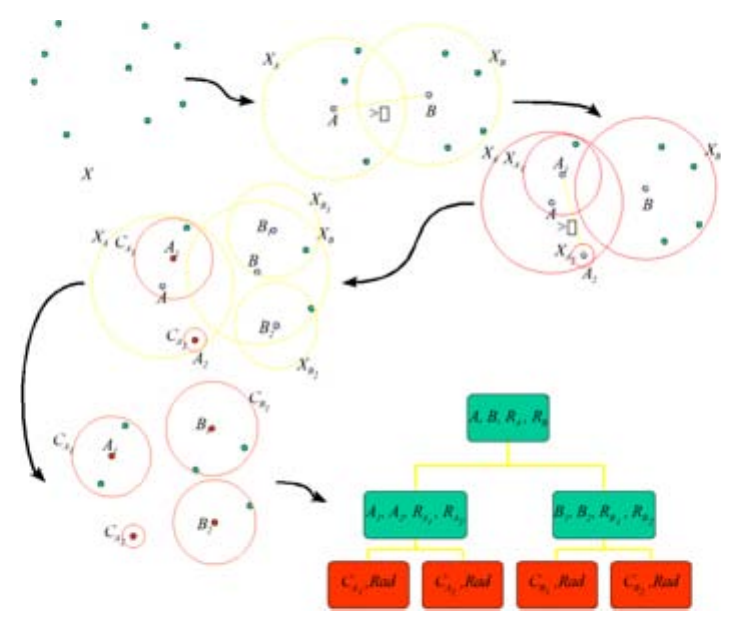
Construction of the Antipole Tree, the clustering structure built over the tile database so that a nearest-neighbour search can find the best-matching tile quickly. (Di Blasi et al. (2006), Fig. 2) - Conference paper Daryl D'Souza, Vic Ciesielski, Marsha Berry and Karen Trist, Generation of self-referential animated photomosaics, Proc. 15th ACM International Conference on Multimedia (MM '07), Augsburg, pp. 489-492, 2007. doi:10.1145/1291233.1291353
D'Souza, Ciesielski and colleagues (2007) and Mat Sah, Ciesielski and D'Souza (2008) used genetic algorithms and genetic programming: candidate solutions are varied and judged over many rounds, so early choices can be reconsidered, and animated or self-referential images become possible.
- Journal article Sebastiano Battiato, Gianpiero Di Blasi, Giovanni Maria Farinella and Giovanni Gallo, Digital Mosaic Frameworks - An Overview, Computer Graphics Forum 26(4): 794-812, 2007. doi:10.1111/j.1467-8659.2007.01021.x
Battiato and colleagues' 2007 survey then put all of this into one classification.

The error function the survey gives for Dobashi et al.'s Voronoi method: the summed squared difference between input and output pixel values over all positions and colour channels, Eq. (1). (Battiato et al. (2007), Eq. (1)) 
The energy the survey reports for Dalal et al.'s packing method: a sum over tiles of a distance-based SSD term plus half an overlap penalty, minimised over tile positions, Eq. (7). (Battiato et al. (2007), Eq. (7)) - Conference paper Vic Ciesielski, Marsha Berry, Karen Trist and Daryl D'Souza, Evolution of Animated Photomosaics, Applications of Evolutionary Computing (EvoWorkshops 2007), Springer LNCS, pp. 498-507. doi:10.1007/978-3-540-71805-5_55
- Conference paper Jeff Orchard and Craig S. Kaplan, Cut-Out Image Mosaics, Proc. 6th International Symposium on Non-Photorealistic Animation and Rendering (NPAR 2008), pp. 79-87. doi:10.1145/1377980.1377997
In Orchard and Kaplan's Cut-Out Image Mosaics (NPAR, 2008), matching uses fast Fourier transform techniques to search for suitable sub-images under irregular tile shapes; a cut-out here can be a fragment clipped to a cell, not a whole object.

C(a, b), the weighted sum-of-squared-differences cost between the target image and a source image shifted by (a, b), with W masking the pixels inside the tile shape, Eq. (1). (Orchard and Kaplan (2008), Eq. (1)) - Conference paper Shahrul Badariah Mat Sah, Vic Ciesielski, Daryl D'Souza and Marsha Berry, Comparison between Genetic Algorithm and Genetic Programming Performance for Photomosaic Generation, Simulated Evolution and Learning (SEAL 2008), Springer LNCS 5361, pp. 259-268. doi:10.1007/978-3-540-89694-4_27
D'Souza, Ciesielski and colleagues (2007) and Mat Sah, Ciesielski and D'Souza (2008) used genetic algorithms and genetic programming: candidate solutions are varied and judged over many rounds, so early choices can be reconsidered, and animated or self-referential images become possible.
- Journal article Darko Pavić, Ulf Ceumern and Leif Kobbelt, GIzMOs: Genuine Image Mosaics with Adaptive Tiling, Computer Graphics Forum 28(8): 2244-2254, December 2009. doi:10.1111/j.1467-8659.2009.01437.x
Pavić, Ceumern and Kobbelt's GIzMOs (Computer Graphics Forum, 2009) went for stronger reconstruction through selection and layout alone, without colour shifts or overlays.
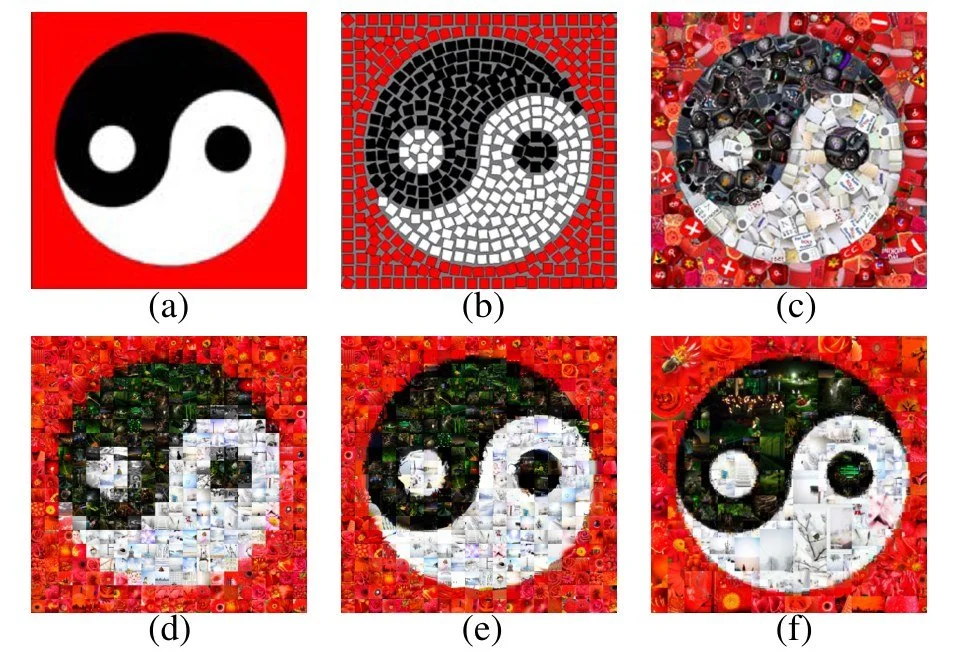
One yin–yang target in several mosaic representations, from plain tesserae to photographs. (Pavić, Ceumern and Kobbelt (2009), Fig. 1) 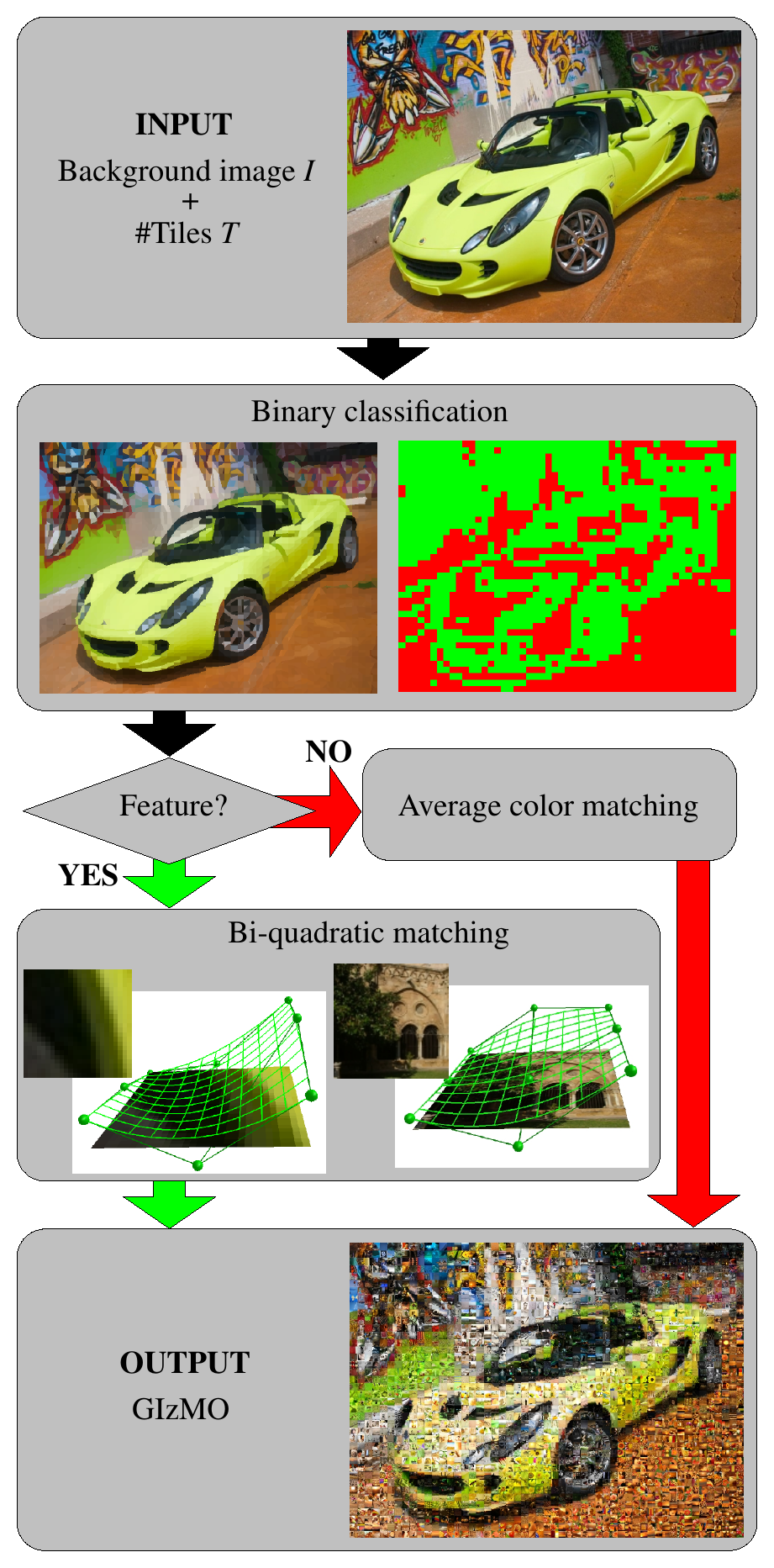
Workflow of the method: tiles of the input image are classified as feature or non-feature; non-feature tiles are matched by average colour, feature tiles by a bi-quadratic polynomial descriptor. (Pavić et al. (2009), Fig. 3) 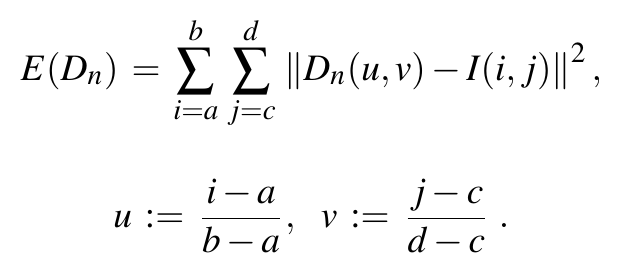
The polynomial image descriptor of a sub-image is computed by minimising this quadratic functional, the summed squared difference between the Bezier descriptor and the image pixels over the sub-image (Sec. 4.1). (Pavić et al. (2009), Descriptor fit, Sec. 4.1) - Conference paper Harikrishna Narasimhan and Sanjeev Satheesh, A Randomized Iterative Improvement Algorithm for Photomosaic Generation, 2009 World Congress on Nature & Biologically Inspired Computing (NaBIC 2009), pp. 777-781. doi:10.1109/NABIC.2009.5393882
Narasimhan and Satheesh's A Randomized Iterative Improvement Algorithm for Photomosaic Generation (NaBIC, 2009) turned repetition control into a search over whole arrangements.
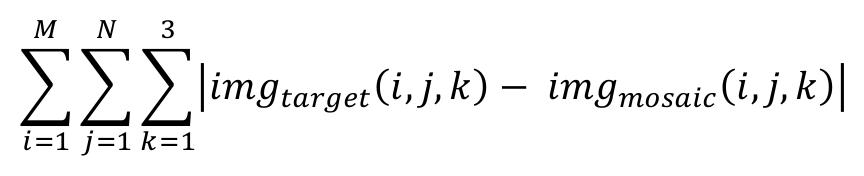
The fitness of a candidate mosaic: the sum of absolute differences between target and mosaic pixels over all M x N positions and the three colour channels. (Narasimhan and Satheesh (2009), Fitness function) 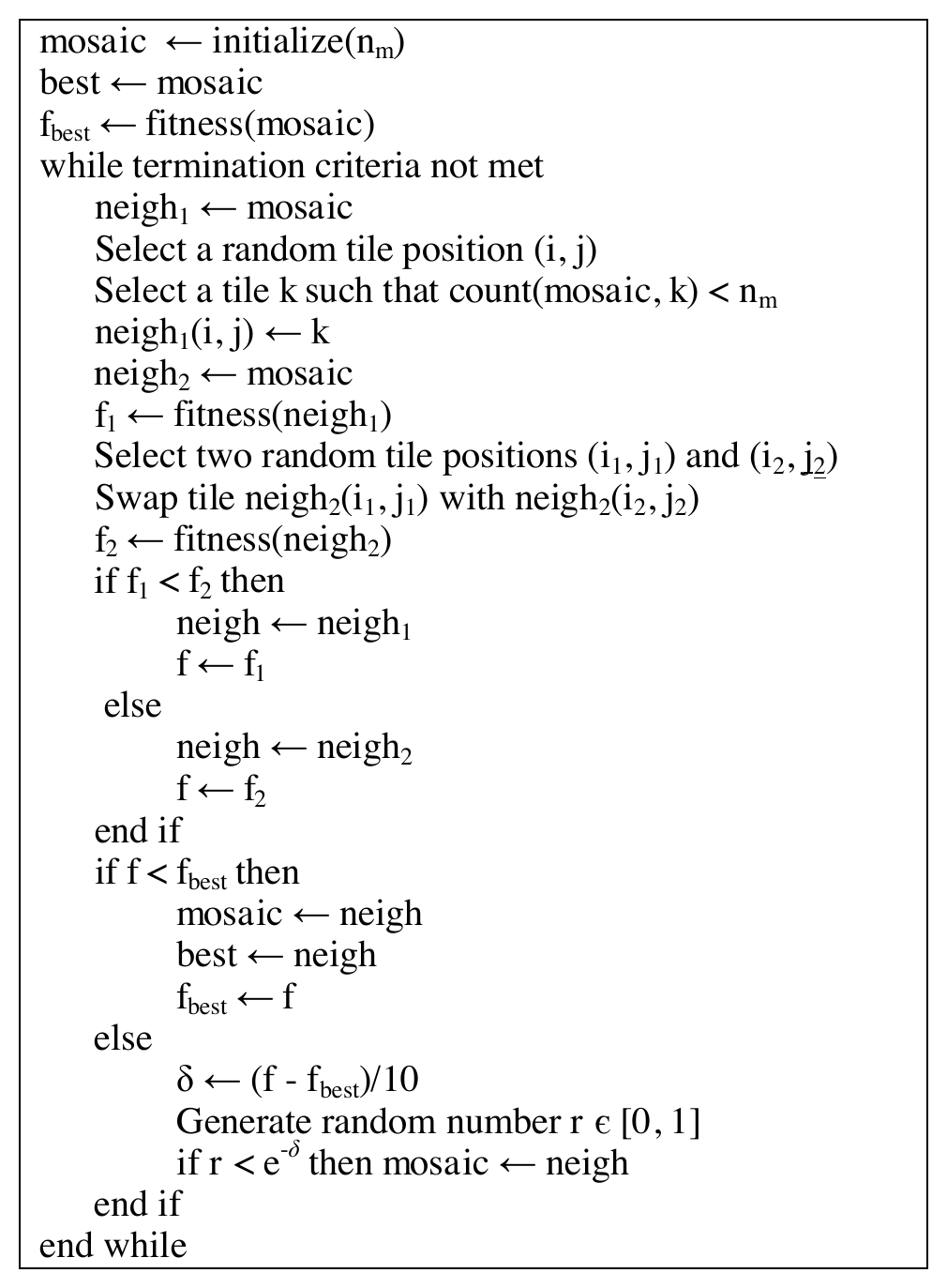
Pseudo-code of the randomized iterative improvement algorithm: two neighbourhood moves (replace one tile, or swap two tiles), keep the fitter neighbour, and accept worse solutions with probability e to the minus delta. (Narasimhan and Satheesh (2009), Fig. 1)
2010–2019
- Thesis I-Jen Lai, Secret-fragment-visible Mosaic - a New Art and Its Applications to Information Hiding, Master's thesis, National Chiao Tung University, 2010. ir.lib.nycu.edu.tw
Lai and Tsai, at National Chiao Tung University, developed secret-fragment-visible mosaics (thesis 2010; IEEE TIFS 2011): the pieces of a secret image are rearranged to look like a different target, while the information needed to reverse the process is kept.
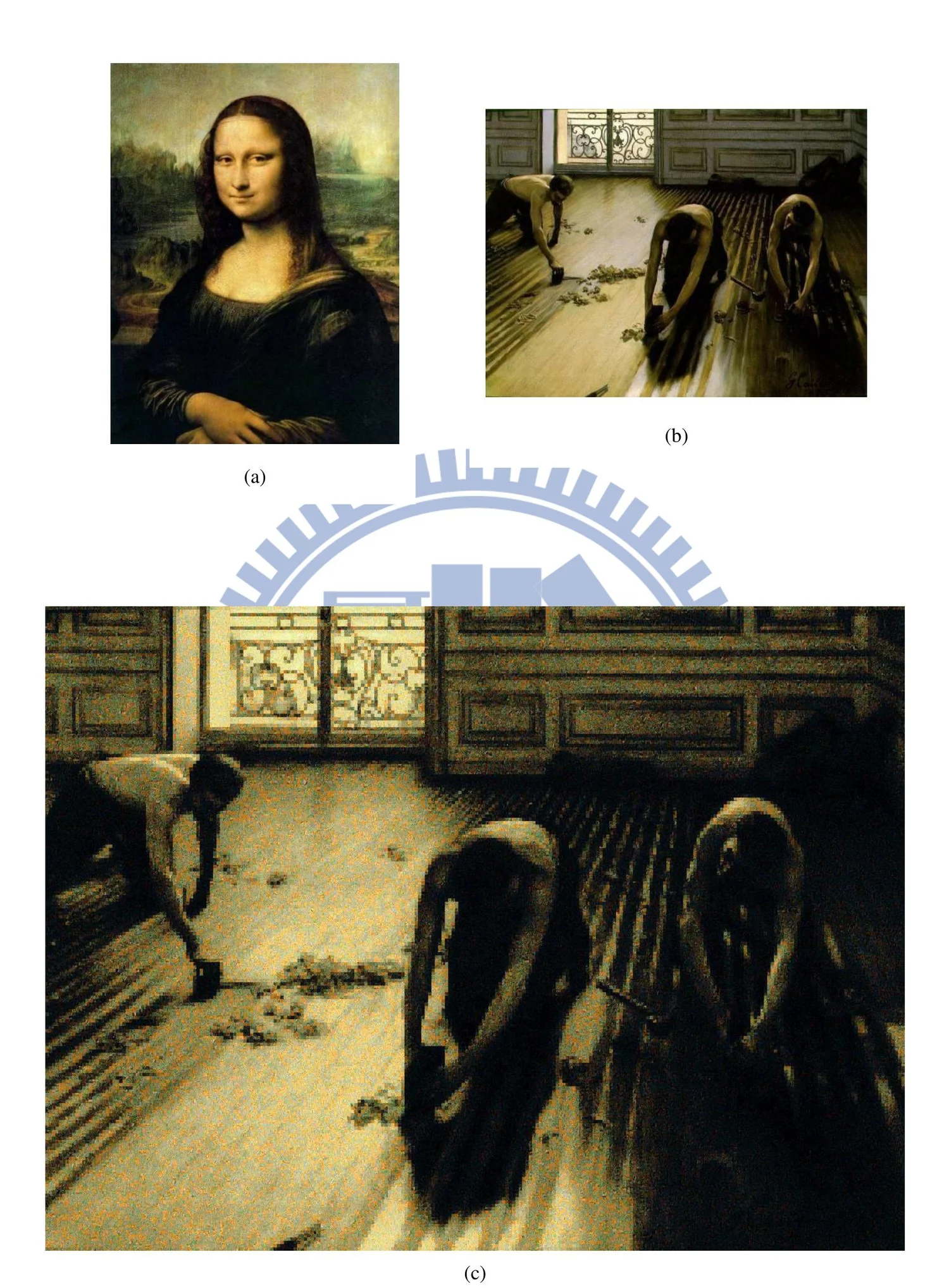
Secret-fragment-visible mosaic: a secret image, a target, and the mosaic made by rearranging the secret image's fragments to resemble the target. (Lai, NCTU thesis (2010), Fig. 3.9) 
The proposed 1-D colour feature h, which folds re-quantised R, G and B values into one number, giving the largest weight to green and the smallest to blue to follow human visual sensitivity, Eq. (3.2). (Lai (2010), Eq. (3.2)) - Conference paper Yoon-Seok Choi, Bon-Ki Koo and Byung-Ro Moon, Optimization of an image set by genetic feature selection for real-time photomosaics, Proc. 12th Annual Conference on Genetic and Evolutionary Computation (GECCO '10), pp. 1309-1310, 2010. doi:10.1145/1830483.1830717
Choi, Koo and Moon (2010) explored genetic methods for making the construction more effective.
- Conference paper Dongwann Kang, Sang-Hyun Seo, Seung-Taek Ryoo and Kyung-Hyun Yoon, A Photomosaic Image Generation on Smartphone, In IT Convergence and Services (Springer, Lecture Notes in Electrical Engineering), 2011, pp. 687-693. doi:10.1007/978-94-007-2598-0_73
Kang and colleagues' smartphone work (2011) and Fujisawa and colleagues' interactive GPU system (2012) worked on access and speed.
- Journal article I-Jen Lai and Wen-Hsiang Tsai, Secret-Fragment-Visible Mosaic Image - A New Computer Art and Its Application to Information Hiding, IEEE Transactions on Information Forensics and Security 6(3): 936-945, September 2011. doi:10.1109/TIFS.2011.2135853
Lai and Tsai, at National Chiao Tung University, developed secret-fragment-visible mosaics (thesis 2010; IEEE TIFS 2011): the pieces of a secret image are rearranged to look like a different target, while the information needed to reverse the process is kept.
- Conference paper Lina Zhang and Jinhui Yu, Image Mosaics with Irregular Tiling, 2011 12th International Conference on Computer-Aided Design and Computer Graphics: 155-162. doi:10.1109/cad/graphics.2011.44
Added after the history of 9 October 2026. Bibliographic data checked against Crossref; we have not read this paper.
- Journal article Marcos Slomp, Michihiro Mikamo, Bisser Raytchev et al., GPU-based SoftAssign for Maximizing Image Utilization in Photomosaics, International Journal of Networking and Computing 1(2): 211-229, July 2011. doi:10.15803/ijnc.1.2_211
Slomp and colleagues' GPU-based SoftAssign study (IJNC, 2011) compared greedy selection, simulated annealing and SoftAssign, which moves gradually from provisional assignments towards a final arrangement.
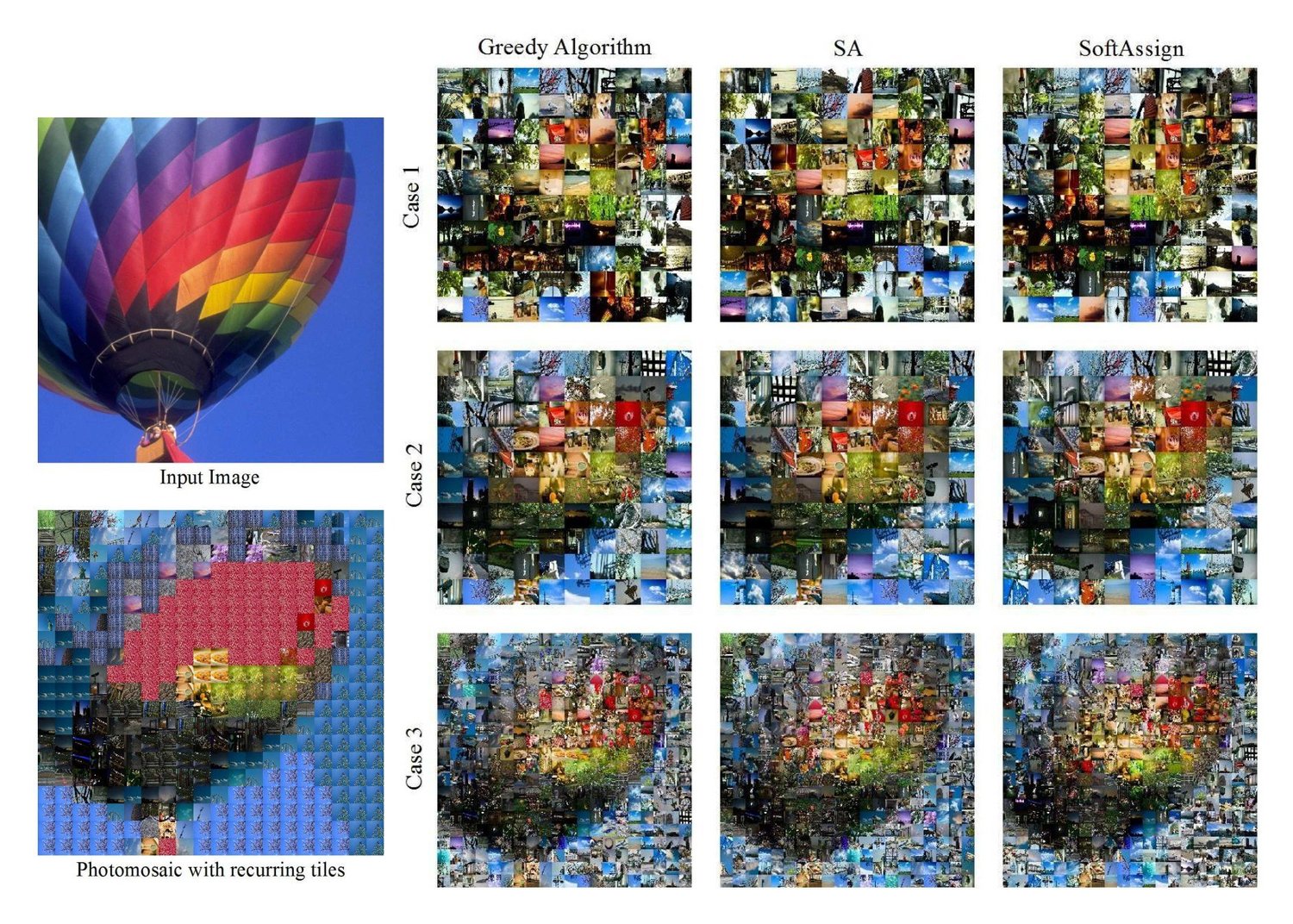
Greedy assignment, simulated annealing and SoftAssign compared on the same target and library. (Slomp et al. (2011), Fig. 4) 
The visual distance between an image patch and a candidate tile: the square root of the summed squared differences of their average R, G and B values over s sub-regions, Eq. (1). (Slomp et al. (2011), Eq. (1)) 
The tile assignment posed as an optimisation: minimise the sum of patch-tile distances d weighted by the binary assignment variable y, with every patch given a unique tile, Eq. (2). (Slomp et al. (2011), Eq. (2)) - Journal article Hui Du, Xiaogang Jin and Xiaoyang Mao, Digital Camouflage Images Using Two‐scale Decomposition, Computer Graphics Forum 31(7): 2203-2212, 2012. doi:10.1111/j.1467-8659.2012.03213.x
Added after the history of 9 October 2026. Bibliographic data checked against Crossref; we have not read this paper.
- Conference paper Makoto Fujisawa, Toshiyuki Amano, Takafumi Taketomi et al., Interactive photomosaic system using GPU, Proc. 20th ACM International Conference on Multimedia (MM '12), pp. 1297-1298, 2012. doi:10.1145/2393347.2396451
Kang and colleagues' smartphone work (2011) and Fujisawa and colleagues' interactive GPU system (2012) worked on access and speed.
- Journal article Sebastiano Battiato, Alfredo Milone and Giovanni Puglisi, Artificial Mosaic Generation with Gradient Vector Flow and Tile Cutting, Journal of Electrical and Computer Engineering 2013: 1-12. doi:10.1155/2013/908905
Added after the history of 9 October 2026. Bibliographic data checked against Crossref; we have not read this paper.
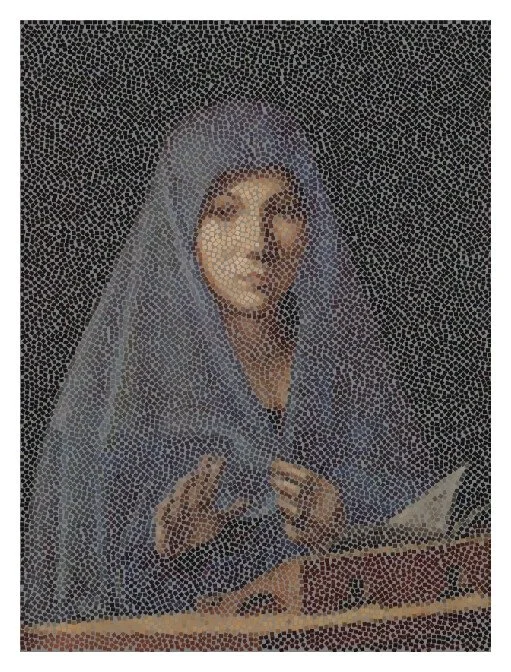
A mosaic of Antonello da Messina's Virgin Annunciate with tiles following the gradient vector flow and cut where they meet. (Battiato, Milone and Puglisi (2013), Fig. 11(a), CC BY 3.0) - Journal article William Plant, Joanna Lumsden and Ian T. Nabney, The Mosaic Test: measuring the effectiveness of colour-based image retrieval, Multimedia Tools and Applications 64(3): 695-716, June 2013 (online January 2012). doi:10.1007/s11042-011-0951-6
In a different direction, Plant, Lumsden and Nabney's The Mosaic Test (2013) used mosaic construction to measure how well colour-based image retrieval works: the finished picture shows the consequences of thousands of retrieval decisions at once.
- Journal article Hae-Yeoun Lee, Generation of Photo-Mosaic Images through Block Matching and Color Adjustment, International Journal of Computer and Information Engineering (WASET) 8(3): 457-460, 2014. doi:10.5281/zenodo.1337093
Hae-Yeoun Lee's work (2014; MTAP 2017) brings several practical operations into one process: block matching, intensity adjustment, adaptive merging and repetition control.
- Journal article Ramesh Kumar Lama, Seung-Jo Han and Goo-Rak Kwon, SVD based improved secret fragment visible mosaic image generation for information hiding, Multimedia Tools and Applications 73(2): 873-886, November 2014 (online February 2013). doi:10.1007/s11042-013-1381-4
Lama and colleagues' 2014 SVD-based variant belongs to the same information-hiding branch.
- Journal article Nenad Markuš, Marco Fratarcangeli, Igor S. Pandžić and Jörgen Ahlberg, Fast Rendering of Image Mosaics and ASCII Art, Computer Graphics Forum 34(6): 251-261, 2015. doi:10.1111/cgf.12597
Added after the history of 9 October 2026. Bibliographic data checked against Crossref; we have not read this paper.
- Journal article Sanghyun Seo and Dongwann Kang, A photomosaic image generation method using photo annotation in a social network environment, Multimedia Tools and Applications 75(20): 12831-12841, October 2016 (online September 2015). doi:10.1007/s11042-015-2867-z
Seo and Kang's social-network mosaic method (MTAP, 2016) adds people and their relationships to the selection.
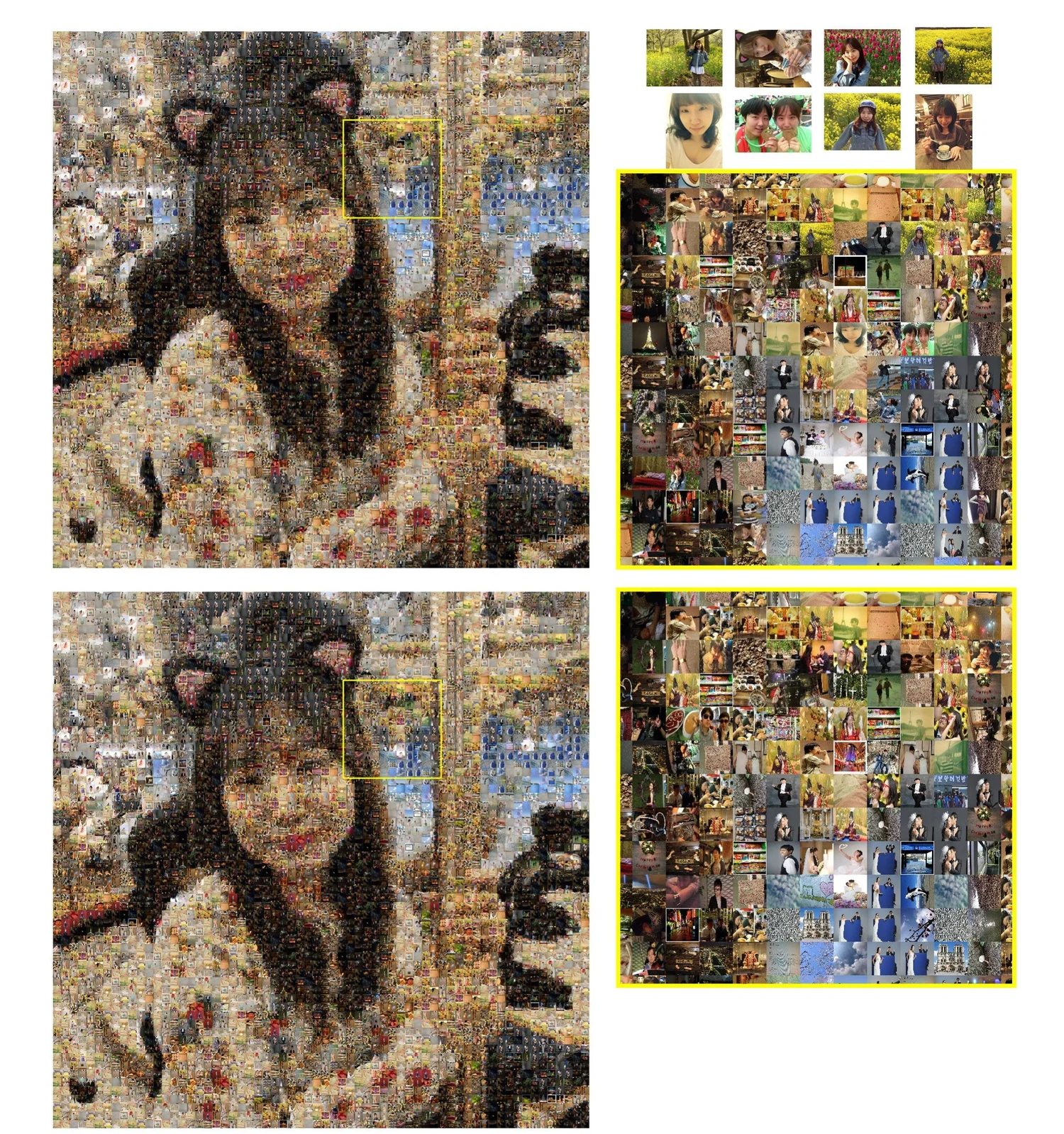
Mosaics made with and without social-network context, with enlarged details of the selected photographs. (Seo and Kang (2016), Fig. 4) 
The matching function used to search for the best tile image: an image-similarity term F1 plus a weighted social network context term F2 that reflects annotations and connections between users, Eq. (1). (Seo and Kang (2016), Eq. (1)) - Journal article Wenchao Hu, Zhonggui Chen, Hao Pan et al., Surface Mosaic Synthesis with Irregular Tiles, IEEE Transactions on Visualization and Computer Graphics 22(3): 1302-1313, 2016. doi:10.1109/tvcg.2015.2498620
Added after the history of 9 October 2026. Bibliographic data checked against Crossref; we have not read this paper.
- Conference paper Chin-Lin Li, Yancong Su and Ran-Zan Wang, Extended Photomosaic with QR Code Capability, 2017 IEEE International Conference on Multimedia & Expo Workshops (ICMEW), pp. 345-350. doi:10.1109/ICMEW.2017.8026225
With Li, Su and Wang's QR-code mosaics (ICMEW 2017; Mathematics 2020), the picture has to please two audiences: people and phone cameras.
- Journal article Hae-Yeoun Lee, Automatic photomosaic algorithm through adaptive tiling and block matching, Multimedia Tools and Applications 76(22): 24281-24297, November 2017 (online December 2016). doi:10.1007/s11042-016-4175-7
Hae-Yeoun Lee's work (2014; MTAP 2017) brings several practical operations into one process: block matching, intensity adjustment, adaptive merging and repetition control.
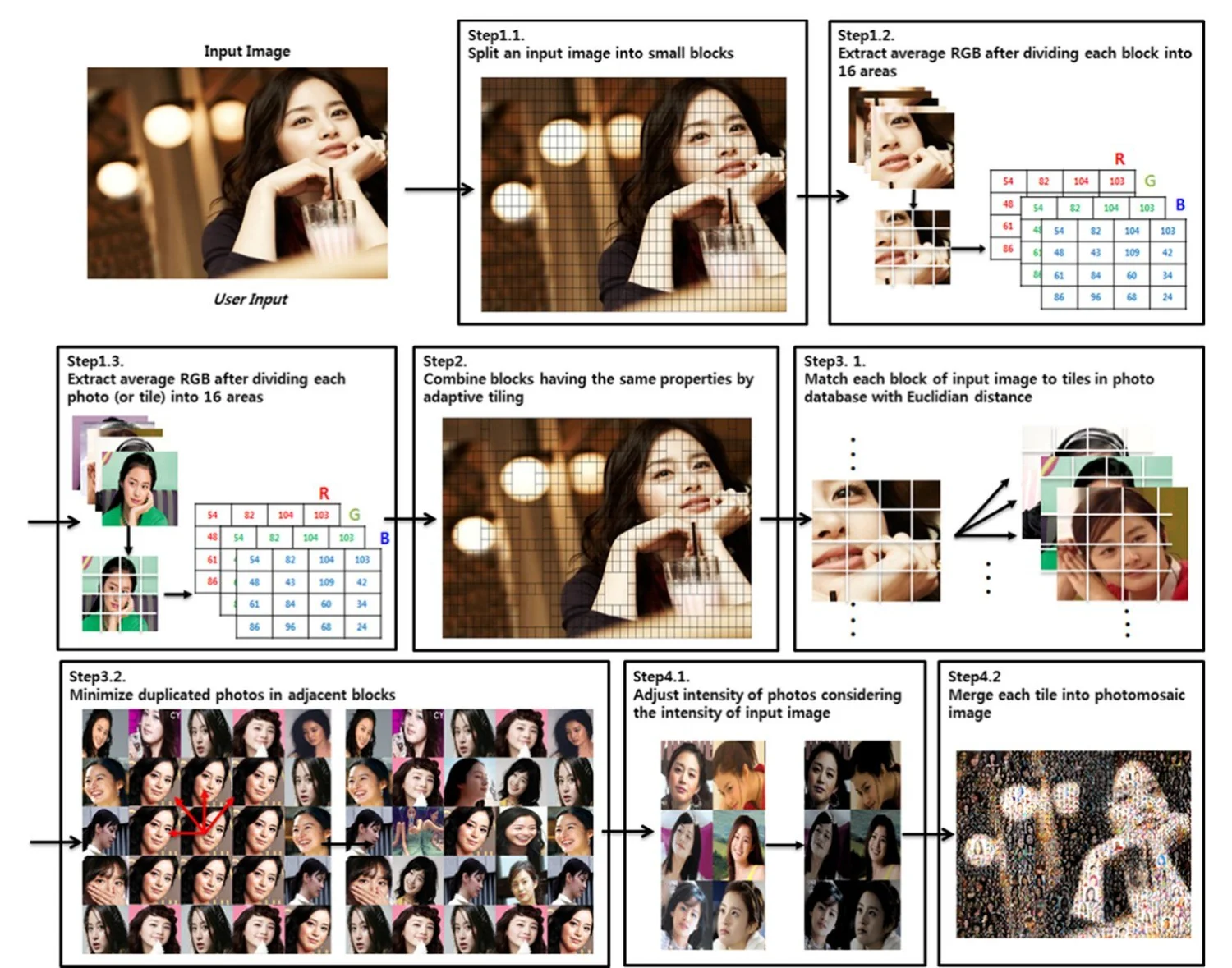
Lee's construction process in one view: subdivision, adaptive merging, matching, repetition control and intensity adjustment. (Lee (2017), Fig. 5) 
Block matching picks the database photo with the lowest sum of squared differences between the 48 feature values of the image block and those of the photo, the root being omitted for speed (Sec. 3.3). (Lee (2017), Block matching, Sec. 3.3) - Preprint Nikolay Jetchev, Urs Bergmann and Calvin Seward, GANosaic: Mosaic Creation with Generative Texture Manifolds, NIPS 2017 Workshop on Machine Learning for Creativity and Design. arXiv:1712.00269
Jetchev, Bergmann and Seward's GANosaic (NIPS Workshop, 2017) changes where the material comes from.
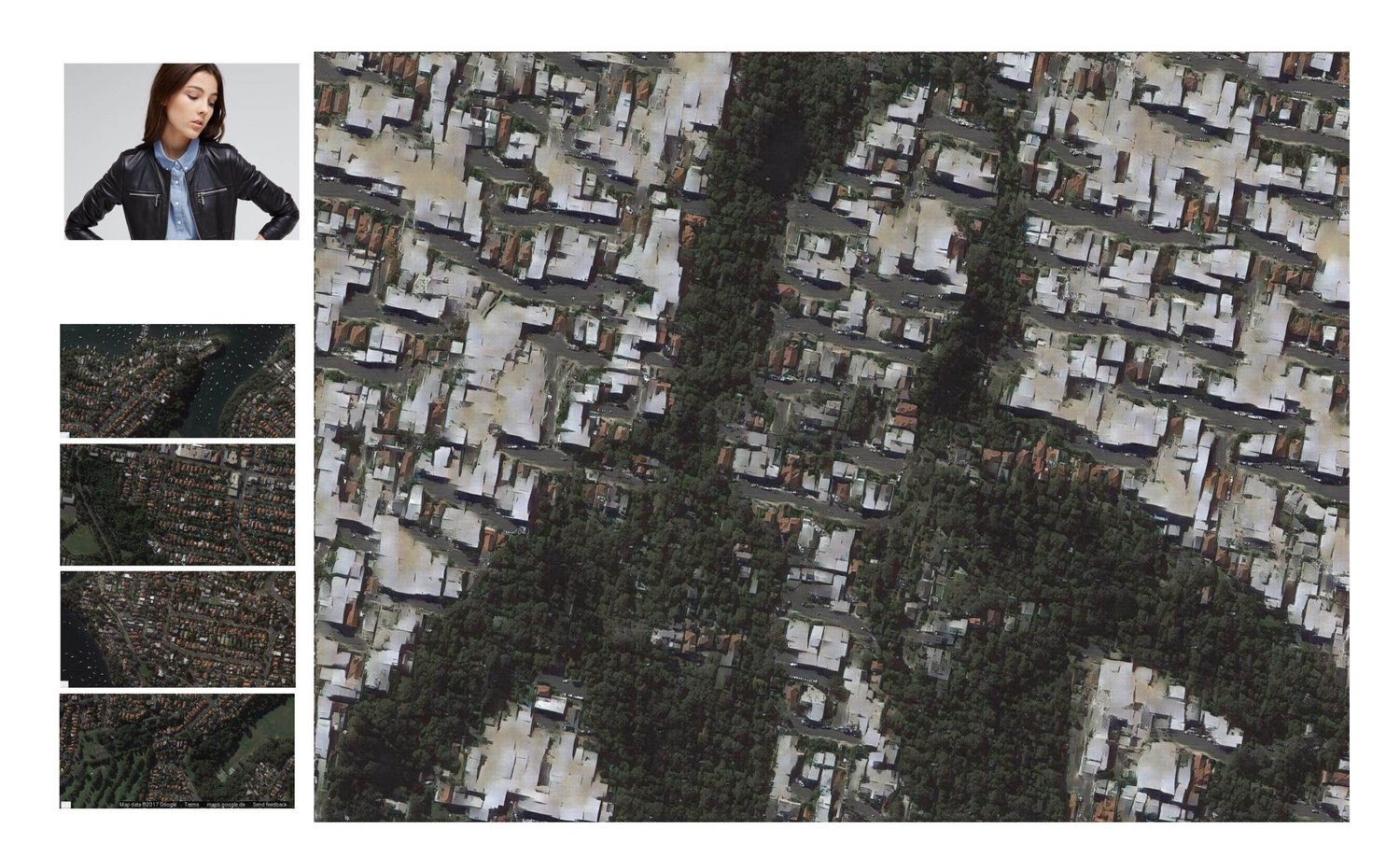
GANosaic: a portrait made with a texture model learned from satellite images of Sydney. (Jetchev, Bergmann and Seward (2017), Fig. 1) 
The total loss optimised over the generator input Z: a content loss ensuring reconstruction of the target image plus a weighted texture loss that keeps the local channels of Z close to their prior statistics, Eq. (1). (Jetchev et al. (2017), Eq. (1)) - Journal article Sanghyun Seo and Sungdae Hong, Scattered Mosaic Rendering Using Unit Images, International Journal on Advanced Science, Engineering and Information Technology (IJASEIT) 7(5): 1742-1747, 2017. doi:10.18517/ijaseit.7.5.2696
Seo and Hong's Scattered Mosaic Rendering Using Unit Images (2017) arranges rotatable motifs using the target's structure and the direction of its brightness changes.
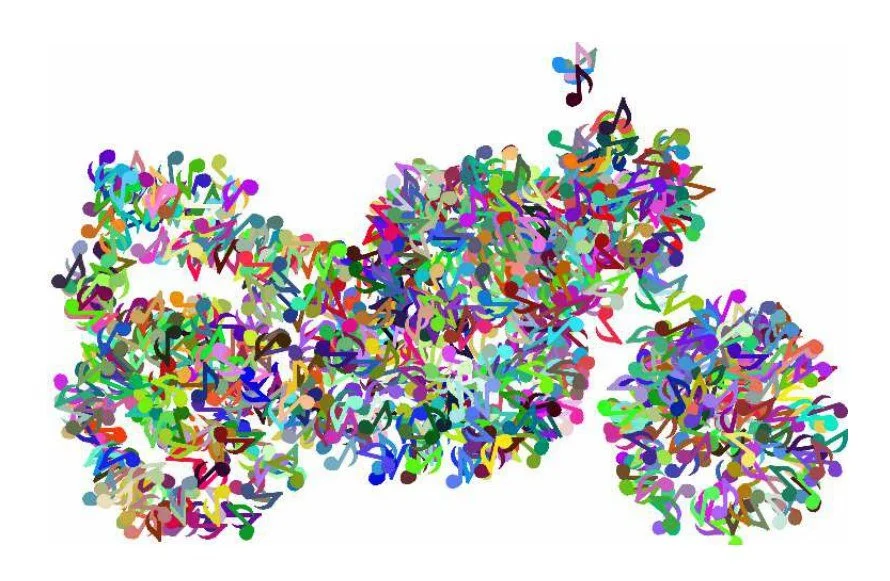
A motorcycle assembled from coloured, rotatable motifs; orientation and density describe the form. (Seo and Hong (2017), Fig. 8) 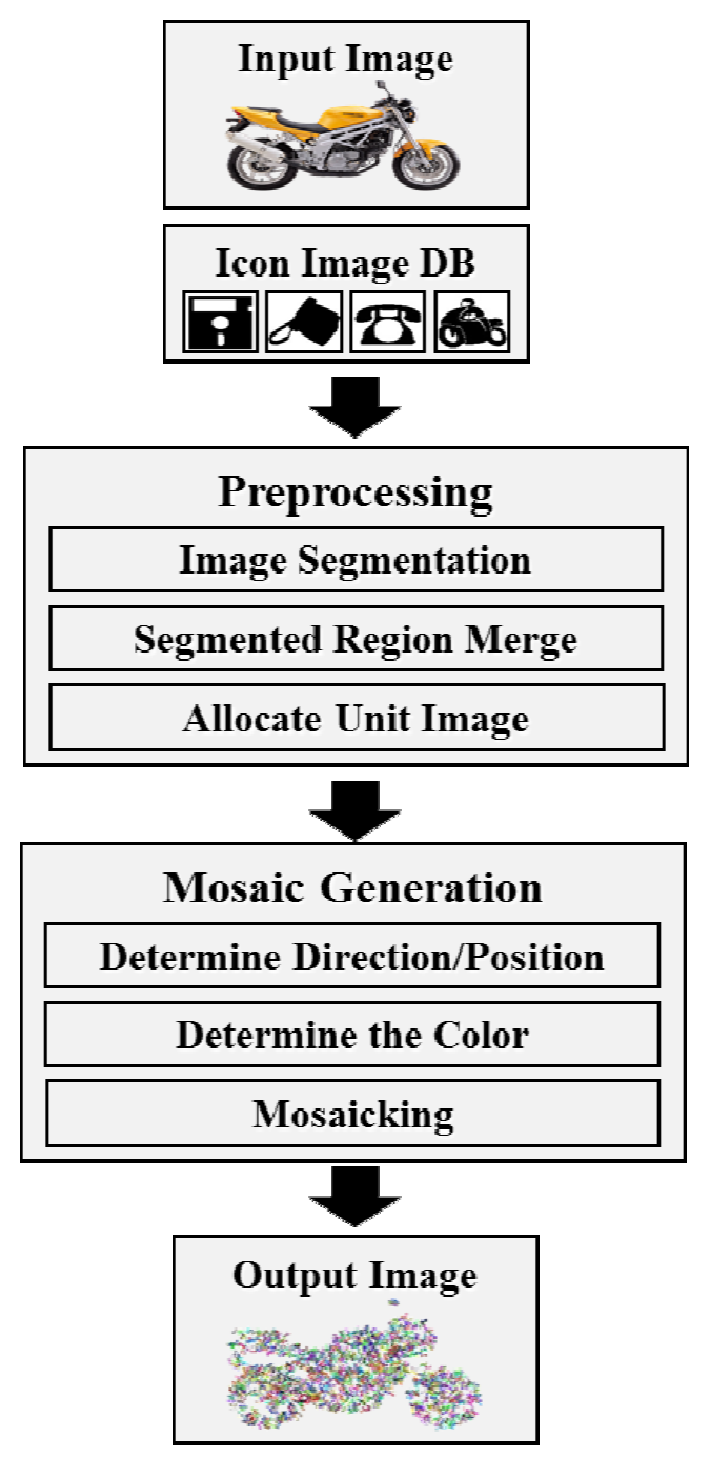
The system flow of scattered image mosaic rendering: an input image and an icon image database pass through preprocessing (segmentation, region merging, unit-image allocation) and mosaic generation (direction, position and colour of each unit image), Fig. 2. (Seo and Hong (2017), Fig. 2) - Conference paper Yi Yang, Yasuaki Ito and Koji Nakano, Photomosaic Generation by Rearranging Subimages, with GPU Acceleration, 2017 IEEE International Parallel and Distributed Processing Symposium Workshops (IPDPSW), APDCM workshop, pp. 942-951. doi:10.1109/IPDPSW.2017.55
Yang, Ito and Nakano (APDCM, 2017) built mosaics by rearranging the pieces of one picture to reproduce another.
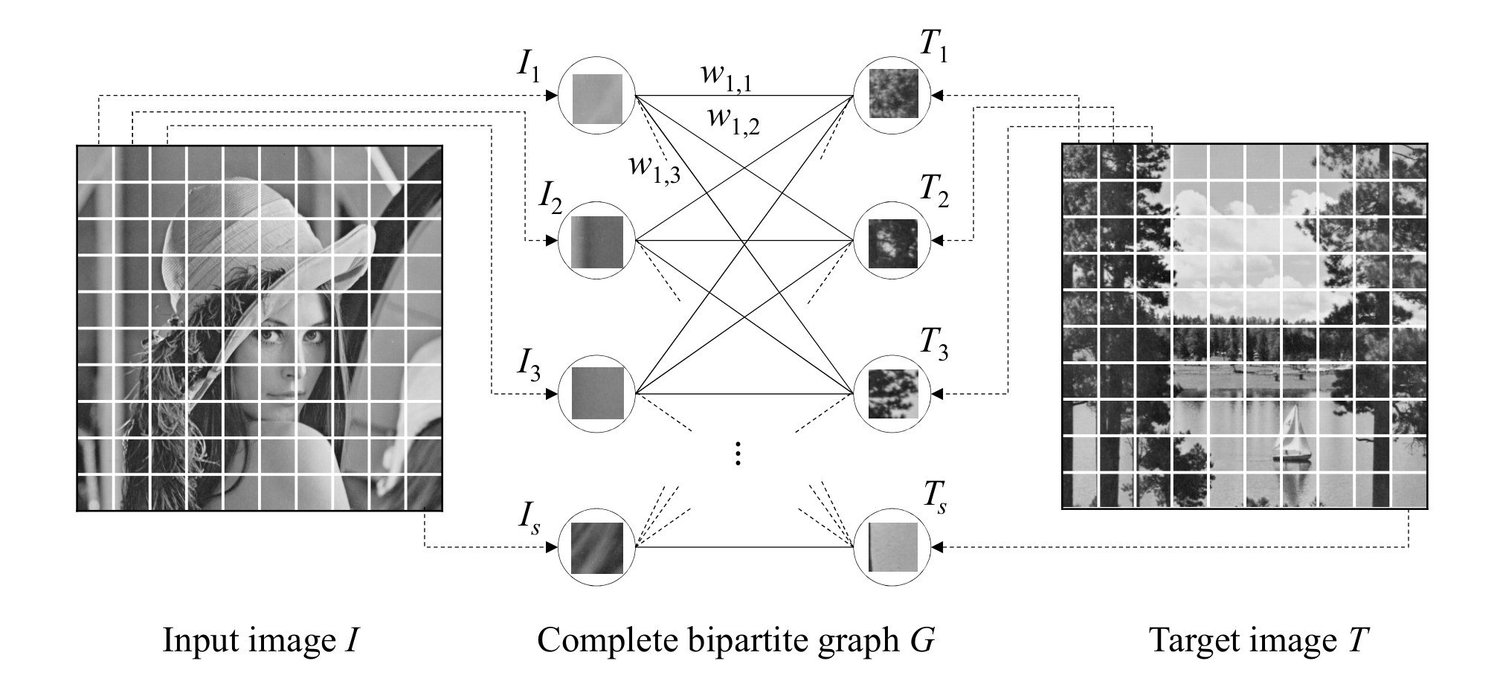
Mosaic assembly as a weighted bipartite graph: source tiles on one side, destination positions on the other. (Yang, Ito and Nakano (2017), Fig. 4) 
The total error between the rearranged image R and the target image T: the sum of tile-to-tile errors over all S tiles, which the method minimises by reducing the problem to minimum weighted bipartite matching, Eq. (2). (Yang et al. (2017), Eq. (2)) - Journal article Alaa Yaseen Taqa, Generating Mosaic Images Based On Texture Analysis, Journal of Education and Science (University of Mosul) 27(4): 69-101, 2018. doi:10.33899/edusj.2018.159299
Taqa (2018) investigated texture statistics with clustering, neural and fuzzy matching.
- Journal article Irene Luque Ruiz, Gonzalo Cerruela García and Miguel Ángel Gómez-Nieto, Interactive mosaic building and its application to marketing strategies using NFC, Multimedia Tools and Applications 77(12): 15291-15320, June 2018 (online August 2017). doi:10.1007/s11042-017-5115-x
Live-event photo walls and participatory installations use contributed photographs in a similar spirit, and Luque Ruiz and colleagues' NFC-linked work (2018) adds interaction.
- Conference paper Matthew Tesfaldet, Nariman Saftarli, Marcus A. Brubaker and Konstantinos G. Derpanis, Convolutional Photomosaic Generation via Multi-Scale Perceptual Losses, Computer Vision - ECCV 2018 Workshops (Springer LNCS, published 2019), pp. 75-83. doi:10.1007/978-3-030-11015-4_9
Tesfaldet, Saftarli, Brubaker and Derpanis (ECCV Workshops, 2018) built mosaics from templates with a convolutional network and multiscale perceptual losses, which compare what a neural network sees at fine and at coarse scales.
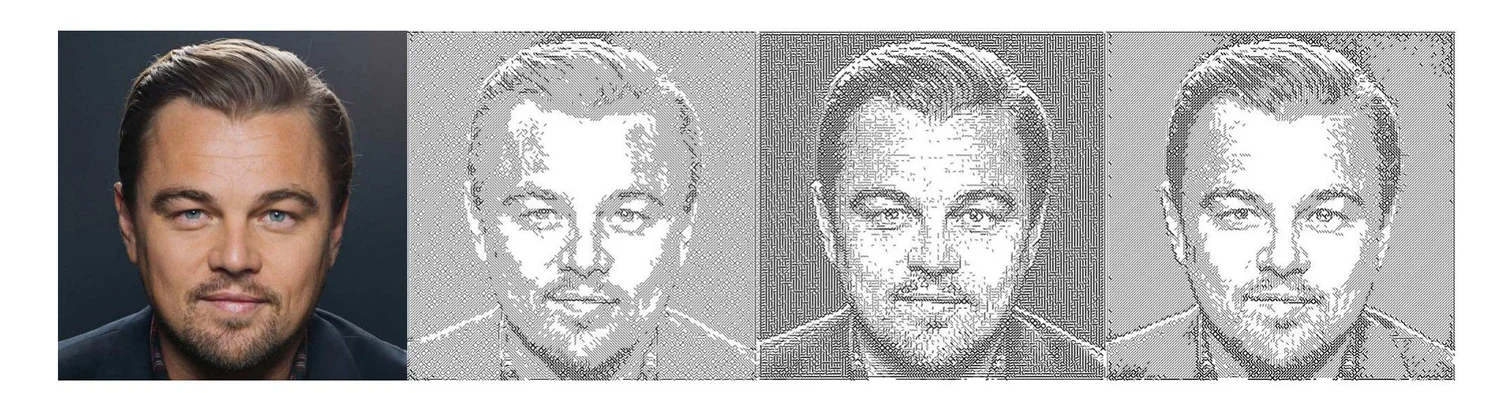
Single-scale against multiscale perceptual losses: how well each preserves the structure of a face. (Tesfaldet et al. (2018), Fig. 4) 
The training objective: a perceptual loss comparing VGG-16 feature maps of the input and the blurred output, averaged over S Gaussian-pyramid levels and L network layers, Eq. (3). (Tesfaldet et al. (2018), Eq. (3)) 
Each output tile is a linear combination of the N_T RGB templates, weighted by the coefficients the network predicts for that region, Eq. (1). (Tesfaldet et al. (2018), Eq. (1)) - Conference paper Naoki Matsumura, Hiroki Tokura, Yuki Kuroda et al., Tile Art Image Generation Using Conditional Generative Adversarial Networks, 2018 Sixth International Symposium on Computing and Networking Workshops (CANDARW): 209-215. doi:10.1109/candarw.2018.00047
Added after the history of 9 October 2026. Bibliographic data checked against Crossref; we have not read this paper.
- Thesis Julian Iseringhausen, Revealing the Invisible: On the Extraction of Latent Information from Generalized Image Data, doctoral dissertation, University of Bonn, 2019. hdl.handle.net
In Iseringhausen's 2019 doctoral work and Computational Parquetry (ACM TOG, 2020), the library is scanned wood veneer.
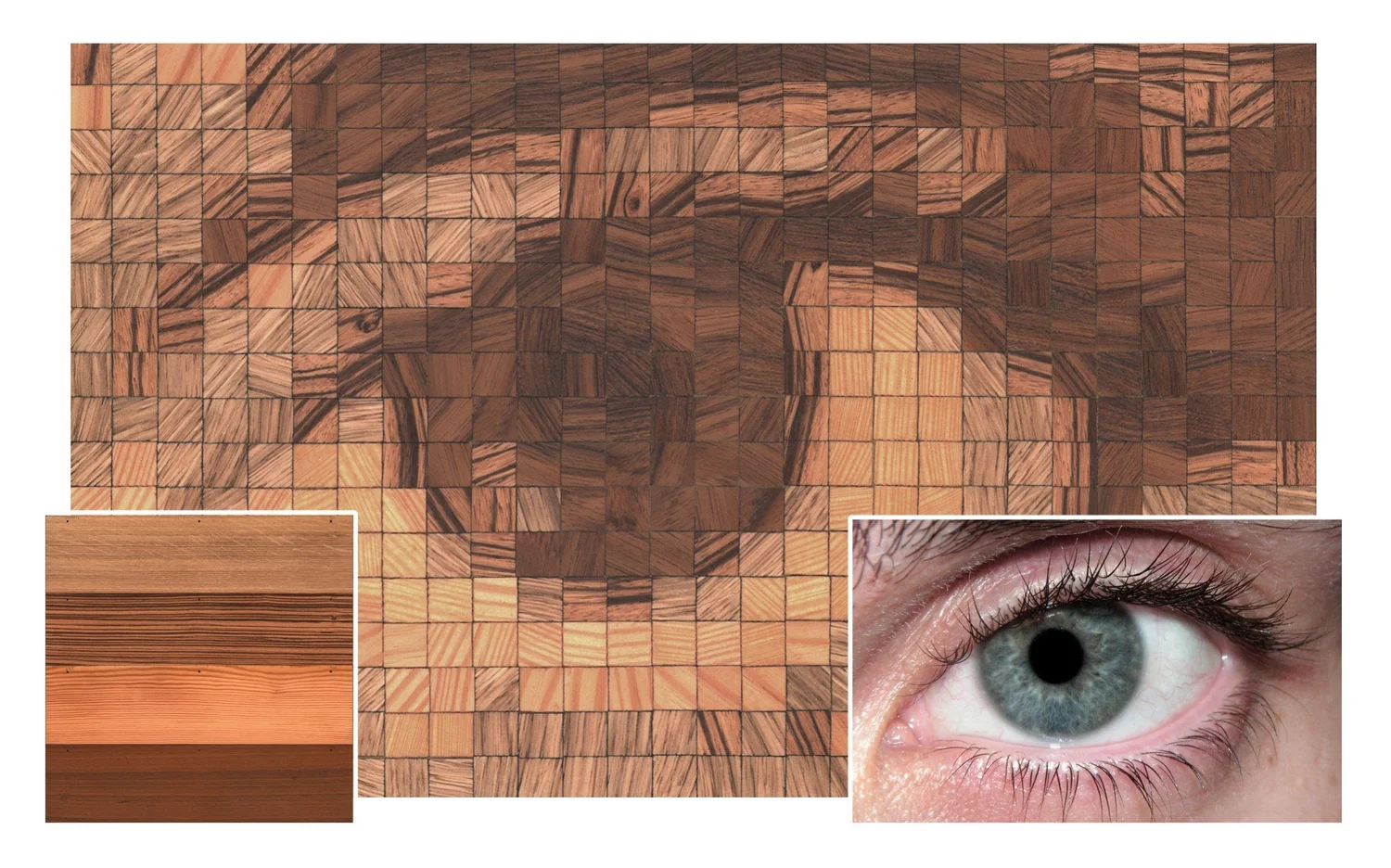
Computational parquetry: wood-veneer samples, the reference eye and the fabricated result. (Iseringhausen (2019), Fig. 4.13) - Journal article Lars Doyle, Forest Anderson, Ehren Choy and David Mould, Automated pebble mosaic stylization of images, Computational Visual Media 5(1): 33-44, 2019. doi:10.1007/s41095-019-0129-0
Added after the history of 9 October 2026. Bibliographic data checked against Crossref; we have not read this paper.
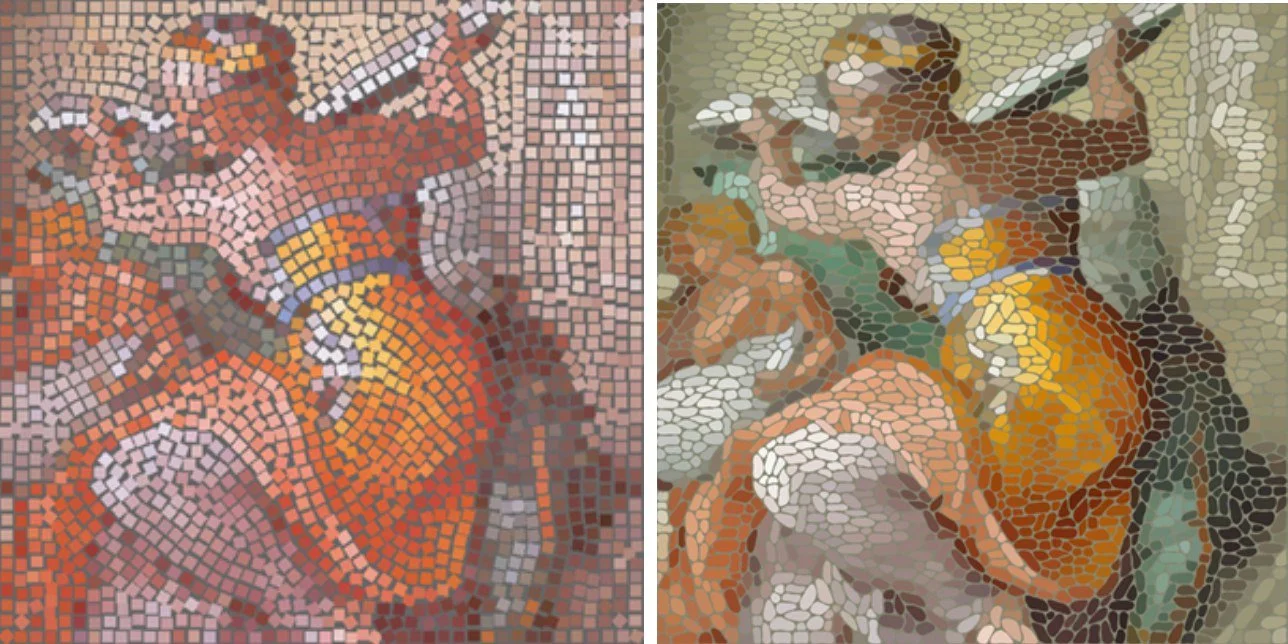
The same detail of a painted figure with 2,000 tiles: square tiles after Hausner (2001), left, and pebbles, right. (Doyle, Anderson, Choy and Mould (2019), Fig. 14, CC BY 4.0) - Journal article Naoki Matsumura, Hiroki Tokura, Yuki Kuroda et al., Tile art image generation using parallel greedy algorithm on the GPU and its approximation with machine learning, Concurrency and Computation: Practice and Experience 33(12), 2021 (online December 2019). doi:10.1002/cpe.5623
Added after the history of 9 October 2026. Bibliographic data checked against Crossref; we have not read this paper.
- Journal article Pengfei Xu, Jianqiang Ding, Hao Zhang and Hui Huang, Discernible image mosaic with edge-aware adaptive tiles, Computational Visual Media 5(1): 45-58, March 2019. doi:10.1007/s41095-019-0130-7
Xu, Ding, Zhang and Huang (2019) used edge-aware adaptive tiles.
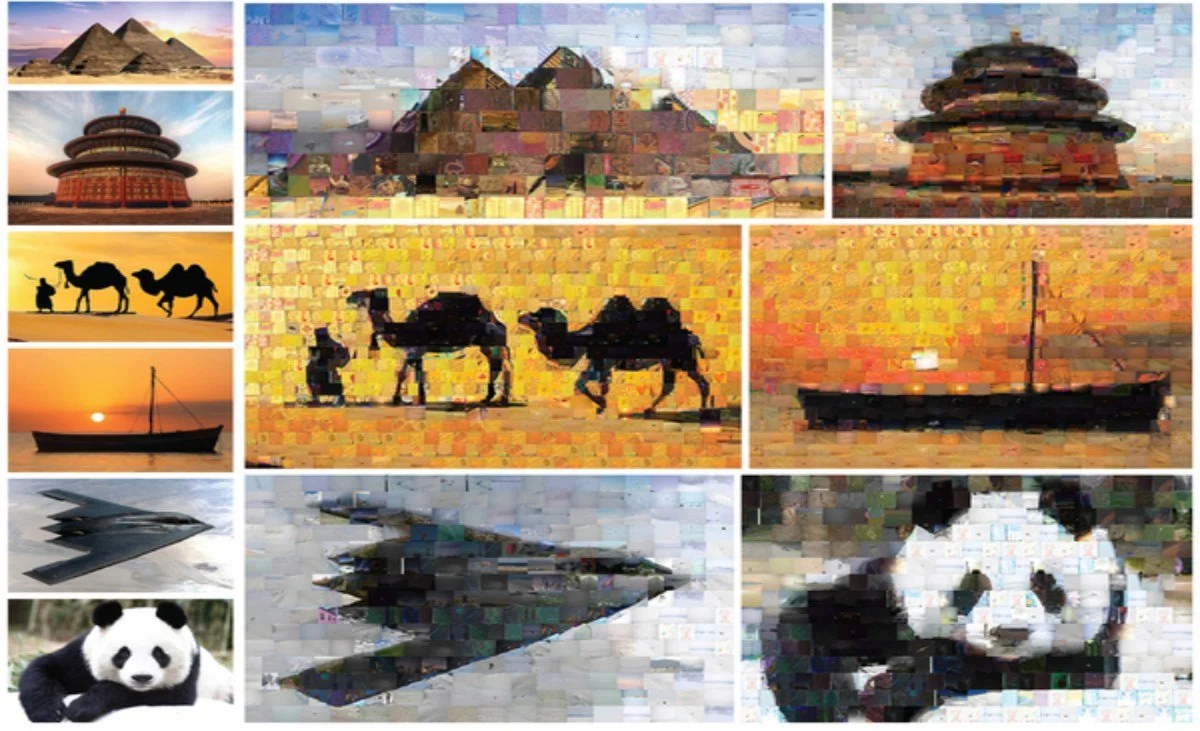
Targets (left) and their mosaics: tiles large enough to be recognised as photographs, placed along the edges of the target. Top row of the original figure omitted. (Xu, Ding, Zhang and Huang (2019), Fig. 11, CC BY 4.0) - Journal article Yaodong He, Jianfeng Zhou and Shiu Yin Yuen, Composing photomosaic images using clustering based evolutionary programming, Multimedia Tools and Applications 78(18): 25919-25936, September 2019 (online June 2019). doi:10.1007/s11042-019-07798-5
He, Zhou and Yuen (MTAP, 2019) combined clustering with evolutionary programming under repetition limits.
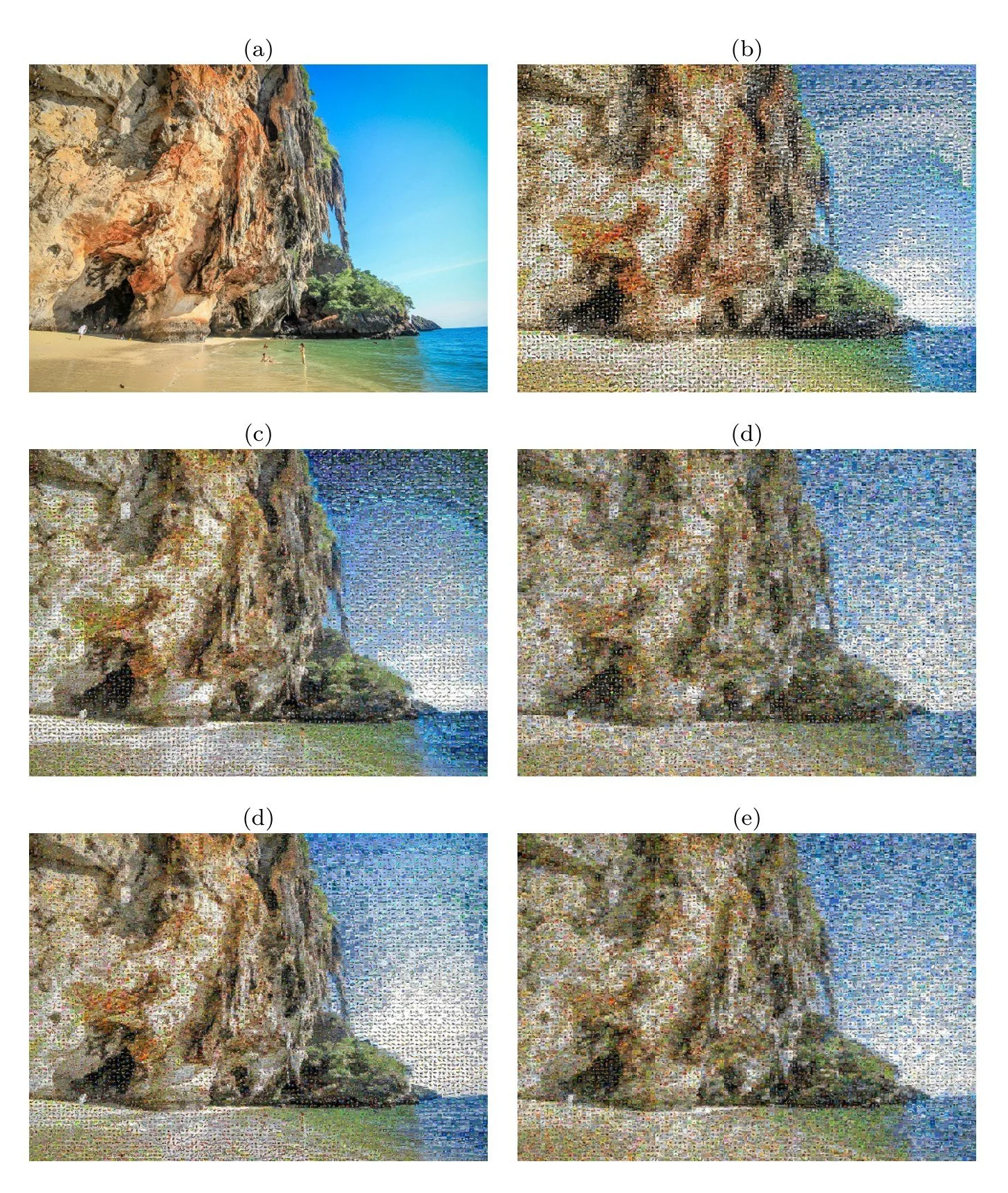
A coastal landscape and results from several methods, including clustering-based evolutionary programming. (He, Zhou and Yuen, arXiv preprint (2018), Fig. 3) 
The average fitness over all D blocks of the image, each block's fitness being the distance between the block and its assigned tile; the evolutionary search seeks the assignment that minimises it, Eq. (2). (He et al. (2019), Eq. (2))
2020–2026
- Journal article Chin-Lin Li, Yangcong Su and Ran-Zan Wang, Generating Photomosaics with QR Code Capability, Mathematics 8(9): 1613, September 2020. doi:10.3390/math8091613
With Li, Su and Wang's QR-code mosaics (ICMEW 2017; Mathematics 2020), the picture has to please two audiences: people and phone cameras.
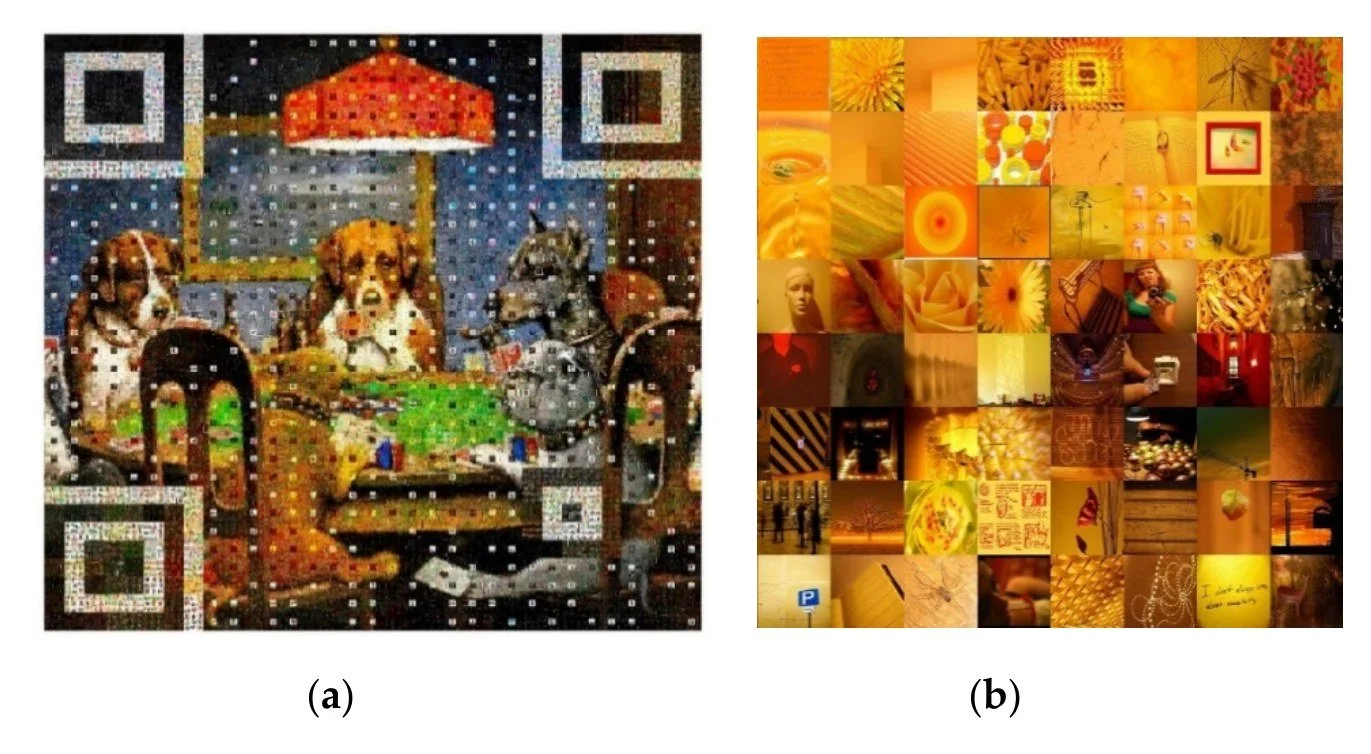
A QR-readable mosaic and an enlarged region: the photographs describe one subject while the code structure survives for the decoder. (Li, Su and Wang (2020), Fig. 11) 
Candidate tiles for white and black QR-code modules are sifted by the averaged luminance of the tile's one-third centre area, with a threshold margin delta controlling robustness, Eq. (3). (Li et al. (2020), Eq. (3)) - Conference paper Hironobu Kobayashi, Yasuaki Ito and Koji Nakano, Stained Glass Image Generation Using Voronoi Diagram and Its GPU Acceleration, Parallel Processing and Applied Mathematics, Lecture Notes in Computer Science: 396-407, 2020. doi:10.1007/978-3-030-43229-4_34
Added after the history of 9 October 2026. Bibliographic data checked against Crossref; we have not read this paper.
- Journal article Julian Iseringhausen, Michael Weinmann, Weizhen Huang and Matthias B. Hullin, Computational Parquetry: Fabricated Style Transfer with Wood Pixels, ACM Transactions on Graphics 39(2): 1-14, April 2020 (online February 2020). doi:10.1145/3378541
In Iseringhausen's 2019 doctoral work and Computational Parquetry (ACM TOG, 2020), the library is scanned wood veneer.
- Conference paper BAI Yuming and Nobuyuki Umezu, Character Mosaics: A New Form of Text-Based Artistic Representation, 2021 IEEE International Conference on Artificial Intelligence and Virtual Reality (AIVR): 65-69. doi:10.1109/aivr52153.2021.00019
Added after the history of 9 October 2026. Bibliographic data checked against Crossref; we have not read this paper.
- Journal article Hongbo Zhang, Xin Gao, Jixiang Du et al., Tile selection method based on error minimization for photomosaic image creation, Frontiers of Computer Science 15(3): 153702, June 2021 (online December 2020). doi:10.1007/s11704-020-9242-6
Zhang and colleagues (Frontiers of Computer Science, 2021) combined error-minimising selection with a weighted overlay of the target.
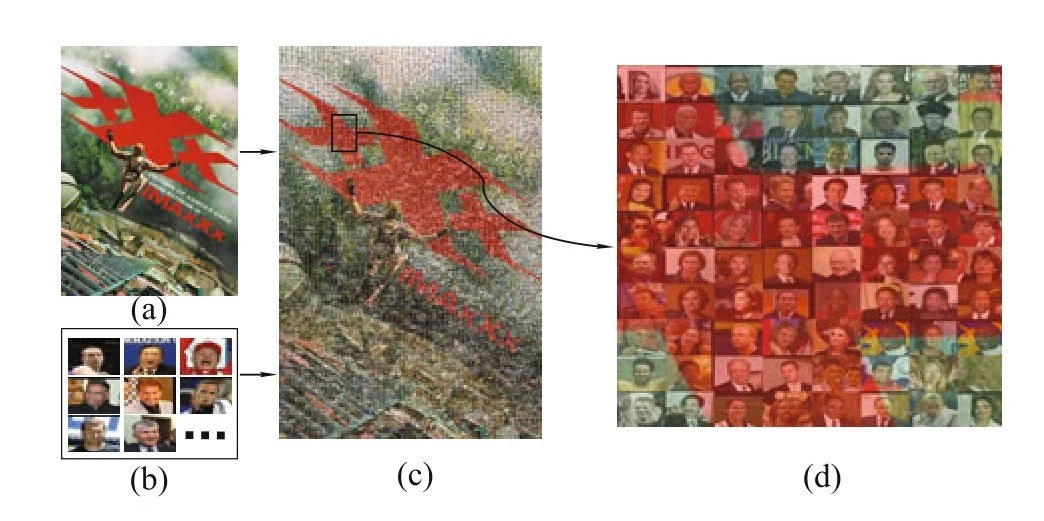
A target, source portraits, the mosaic and an enlarged tile region. (Zhang et al. (2021), Fig. 1) 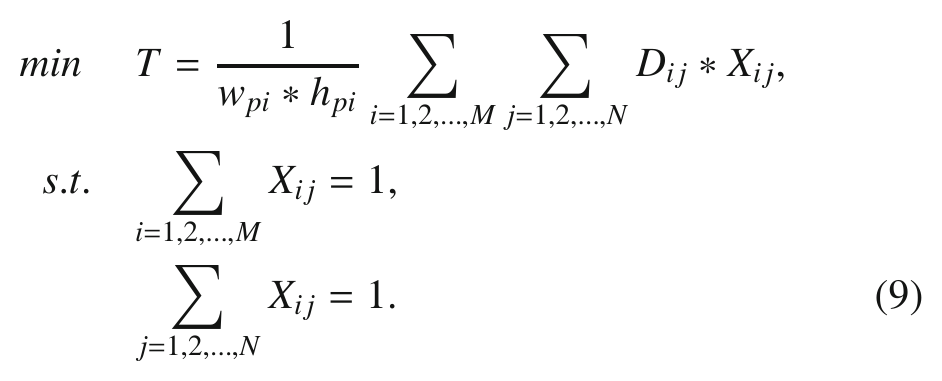
Tile selection posed as an optimisation: minimise the total error T, the sum of block-to-tile distances D weighted by the matching matrix X, under one-to-one constraints; the paper solves it as a bipartite perfect matching with the Hungarian algorithm, Eq. (9). (Zhang et al. (2021), Eq. (9)) - Conference paper Bai Yuming and Nobuyuki Umezu, Formulation of Ever Zooming-up Photomosaics, 2022 IEEE 11th Global Conference on Consumer Electronics (GCCE): 738-739. doi:10.1109/gcce56475.2022.10014064
Added after the history of 9 October 2026. Bibliographic data checked against Crossref; we have not read this paper.
- Preprint Yuseung Lee, Kunho Kim, Hyunjin Kim and Minhyuk Sung, SyncDiffusion: Coherent Montage via Synchronized Joint Diffusions, Advances in Neural Information Processing Systems 36 (NeurIPS 2023), pp. 50648-50660. arXiv:2306.05178
SyncDiffusion (2023), Visual Anagrams (2024) and Factorized Diffusion (2024) explore coherence and double readings in generated images.
- Conference paper Daniel Geng, Inbum Park and Andrew Owens, Factorized Diffusion: Perceptual Illusions by Noise Decomposition, Computer Vision - ECCV 2024 (Springer LNCS), pp. 366-384. doi:10.1007/978-3-031-72998-0_21
SyncDiffusion (2023), Visual Anagrams (2024) and Factorized Diffusion (2024) explore coherence and double readings in generated images.
- Conference paper Daniel Geng, Inbum Park and Andrew Owens, Visual Anagrams: Generating Multi-View Optical Illusions with Diffusion Models, Proc. IEEE/CVF Conference on Computer Vision and Pattern Recognition (CVPR 2024), pp. 24154-24163. doi:10.1109/CVPR52733.2024.02280
SyncDiffusion (2023), Visual Anagrams (2024) and Factorized Diffusion (2024) explore coherence and double readings in generated images.
- Preprint Kevin Li and Fulu Li, TalkMosaic: Interactive PhotoMosaic with Multi-modal LLM Q&A Interactions, arXiv:2409.13941 (v2), 20 September 2024. arXiv:2409.13941
Li and Li's TalkMosaic (2024) makes the trip from whole to part interactive.
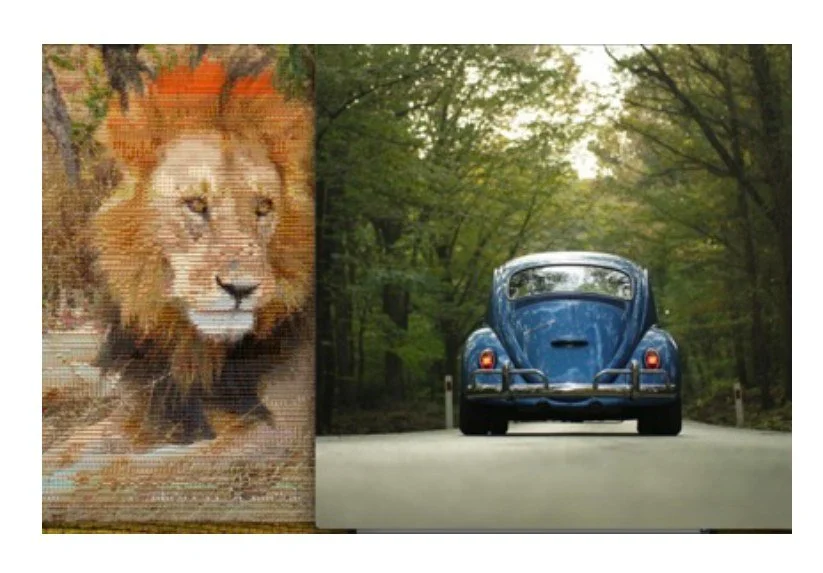
TalkMosaic: a lion mosaic with one component photograph selected and displayed. (Li and Li (2024), Fig. 4) - Conference paper Zhenyu Wang and Min Lu, Image-Space Collage and Packing with Differentiable Rendering, Proc. SIGGRAPH 2025 Conference Papers (ACM), pp. 1-11. doi:10.1145/3721238.3730690
Wang and Lu's Image-Space Collage and Packing with Differentiable Rendering (SIGGRAPH, 2025) works instead on arranging existing elements: its rendered losses judge every change of position and layout by its effect on the image.
- Preprint Jaeyoung Chung, Hyunjin Son and Kyoung Mu Lee, Generative Phomosaic with Structure-Aligned and Personalized Diffusion [sic], arXiv:2604.06989 (v1), 8 April 2026. arXiv:2604.06989
Chung, Son and Lee's structure-aligned generative method (2026) separates broad structure from local detail through low-frequency conditioning.
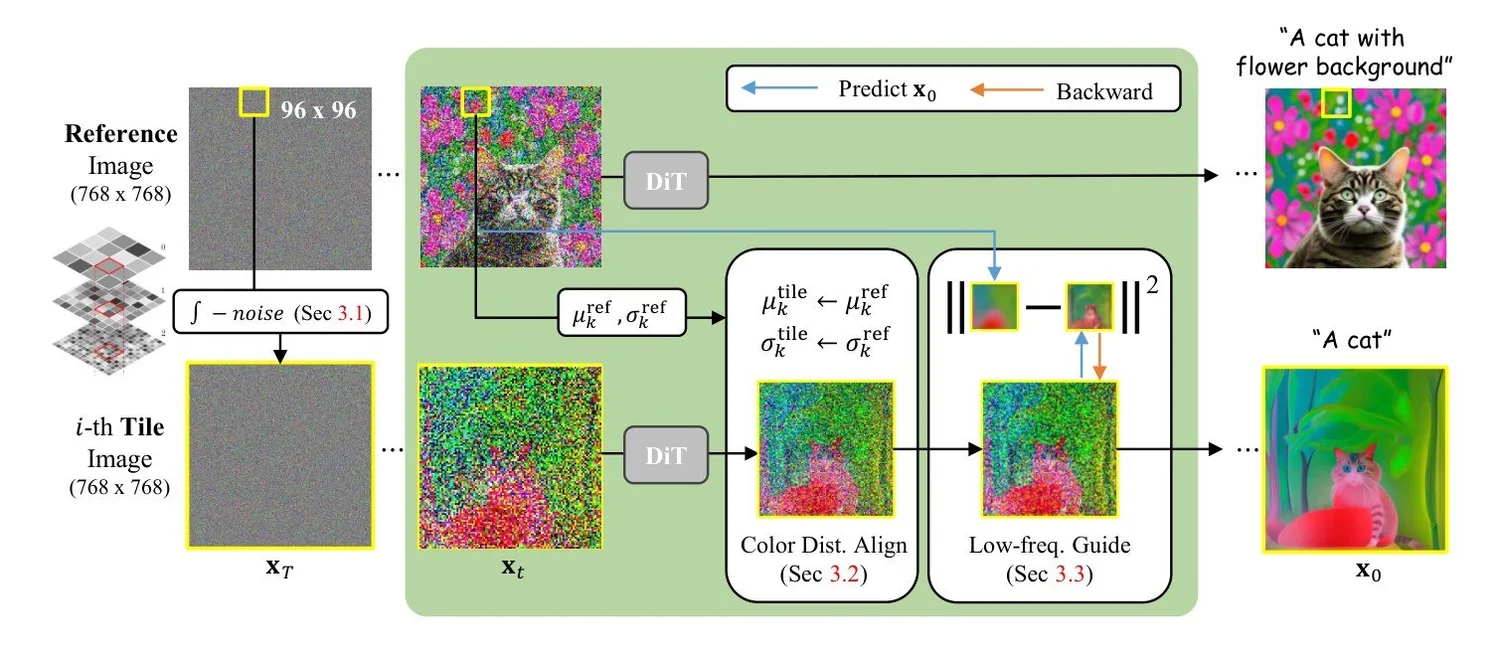
Overview of the structure-aligned generative method: low-frequency guidance holds the target together while each tile follows its prompt. (Chung, Son and Lee (2026), Fig. 2) - Preprint Koorosh Roohi, Javad Rajabi, Andrew Fleet and Babak Taati, PhotoQuilt: Training-Free Arbitrary-Resolution Photomosaics via Bootstrapped Tiled Denoising, arXiv:2606.30968 (v1), 29 June 2026. arXiv:2606.30968
Roohi, Rajabi, Fleet and Taati's PhotoQuilt (2026) starts from a coarse global image, enlarges it, adds noise again and then denoises the tiles one by one while keeping track of the overall arrangement.
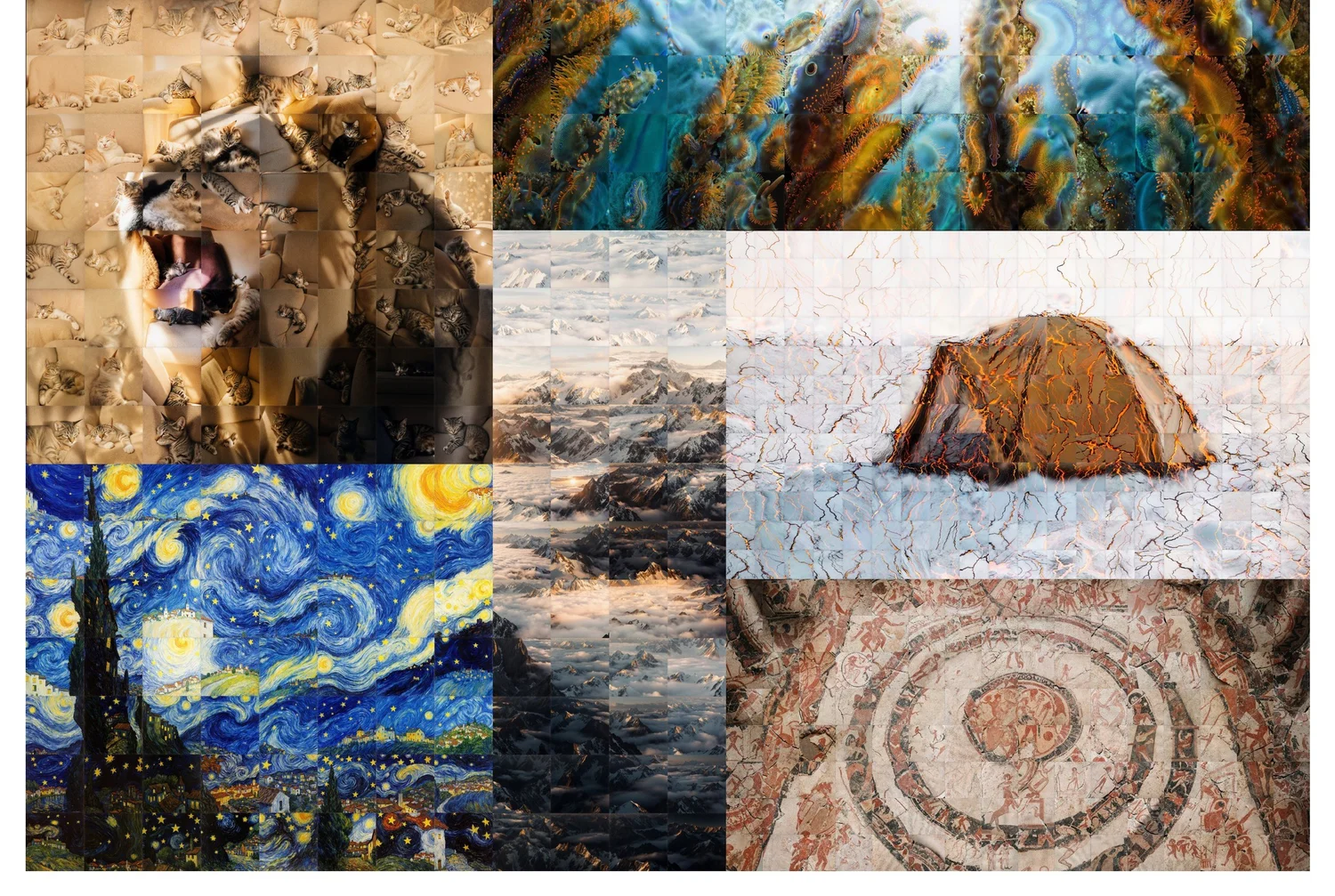
PhotoQuilt: high-resolution mosaics with several targets and tile settings. (Roohi et al. (2026), Fig. 1) - Conference paper Lars Doyle and David Mould, Diffusion-based Image Mosaics, Graphics Interface 2026 (GI '26), Kitchener-Waterloo, ON (ACM), 10 pages. cs.uwaterloo.ca
In Doyle and Mould's Diffusion-based Image Mosaics (Graphics Interface, 2026), a model generates each tile for its intended position.
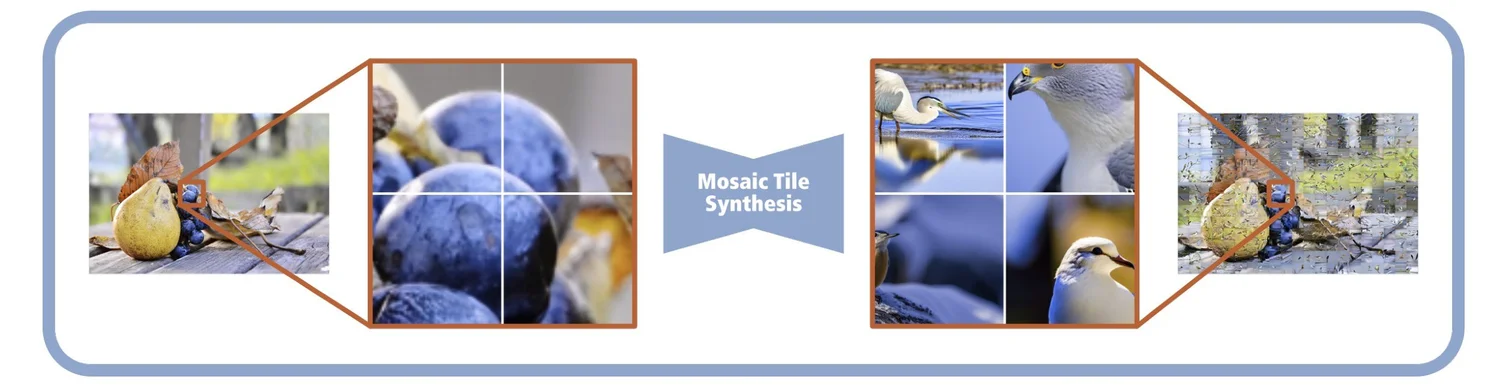
Tiles generated for their positions in the target composition. (Doyle and Mould (2026), Fig. 1) 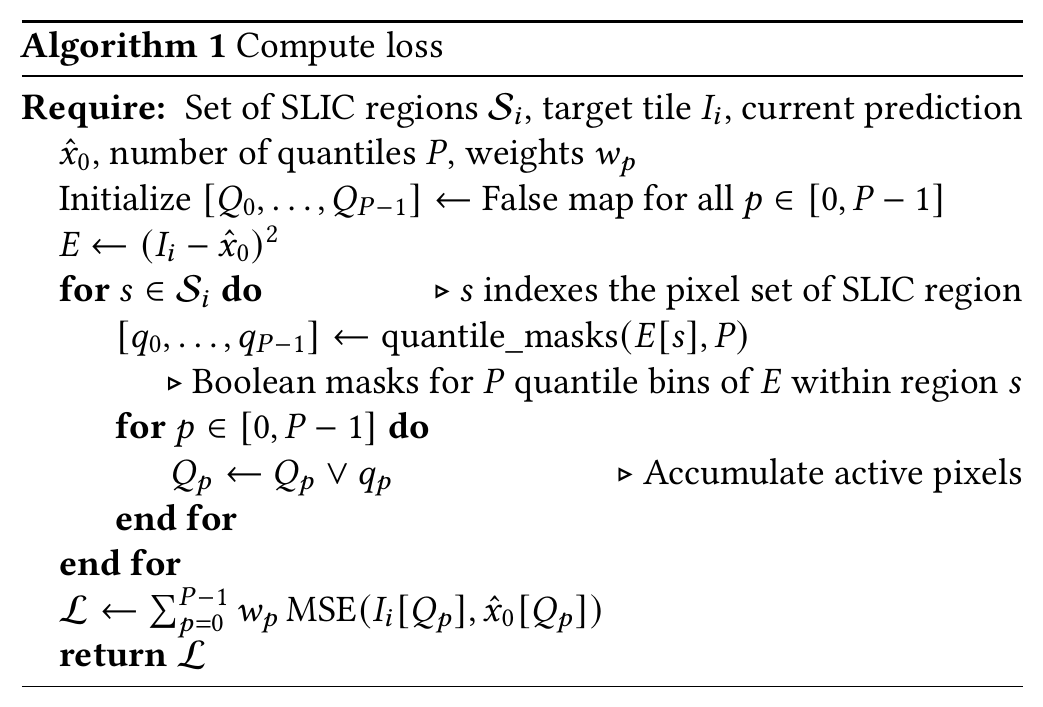
Algorithm 1 computes the adaptive quantile-weighted MSE loss that guides tile generation: pixels are binned by error quantile within each SLIC region and the per-bin MSE terms are summed with weights. (Doyle and Mould (2026), Algorithm 1)
Software, course material and web texts
- Software, course material or web text Joseph Francis, History of Photo Mosaics, digitalartform.com, 2017. digitalartform.com
Joseph Francis's Live from Bell Labs poster (1993) is described on his own site as an early computer-made photographic mosaic; in his own account it was the first image his software produced, made at R/Greenberg Associates for the annual Live From Bell Labs event.
- Software, course material or web text Rich Pattis, Nifty Assignments 2005: Photomosaics, SIGCSE Nifty Assignments, 2005. nifty.stanford.edu
The Nifty Assignments material of 2005, associated with Pattis, and the Williams CS326 exercises brought the same ideas into classrooms.
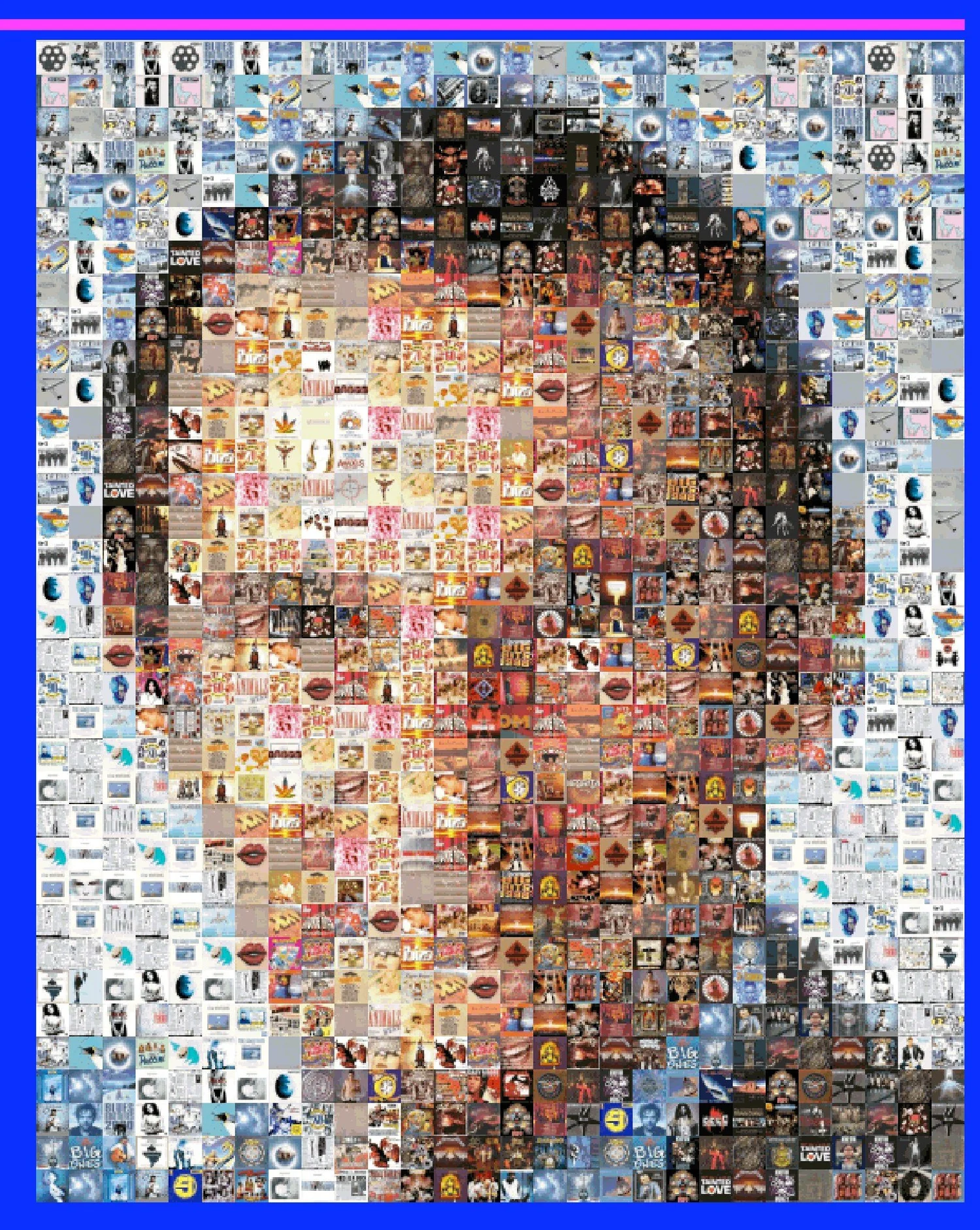
A mosaic portrait from the Nifty Assignments 2005 teaching material. (Nifty Assignments (2005)) - Software, course material or web text Stephen Freund, Lab 7: Photomosaics, CS 326, Williams College. cs.williams.edu
The Nifty Assignments material of 2005, associated with Pattis, and the Williams CS326 exercises brought the same ideas into classrooms.
- Software, course material or web text Mark Probst, Metapixel - A Photomosaic Generator, software. complang.tuwien.ac.at
Metapixel, AndreaMosaic, Mazaika, ArcSoft PhotoMontage and Foto-Mosaik-Edda let people work with their own collections and adjust the construction.
- Software, course material or web text Andrea Denzler, AndreaMosaic, software. andreaplanet.com
Metapixel, AndreaMosaic, Mazaika, ArcSoft PhotoMontage and Foto-Mosaik-Edda let people work with their own collections and adjust the construction.
- Software, course material or web text Mazaika, Mazaika - photo mosaic software, software. mazaika.com
Metapixel, AndreaMosaic, Mazaika, ArcSoft PhotoMontage and Foto-Mosaik-Edda let people work with their own collections and adjust the construction.
- Software, course material or web text Steffen Satrapa, Foto-Mosaik-Edda, software. fmedda.com
Metapixel, AndreaMosaic, Mazaika, ArcSoft PhotoMontage and Foto-Mosaik-Edda let people work with their own collections and adjust the construction.
- Software, course material or web text William Kromydas, Digital Composition of Mosaics using Edge Priority Tile Assignment, project report, Department of Electrical Engineering, Stanford University. slideshare.net
William Kromydas's edge-priority method, a Stanford project report, speaks to me directly.
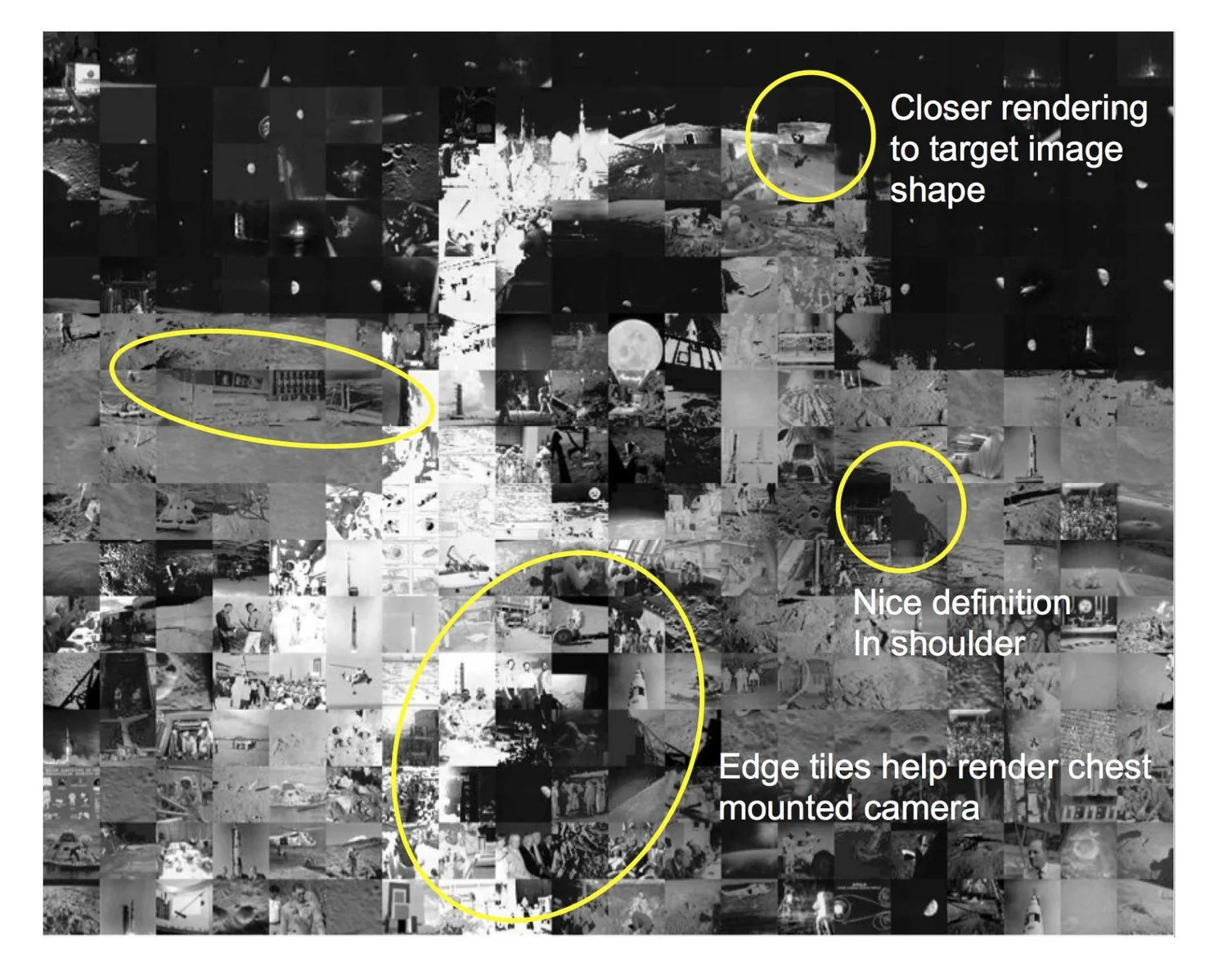
Edge priority, annotated: the silhouette, the equipment and the suit are where the structural improvements are easiest to see. (Kromydas, Stanford project report) 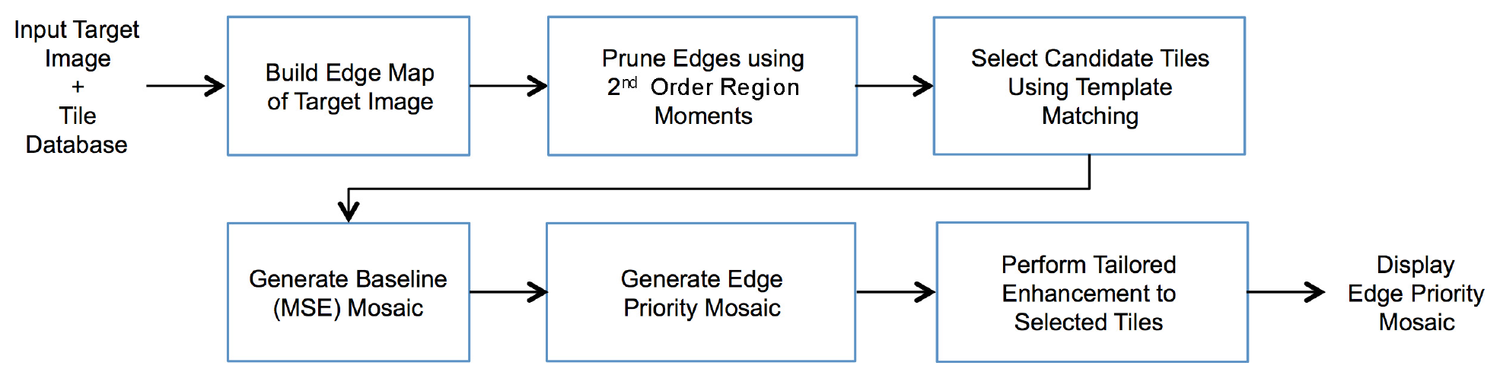
The edge priority processing pipeline: build and prune an edge map of the target, select candidate edge tiles by template matching, then generate a baseline MSE mosaic and an edge priority mosaic with tailored enhancement of the selected tiles, Fig. 1. (Kromydas, Fig. 1) - Software, course material or web text Tom Hudson, Creating photo mosaics from Instagram using Python, Linear Optimisation and Neural Networks, Medium, 2022. medium.com
Tom Hudson's practitioner account connected neural image descriptions with linear optimisation.
Evaluation metrics used by the recent papers
- Journal article Zhou Wang, Alan C. Bovik, Hamid R. Sheikh and Eero P. Simoncelli, Image quality assessment: from error visibility to structural similarity, IEEE Transactions on Image Processing 13(4): 600-612, April 2004. doi:10.1109/TIP.2003.819861
Pixel error records numerical differences; SSIM compares aspects of luminance, contrast and structure; learned measures such as LPIPS compare image features; generative work also asks whether the small images match their prompts and look convincing.
- Conference paper Richard Zhang, Phillip Isola, Alexei A. Efros et al., The Unreasonable Effectiveness of Deep Features as a Perceptual Metric, Proc. IEEE/CVF Conference on Computer Vision and Pattern Recognition (CVPR 2018), pp. 586-595. doi:10.1109/CVPR.2018.00068
Pixel error records numerical differences; SSIM compares aspects of luminance, contrast and structure; learned measures such as LPIPS compare image features; generative work also asks whether the small images match their prompts and look convincing.
Version and how to cite
Version 1.0, 22 October 2026. Living document: I add and correct entries, and every change is listed below.
Tsevis, Charis. "Annotated bibliography of artistic image mosaics, 1967–2026." Tsevis Studio, version 1.0, 22 October 2026. https://www.tsevis.com/blog/annotated-bibliography-artistic-image-mosaics
Changelog
- 1.0 (22 October 2026): first publication, 86 entries.
To report an error or suggest a missing paper, write to me through the contact page.