
Natural Experiments: Faces Grown by Nature and Mathematics
In each of these films, a rule from nature or mathematics grows the face of the person who studied it. Nature solves its problems with simple rules, repeated: a crystal adds one cell at a time, a sunflower places one seed at a time, a fish adds one stripe as it grows. Each film starts from a question that a naturalist or a mathematician asked about such a rule, and the rule answers it.
We build the portraits as algorithmic mosaics. Every tile is a number, and the number is the moment the tile was born: the step at which a crystal froze, the week a scale appeared, the branching order of the wood. So the picture is also a record of how it grew; the mathematics of mosaic explains the ideas behind it. These are studies, a work in progress, and we add a piece when it is ready.
In this series: Reed, Goethe, Arcimboldo, Bloch, Margulis, Kepler, Cajal, Graham, Fries, Turing, Corbett.
Reed: an apple tree with two faces
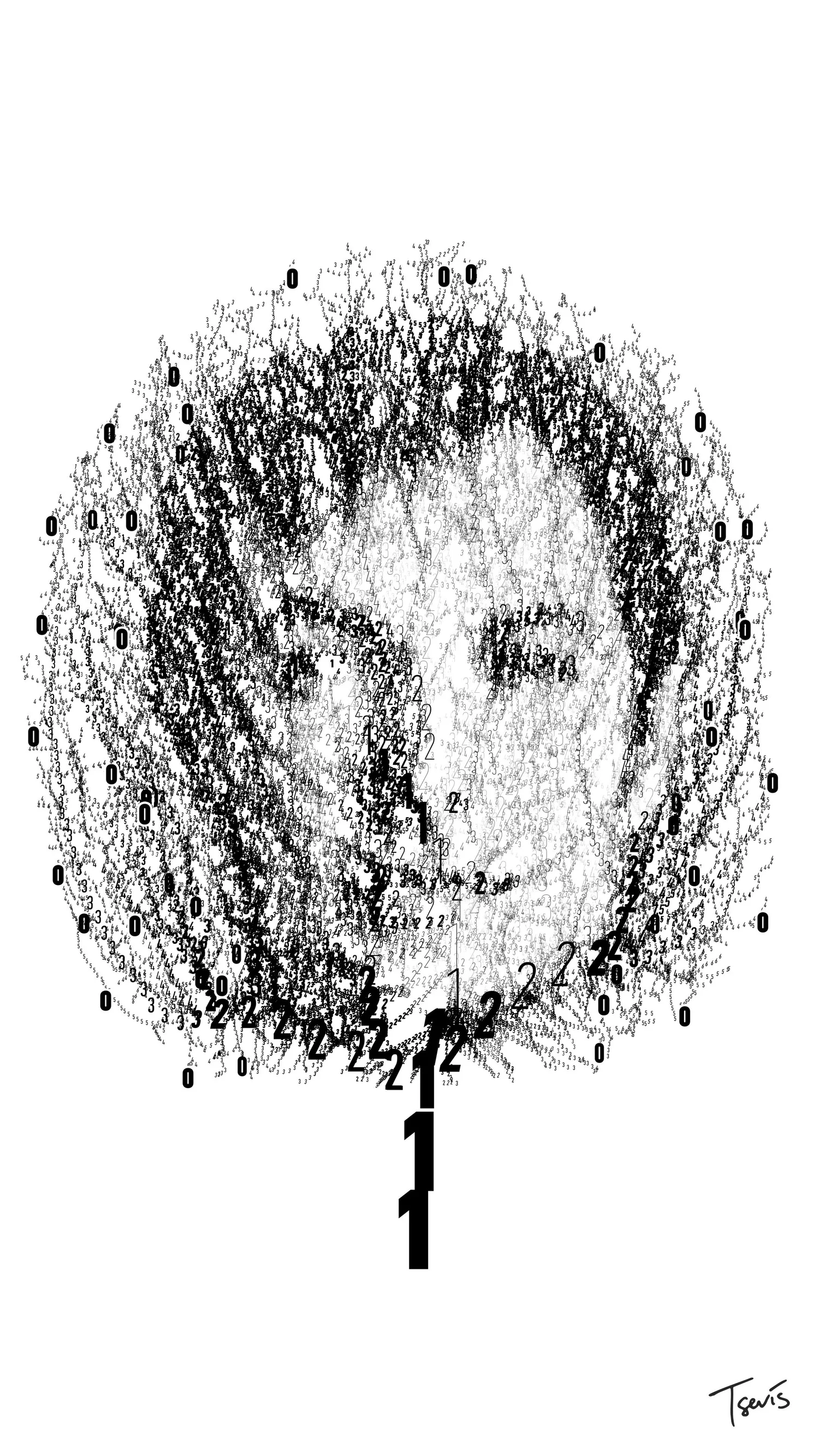
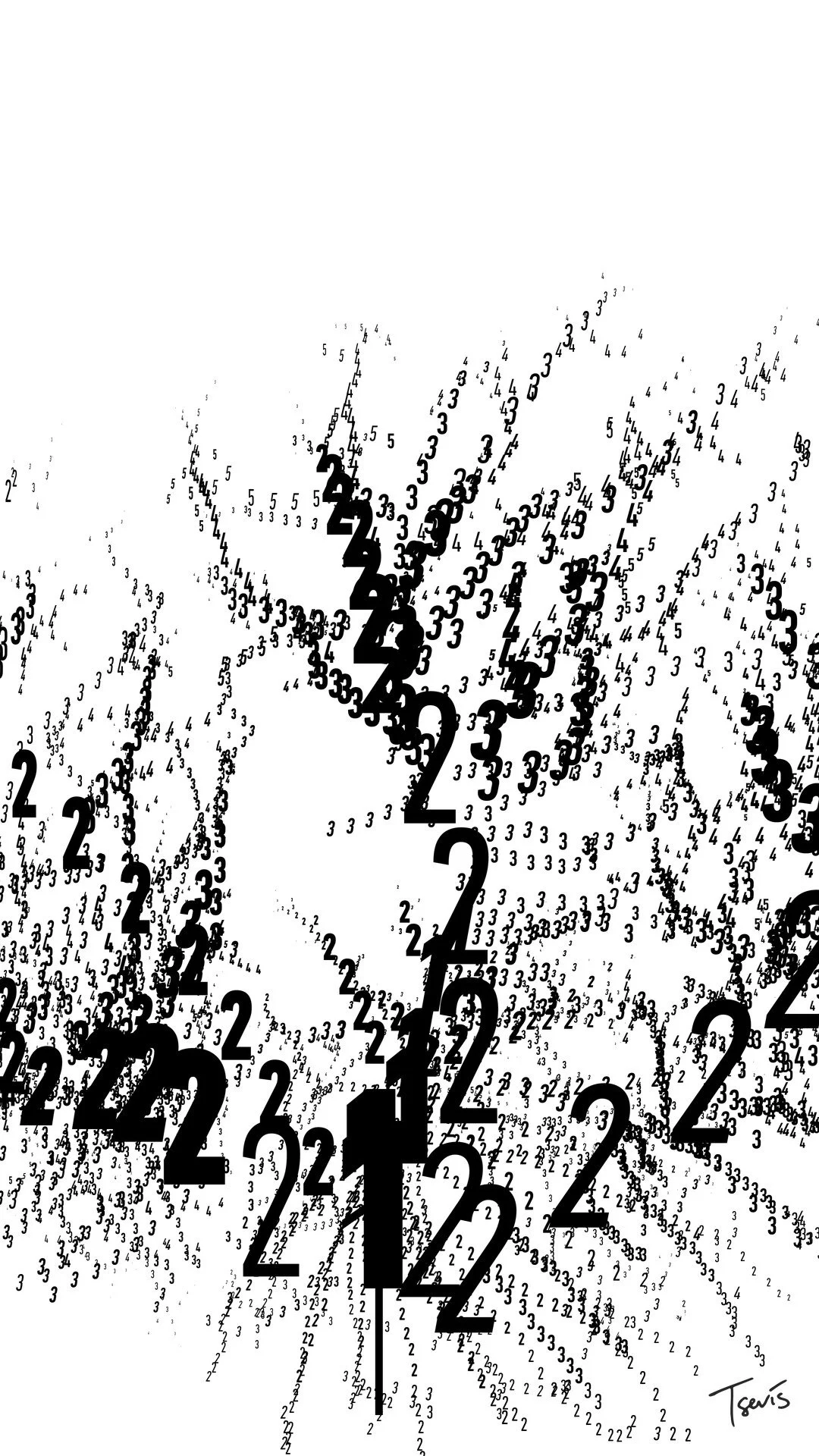
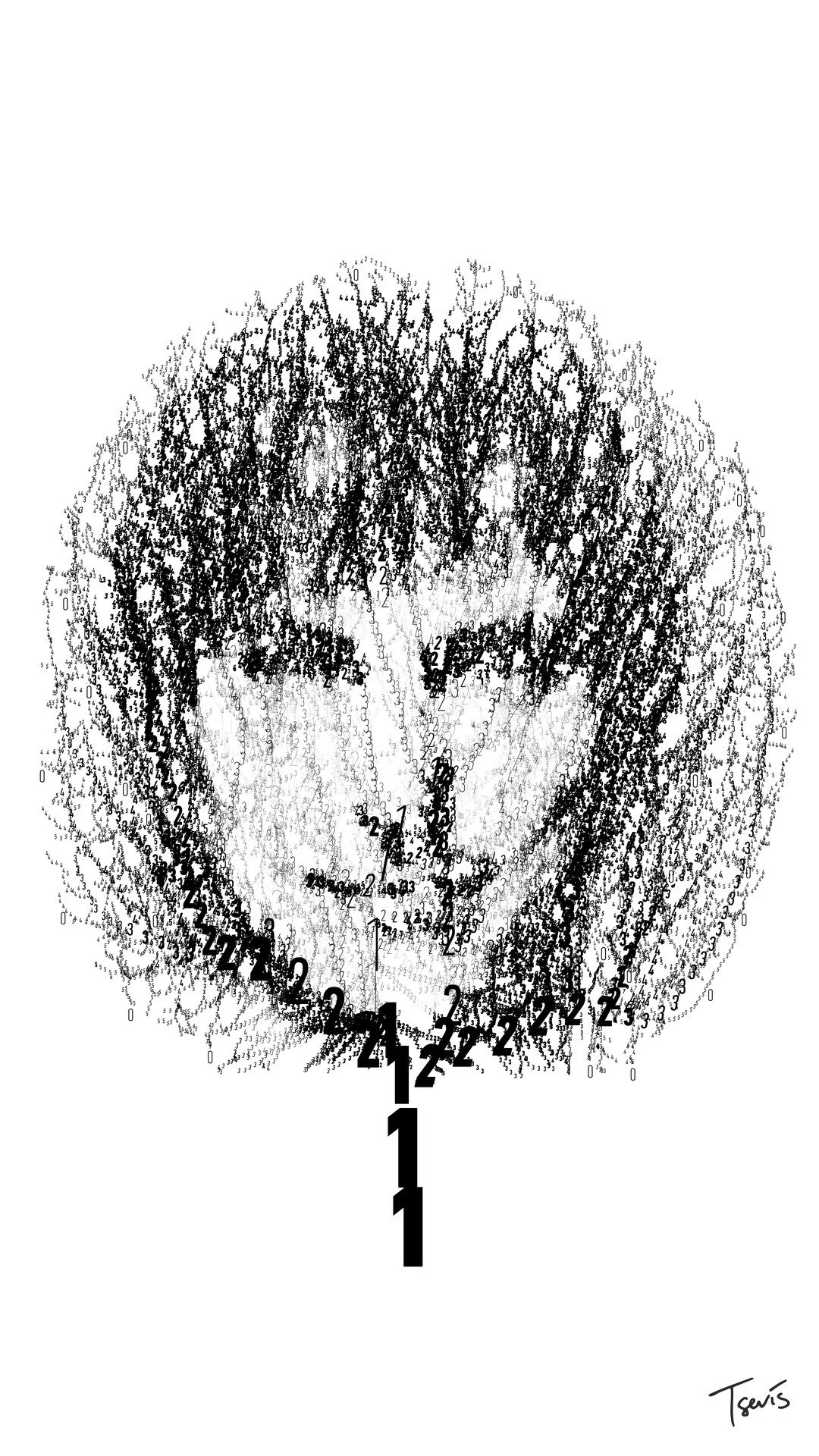
An apple tree grows from a single numeral at its foot. Its branches find the light the way a real crown does, and every tile is a numeral: the branching order of the wood it sits on. The crown has two faces, the young Steve Jobs and his son Reed.
The question
What does a face inherit? A tree answers in a literal way: every twig carries the history of the branches below it. We took the most familiar picture of inheritance, the family tree, and grew it the way a real tree is grown.
The mathematics
The branches are found by space colonisation, the algorithm of Runions, Lane and Prusinkiewicz (2007): a cloud of points that stand for the space and light a crown reaches for, and a branch that grows toward the nearest ones. The wood thickens by Leonardo’s rule: the branches above a fork add up to the cross-section of the branch below. Every piece of wood has a branching order, from 1 for the trunk to the finest twigs.
The mosaic
Each tile is that number, set in PF DIN Text Comp Pro, in a weight that follows the tone of the portrait. On one side of the crown is the young Steve Jobs, on the other his son Reed. The camera rises through the growing tree, settles on the father, turns half a circle until their eyes line up, and comes to rest on the son, while the blossoms become apples. Then it falls into the 1 in Reed’s eye, which is where the film begins. The film is a 41-second loop with sound.
At a glance
- Subject
- Heredity: Steve Jobs and his son Reed Jobs in one apple tree
- Rule
- Space colonisation (Runions, Lane and Prusinkiewicz, 2007); branch thickness by Leonardo’s rule
- Tiles
- Numerals in PF DIN Text Comp Pro; each is the branching order of its wood, 1 for the trunk
- Film
- 41 s seamless loop with sound, 1080 × 1920 (9:16), 30 frames per second
- Stills
- 3240 × 5760 px; layered PSD and flat TIFF in the studio archive
Goethe: a tree of numerals that is his face
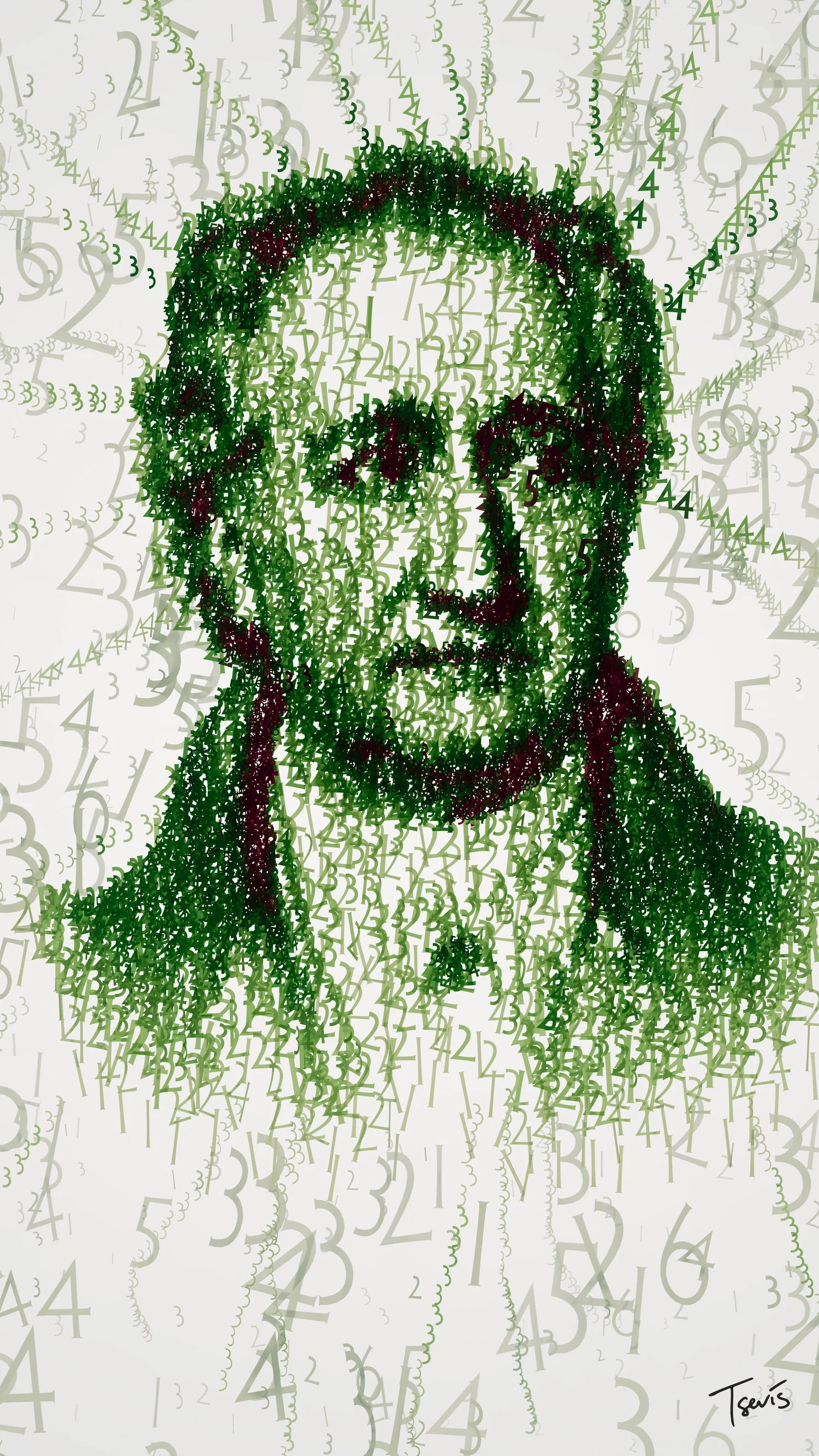
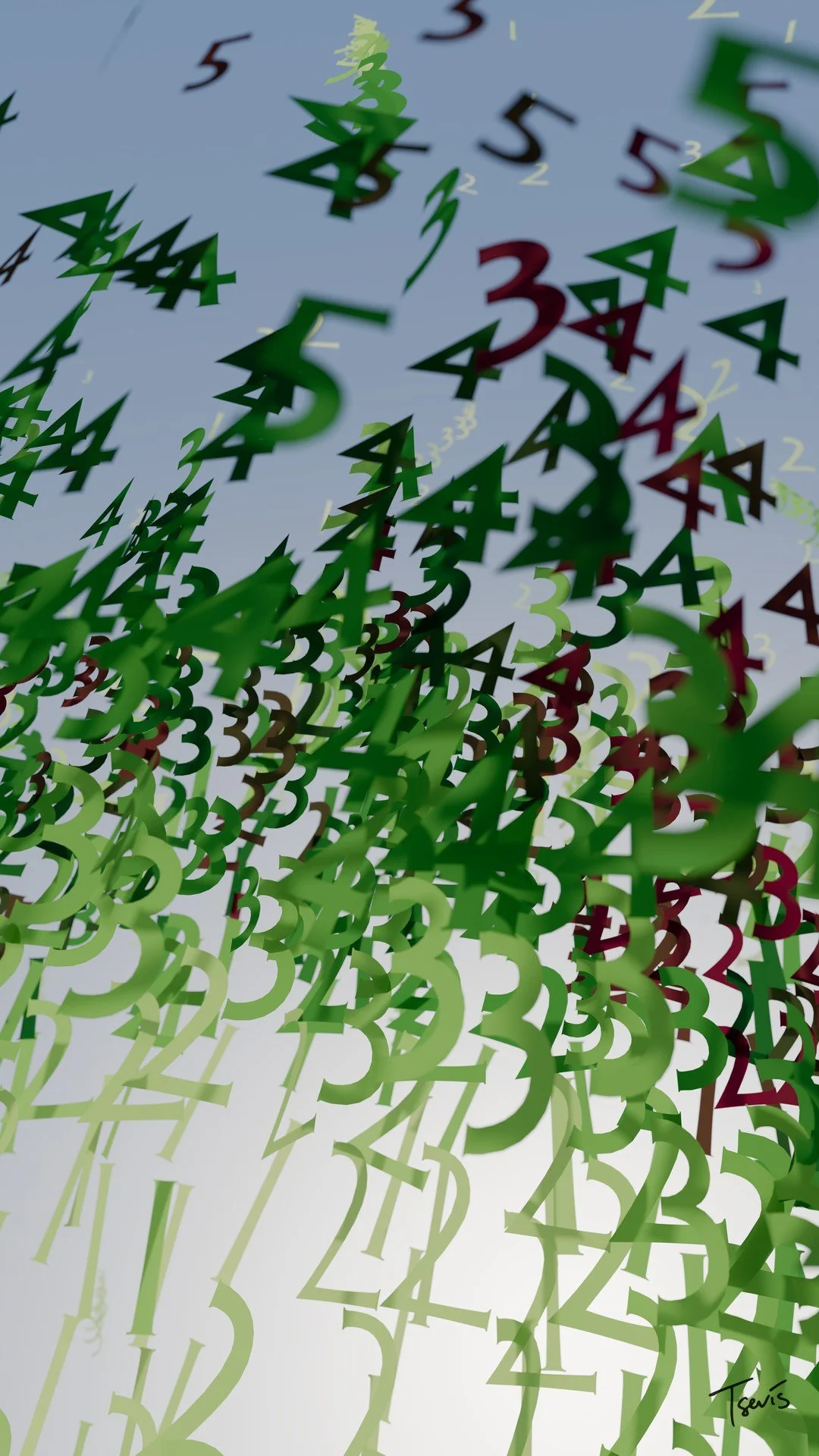
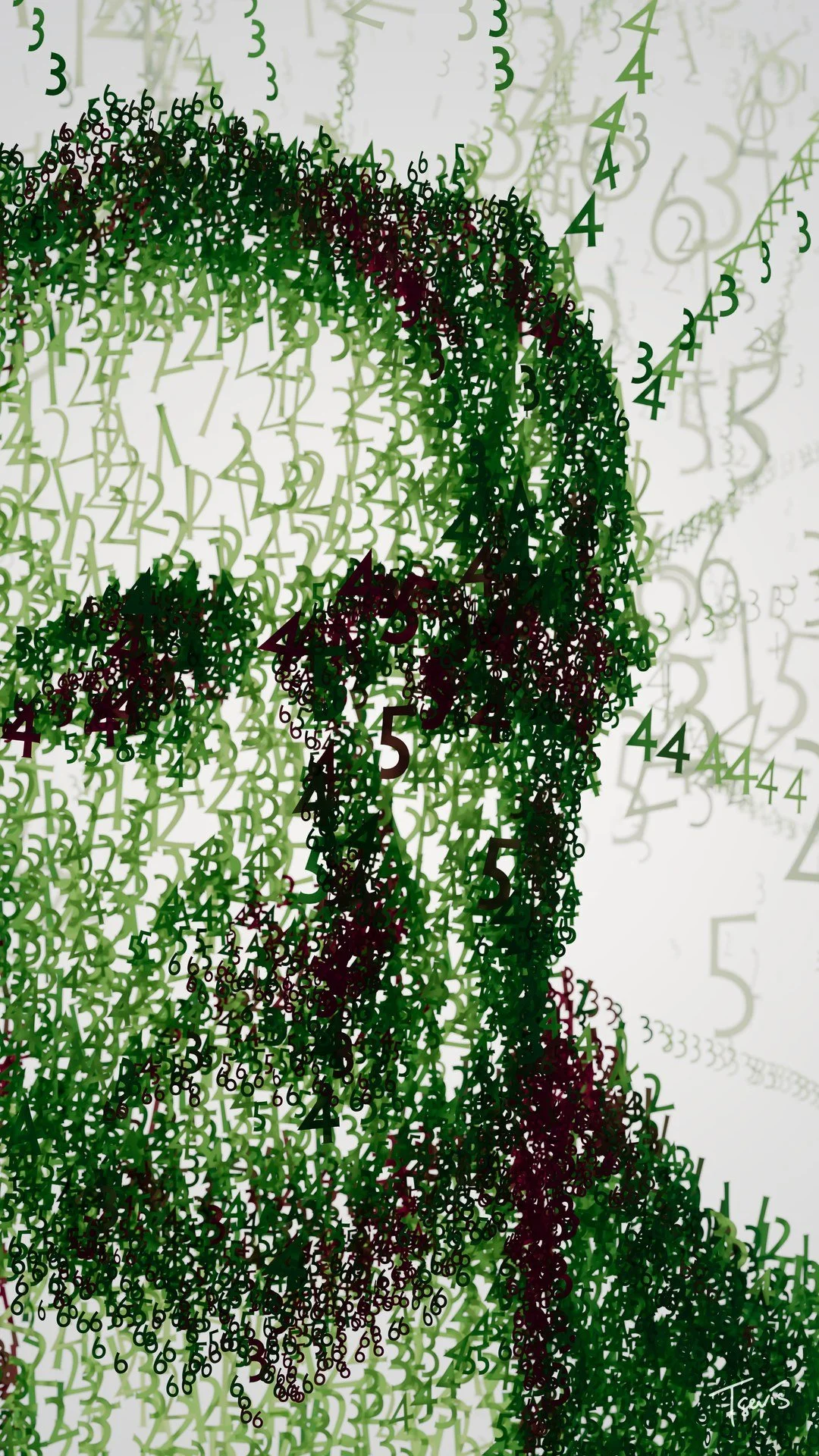
Goethe wrote that every part of a plant is one organ that changes its form, and that the eye can see the light because it is like the sun. Here the one organ is the numeral. A tree of numerals grows from the pupil of his eye, and it is his face from one point in space only, against the sun.
The question
In 1790 Goethe proposed that the leaf, the petal and the stamen are one organ in different forms (The Metamorphosis of Plants). In 1810, in the introduction to his Theory of Colours, he quoted an old saying: “Wär nicht das Auge sonnenhaft, / Wie könnten wir das Licht erblicken?” If the eye were not like the sun, how could we see the light?
We joined the two ideas in one picture. The same numerals are first seed, then vein, then tree, then face. The growth starts at the pupil of his eye, the sun stands exactly behind his head on the axis of the camera, and the film begins and ends in the white of the sun. The face is drawn by the numerals that hide it. There is no leaf shape and no outline anywhere, only flat numerals.
The mathematics
The veins grow by space colonisation (Runions and colleagues, 2005). The places of the numerals are the sources. At every step each source pulls the nearest node of the vein, the node puts out a new node, 12 mm long, toward the average direction of the sources that pull it, and a source is switched off when the vein comes within 16 mm of it. The root is the pupil of the darker eye. Nobody drew the tree: it follows from the rule, and it grows in three dimensions inside the volume of the head.
A numeral opens when its vein reaches it. With i running from 1 to N, the numeral i opens at t = 0.4 + 19.6 × (i/N)1.25 seconds, so the growth bursts from the eye and then fills the space. Each numeral takes 0.6 seconds to open, and the last one opens at 20.1 seconds. The veins are ranked by stream order (Strahler, 1952): a twig at the tip has order 1, where two branches of the same order k meet the vein gets order k+1, and otherwise it keeps the higher one. The root reaches order 6.
Then the picture is made from one point. The camera of the lock stands 4.67 metres in front of the first plane, where the frame is 1.778 metres high. Every numeral of the face lies on the straight line from that point to its place in the image, up to 2.43 metres behind the plane, and it is scaled with its distance, so that from there it appears at the right size. From any other point it is a cloud.
The mosaic
There are 13,523 numerals: 11,643 in the portrait and 1,880 in the rest of the tree around and behind it, from 4.7 to 78.7 mm high. In the face the image is divided into cells that shrink where the source darkens, and the numeral is the rank of its cell: 1 for the largest, 6 for the smallest (the median height of a 1 is 23.7 mm, of a 6, 5.8 mm). On the thick veins the numerals show the stream order of the vein, from order 3 upward. The numeral in the pupil counts the order of the root as the tree grows, 1 to 6; it follows the growth with a delay of 1.35 seconds so that the first 1 can be seen after the flash. That delay is a choice for the picture, not a measurement.
The numerals are set in PF Hellenica Serif Pro, Light, Regular and Bold, and the weight follows the tone: Light in the lights, Bold in the shadows. Each one is a thin translucent sheet that lets the light through, not glass and not metal, and nothing glows by itself. They are green in the lights and burgundy in the darkest places. One sun stands on the camera axis, there is lit air behind the head, and the sky goes from white around the sun to blue far from it. The camera never stops, with a lens from 16 to 63 mm. The source is Joseph Karl Stieler’s portrait of Goethe of 1828 in the Neue Pinakothek in Munich, in the public domain, which we cleaned.
At a glance
- Subject
- Johann Wolfgang von Goethe, The Metamorphosis of Plants (1790) and Theory of Colours (1810)
- Rules
- Open vein growth by space colonisation (Runions and colleagues, 2005); stream order (Strahler, 1952); anamorphosis from one camera position
- Tiles
- 13,523 numerals, 4.7 to 78.7 mm high: 11,643 in the portrait, 1,880 in the rest of the tree
- Marks
- PF Hellenica Serif Pro, Light, Regular and Bold; weight follows the tone; flat numerals, no outline
- Portrait source
- Joseph Karl Stieler, 1828, oil on canvas, Neue Pinakothek, Munich; public domain, cleaned by us
- Film
- 40 s, 9:16, 30 fps, 1,200 frames, one shot; a loop that begins and ends in the white of the sun
- Render
- Blender 5.2.3, Cycles: 32 samples for the film, 128 for the stills
- Sound
- A custom mix of sounds made from the film’s own plan and machine-generated samples created with MiniMax Music 3 and Claude Code, 90 bpm
- Stills
- 3240 × 5760 px; layered PSD and flat TIFF in the studio archive
Arcimboldo: letters that grow his face
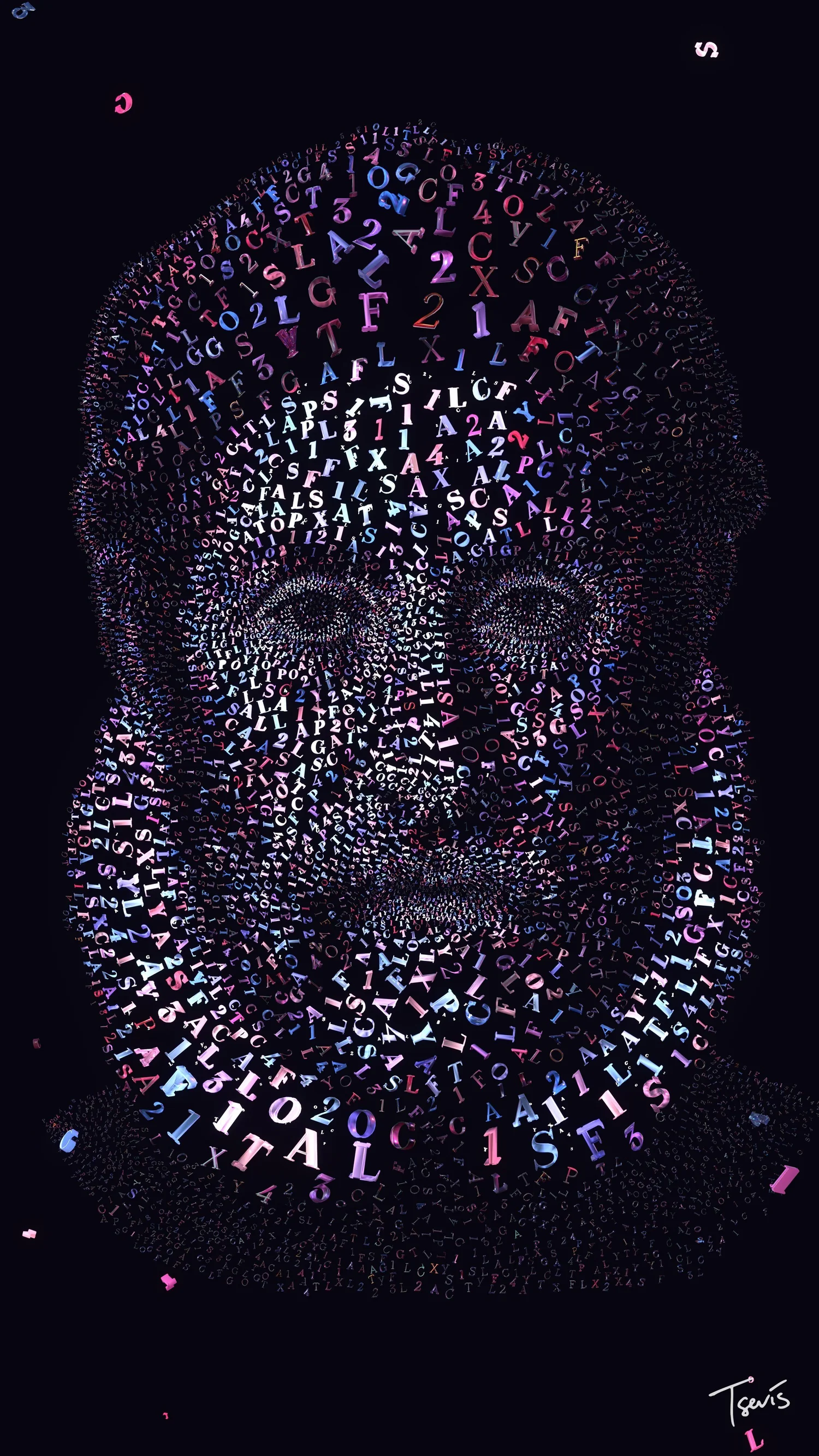
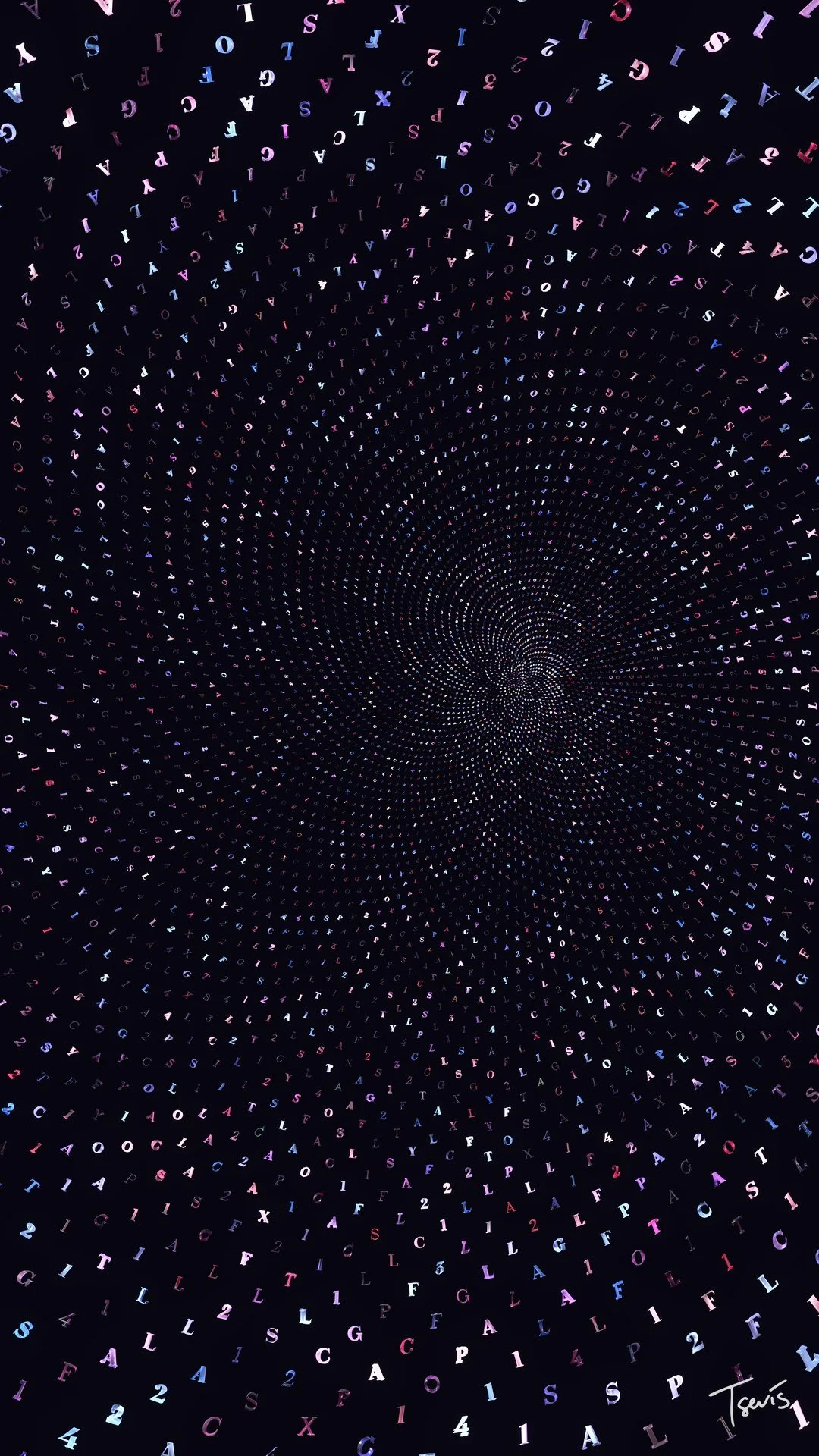
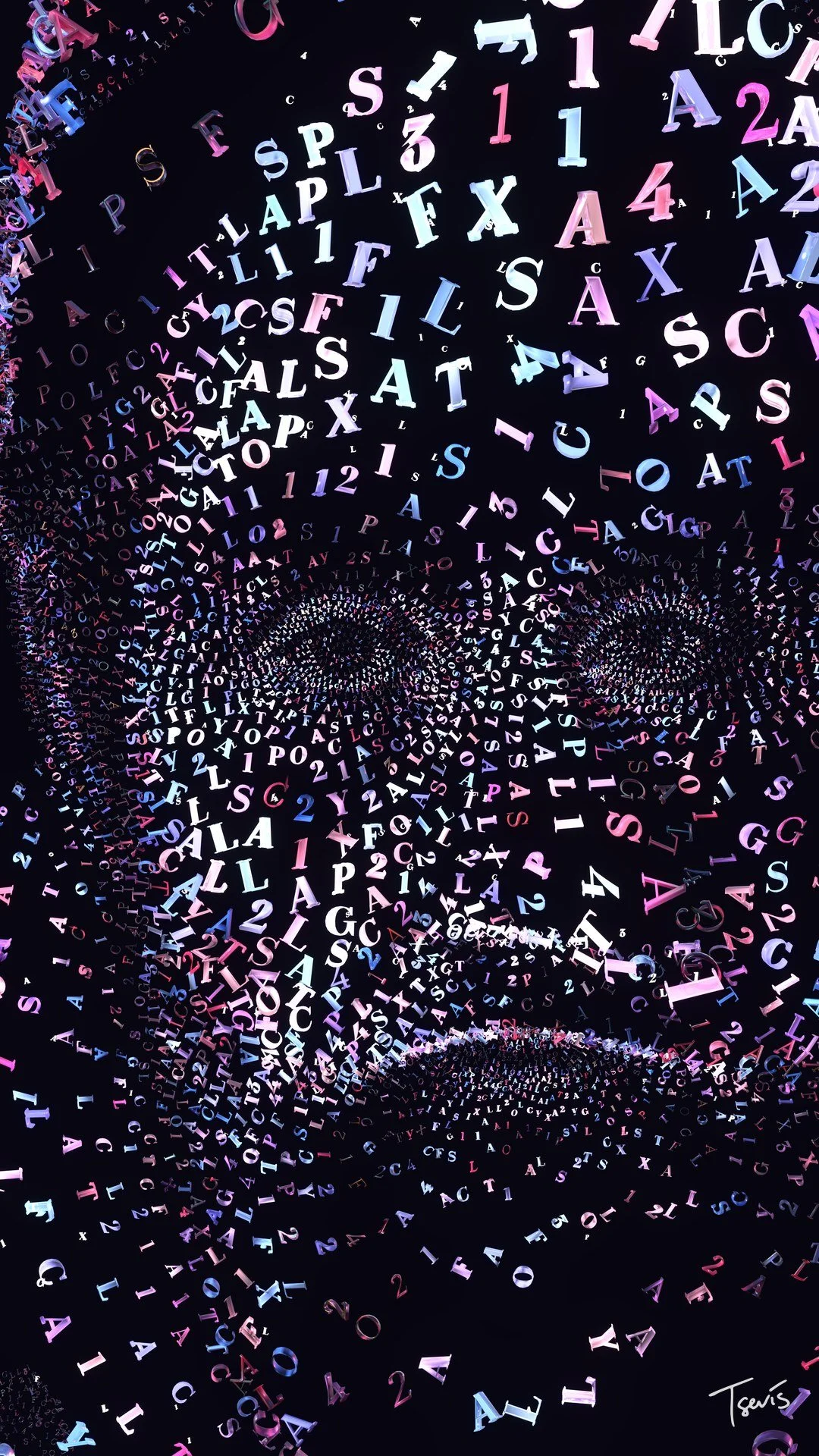
Giuseppe Arcimboldo built heads out of fruit, vegetables and flowers. Here his head is built of letters and numerals that are born one by one like the buds of a romanesco, form a funnel, and then fly into his face, which exists from one point in space only.
The question
Arcimboldo made faces that are really something else: a gardener who is a heap of vegetables, a summer made of fruit. You see the face and the pile at once. We asked what happens when the pile is writing, and when the face can be seen from a single place and falls apart everywhere else.
The letters come from the plant that suggested the growth. They are the names of the genes that make a cauliflower — LFY, AP1, CAL, TFL1, SAX, SOC1, AGL24 — and their digits.
The mathematics
A romanesco puts each new bud a fixed turn, 137.5°, the golden angle, from the one before, and each new bud pushes the older ones outward (Douady and Couder, 1992). The buds also come faster and faster, and the spirals appear without being drawn (Azpeitia and colleagues, 2021). The film starts from that rule: letters are born one by one at the same point, the old ones grow as they age and travel outward, and the birth rate rises.
Then the rule is turned into a picture. The letters leave the funnel and each one goes to its place in the face along a ray from one camera position, at a depth of up to 2.3 metres. This is an anamorphosis: the depth of the face decides the size of every letter, nearer is larger, so that from that one point the sizes add up to a face. From the side it is a cloud of letters. For the last ten seconds the camera moves forward and the face opens up through perspective alone, until the way ends in the left eye.
The mosaic
The face holds 5,860 letters and numerals, from 4.6 to 65 pixels at 1080 wide, with 50 more drifting around it. The smallest draw the eyes, the lips and the nostrils. The letters follow the forms: they turn around the eyes, run along the nose, and stand like pleats on the collar. They are set in PF Armonia, all twelve styles, and the weight follows the tone. Each point of a letter takes the tone of the portrait behind it, so the large letters do not wipe out the face.
The materials are opaque, translucent and clear, in burgundy, blue, violet and pink on black. When two letters come close enough to touch, a small arc lights up for one frame. The source is Arcimboldo’s own pen and wash self-portrait of the 1570s in the National Gallery in Prague, in the public domain, which we edited.
At a glance
- Subject
- Giuseppe Arcimboldo and the heads he built from other things
- Rules
- Phyllotaxis at the golden angle, with births that speed up (Douady and Couder, 1992; Azpeitia and colleagues, 2021); anamorphosis from one camera position
- Tiles
- 5,860 letters and numerals in the face, 4.6 to 65 px at 1080 wide, plus 50 drifting; the names of cauliflower genes and their digits
- Marks
- PF Armonia, all twelve styles; weight follows the tone of the portrait
- Portrait source
- Arcimboldo, self-portrait, 1570s, pen, brush and wash, National Gallery Prague; public domain, edited by us
- Film
- 38 s, 9:16, 30 fps, 1,140 frames; begins and ends in black
- Render
- Blender 5.2.3, Cycles, with clear glass: the same render for the film and the stills
- Sound
- A custom mix of machine-generated samples created with MiniMax Music 3 and Claude Code: eerie ambient trip hop at 85 bpm in D minor
- Stills
- 3240 × 5760 px; layered PSD and flat TIFF in the studio archive
Bloch: an angelfish that grows his face
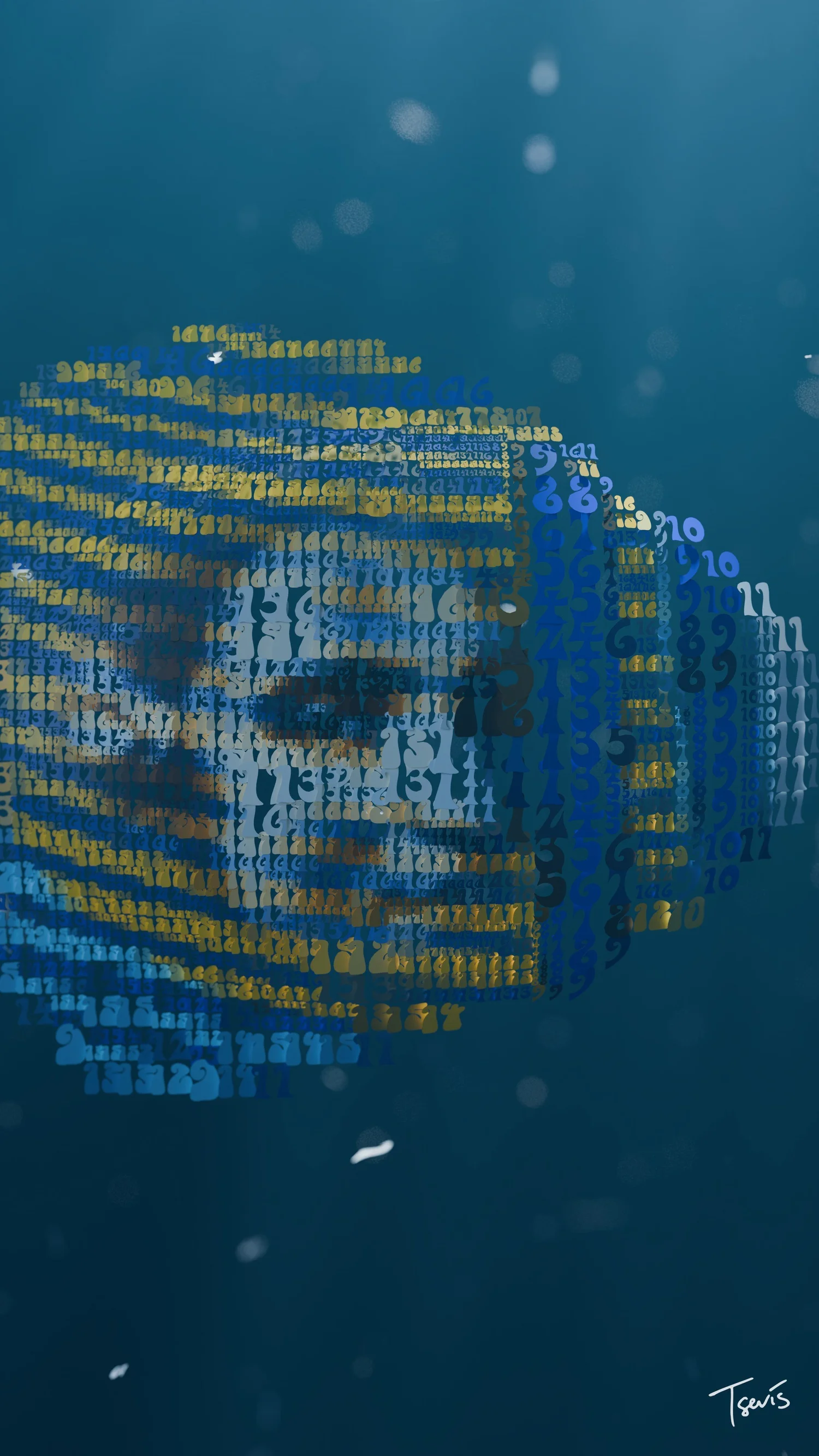
In 1787 the Berlin physician Marcus Elieser Bloch named a reef fish with yellow stripes on deep blue imperator: the emperor angelfish. Two centuries later Shigeru Kondo and Rihito Asai showed that its stripes behave as Alan Turing had predicted: as the fish grows, a new stripe opens between two old ones and the spacing stays the same.
The question
A growing animal has to keep its pattern. A fish ten times larger does not have stripes ten times wider: new stripes are added so that the spacing stays. Kondo and Asai watched this on living angelfish in 1995, and showed that the stripes move and split like the waves of Turing’s equations. Crampin, Gaffney and Maini modelled the same stripe-splitting in 1999.
The mathematics
Two chemicals diffuse and react: the Gray–Scott system, which makes stripes, spots, mazes and rings depending on two numbers, the feed and the kill rate. We take the regimes from Robert Munafo’s atlas of the system. The field it runs on grows by cell division, which is how the new stripes open as the fish gets larger.
The mosaic
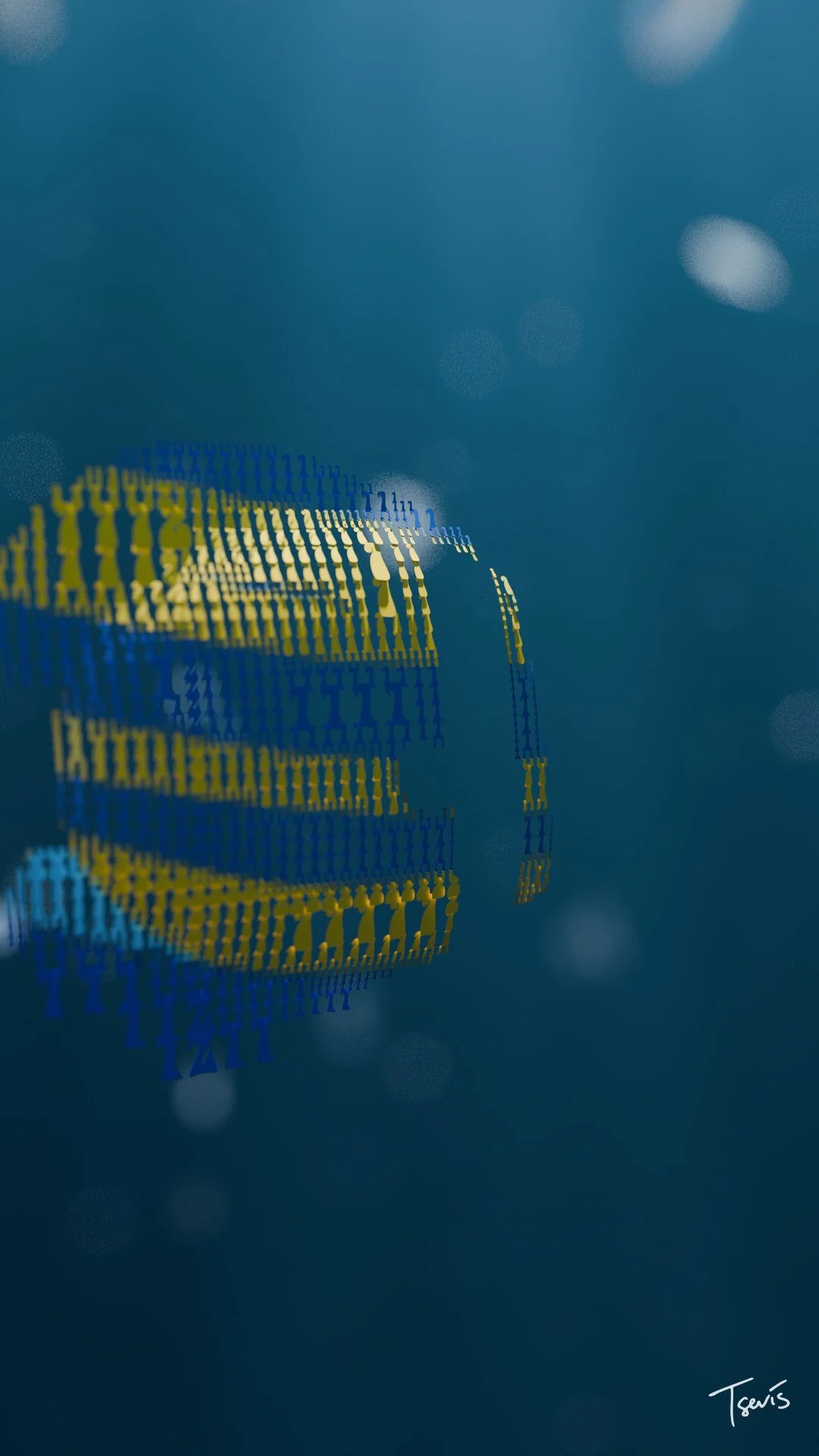
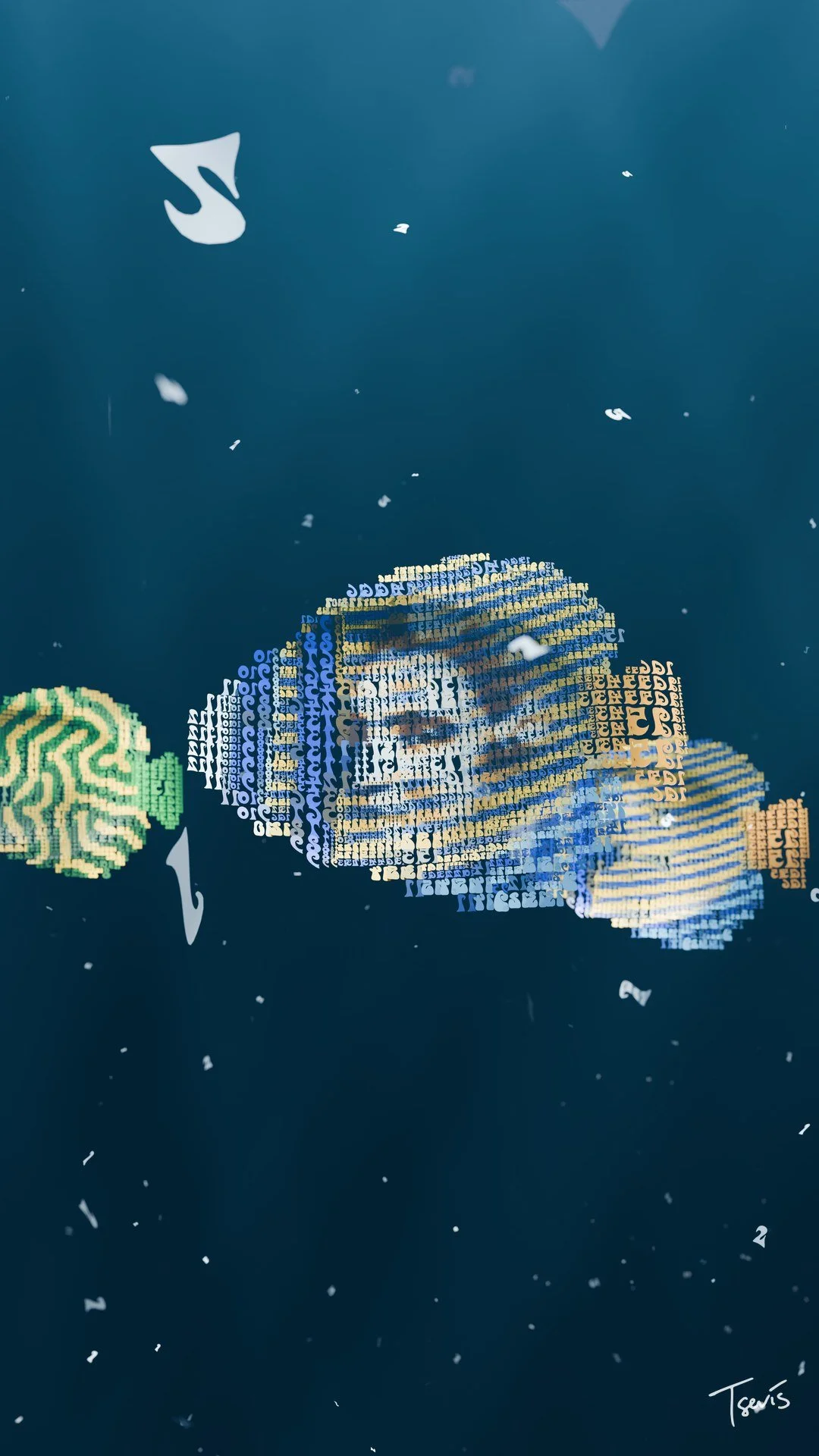
The fish grows from a single scale. Its body carries 2,438 scales, each a numeral set in PF Psychedelia, and the numeral is the week the scale was born. The skin is a relief, and Bloch’s face, taken from an oil painting of about 1780, shows only when the flank turns to face the viewer. Then the fish swims into a school patterned by the same equation, as spots, mazes and rings. The film runs 60 seconds, with sound, and is rendered in Blender.
At a glance
- Subject
- Marcus Elieser Bloch (1723–1799) and the emperor angelfish, Pomacanthus imperator
- Rule
- Gray–Scott reaction–diffusion on a growing field; stripe splitting after Kondo and Asai (1995)
- Tiles
- 2,438 numeral scales on the body, each the week it was born
- Portrait source
- An oil painting of about 1780, public domain
- Film
- 60 s with sound, 1080 × 1920 (9:16), 30 frames per second
- Sound
- Written in code, no samples: the sea, a chord of stacked fifths, a glass drop for every growth step, the beat of the tail
- Stills
- 3240 × 5760 px; layered PSD and flat 16-bit TIFF in the studio archive
Margulis: a glass box that stirs her face away and gives it back
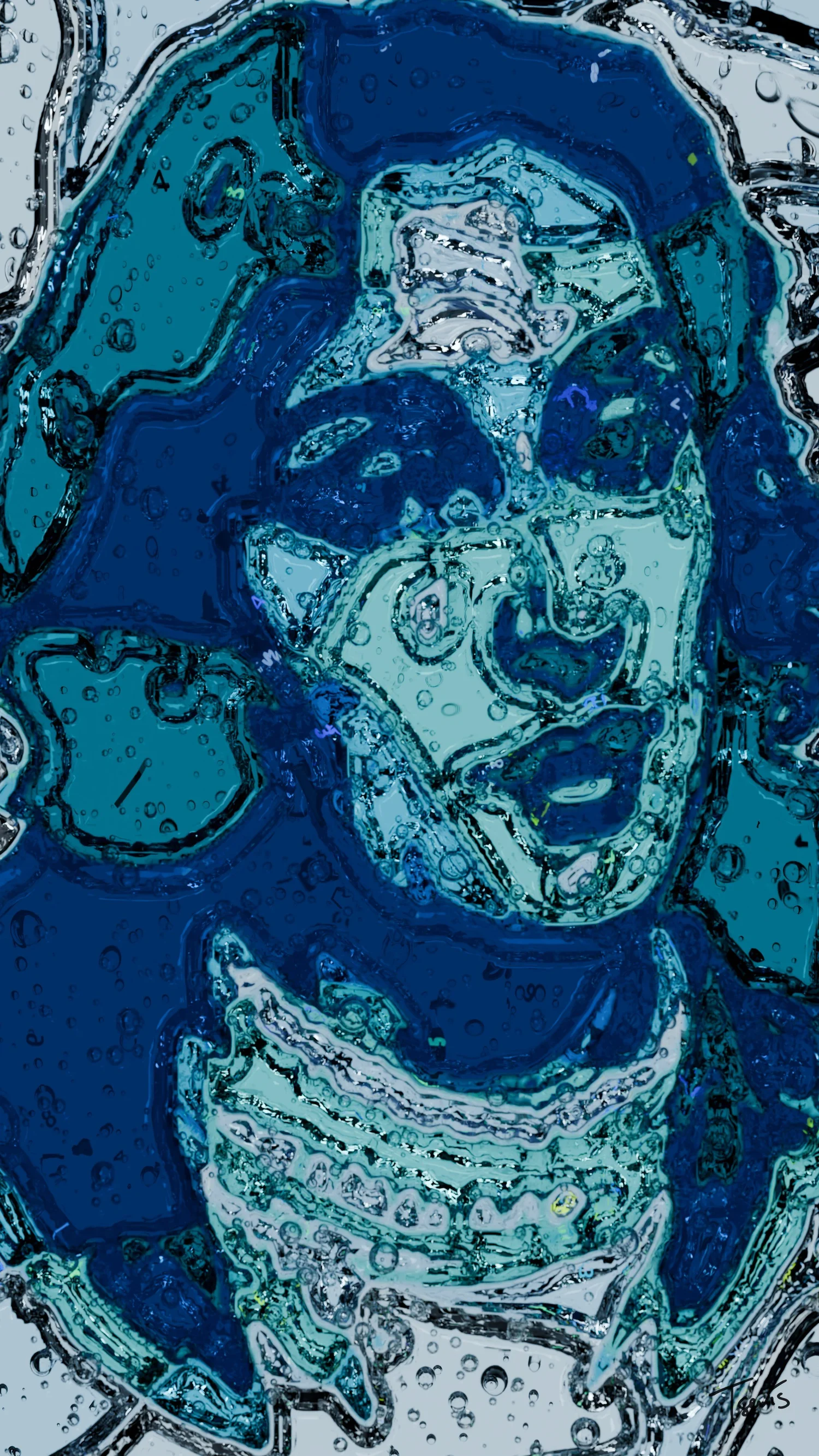
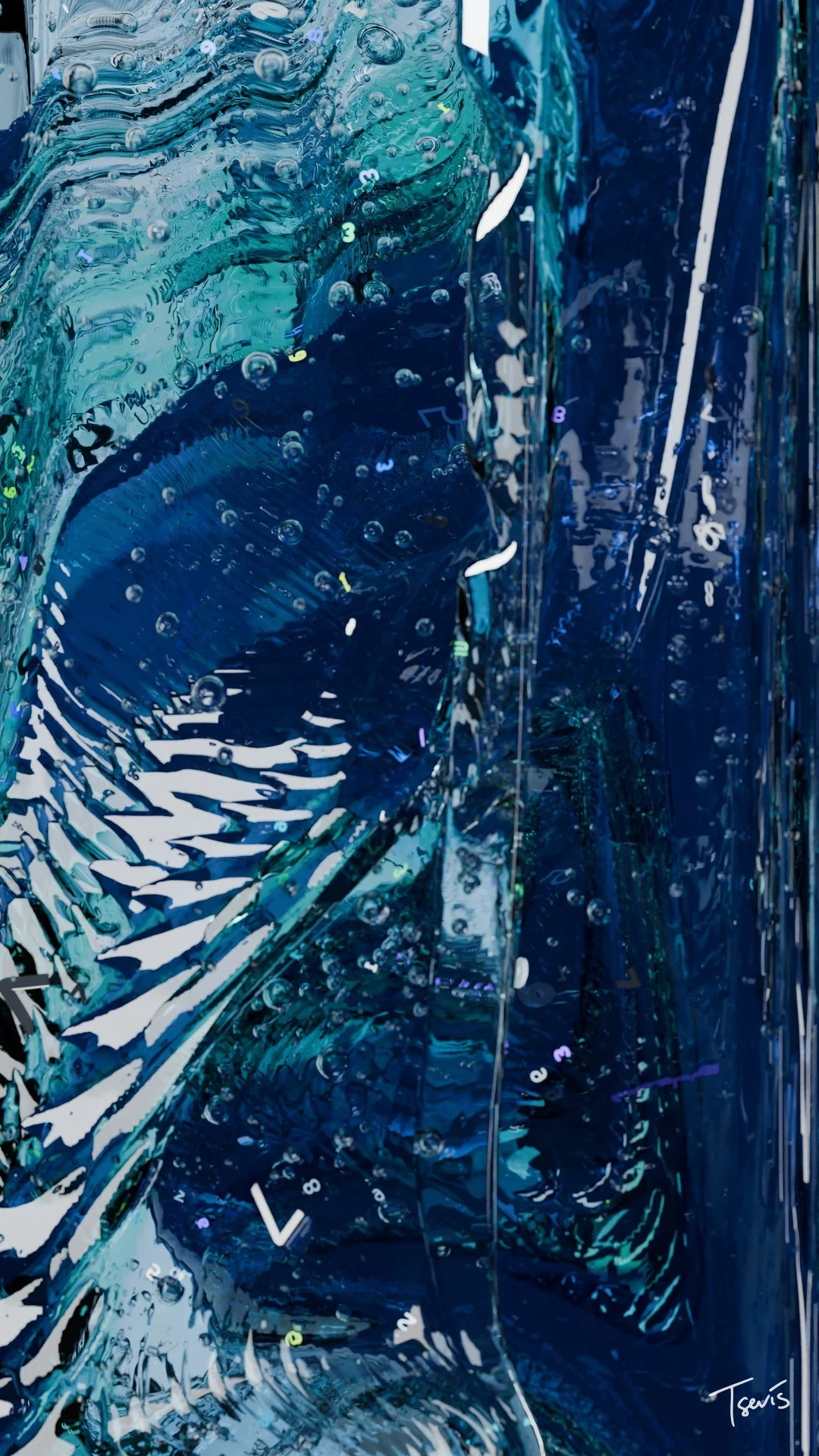
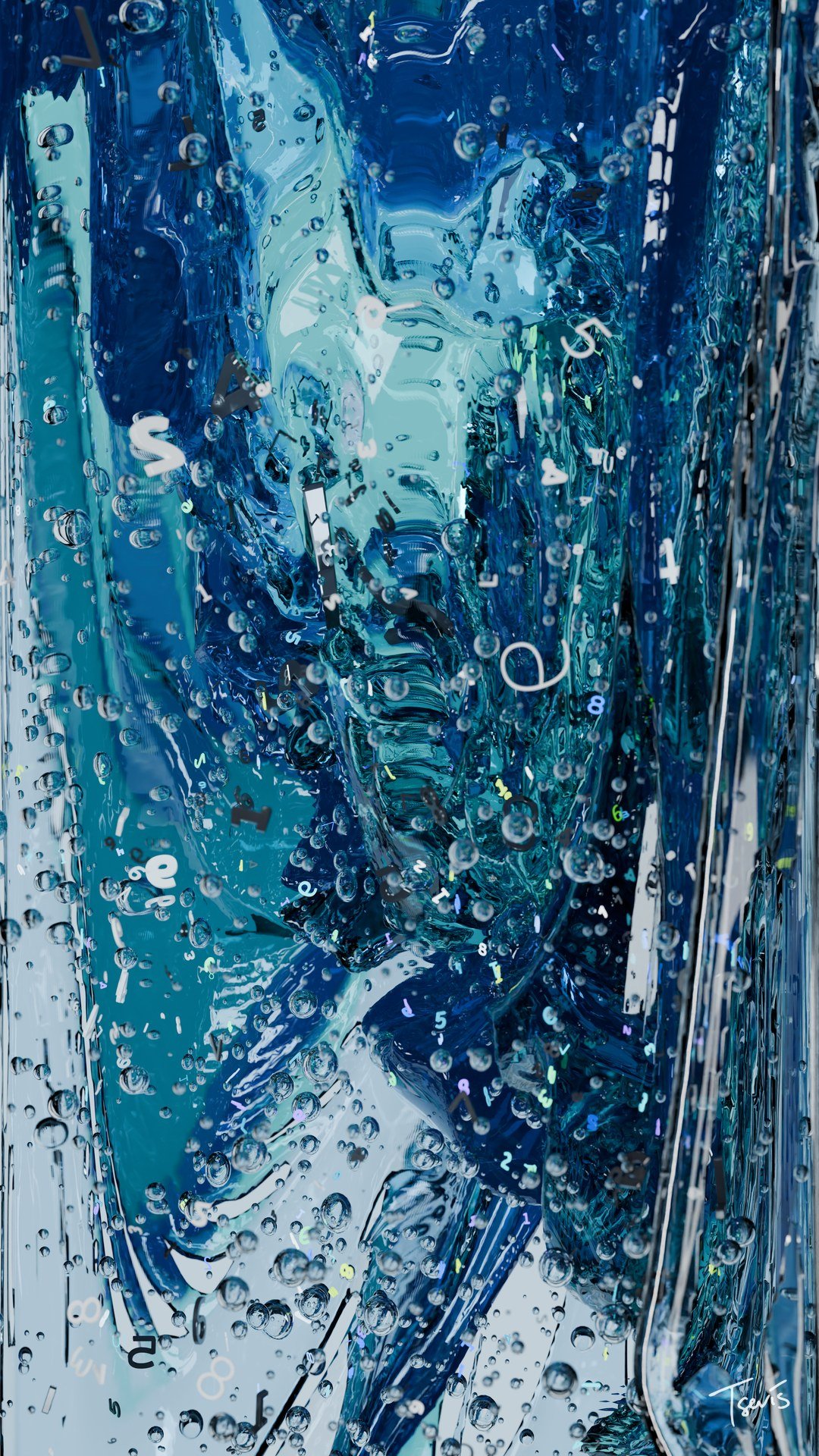
Nobody drew this. Liquids that do not mix make the face of Lynn Margulis inside a glass box. Moving walls stir them until the face is gone, and when the walls run back the same way, the face comes back exactly.
The question
Lynn Margulis (1938–2011) argued that life is built from living together. The mitochondria and the chloroplasts of our cells were once free bacteria that entered other cells and stayed (“On the origin of mitosing cells”, Journal of Theoretical Biology, 1967). We wanted a picture of that idea: liquids that share one space without losing their identity, and a form that comes back out of the chaos.
The question the film asks is a physical one. Can a face be stirred away completely and then returned, without being drawn again?
The mathematics
In a very thick liquid, such as glycerine or honey, inertia plays no part, and the motion follows the Stokes equations, which are linear and contain no time. Two things follow. The flow at any moment depends only on how the walls move at that moment, so slow motion and braking in the film are only the pace at which we walk the same path. And the flow is reversible: if the walls run back along the same path, every drop returns to its place. G. I. Taylor showed this in 1966 with dye in glycerine that “unmixes”. The face does not return because we paint it again. Physics gives it back.
The glass box is square from above, 0.5625 wide and deep and 1 high, so that each side is a 9:16 window. Its six walls are covered with a grid of regularized Stokeslets (Cortez, Fauci and Medovikov, 2005), points that each push the liquid, and a linear system is solved once so that the liquid next to the glass moves exactly like the glass (the no-slip condition). Twelve belt motions, the lid and the floor in two directions and each side wall up, down and sideways, give twelve fixed flow fields, and any programme of belts is a weighted sum of them.
There are two stirrings. In A, a great vortex whose axis turns, the lid and the floor slide against each other while the front and back walls turn the liquid over in depth, and the sheet of the face folds through the whole volume. In B, opposite walls run up and down out of phase while all the liquid spins, and tall columns wind around one another. A map of where every point came from is followed backward from frame to frame, so each point of the box knows its first place in the face, and so its colour and thickness.
The mosaic
Here the mosaic is poured and not cut. The liquid is a glass material, coloured by the eight tone bands of the portrait in cool colours: deep navy, cobalt, turquoise, aqua, jade and pearl. In the darkest places it keeps a faint deep blue glow, so its folds are never quite black. Glass numerals in PF Beau Sans Pro, all eight upright weights from XThin to Black, drift in the flow. They are flat bodies, and the flow carries them and also turns them, as G. B. Jeffery showed in 1922 for a particle in a thick liquid, so they flip over now and then and catch the light. White numerals sit only in the brightest places and black ones only in the deepest shadows, and there are few of them. Small coloured glass numerals and bubbles sit at the edges of the liquids.
The film is a loop of 48 seconds. The box turns four times by 90°, and on each side we see another motion: front, right, back, where the face is mirrored through the glass, left and front again. Stirring A starts at the face, reaches its peak at 18 seconds and returns to the face from behind at 26. Stirring B starts there, peaks at 40 and comes back to the face at 48, which is also the start of the loop. The camera draws a small figure eight, three times, and never stands still.
The sound is not written in notes. It is built from the film’s own timeline in five layers that all loop: a deep drone and the roar of water that follow the speed of the stirring, a current of filtered noise that rises in pitch with it, narrow bands around the harmonics of a drinking glass whenever the box turns, bubbles that rise slightly in tone as they fade, and a breath for the face with a deep beat and a glass chord at the moment it locks. Twice, 2.5 seconds before the face locks, a woman’s a cappella voice without words enters in C minor, like the chord.
At a glance
- Subject
- A portrait of Lynn Margulis, made by liquids in a glass box that are stirred away and returned by reversing the flow
- Rules
- Stokes flow with regularized Stokeslets and no-slip glass walls that move as belts (Cortez, Fauci and Medovikov, 2005); reversible stirring after G. I. Taylor (1966); numerals turned by Jeffery orbits (Jeffery, 1922)
- Liquid
- Eight tone bands in cool colours, refractive index 1.46, in water of 1.33; 12 belt motions, two stirrings A and B
- Marks
- Glass numerals and bubbles; PF Beau Sans Pro, all eight upright weights, XThin to Black
- Film
- 48 s, 9:16, 1080 × 1920 (master 1620 × 2880), 30 fps, 1,440 frames; a loop from the face back to the face
- Render
- Blender 5.2.3, Cycles; 32 samples a frame for the film
- Sound
- Generated from the film’s own timeline: water, current, glass, bubbles, and a breath for the face. The a cappella voice is machine-generated with MiniMax Music 3
- Stills
- 3240 × 5760 px, 128 samples, at 18.7, 26.0 and 40.0 seconds; layered PSD and flat TIFF in the studio archive
Kepler: a snowflake that forms as it falls
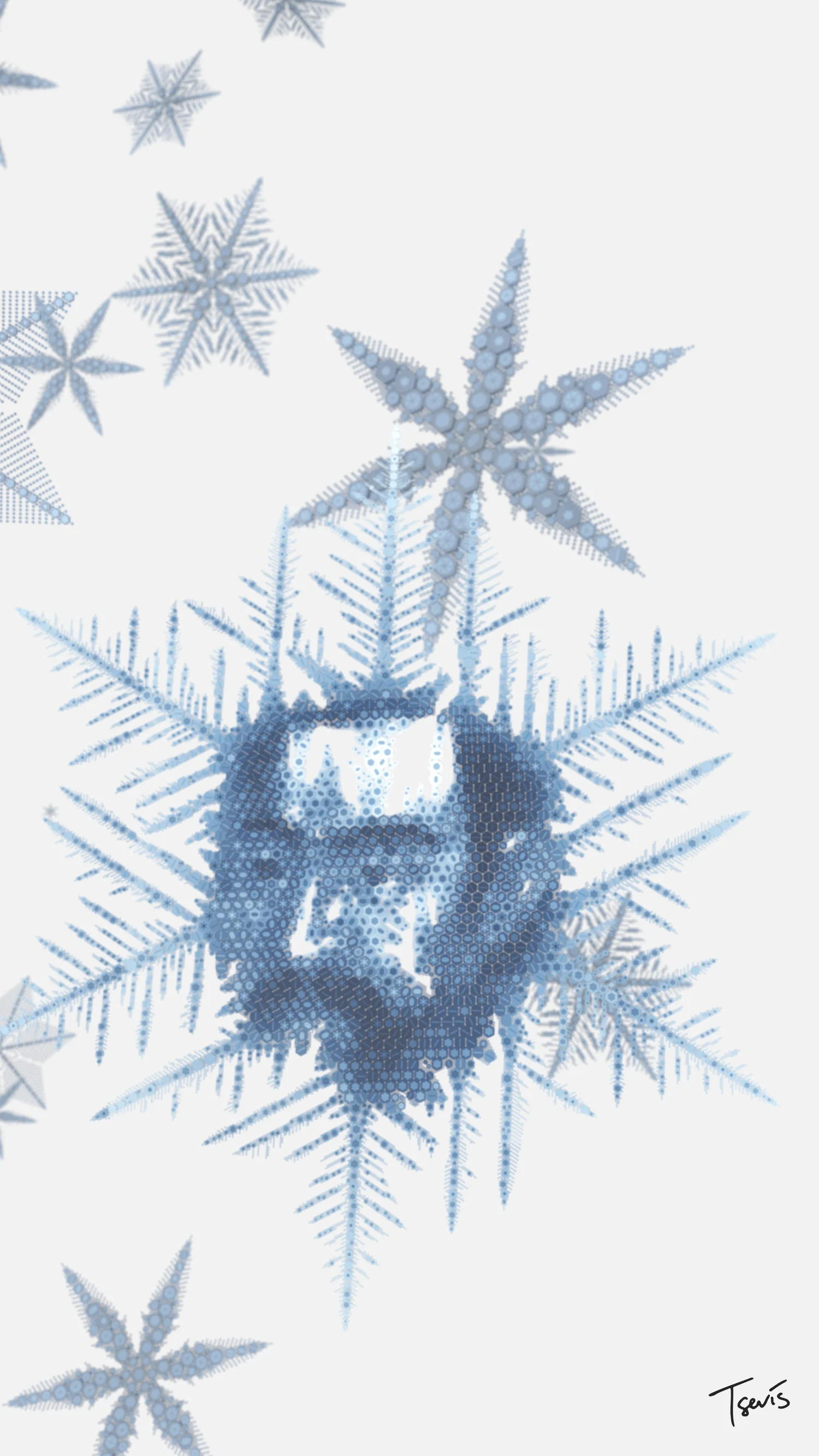
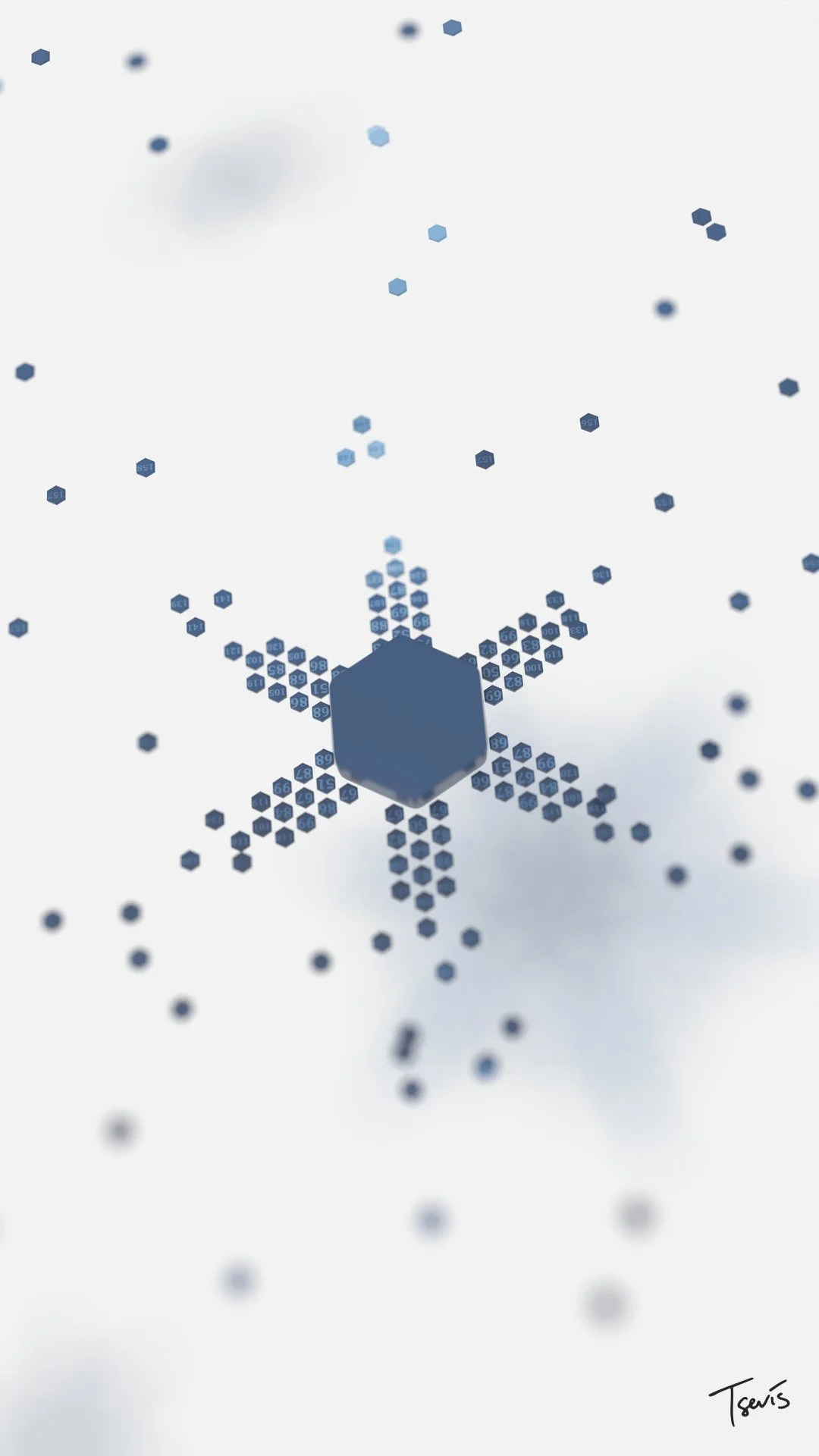
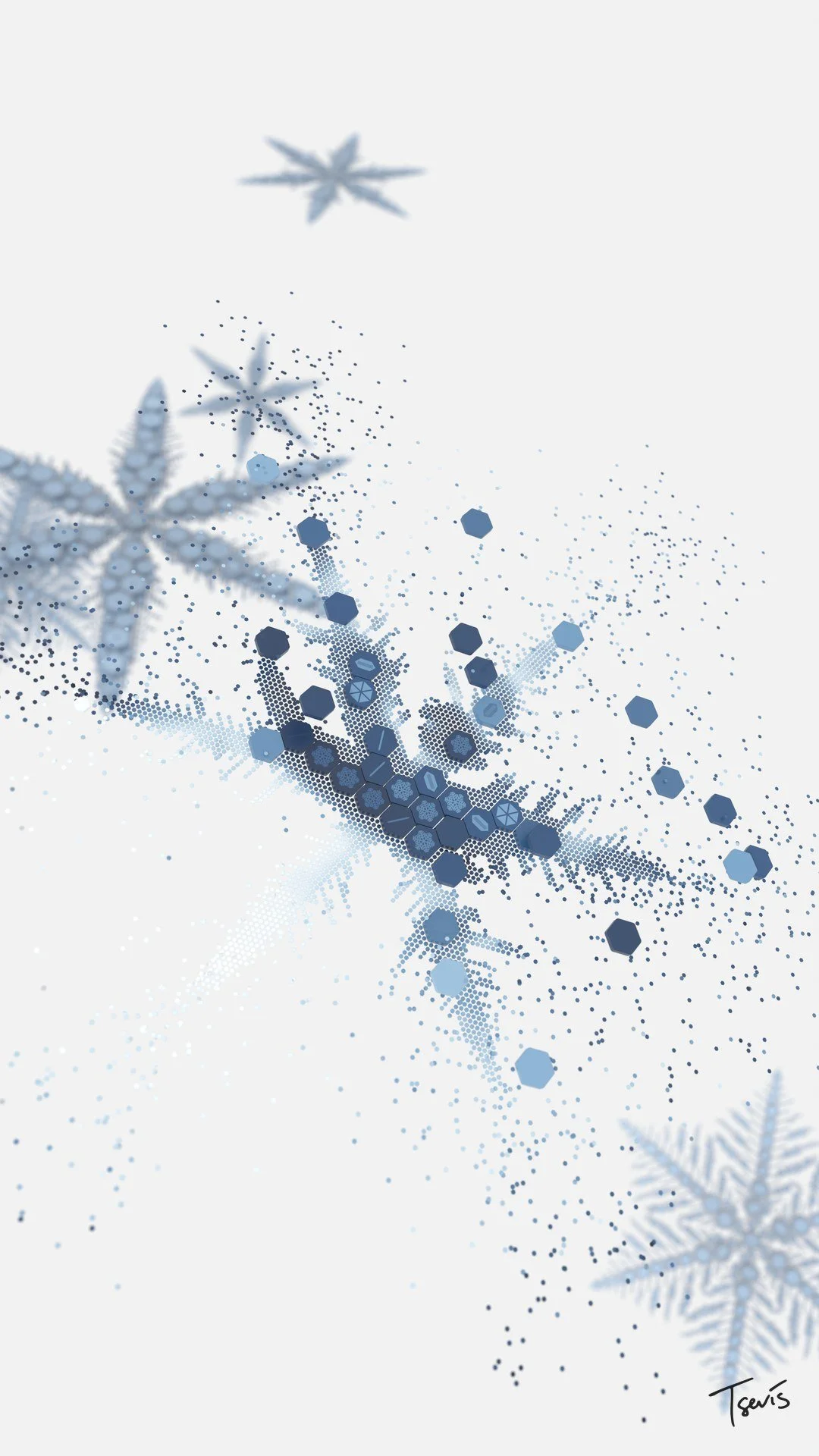
In 1611 Johannes Kepler asked why a snowflake has six corners. Here his portrait is the answer in motion: a crystal grows by a simple rule while it falls, and every tile of the mosaic carries the number of the step at which it froze.
The question
In 1611 Kepler gave his patron a small book as a New Year’s gift, On the Six-Cornered Snowflake. He turned the problem over, stacked spheres, honeycombs, the seeds of a pomegranate, and did not reach a final answer. The shortest honest answer today is a growth rule.
The mathematics
Clifford Reiter’s 2005 cellular model lives on a hexagonal grid. A cell is part of the crystal, next to it, or open air. Vapour diffuses through the air, and a cell next to the crystal collects it and freezes once it holds enough. A few parameters, such as the background level of vapour, decide whether a flake grows plates or branches. Every cell has six neighbours, so the six corners are not drawn: they follow.
The mosaic
The finished crystal is Kepler’s portrait, taken from a 17th-century painting. Its 18,156 hexagonal tiles are packed greedily from larger to smaller, and each carries the number of the step at which its last cell froze. In the film the tiles travel in from the air and freeze onto the flake among other flakes, the camera follows the birth of the portrait and then closes on the finished face. The film is a 40-second loop.
At a glance
- Subject
- Johannes Kepler (1571–1630) and the six-cornered snowflake
- Rule
- Clifford Reiter’s hexagonal cellular model of snow crystal growth (2005)
- Tiles
- 18,156 hexagons in the portrait; each carries the step at which it froze
- Marks
- Numerals in PF DIN Text Comp Pro
- Portrait source
- A 17th-century painting, public domain
- Film
- 40 s seamless loop, 1080 × 1920 (9:16)
- Stills
- 3240 × 5760 px; layered PSD and flat 16-bit TIFF in the studio archive
Cajal: a neuron that grows his face
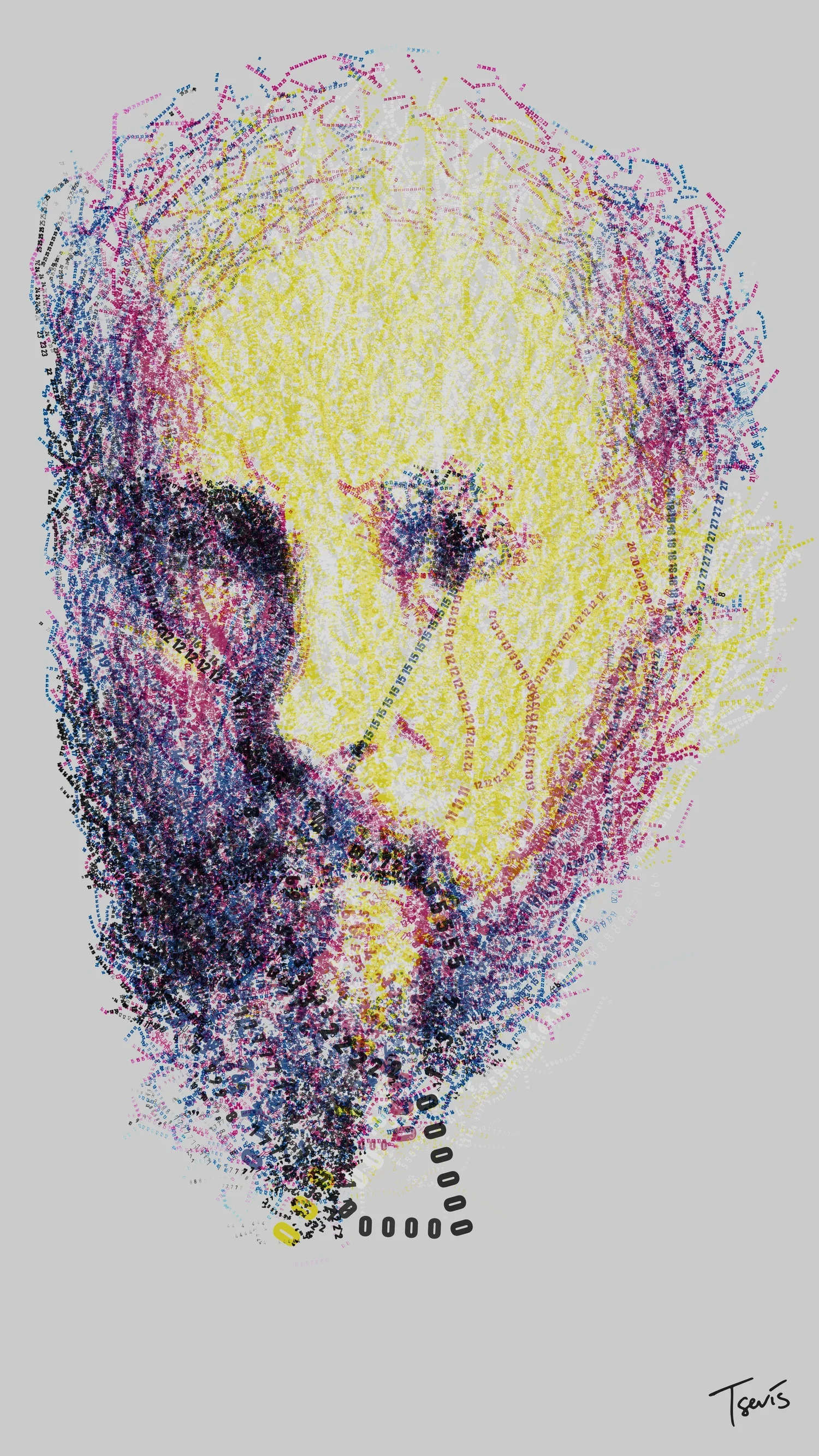
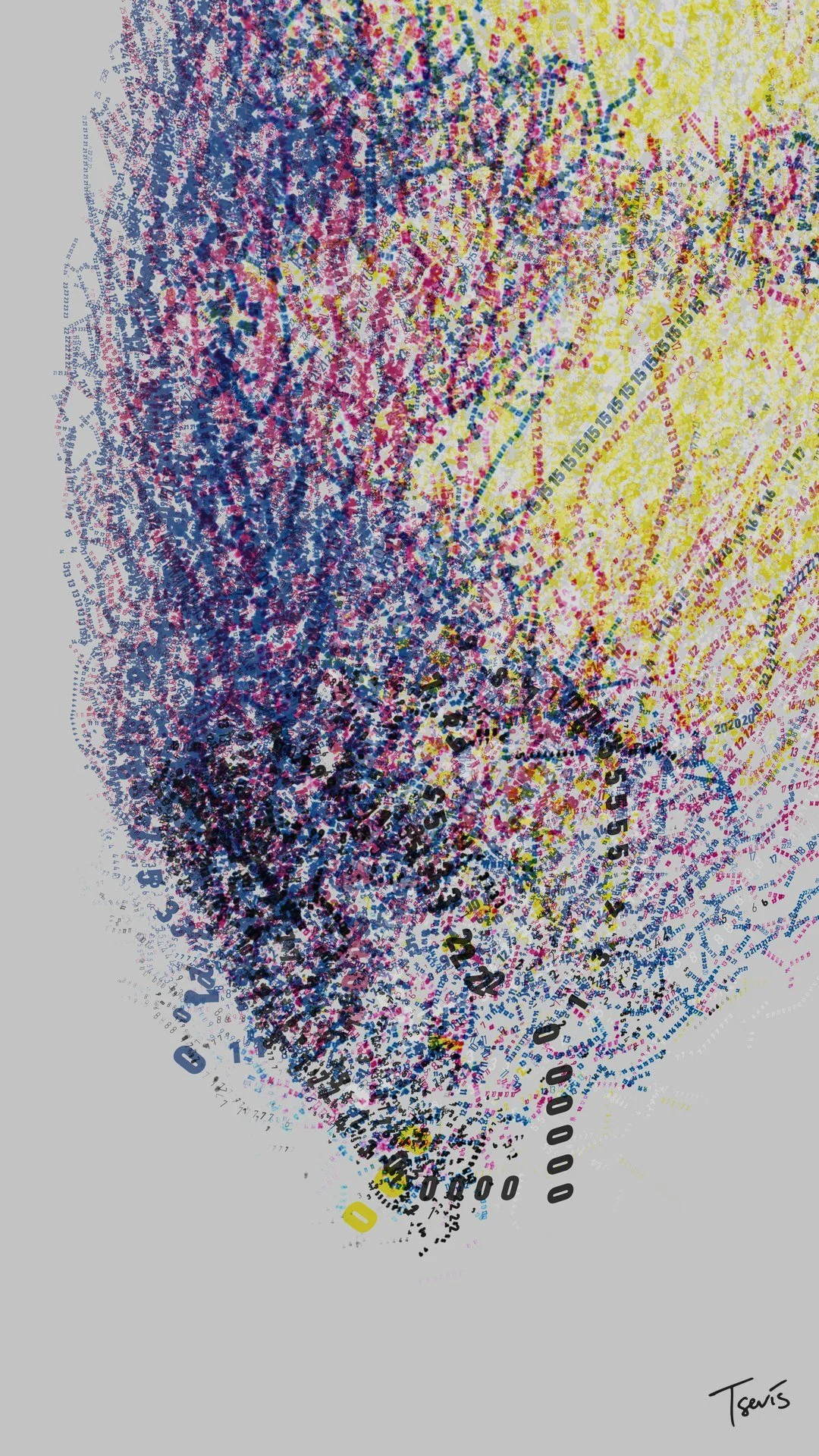
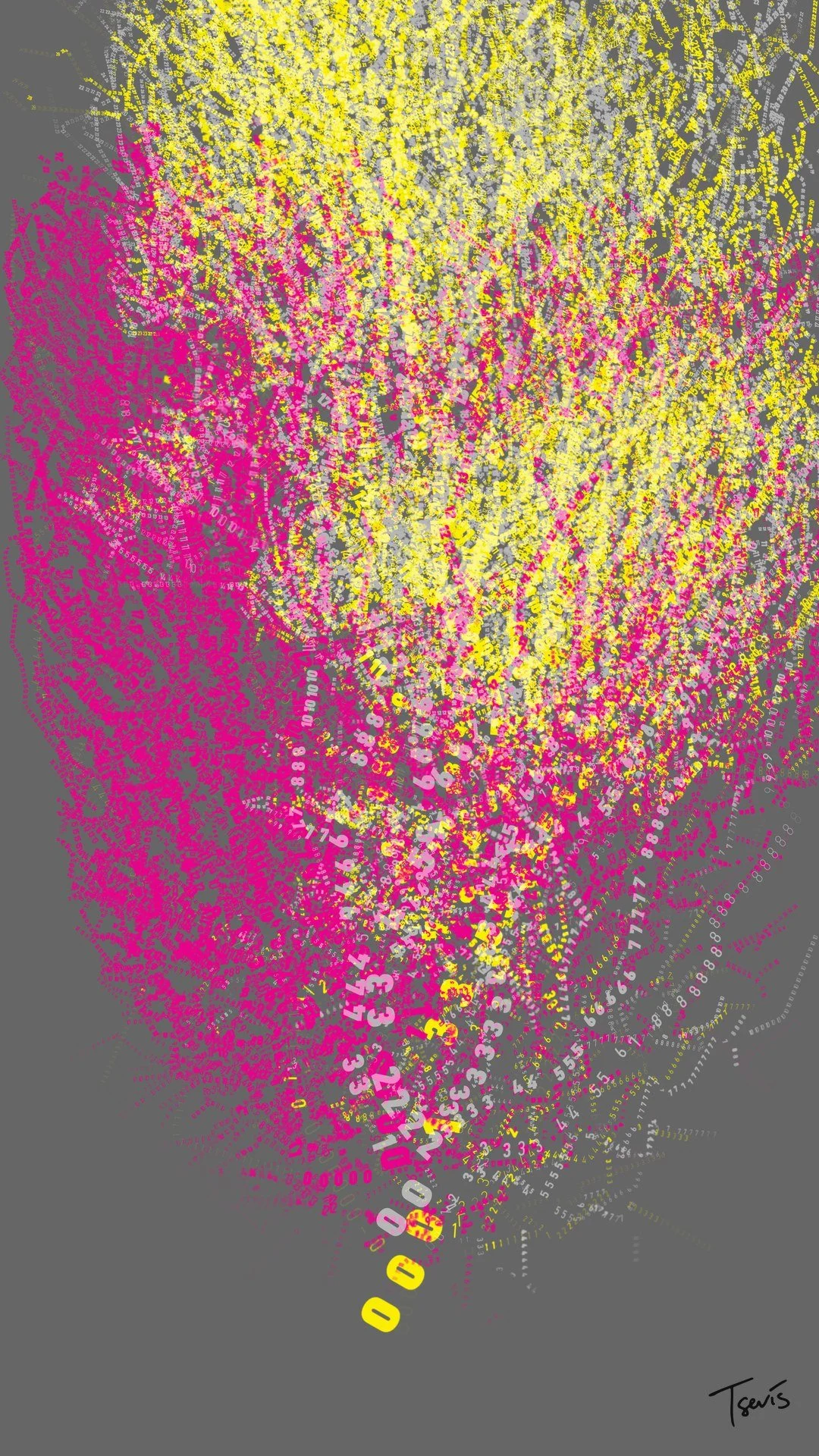
Santiago Ramón y Cajal drew the cells of the brain and stated two laws for their shape: spend as little wire as possible, and keep every path to the cell body short. Here those two laws grow his portrait, from five neurons, one for each ink.
The question
Cajal (1852–1934) saw that the branches of a nerve cell are not scattered at random. They save material, which means less total length of wire, and they save time, which means a short way from every tip to the cell body. A neuron has to balance the two, and that balance gives it its form.
The mathematics
We run the model of Cuntz, Forstner, Borst and Häusser (2010), “One rule to grow them all”. The dendrites are a minimum spanning tree with a balancing factor, here 0.5, between the total length and the path length to the soma. Target points are spread through the head. Each target joins the tree at the node where its new branch plus 0.5 times its path to the soma costs least. Targets enter from the nearest to the farthest, with a little chance, so the tree spreads like a front. That path length is also the time of the film: a branch appears when the growth reaches it.
The mosaic
The tree grows in three dimensions inside a slab 100 mm deep and prints the portrait when seen from the front; when the camera turns, the volume shows. The source is a black-and-white photograph of 1899, taken at Clark University, public domain. We split it into cyan, magenta, yellow and black with the macOS Generic CMYK profile, and add white as a fifth ink, a veil over the lightest parts of the face. Each ink has its own tree, and the five trees start close together at the knot of the bow tie, at different depths, so that they tangle. The finished portrait holds 117,944 numbers. Each is the centrifugal order of its branch, the number of branch points it has passed since the soma, with 0 for the trunk. Rows of numerals follow the branches, flat and turned along them; their size follows the thickness of the branch and their weight the density of the ink under them.
At a glance
- Subject
- Santiago Ramón y Cajal (1852–1934) and the shape of the neuron
- Rule
- Cuntz, Forstner, Borst and Häusser (2010): a minimum spanning tree balancing wire length and path length
- Tiles
- 117,944 numerals in five inks: 24,649 white, 26,026 yellow, 29,848 magenta, 24,114 cyan, 13,307 black
- Marks
- Numerals in PF DIN Text Cond Pro, Hairline to XBlack; weight follows the density of the ink
- Portrait source
- A photograph of 1899, Clark University, public domain; digital restoration on Wikimedia Commons
- Film
- 36 s seamless loop with sound, 9:16, published at 1080 × 1920
- Sound
- Written in code: a chord rooted at 196 Hz with bells, 975 of them
- Stills
- 3240 × 5760 px; layered PSD and flat TIFF in the studio archive
Graham: a face found by copying and selecting
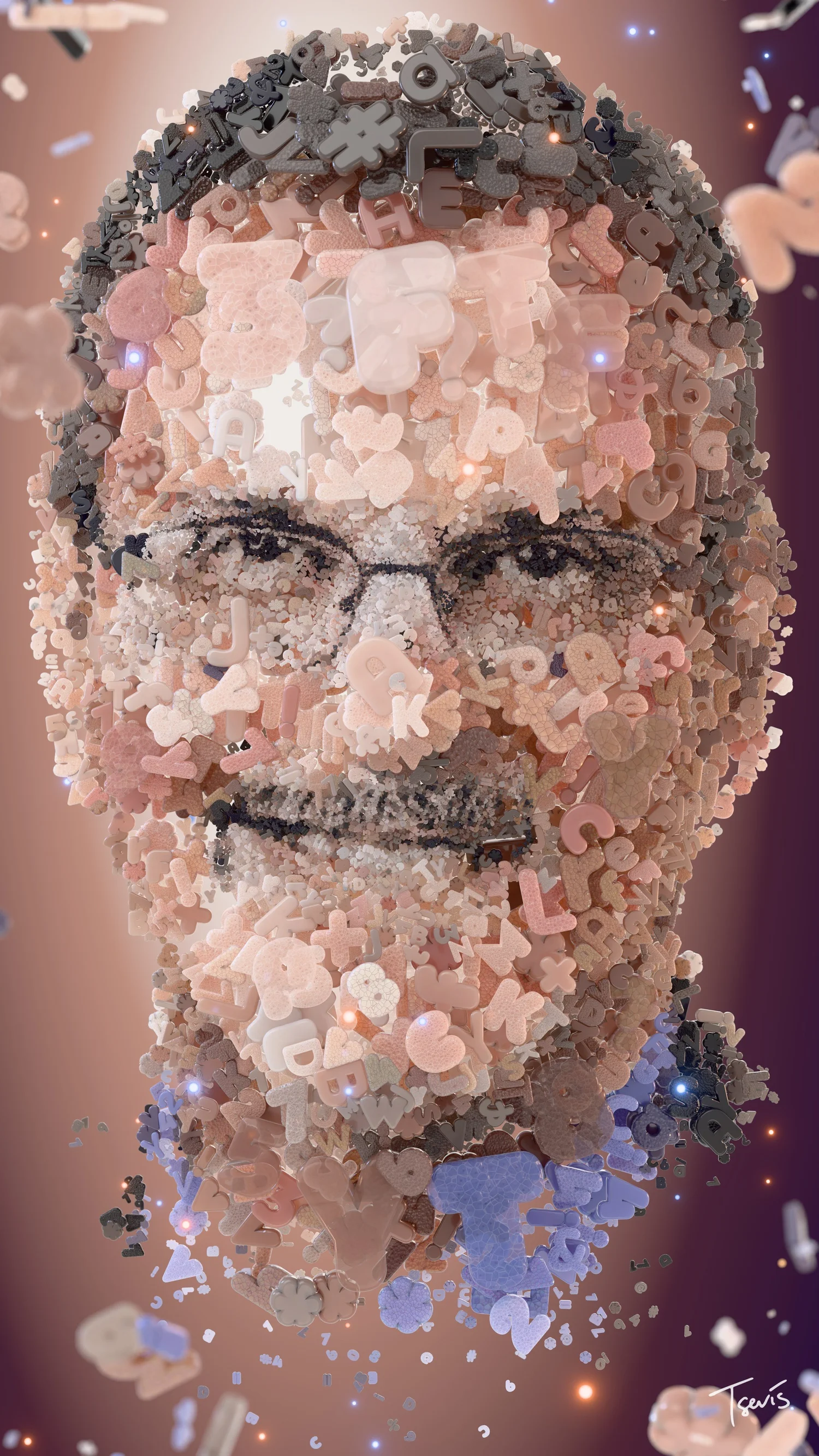
Nobody drew this face. One letter is copied, a copy may change by one small step, and only the copies that fit a place in the picture stay. Repeat it 337 times and a portrait of Barney S. Graham is what was left.
The question
Can a picture be found instead of drawn? Take one letter and copy it. Let some of the copies change by one small step: the next colour, the next letter, the next weight. Try every copy against the places that are still empty, keep the ones that fit exactly, and let the others drift away. Repeat, and see whether a face appears.
We chose the face of Barney S. Graham. The cycle of copying, varying, trying and selecting follows a published model of cyclic re-entry (Kepler and Perelson, 1993), reduced here to a schematic rule. No biological data and no biological sequence is used, and the piece makes no claim about biology.
The mathematics
The photograph is divided into 8,524 places. Each place asks for one shape: a colour from the palette, a letter or sign, and a weight of the typeface. Each candidate carries one such shape. One round has four steps. Copy: every candidate that was kept becomes two. Vary: every copy, with a probability of one in two, changes by one step. Try: every copy is measured against the open places, by how many steps it is away from what they ask. Select: a copy that matches a place exactly sits there and stays, and it is a tile of the mosaic. Of the rest, every empty place keeps the four copies nearest to it, and the others are lost.
A place opens only when the larger letters that cover it have been set. So the face is found from coarse to fine, and the eyes, the glasses and the mouth come last. That order was not designed. It is what the selection left.
The run started from 102 founding letters, and all 8,524 places were filled in 337 rounds. At a typical place, 28 copies failed before one stayed (the median), and at the hardest place 2,401 did. 98 of the 102 founders have descendants in the finished mosaic. The film shows only a small part of the copies that were lost.
The mosaic
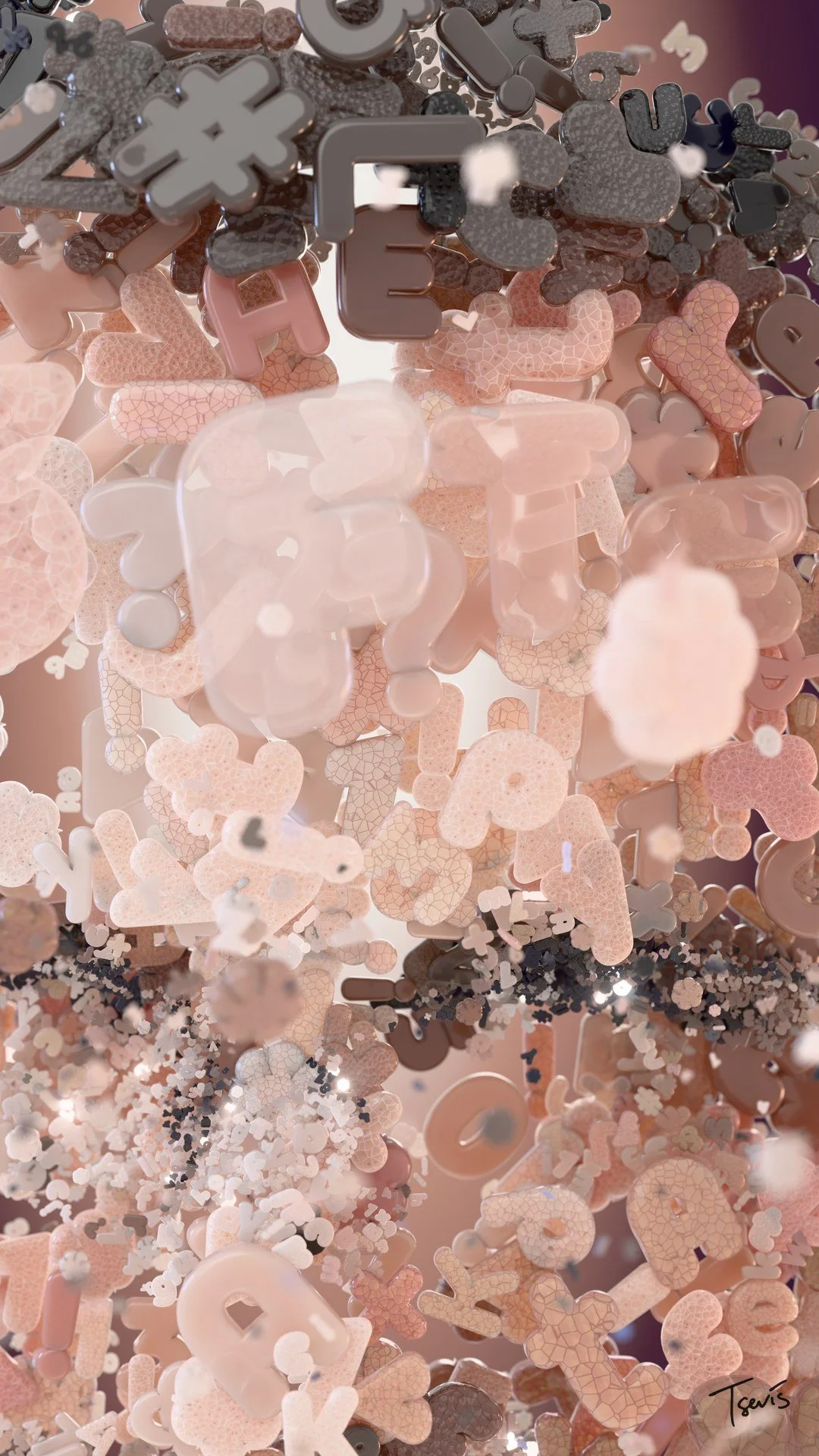
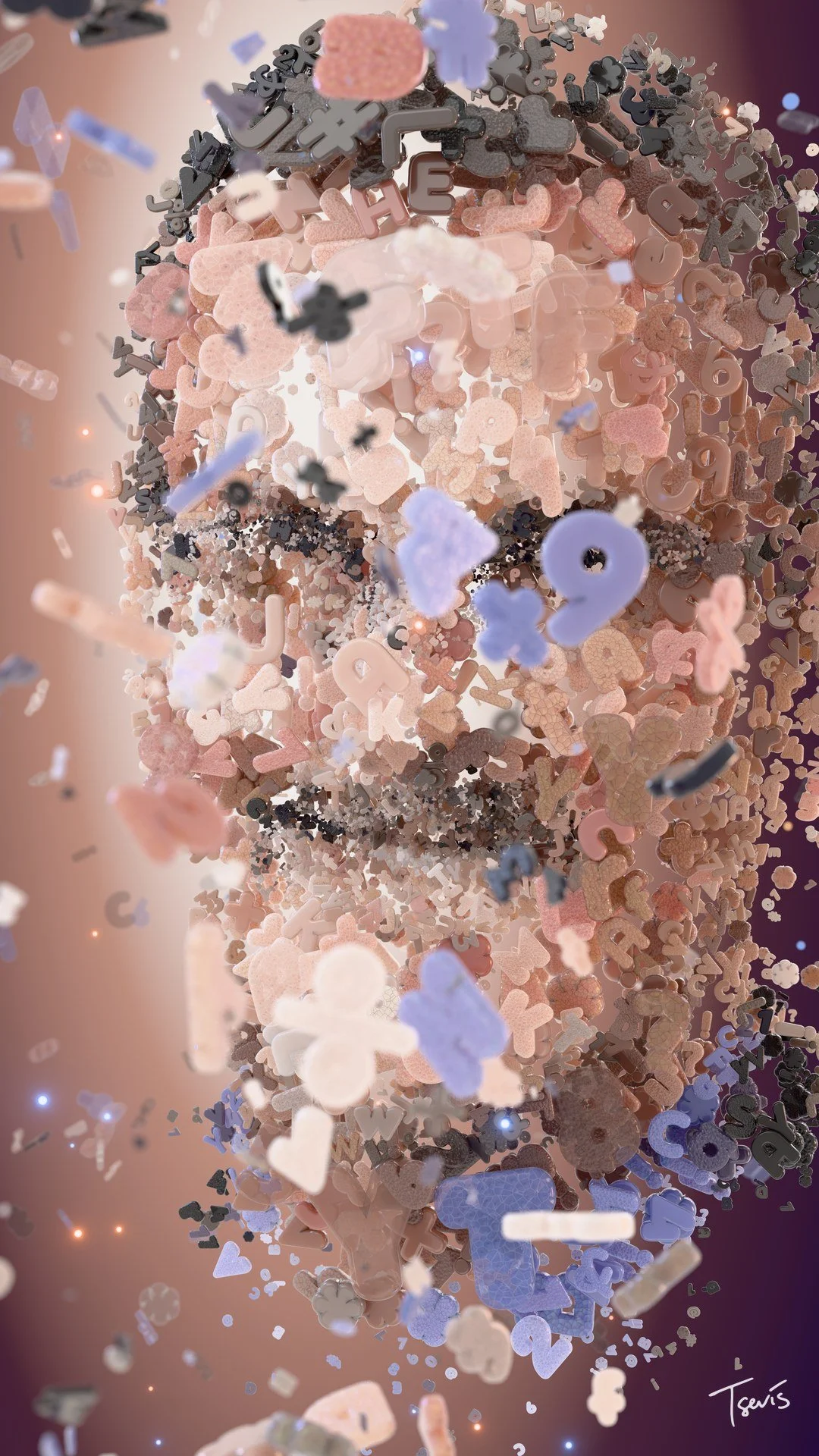
The mosaic is made with Mozaix, using Jigsaw Packing and the Tsevis Portrait preset of five layers, with the outlines of letters as the shapes. The eyes and the mouth are finer passes of their own, and the glasses are a few dark letters tangled among the others. The letters are set in PF Bague Round Pro, Medium, Bold, Black and Ultra Black.
The film follows the rule. It begins with a single letter, which becomes two, and again two, while some copies change. Copies come down over one place, do not fit, and leave blurred. Then the same rule runs everywhere, round after round, and the face is found, every selection a flash. Around the finished face float the copies that were not kept. Then time becomes depth: each letter moves back as far as its generation, the first staying in front and the last reaching almost two metres behind, and the camera passes through them and turns. It returns to the axis, falls into the letter where everything began, and the loop closes there.
At a glance
- Subject
- A portrait of Barney S. Graham, found by a schematic cycle of copying, varying by one step, trying and selecting
- Rules
- Copy; vary by one step with probability one in two; try against the open places; select, keeping the four nearest copies per empty place; a place opens when the larger letters over it are set. After Kepler and Perelson (1993). Schematic: no real biological data
- Tiles
- 8,524 places, each held by one letter, numeral or sign; 102 founders, 337 rounds
- Marks
- PF Bague Round Pro, Medium, Bold, Black and Ultra Black
- Portrait source
- Barney S. Graham, official photograph of the National Institute of Allergy and Infectious Diseases (NIAID, NIH), 2014, in the public domain; the full-resolution crop is by KSRE Photo (K-State Research and Extension), Flickr, CC BY 2.0; cropped, converted and edited by us
- Film
- 44 s, 9:16, 24 fps, 1,056 frames; a loop that begins and ends in the first letter
- Render
- Blender 5.2.3, Cycles, 64 samples; the depth of the portrait from Depth Anything V2
- Sound
- Music machine-generated with MiniMax Music 3 from a written description
- Stills
- 3240 × 5760 px; layered PSD and flat TIFF in the studio archive
Fries: a spore print written in the dark
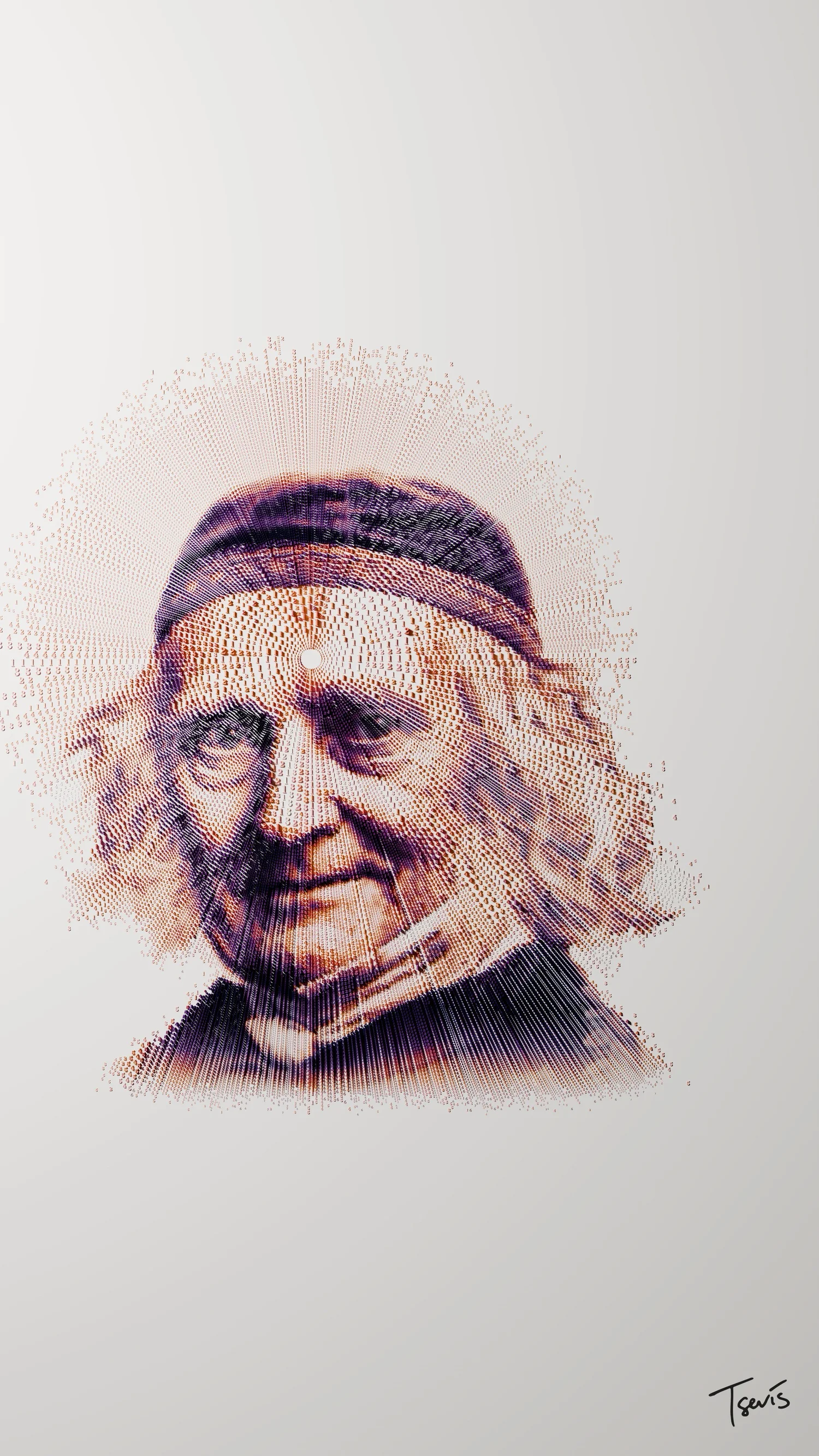
Nobody drew this. The cap is lifted, and the portrait of Elias Fries is on the paper: a spore print written in the dark, one numeral for every gill that dropped it.
The question
Elias Magnus Fries (1794–1878) laid the foundations of the classification of mushrooms in his Systema Mycologicum (1821–1832). He sorted the agarics first by the colour of their spores. To see it, you cut the stem, lay the cap on paper and wait a night. In the morning you lift it, and underneath is a radial print that was made in the dark with no one watching.
This film is the witness that was never there: the camera sits under the cap while the print is written, and the print is the face of Fries.
The mathematics
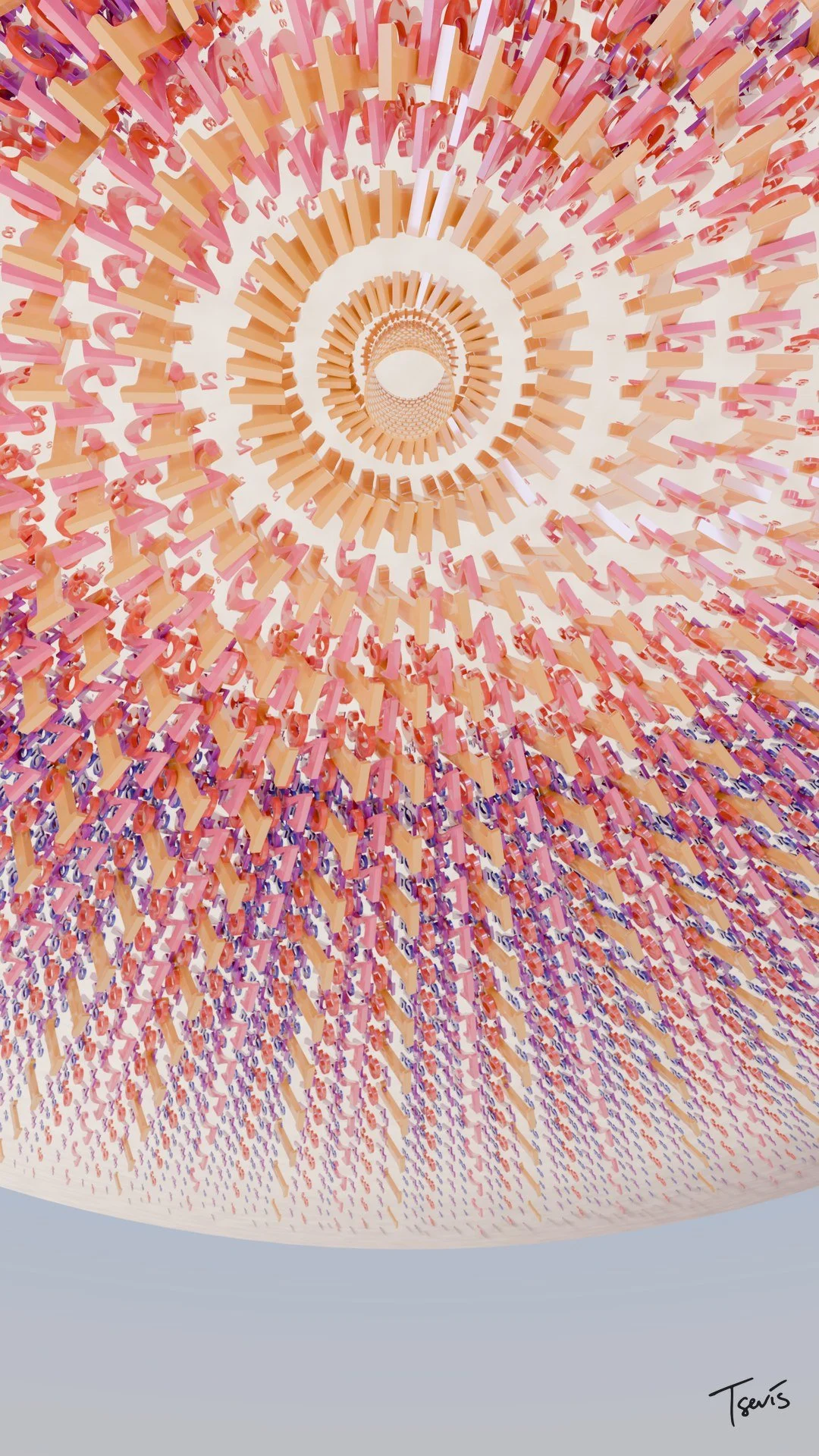
The gills of an agaric do not all reach the stem. Between the whole ones there are shorter ones, in rows. David Moore proposed a mechanism: each gill inhibits new gills around it, and where the cap opens so far that the gap between two gills escapes the inhibition, a new gill is born between them. M. W. F. Fischer and N. P. Money (Fungal Biology, 2010) describe the rule as a gap that doubles before a gill is inserted. That is why the rows come out whole, half and quarter, as in a real mushroom.
The model lets the rim advance outward from the stem, measures at every step the gap between neighbouring gills, and puts a new gill in the middle where the gap passes the threshold. The photograph decides only how dense: in the dark parts of the face the gills crowd together, in the light parts they stay sparse.
The mosaic
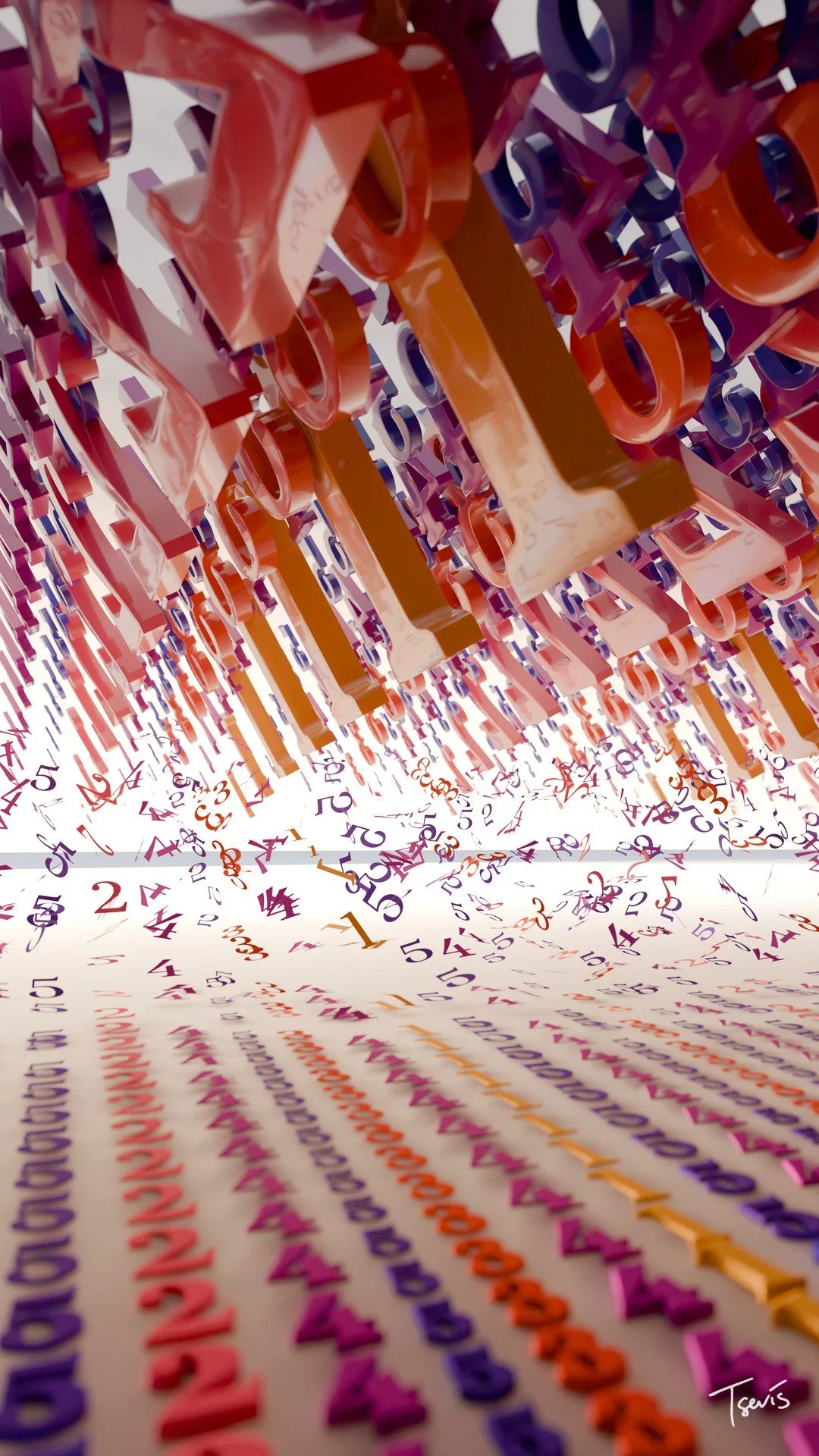
A gill drops spores onto the paper directly beneath it. So each tile of the print is a piece of the strip of paper under one gill, and it falls from the gill above it. The paper is the shadow of the dome.
Each tile carries the order of its gill. The gills that reach the stem are 1. A new gill takes a number one above the larger of the two neighbours between which it was born. Around the stem you read a ring of 1s, and the further out you go, the larger and denser the numbers get where the face is dark. In the film 34,549 numerals fall. By order, from 1 to 6: 2,984, 2,682, 4,996, 8,613, 9,982 and 5,292. The cap has a radius of 150 mm. Beyond its rim the same rays go on in a thinning tail, where the air carried the spores, and the shoulders are there. Nothing is cut with a line: the portrait fades to white by itself.
The numerals are set in PF Regal Display Pro in five weights, from Regular to Ultra Black. The weight follows the tone of the photograph, the darker the point the heavier the numeral, and so does the height. The palette is the series of spore colours with which Fries divided the agarics, white, pink, rust, purple-brown and black, spread over the range from light to dark with a little of the tint of the portrait.
The film is one continuous shot of 42 seconds, 1080 × 1920, and it loops. It begins at night beside the stem, at the height of the paper, with the first numerals falling; the first 1 lands at 1.3 seconds. The camera travels outward under the gills while the rain thickens and night turns to dawn, comes down to the paper where the rays are written, then the cap lifts away, daylight enters, and the camera rises and looks straight down. From above, a slow opening from the eyes shows the portrait while the tail spreads. The next cap descends, darkness returns, and the film is back at its first frame.
A spore falls slowly, almost vertically, with no acceleration that counts, and so do the numerals: each sprouts from its gill, sinks at a steady rate, tilts and sways a little, and settles flat exactly in its place. A real print takes hours, and the film joins the two clocks, the seconds of the fall and the hours of the print, with a time that speeds up.
At a glance
- Subject
- A portrait of Elias Magnus Fries, written as a spore print by gills that insert a new gill when the gap between them doubles
- Rules
- The rim advances from the stem; a new gill is inserted in the middle where the gap between neighbours doubles; the photograph sets the density. After Fischer and Money (2010), and the inhibition mechanism of Moore (1998)
- Tiles
- 34,549 numerals, orders 1 to 6; cap radius 150 mm
- Marks
- PF Regal Display Pro, Regular to Ultra Black; weight and height follow the tone
- Palette
- The spore colours of Fries’s classification: white, pink, rust, purple-brown and black
- Portrait source
- Elias Magnus Fries, photograph by the studio of Henri Osti, Uppsala, 1870s, in the public domain (Wikimedia Commons); cleaned and edited by us
- Film
- 42 s, 9:16, 1080 × 1920, 30 fps, 1,266 frames; a loop from night under the cap back to the same night
- Sound
- Nature sound synthesised for the film, no recordings. Music machine-generated with MiniMax Music 3 from a written description, drawing on the Swedish hymn “Den blomstertid nu kommer” (Israel Kolmodin, 1694, public domain) and kulning
- Stills
- 3240 × 5760 px, at 6.0, 16.5 and 30.0 seconds; layered PSD and flat TIFF in the studio archive
Turing: a sunflower that grows his face
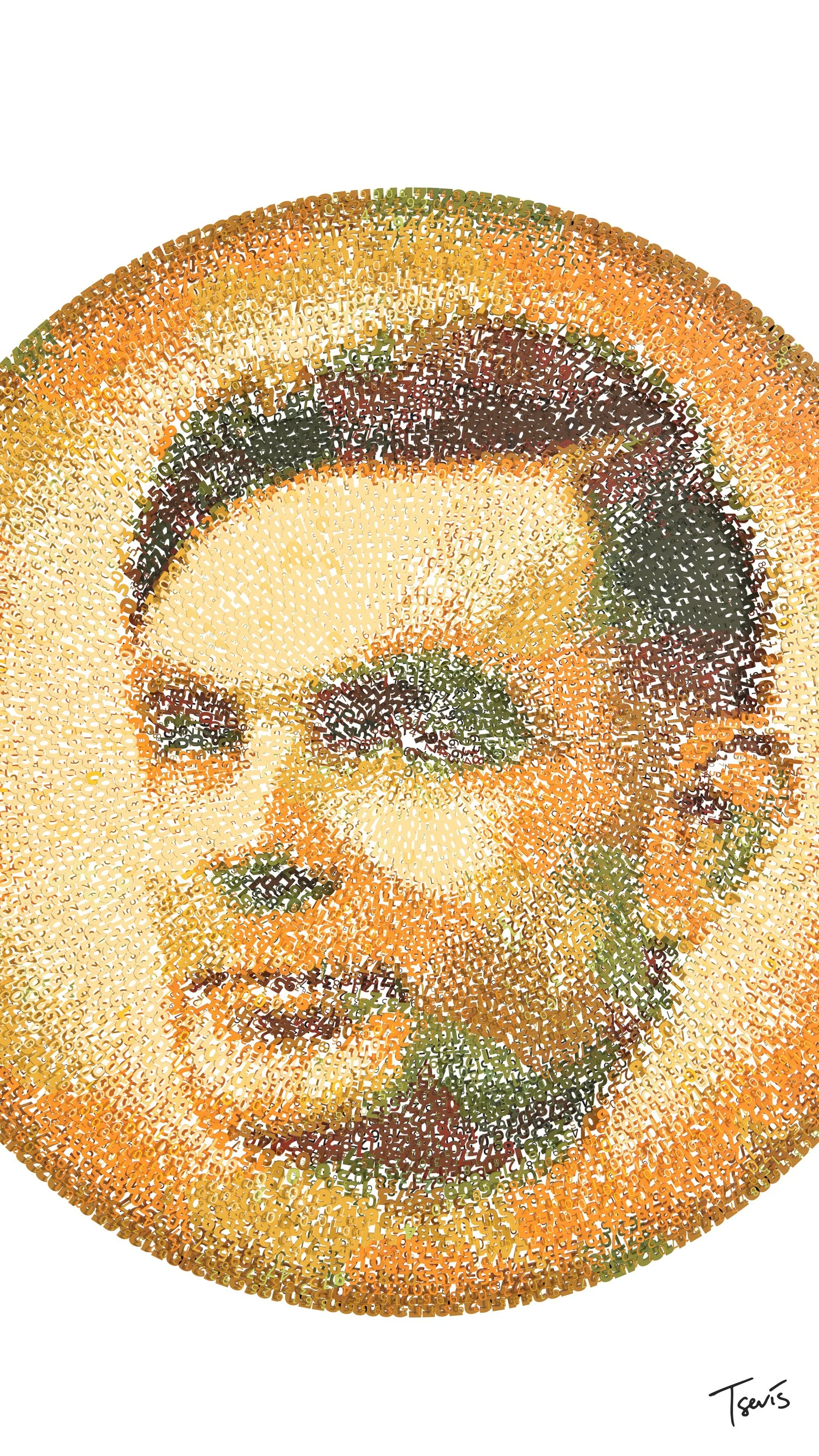
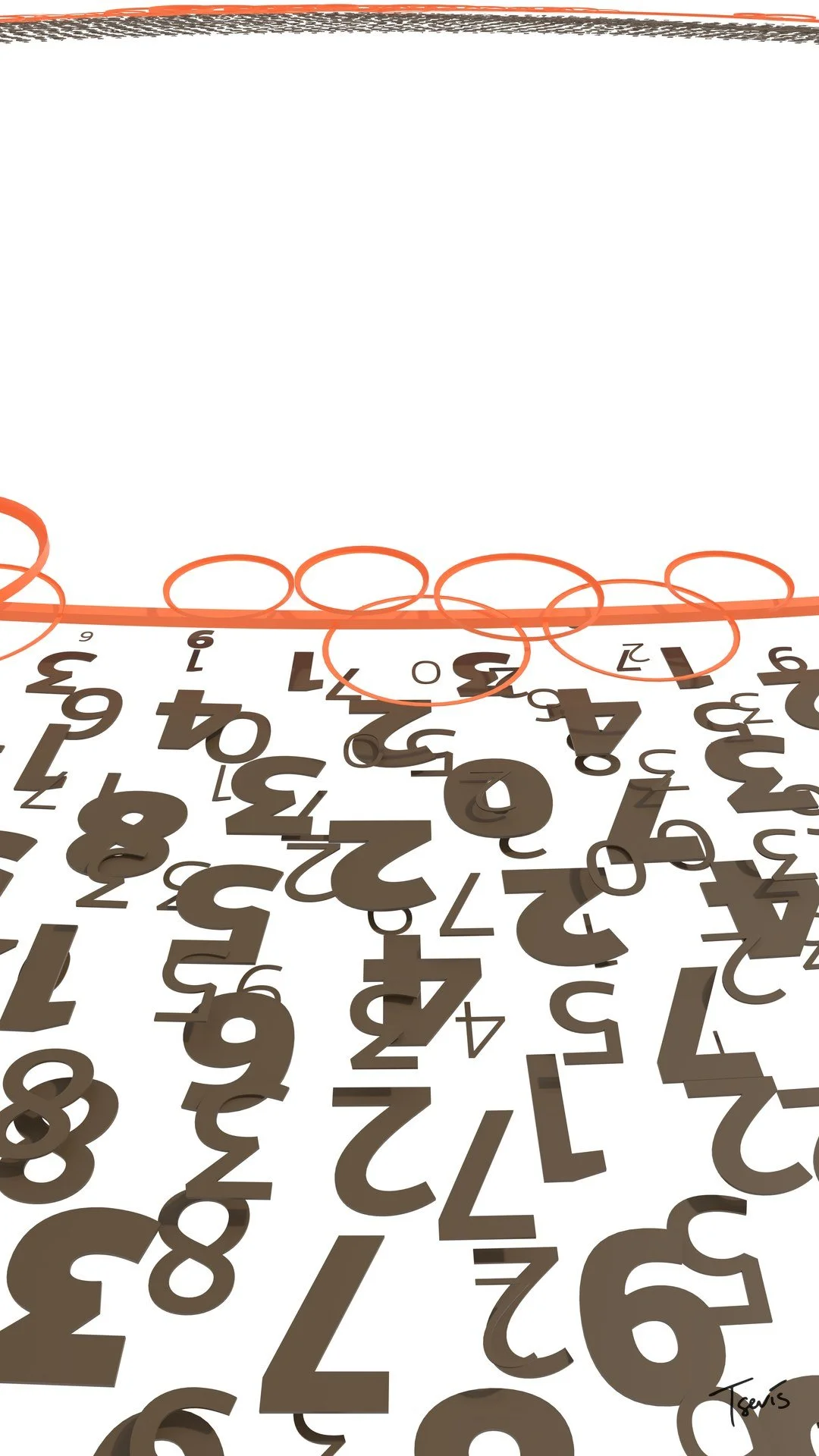
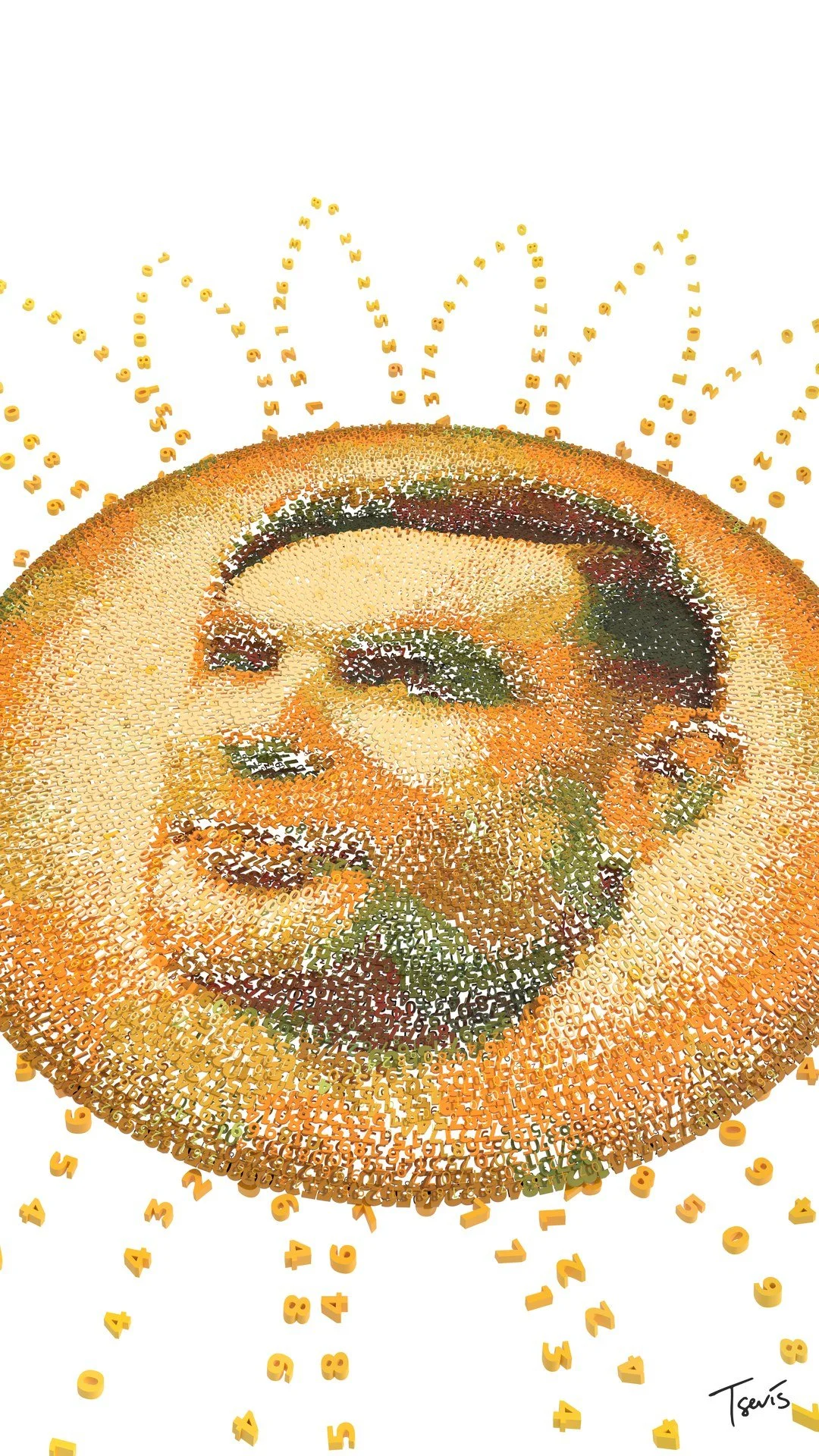
In his last years Alan Turing studied why the seeds of a sunflower sit on spirals counted by Fibonacci numbers. Here the seeds are numerals, born one by one at a red front that closes from the rim to the eye, and as the head ripens they take the colours of his portrait.
The question
Count the spirals on a sunflower head and you get two neighbouring Fibonacci numbers, 34 and 55 for instance. Turing, better known for the computer and for the codebreaking, spent his last years on exactly this problem of phyllotaxis, the arrangement of leaves and seeds, and on how chemistry can pattern a living surface.
The mathematics
In a real sunflower each seed is placed a fixed turn, the golden angle, from the one before, and the spirals appear without being drawn. Here the spirals are read in numbers, and the petals are made from the digits of φ, the golden ratio. A red front moves from the rim to the centre of the disc and every numeral is born as it passes.
The mosaic
Each seed is a digit set in PF Centro Sans Pro, in one of eight weights. The weight follows the tone of a 1951 photograph of Turing: the darkest digits appear first, the lightest last, and as a digit appears it grows by about half again its size before it settles. The disc ripens from the pale ground into the face. The film is a 40-second loop with sound that begins and ends on white.
At a glance
- Subject
- Alan Turing (1912–1954) and the spirals of the sunflower
- Rule
- Fibonacci spirals; petals from the digits of φ
- Marks
- Numerals in PF Centro Sans Pro, eight weights, weight follows tone
- Portrait source
- A 1951 photograph of Turing (Wikimedia Commons)
- Film
- 40 s seamless loop with sound, 1080 × 1920 (9:16)
- Sound
- Written in code, no samples: a chord built on Fibonacci numbers, a tick for every numeral born, a wooden tap for every digit of φ
- Stills
- 3240 × 5760 px; layered PSD and flat 16-bit TIFF in the studio archive
Corbett: readers on one thread that write her face
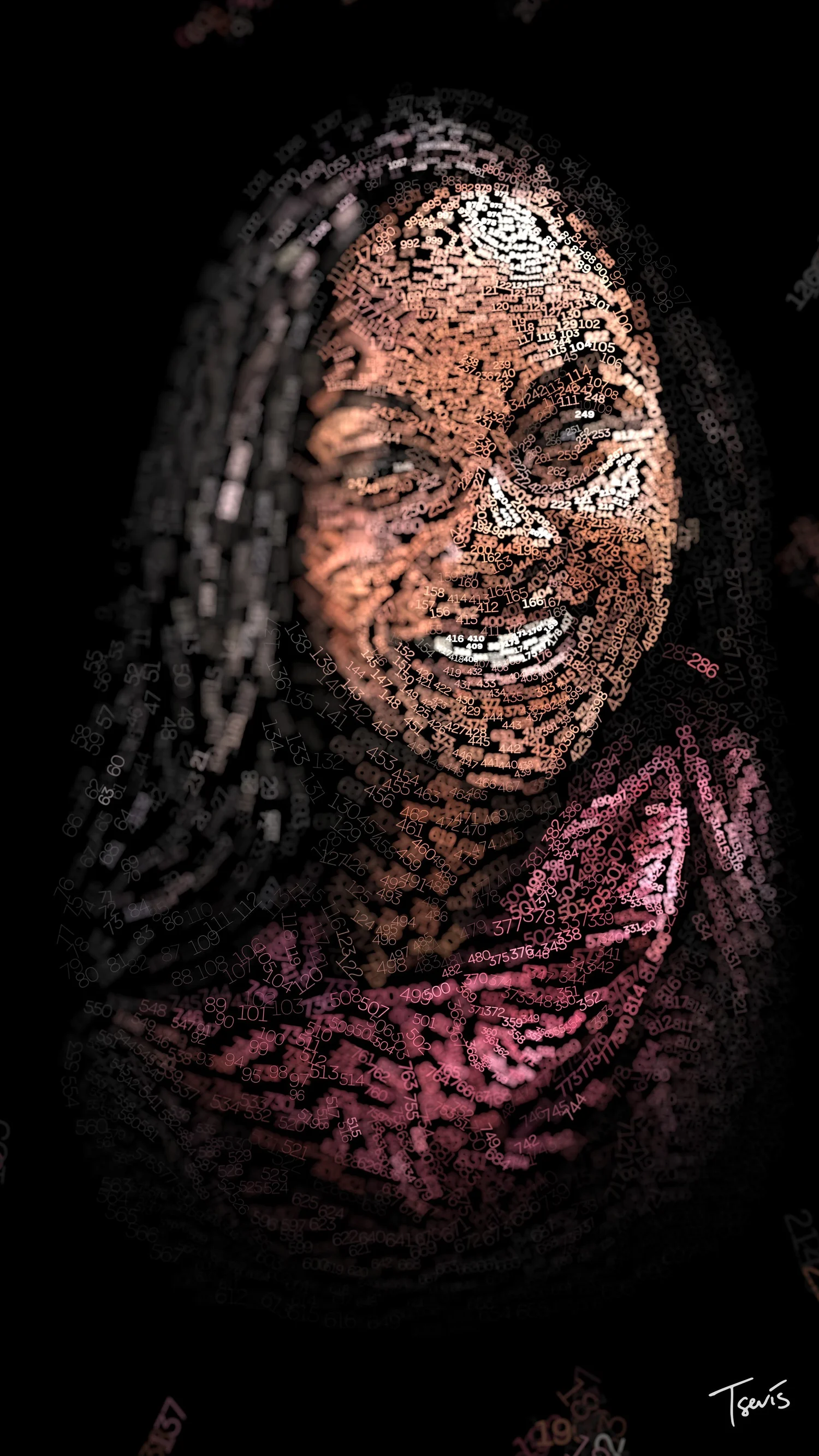
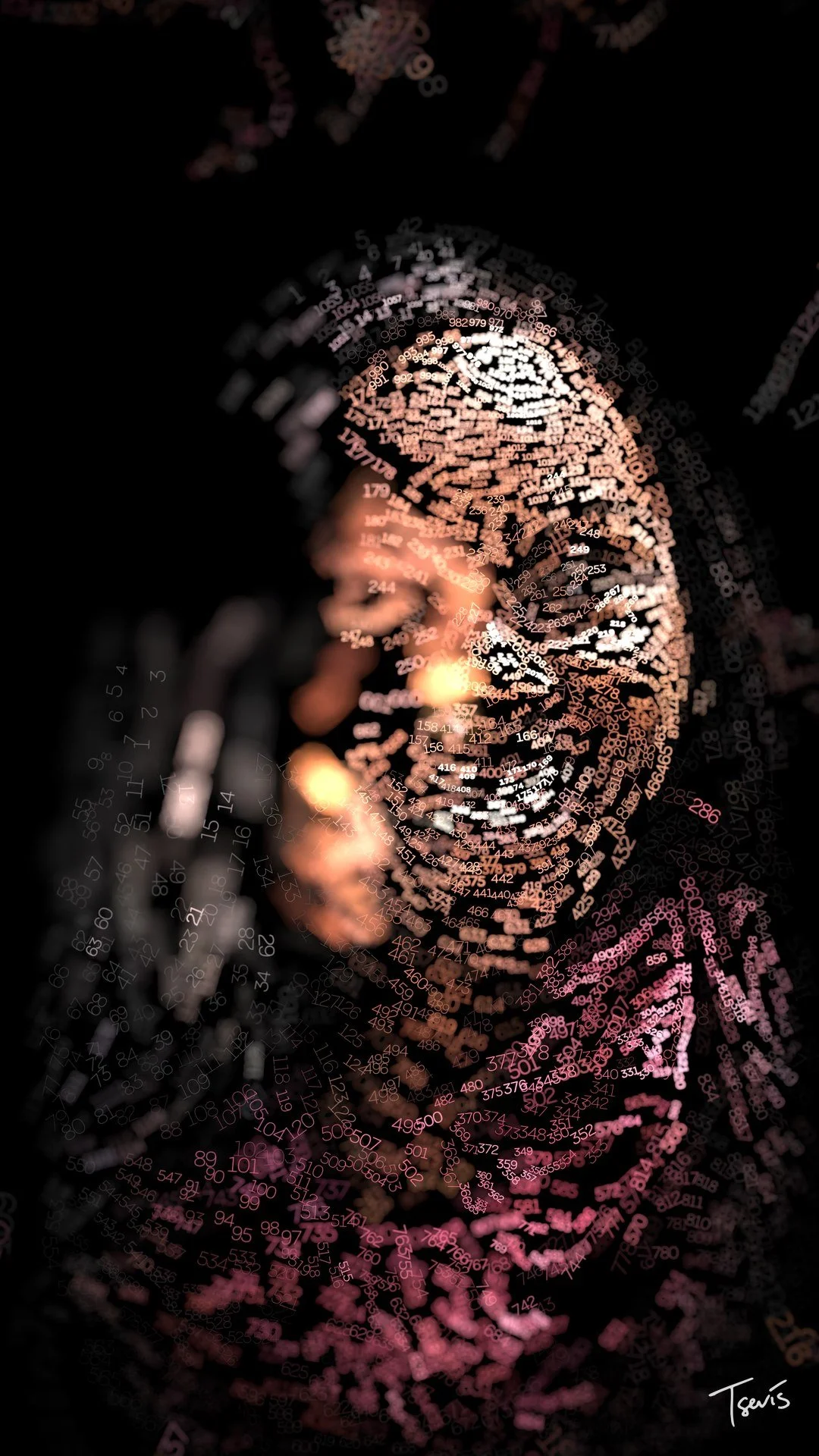
Nobody drew this. Readers walk along a thread of 1,273 positions and leave a numeral where each of them stands, and the numerals add up to the face of Kizzmekia Corbett-Helaire. Two copies are written, one behind the other, and from one point they are a single face.
The question
Kizzmekia Corbett-Helaire worked at the Vaccine Research Center of the US National Institutes of Health and was among the leaders of the team that designed the mRNA-1273 vaccine in 2020. Its messenger RNA writes the spike protein of the SARS-CoV-2 virus, 1,273 amino acids long, and she is one of the authors of the paper that solved the structure of the stabilised spike (Wrapp, Wang, Corbett and colleagues, Science, 2020).
We wanted a portrait made of that number: 1,273 positions in order, each one written by something that reads along a thread. The question the film asks is simple. Can a face be the trace of readers moving along one line, in a queue where nobody passes?
The mathematics
The rule is a queue. Readers enter at the start of the thread and step one position at a time. They never pass one another: a reader who finds the one in front too close waits. In physics this is the totally asymmetric exclusion process, TASEP (MacDonald, Gibbs and Pipkin, 1968), first drawn to describe ribosomes moving along messenger RNA. Here it is a schematic and nothing more: we claim nothing biological. An earlier version of this piece used the real sequence and structure of the protein (UniProt P0DTC2, PDB 6VSB), and they now serve only as the order of the positions and as depth in space.
Each position holds one numeral, from 1 to 1,273, and the numeral stands where its reader leaves it. Two readers write the same face, one behind the other, the back copy 1.2 times further from the eye. Neither shows the whole face alone. From one point, the eye, they become one.
The mosaic
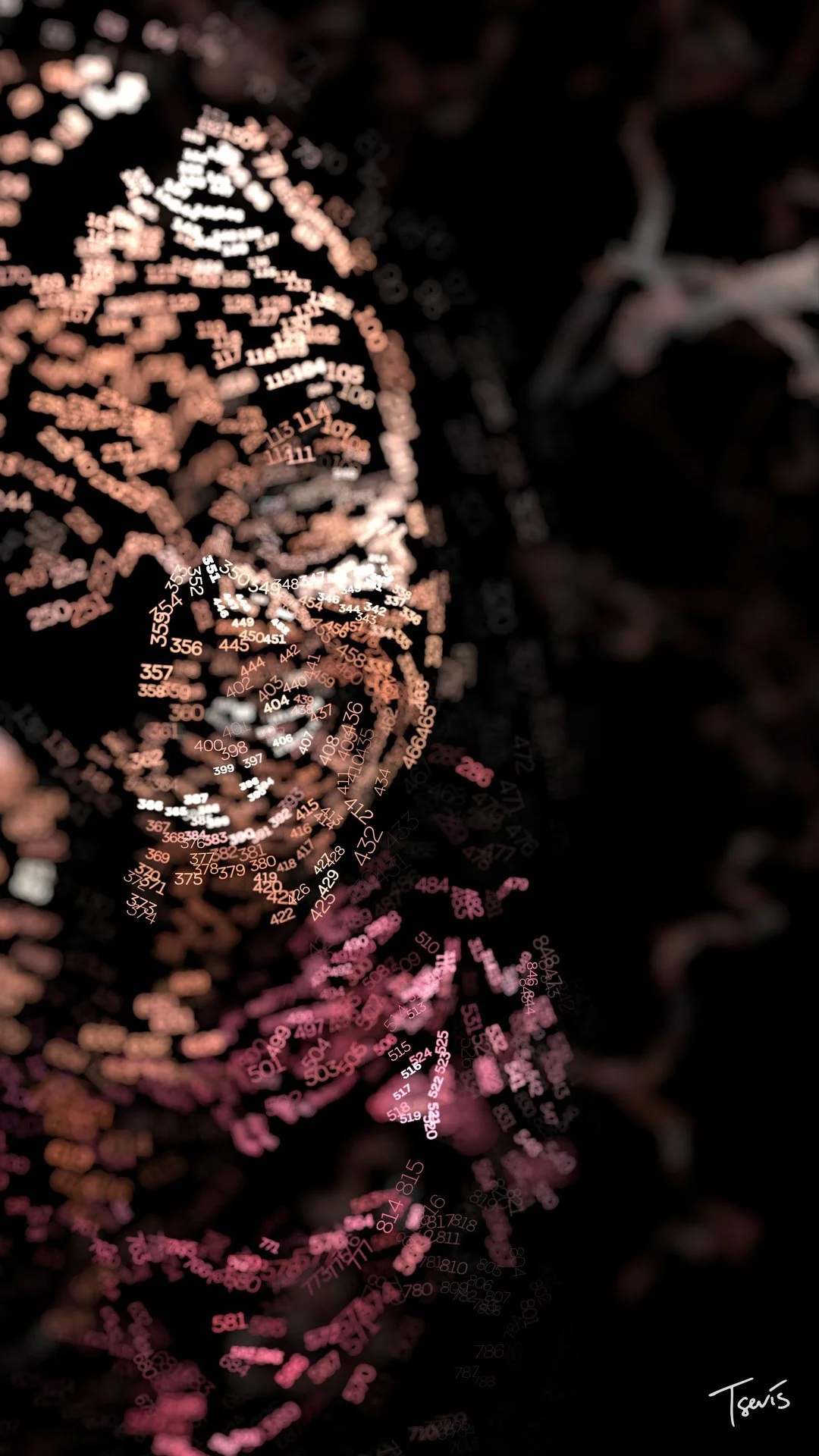
The portrait is made only of numerals, 2,546 in all, flat and the same shape everywhere. The colour comes from the photograph and the tone sets the weight: the darker the place, the heavier the numeral, across the eleven weights of PF Encore Sans Pro. The numerals follow the lines of the face, as the lines of an engraver do. The face fades downward and at its edges in dark numerals, never light ones, and is never cut by a straight edge. Each numeral stands at its own depth, on the ray that joins it to the eye. Far behind, 1,600 more numerals spread as dark, blurred branches: readings that did not become a face. There is no frame, no wall and no floor. The portrait forms in black.
The film is a closed loop of 45 seconds. For the first eleven seconds the front copy is written, and a warm light, the reader, lights each new numeral. The camera then passes to the back copy, where the writing stops for a moment wherever a reader waits, so the queue is seen as a pause. At 22 seconds it reaches the eye, where the two copies become one face, and it stays there with a very small movement. In the last 13 and a half seconds the oldest numerals leave backward along their rays, the face comes undone, and the last frame leads into the first.
The music was generated by machine with the MiniMax-Music3 model, from a written description of nocturnal, hopeful trip hop. We chose one of three variants and cut it into a 45-second loop.
At a glance
- Subject
- A portrait of Kizzmekia Corbett-Helaire, written by readers on one thread
- Rules
- A queue in which nobody passes, a schematic totally asymmetric exclusion process (MacDonald, Gibbs and Pipkin, 1968); no biological data is drawn or claimed
- Tiles
- 2,546 numerals in the face (two copies of positions 1 to 1,273) and 1,600 in the branches behind
- Marks
- PF Encore Sans Pro, all eleven weights; weight follows the tone of the portrait
- Portrait source
- Kizzmekia Corbett, 2017, Wikimedia Commons, CC BY-SA 4.0; cleaned and redrawn by us
- Film
- 45 s, 9:16, 1620 × 2880, 30 fps, 1,350 frames; a loop from the first frame back to the first
- Render
- Blender 5.2.3, Cycles, 64 samples a frame; 6 h 5 min for the whole film
- Sound
- Music machine-generated with the MiniMax-Music3 model from a written description, cut to a 45-second loop
- Stills
- 3240 × 5760 px, at 20.7, 25.3 and 33.7 seconds; layered PSD and flat TIFF in the studio archive
- Licence
- This piece is published under CC BY-SA 4.0, as the portrait photograph is
Portrait: “Kizzmekia Corbett portrait.jpg” by Kizzmekia Corbett (Wikimedia user Chocolatekizz86), own work, 6 April 2017, Wikimedia Commons, CC BY-SA 4.0. Cleaned and redrawn by Charis Tsevis and translated into numerals. The film and the stills of this piece are published under the same licence, CC BY-SA 4.0 (Tsevis Studio, 2026).

The typefaces
The numerals, letters and signs of all eleven pieces are set in typefaces from Parachute, the PF families, ten in all: PF DIN Text Comp Pro for Reed and Kepler, PF Hellenica Serif Pro for Goethe, PF Armonia for Arcimboldo, PF Psychedelia for Bloch, PF Beau Sans Pro for Margulis, PF DIN Text Cond Pro for Cajal, PF Bague Round Pro for Graham, PF Regal Display Pro for Fries, PF Centro Sans Pro for Turing and PF Encore Sans Pro for Corbett. In most of them the weight of a glyph follows the tone of the portrait, heavier where the picture is darker.
Questions
What are the Natural Experiments?
A series of short portrait films by Tsevis Studio. Each one takes a rule from nature or mathematics, such as crystal growth, phyllotaxis, reaction–diffusion or branching, and lets it grow the face of the person who studied it. This page shows the first eleven: Jobs, Goethe, Arcimboldo, Bloch, Margulis, Kepler, Cajal, Graham, Fries, Turing and Corbett.
What is an algorithmic mosaic?
A picture built from tiles whose size, place and tone are decided by rules instead of by hand. Here the rule is also the subject: the same equation that makes the stripes of a fish decides where the tiles of its portrait go. Read more on our algorithmic mosaic page.
Why do the tiles carry numbers?
Because the number is the data. It records when each tile appeared, or its order in the structure: the step a snowflake froze, the week a scale was born, the branching order of a branch. Light and dark numerals give the tones of the portrait.
How are the films made?
The pictures are computed, not painted or photographed. The growth rules run in Python, the scenes are rendered in Blender, and each film is made in the 9:16 format of a phone. For every piece the studio also keeps three layered Photoshop files and three flat TIFFs of the stills.
Can the films or the stills be licensed?
Yes. Every work is © Tsevis Studio. Usage and licensing are described on the image licensing page, and we answer questions at contact.
We are open to ideas for the pieces to come: get in touch. Continue with algorithmic mosaic, what a mosaic is, mosaic and perception, algorithmic mosaic artists, the mosaic glossary and our mosaics.