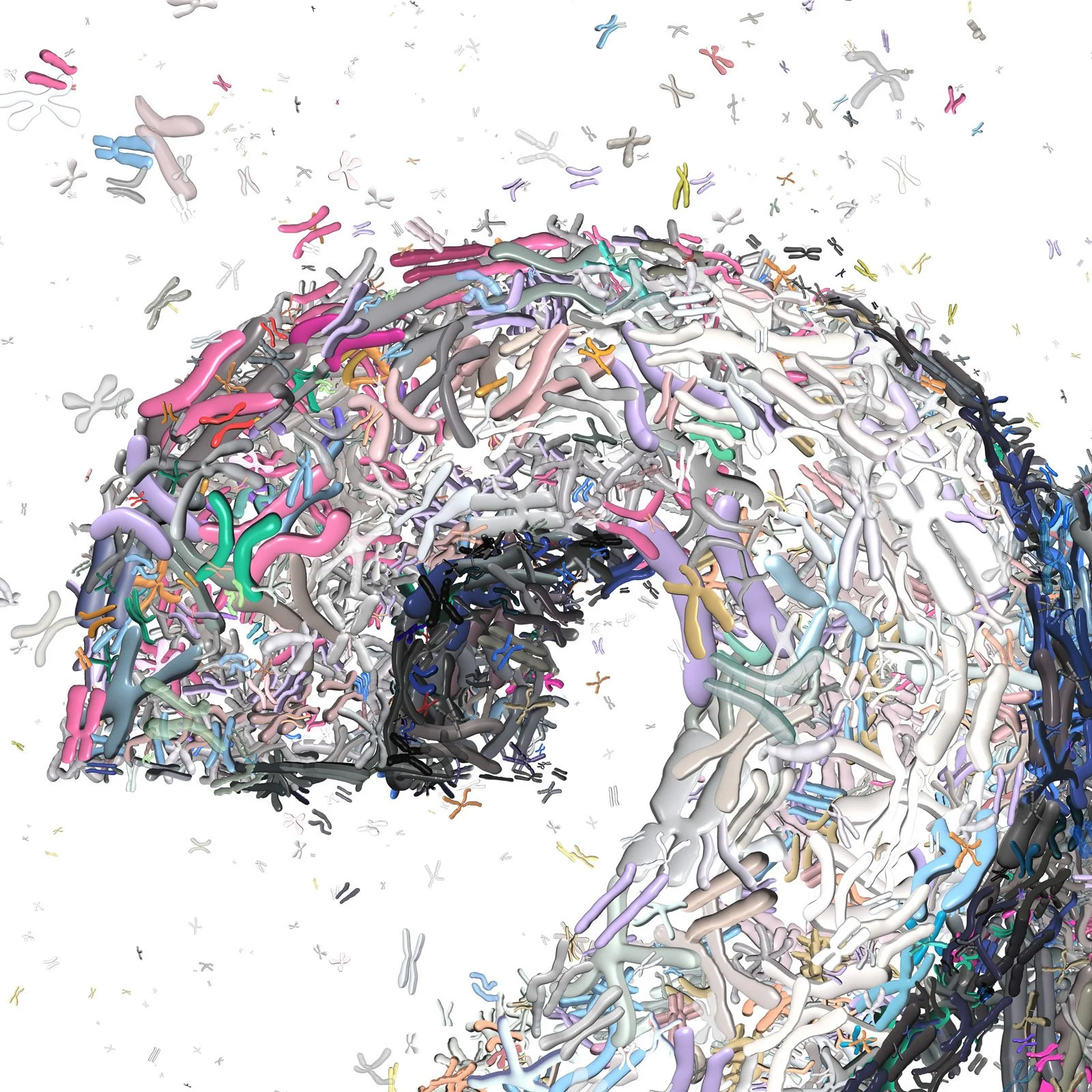
A mosaic illustration of the number 20 built from chromosomes, for the cover of Science magazine's special issue Human Genome at 20, 5 February 2021.
You can read a detailed description of this project in this article by Chrystal Smith titled "Celebrating Human Genome Sequencing".
How many chromosomes do humans have?
Forty-six, in 23 pairs: one set of 23 from each parent. Twenty-two pairs are alike in everyone; the 23rd pair, the sex chromosomes, is usually XX in women and XY in men. The X shape we all picture is a chromosome that has copied itself before a cell divides, its two copies joined at the middle.
Those X shapes are the pieces of this cover. The 20 is built from chromosomes, and a confetti of them flies off its surface.
When was the human genome sequenced?
The first two drafts were published in February 2001, the public Human Genome Project's in Nature and Celera Genomics' in Science. The project was declared complete in 2003 with about 92 percent of the sequence; the Telomere-to-Telomere consortium closed the remaining gaps in 2022 and finished the Y chromosome in 2023.
Also for Science: the cover on immunology in pregnancy and early life, and the 2023 cover Predicting Pathogenicity.

Human genome mosaic celebrating the 20th anniversary of this important scientific discovery.